Key takeaways
- An AI platform can sometimes diagnose and help patch a repeatable failure in an AI-generated game, but it cannot guarantee instant or automatic repair. The safest last-minute workflow is reproduce, isolate, make one bounded change, preserve rollback, and verify the exported artifact with a human.
Yes—sometimes, and usually only if the failure is made small enough to inspect. A platform can help you reproduce a browser or game-runtime problem, trace the smallest failing path, suggest a focused change, and generate a testable revision. It cannot promise to understand every generated system, repair an unknown engine failure instantly, or decide that a build is safe to submit without human playtesting.
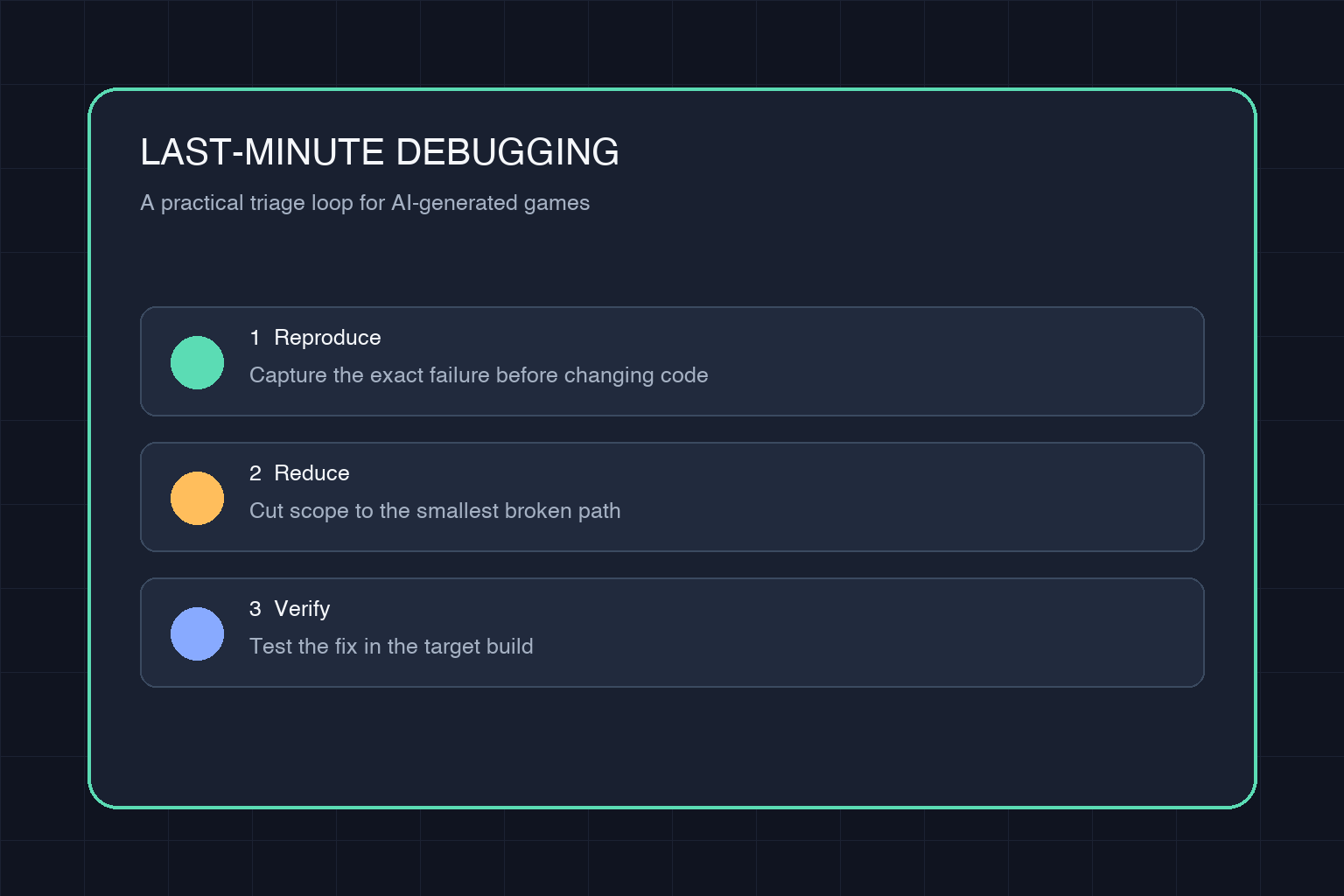
When the clock is running out, the winning strategy is not “ask for a total rewrite.” It is a controlled triage loop: preserve the last playable build, capture evidence, reduce the scope of the failure, apply one bounded fix, and verify the final artifact on the same path a judge will use.
!A three-step last-minute debugging loop for an AI-generated game
What quick diagnosis can and cannot cover
A fast diagnosis is realistic when you can describe a repeatable symptom. Examples include a button that does nothing after a scene transition, a null value when a player restarts, an asset that fails to load, a JavaScript exception in a browser build, or a win condition that never fires. Logs, a short reproduction recipe, the expected result, and the last known-good version give an assistant something concrete to reason about.
Diagnosis is less reliable when the symptom is intermittent, the project contains many generated systems, the failure depends on a specific graphics driver, the build is missing its source assets, or the error is really a design decision rather than a defect. A platform may identify likely causes and propose experiments, but “likely” is not the same as “fixed.” Treat every proposed patch as a candidate until the game passes a focused test and a human plays the critical path.
A useful scope boundary is three layers. First, inspect the visible failure and its immediate call path. Second, check nearby state, inputs, assets, and build configuration. Third, stop and ask for human review when the change would alter scoring, save data, permissions, networking, or a large amount of generated code. That boundary keeps a late patch from creating a less visible failure.
The five-minute evidence packet
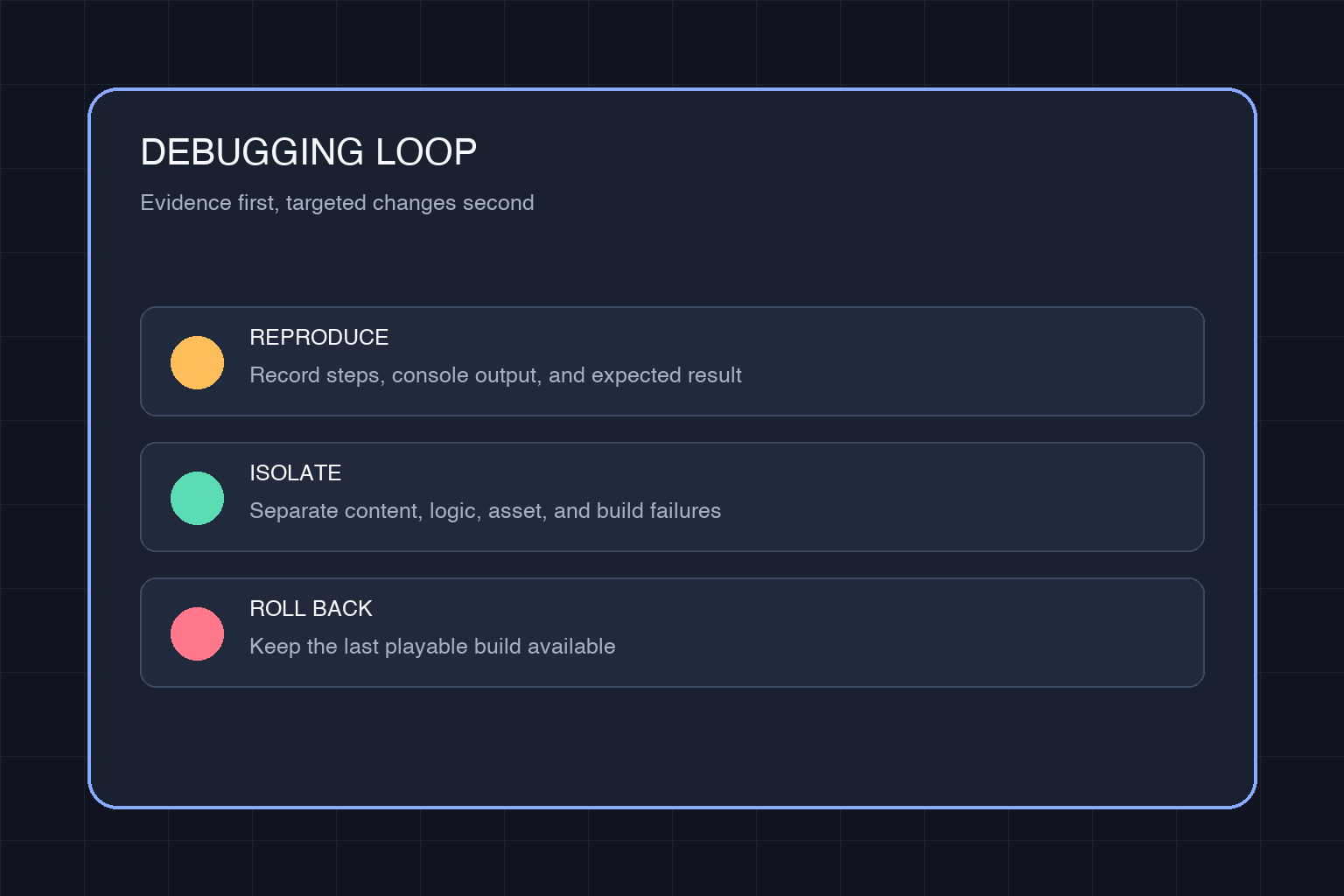
Before changing anything, make a tiny evidence packet. Save the current build or commit it, then write the exact steps: launch, choose a mode, press a control, and note where the observed result diverges from the expected result. Include the first useful console error rather than a screenshot of a long log. If the game has a seed, level, or input sequence, record it. Also state what must not change, such as the art direction, level layout, scoring rule, or submission format.
This packet turns a vague request—“the game broke”—into a bounded debugging question. It also makes rollback possible. If the next revision is worse, you can return to the known-good build instead of trying to reconstruct it from memory. For a jam project, a playable but visually rough build is usually more valuable than an ambitious rewrite that has not been tested.
Keep secrets out of the packet. Remove API keys, private URLs, player data, and credentials before sharing logs or project files. If an error can be reproduced with a small excerpt, send the excerpt rather than the whole repository.
A repeatable triage workflow
!An evidence-first debugging workflow for a game jam build
1. Reproduce once without editing
Run the exact path from a clean start. Record whether the issue happens every time, only after a reload, or only in the exported build. Compare the target environment with the editor or development preview. Many “fixes” are actually environment mismatches, such as a missing file in the export or a browser-only input event.
2. Classify the failure
Put the symptom into one primary bucket: logic, state, asset, input, performance, or packaging. Classification is not a diagnosis, but it narrows the next experiment. A missing texture should not trigger a rewrite of player movement. A restart crash should first prompt a check for state that was not reset.
3. Ask for the smallest useful change
Give the assistant the evidence packet and ask for a minimal patch. Request the suspected cause, the files or functions it would touch, assumptions it is making, and a test that could falsify the explanation. Ask it not to refactor unrelated code, rename public interfaces, or replace working content. A good answer is specific enough that you can inspect the diff before accepting it.
4. Test the narrow path
Run the reproduction steps again. Then run one nearby boundary case: restart, refresh, a missing input, a second level, or a slow asset load. If the patch changes a scoring or progression rule, test both success and failure outcomes. If the platform can run the game, use that result as evidence; do not treat a clean generation response as proof that the exported artifact works.
5. Cut scope deliberately
If the diagnosis remains uncertain, cut the risky feature. Disable a multiplayer mode, simplify an effect, remove a nonessential level, or replace a fragile generated asset with a known-good one. A visible scope cut is safer than hiding a broken path. Tell the submission notes what changed and what was not tested.
What to provide for better fixes
The most useful prompt has five parts: the symptom, reproduction steps, expected behavior, relevant evidence, and constraints. For example: “After restarting level two, the player can move but the exit trigger never completes. This happens in the exported browser build after the player dies once. The console reports an undefined reset state. Keep the level layout and scoring unchanged. Propose the smallest patch, explain why it addresses the reset path, and give me three checks.”
Include version information and the target build when they matter. A platform should distinguish between a source-level suggestion and a verified result. Ask for a diff or a clear list of edits. Review generated changes for accidental deletions, new dependencies, hard-coded paths, and changes to input or scoring behavior.
Avoid prompts that encourage unsafe speed: “rewrite the whole game,” “remove all checks,” or “make it work somehow.” Those requests optimize for apparent progress, not a reliable submission.
Rollback, backups, and human verification
Keep at least two recovery points: the last playable build and the current candidate. Export a fresh artifact before a risky edit. If the project is stored in version control, make a small commit before each bounded experiment; if not, duplicate the project directory and label the copy with the time and change.
Human verification is mandatory for the player-facing path. Have someone else launch the submitted artifact, follow the first-time flow, play the core loop, trigger the failure’s former reproduction steps, and restart. Ask them to check sound, input, loading, and the platform or file format required by the jam. A developer who just watched the fix land is likely to skip the exact edge case that caused the panic.
A practical ship decision
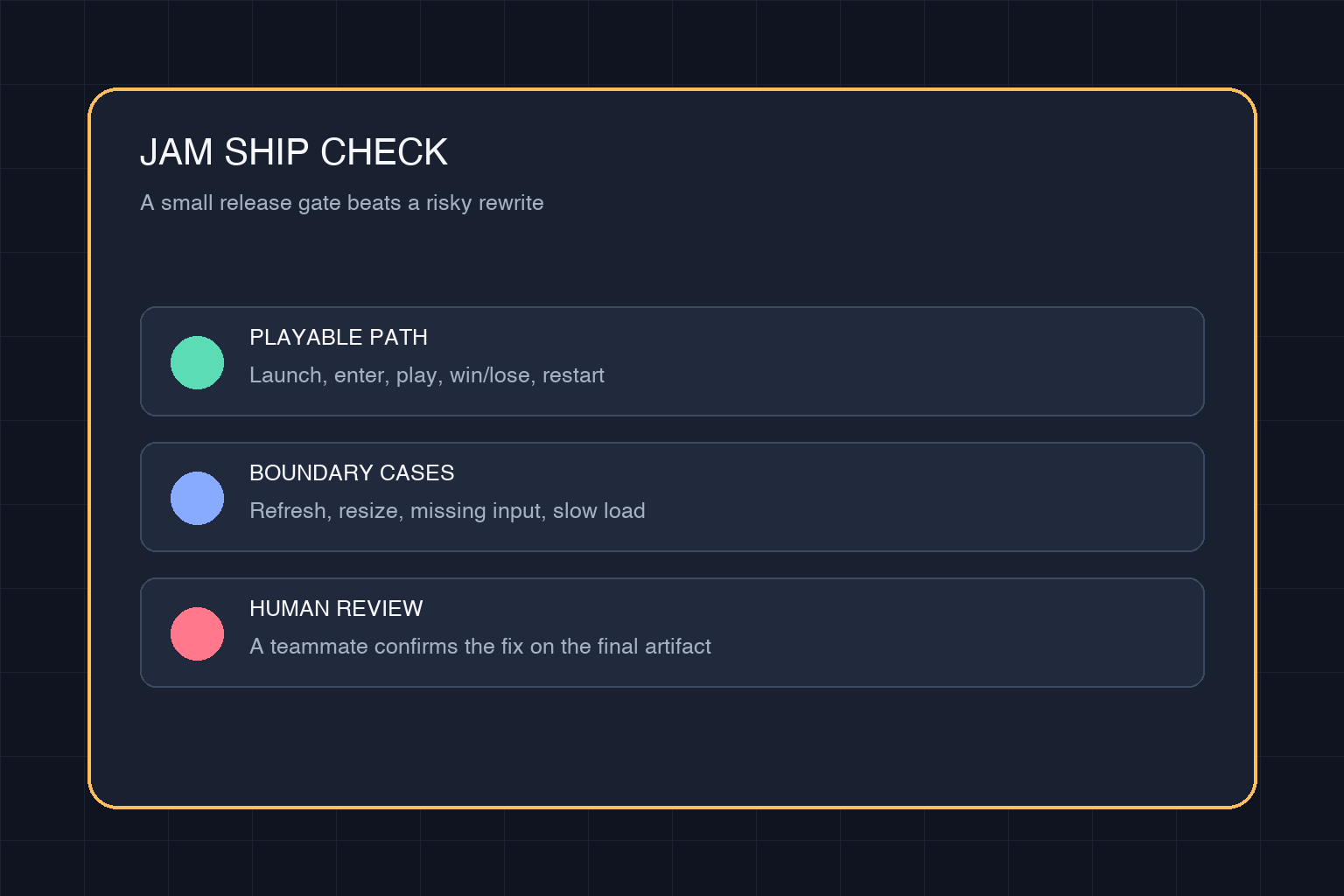
Ship the fix when the symptom is reproduced, the patch is narrow, the critical path passes in the target artifact, the rollback point is preserved, and another person has verified the result. Ship a scope cut when the feature is nonessential and its behavior remains uncertain. Do not claim the issue is resolved when you only have a plausible explanation or an editor preview.
!A compact release gate for a game jam submission
Frequently Asked Questions
Can an AI platform fix any broken AI-generated game quickly?
No. It can accelerate diagnosis for repeatable, observable failures, but coverage depends on the available source, logs, runtime, assets, and reproduction steps. Engine-specific, intermittent, hardware-dependent, or broad architectural failures may need a developer and more time.
What should I do before asking for a fix?
Preserve the last playable build, reproduce the issue once, write exact steps and expected behavior, capture the first useful error, and remove secrets. State the target export and the parts that must not change.
Should I ask for a rewrite when the deadline is close?
Usually not. Ask for a minimal patch with an explanation, affected files, assumptions, and tests. If the cause is unclear, reduce scope or restore a known-good feature instead of replacing the whole project.
How can I tell whether a suggested fix really works?
Run the original reproduction steps on the submission artifact, then test a nearby boundary case such as restart, refresh, missing input, or a second level. Have another person play the core loop without your guidance.
What if the fix breaks another part of the game?
Use the preserved build to roll back. Compare the candidate and known-good versions, keep only the smallest safe change, and retest scoring, progression, input, loading, and restart behavior.
Is a successful editor preview enough for a game jam submission?
No. An editor or development preview can differ from an exported browser or packaged build. Verify the exact artifact, runtime, resolution, controls, and file format that judges will receive.