Key takeaways
- For a first 48-hour game jam, build one tiny playable loop with a clear start, one repeated action, one challenge, and an ending. Use simple shapes or permitted assets, make an ugly complete prototype early, test export immediately, freeze new features before the final hours, and protect time for packaging and submission. Finishing is possible but not guaranteed; scope control is the strongest risk reduction.
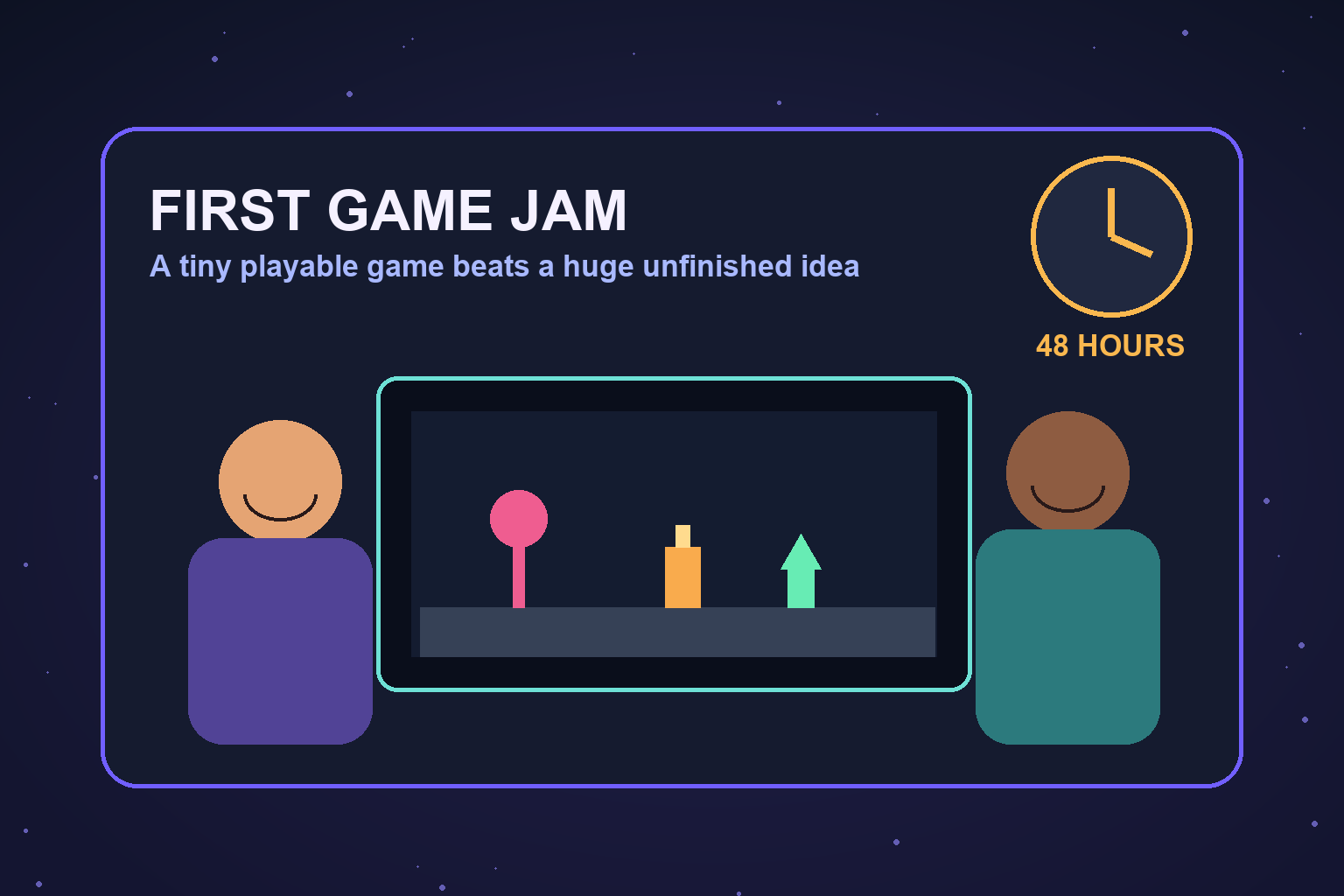
You do not need strong coding or art skills to make a valid first game-jam entry. You need a tiny idea, a tool you can operate, and ruthless scope control. In two days, aim for one complete playable loop: a clear start, one action the player repeats, one challenge or decision, and an ending. Use primitive shapes, free assets with compatible licenses, simple sounds, and visual scripting or a beginner-friendly engine if that reduces friction.
Finishing is possible, but not guaranteed. Technical trouble, fatigue, unfamiliar tools, and an oversized concept can consume the schedule. Your best strategy is to make something finishable in the first 24 hours, then spend the remaining time improving clarity, fixing blockers, and packaging a build you can submit.
Define the smallest game that still has a point
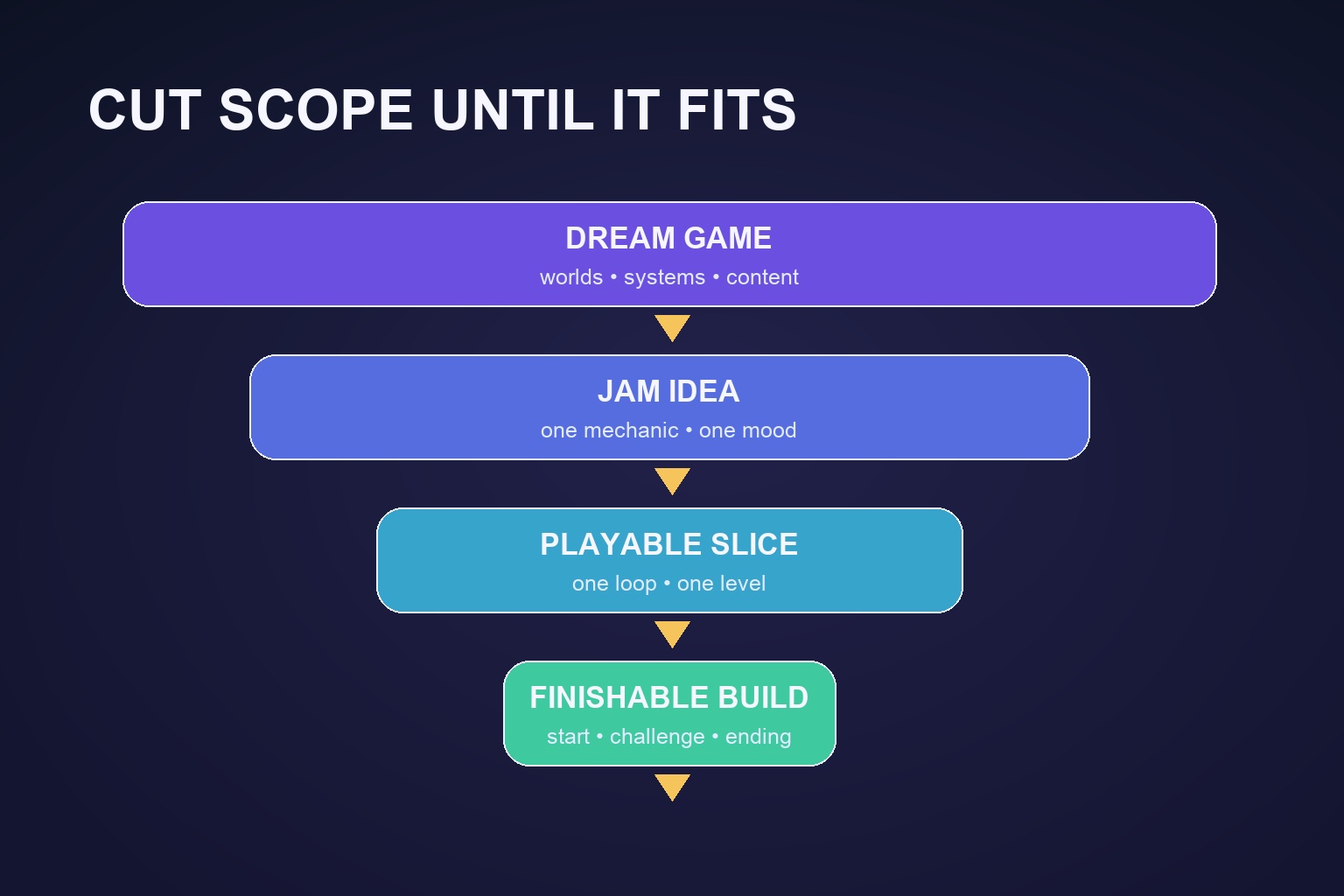
Start with a one-sentence loop, not a genre. “The player moves through a haunted castle” is a setting. “The player carries one candle between three rooms, choosing which shadow to reveal before the flame dies” is a loop. It says what the player does, what creates pressure, and when the experience ends.
Use this scope test:
- The game has one main player verb, such as move, dodge, click, match, choose, or drag.
- It uses one level or one repeating screen.
- It has one win condition and, at most, one fail condition.
- A first playthrough takes roughly two to five minutes.
- Every required asset can be made with shapes, text, simple effects, or legally usable existing material.
- The complete loop can be tested before you add polish.
If your idea needs inventory, dialogue trees, combat, crafting, procedural levels, multiple endings, and a boss, choose one. Remove the rest. A short game with an understandable ending is more complete than a collection of half-working systems.
Pick a format that forgives your weak spots
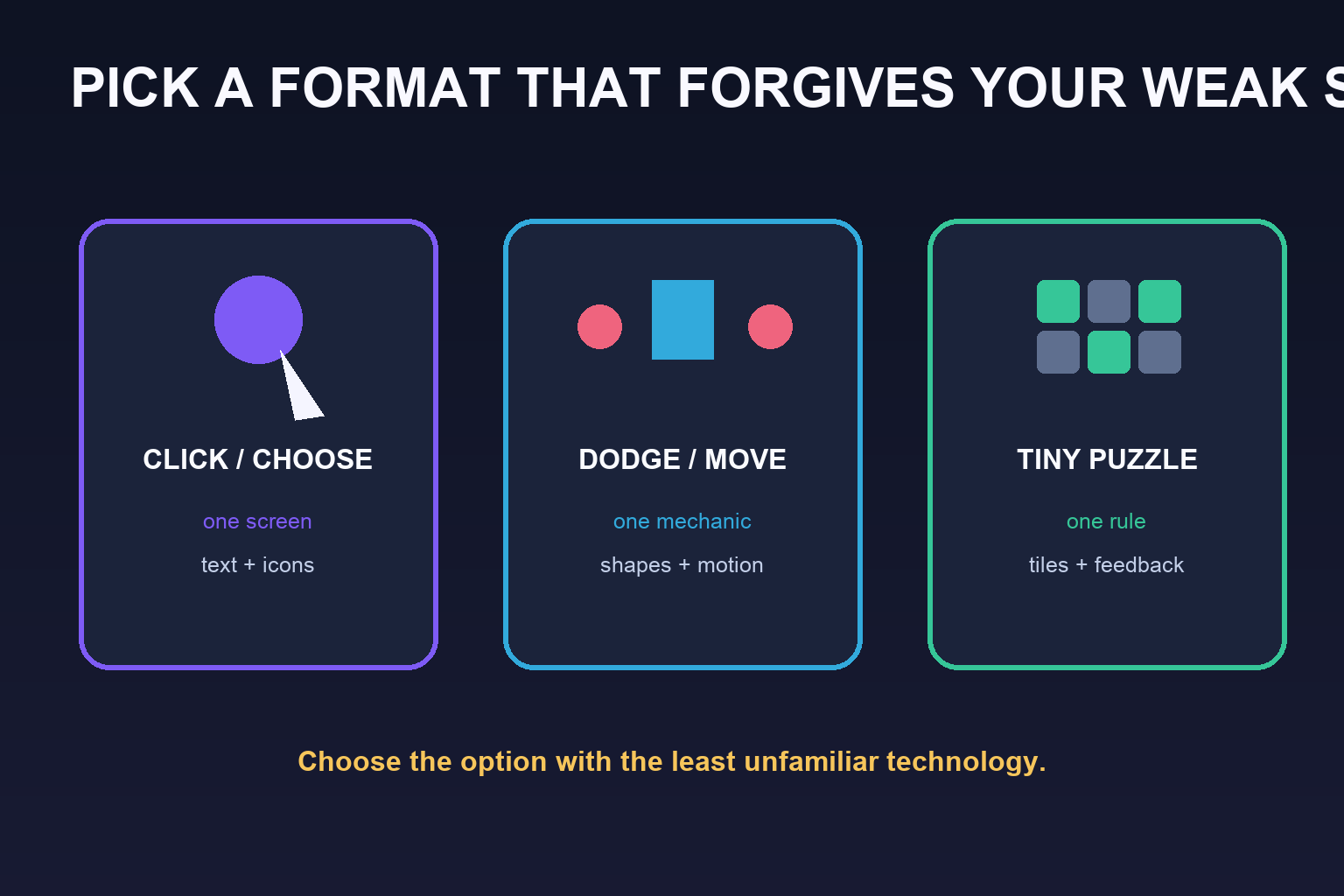
Choose the project around the skills you have today. If coding is the main obstacle, favor a visual scripting tool, a template you understand, or an engine with a simple event system. Do not spend the jam learning a complex technology because you hope it will save time later.
If art is the obstacle, choose a visual language that looks intentional with limited assets. Colored rectangles can become doors, hazards, and characters. Icons and typography can support a puzzle. A game can take place on a single photograph or textured background if you have permission to use it. Consistency matters more than detail: one palette, one typeface family, and a few repeated shapes can feel coherent.
Audio can also carry mood cheaply. A few original beeps, recorded household sounds, or properly licensed effects may make simple movement feel responsive. Keep a note of every external asset and its license. If the rules restrict pre-made content or AI-generated material, follow the event's specific policy rather than assuming it is allowed.
Freeze scope with a one-page plan
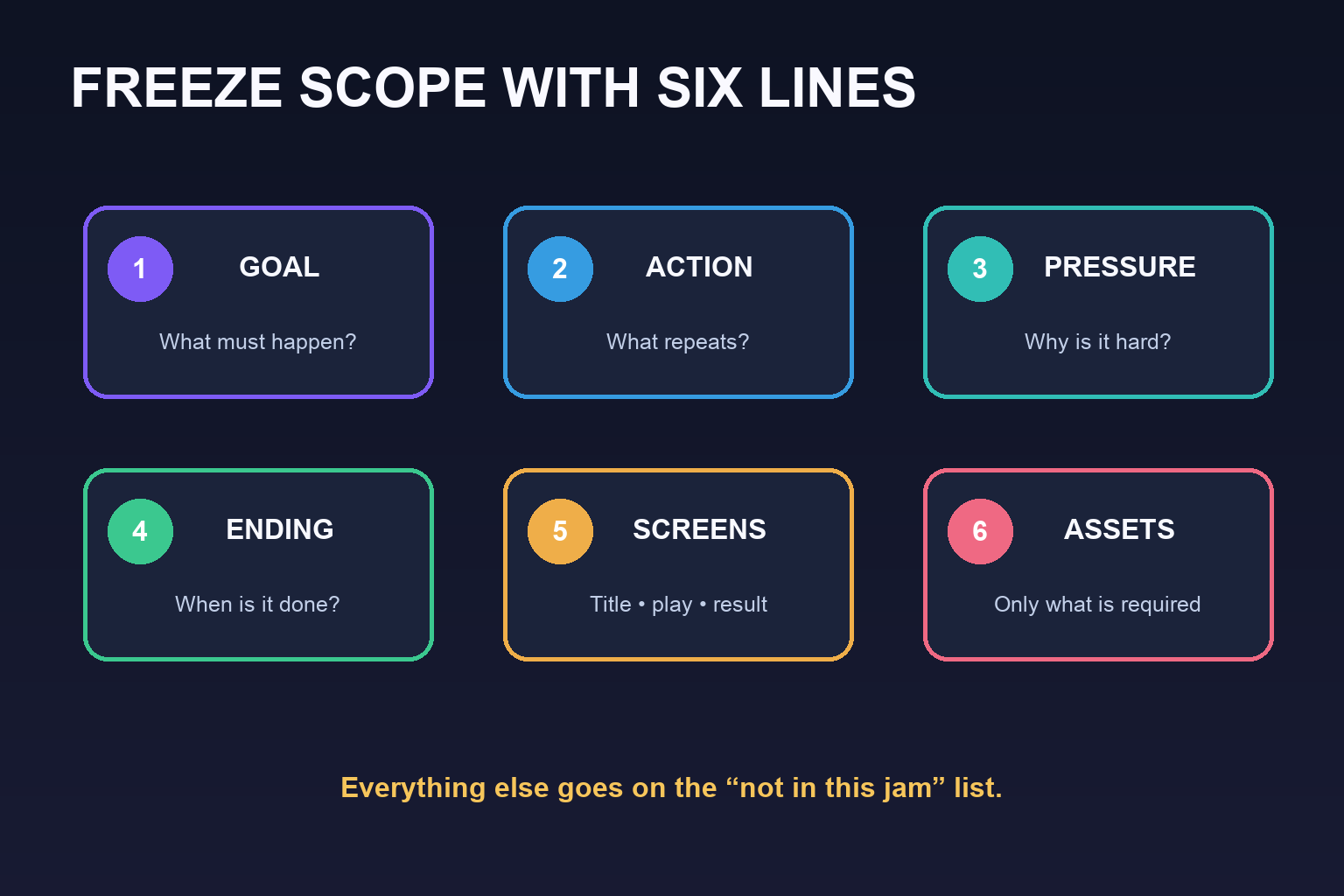
Before opening the editor, write six lines:
- Player goal: what must the player accomplish?
- Core action: what will they do most often?
- Pressure: what makes the action interesting or difficult?
- Ending: what clearly signals success or failure?
- Required screens: usually title, game, and result.
- Minimum assets: list only items needed for the complete loop.
Add a “not in this jam” list. Put attractive distractions there: online multiplayer, save systems, skill trees, procedural generation, cinematic introductions, custom character animation, and extra levels. You are not rejecting those ideas forever. You are protecting the current build.
Create one cut rule: if the core loop is not playable by your first major checkpoint, remove a feature rather than adding hours to the schedule. This makes scope reduction a planned response, not a last-minute failure.
A practical 48-hour schedule
Treat the schedule as a set of checkpoints, not a promise. Adjust for the jam's start time, submission rules, your sleep needs, and whether you work alone.
Hours 0–2: decide and set up
Read the rules, confirm the theme, choose your tool, and write the six-line plan. Create the project, verify that you can run it, and make a test export immediately. A failed export at hour 46 is much harder to fix than the same problem at hour one.
Hours 2–8: build the ugliest complete prototype
Use boxes, labels, and placeholder sounds. Implement input, the main action, the win or fail condition, and a restart. The checkpoint is not beauty. It is whether you can play from start to ending without editing the project.
If you cannot reach the ending by this checkpoint, cut the mechanic in half. Reduce the number of objects, remove an enemy type, turn movement into clicking, or replace a complicated simulation with a timer.
Hours 8–24: make the whole loop reliable
Fix game-breaking bugs and confusing rules. Add the minimum title and result screens. Let another person try the game without instructions. Watch where they stop, click the wrong thing, or misunderstand the goal.
Complete the full experience before creating optional content. One working level is the target. A second level is optional and should not exist until the first can be submitted.
Hours 24–34: add only high-value content
Replace the most distracting placeholders, improve feedback, and add a small amount of variation. Prioritize changes the player can notice: clearer contrast, a visible timer, a sound when an action succeeds, a brief hit flash, or a stronger ending.
Do not rebuild the art style now. Use a fixed palette and reuse shapes. If a borrowed asset requires complex editing, replace it with something simpler.
Hours 34–42: test and cut
Export a fresh build and test it outside the editor. Check controls, restart behavior, screen sizes, audio volume, and the complete start-to-ending path. Ask a tester to say the goal aloud. Fix blockers first, then misleading feedback, then cosmetic issues.
Freeze new features. Keep a short bug list labeled “must submit,” “nice if safe,” and “after the jam.” Work only from the first category until it is empty.
Hours 42–48: package and submit
Protect these hours. Make release builds, prepare the project page, capture screenshots, write controls, add credits and licenses, and upload early. Download or launch the uploaded file if the platform allows it. A local build is not evidence that the submitted package works.
Leave time for account problems, slow uploads, archive mistakes, and submission forms. Sleep and breaks are part of risk management; exhausted work often creates new bugs faster than it fixes old ones.
Make programmer art look deliberate
Use constraints as style. Pick a dark background, one neutral color, and two accent colors. Give each function a consistent visual identity: player, danger, goal, and inactive scenery. Use the same outline width and corner style everywhere.
Animate properties you already have. A shape can scale when collected, flash when hit, rotate when dangerous, or leave a short trail when moving. These small responses communicate interaction without requiring character animation. Keep text large and controls visible. If the player cannot tell what matters, decoration will not solve the problem.
Avoid downloading a huge mixed asset pack unless you already know it. Searching, importing, resizing, and reconciling inconsistent styles can cost more time than drawing basic shapes. Use external material only when it directly removes work from the critical path.
Use simple logic you can debug
Build the game as a small state machine. It may have only three states: title, playing, and result. During “playing,” track one or two values, such as score and time remaining. When the end condition is met, change to “result.”
Keep each rule observable. When the player clicks the target, increase the score and show feedback. When time reaches zero, stop input and display the ending. Add one rule at a time, test it, and save a working copy before the next change.
When something breaks, reduce the problem. Reproduce it with the fewest steps, inspect the values involved, and temporarily remove unrelated effects. Do not rewrite the whole project during the final hours unless the current approach cannot produce a build at all.
What to cut first when you fall behind
Cut quantity before clarity. Remove extra levels, enemies, dialogue, particles, music tracks, and menu options. Preserve the input, core action, ending, restart, and basic instructions. If necessary, turn a planned three-minute game into a 45-second game that still makes sense.
Cut technical risk next. Remove online features, physics chains, procedural systems, complex camera behavior, and platform-specific integrations. Replace them with deterministic rules you can test quickly.
Never spend the last hour hiding a missing ending with presentation. A plain result screen is enough. Players need to know the experience is complete and how to play again.
A realistic definition of success
Your first jam is practice in making decisions under constraints. A successful result might be a rough game that exports, starts, communicates one idea, reaches an ending, and teaches you what to change next. Ranking, ratings, and polish are secondary.
If you miss the deadline, preserve the build and write down the exact reason. Was the tool unfamiliar? Did export fail? Did the idea require too many assets? That diagnosis turns an unfinished entry into useful production knowledge. For the next jam, choose a smaller loop and test delivery even earlier.
Frequently Asked Questions
Can a complete beginner finish a game jam in 48 hours?
A beginner can finish a very small game, but completion is not guaranteed. Use a familiar or beginner-friendly tool, define one playable loop, test export early, and cut features whenever the complete start-to-ending path is at risk.
What is the easiest game type for a first game jam?
A one-screen clicking game, simple dodging game, short choice game, or tiny puzzle is often manageable because it can work with one main action and few assets. Choose the format that requires the least unfamiliar technology.
What if I cannot draw game art?
Use primitive shapes, typography, a restricted color palette, simple animations, or assets whose licenses and jam rules permit use. Consistent visual rules and clear feedback matter more than detailed illustration.
How many hours should I spend coding?
Do not optimize for coding hours. Aim to make the full loop playable in the first quarter to half of the event, then reserve substantial time for testing, fixing, packaging, sleep, and submission. The exact split depends on your tool and schedule.
Should I join a team for my first jam?
A team can help if roles and communication are clear, but coordination also takes time. Solo participants should reduce scope further. If you join others, agree on one core loop, file-sharing rules, ownership, and cut decisions at the start.
Is it okay to use free assets or AI-generated assets?
Only if the specific jam rules and the asset license allow it. Record sources and required credits. Some events restrict pre-made or generated material, so check before building the project around it.