Key takeaways
- A tightly scoped idea may become a first playable in one focused session, but there is no universal time. A testable prototype and polished result require separate iteration, review, content, QA, and sharing work.
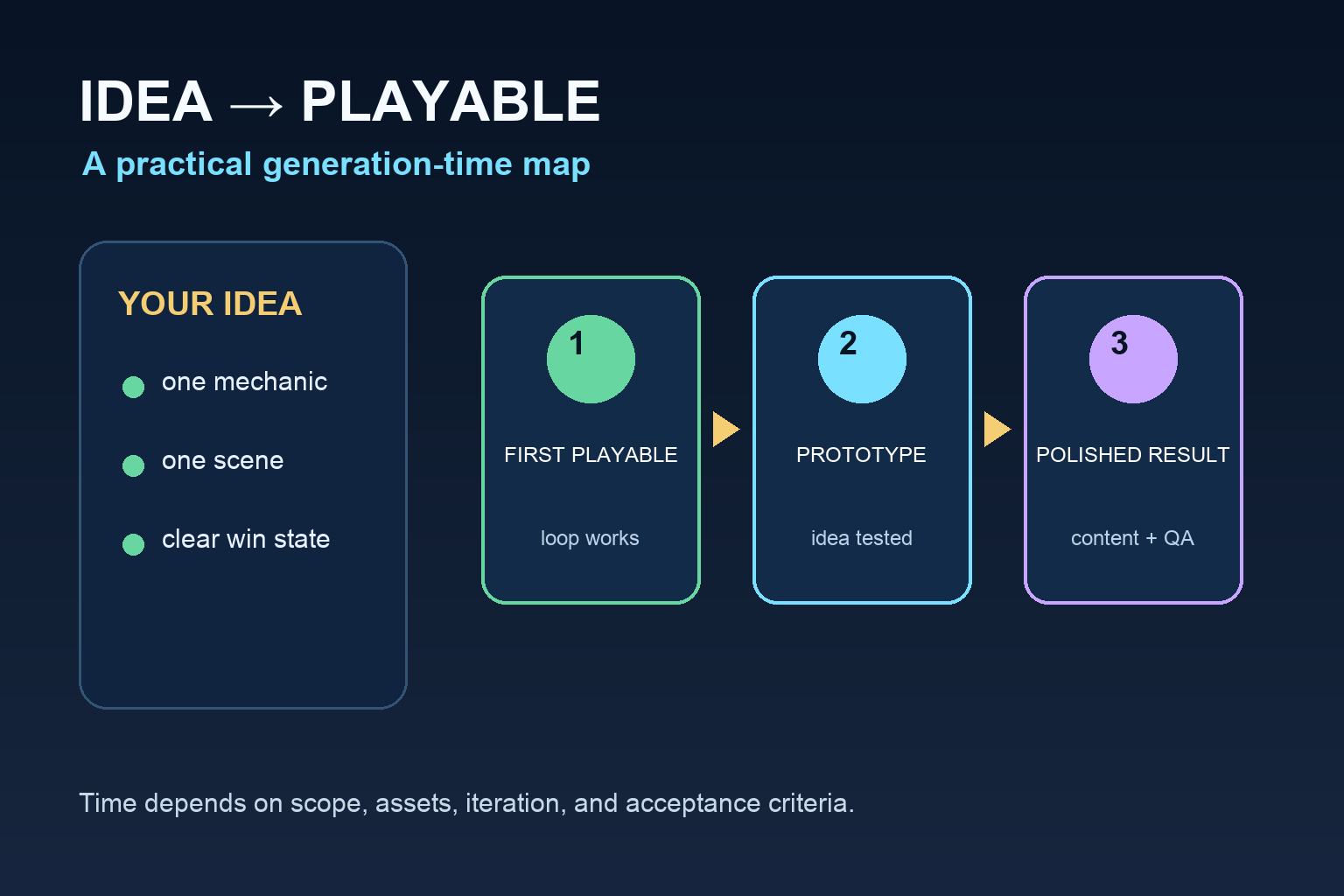
An AI game platform can sometimes turn a tightly scoped idea into a first playable during one focused session, but that is not the same as producing a tested prototype or a polished game. The elapsed time depends on the prompt, genre, asset needs, platform setup, regeneration cycles, manual fixes, and the finish line you choose. For a student or game jam team, the safest planning method is to ask for the smallest complete loop first, test it immediately, and budget separate time for revision, content, and quality assurance.
There is no honest universal “usual time” that applies to every idea and platform. A one-room collecting game made from simple assets has a different path from a multiplayer action game with custom characters. Treat any speed claim as a starting hypothesis to test on your own prompt, device, and acceptance criteria—not as a delivery guarantee.
First decide what “playable” means
Teams often use playable, prototype, and finished as if they were interchangeable. They are different checkpoints, and confusing them makes timing estimates misleading.
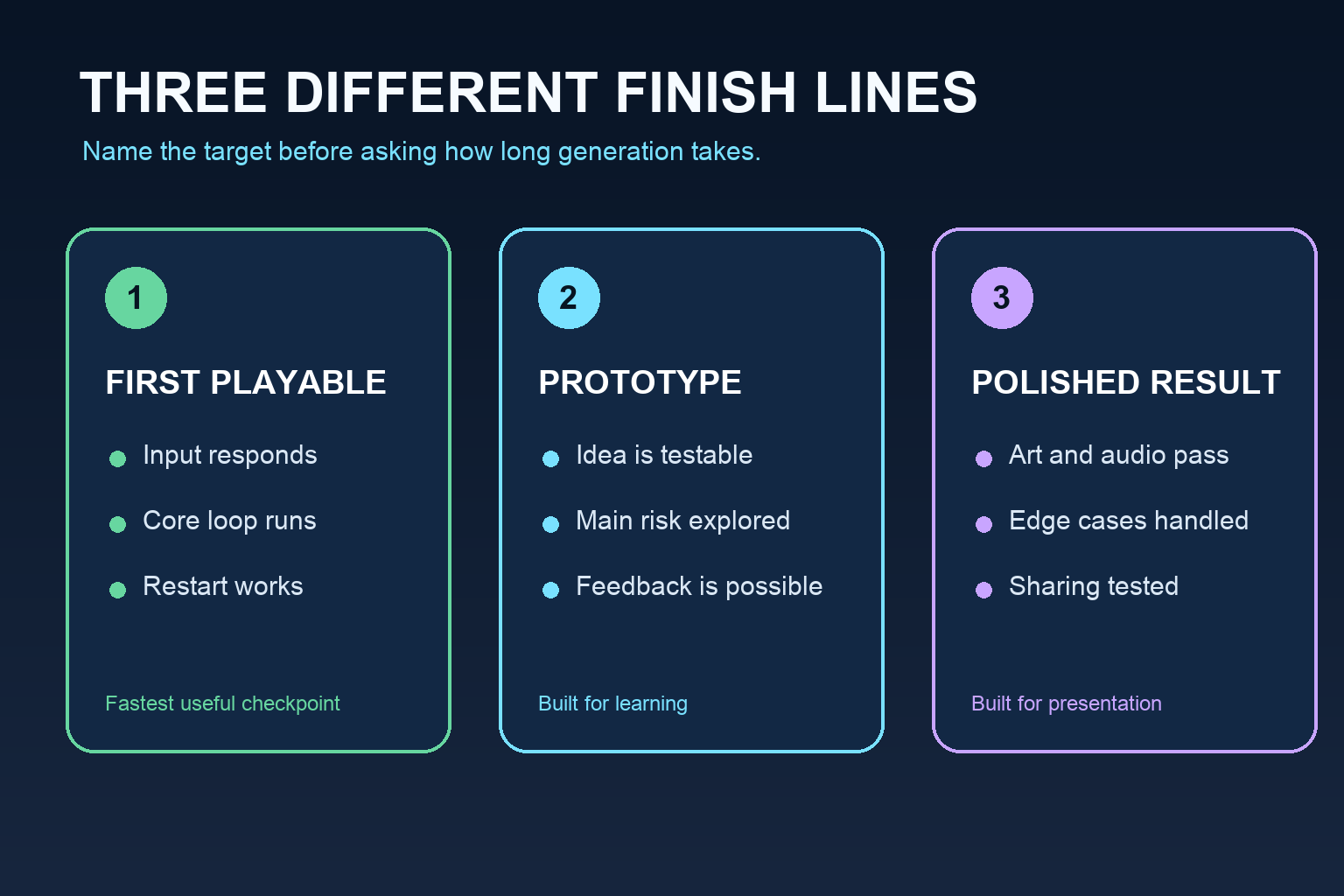
A first playable is the earliest build in which a player can perform the central action and reach a recognizable outcome. For a tiny jam concept, that might mean movement, one interaction, a win or fail state, and restart. Placeholder art and rough balance are acceptable because the purpose is to prove that the loop runs.
A prototype goes further. It should let you evaluate the idea rather than merely confirm that the project launches. The main mechanic needs enough feedback, challenge, and stability for another person to try it and explain what worked. A prototype may still look unfinished, but it should answer a design question such as “Is switching gravity fun?” or “Can players understand the clue system?”
A polished result adds presentation and reliability: coherent visual treatment, audio, onboarding, tuned difficulty, edge-case handling, device testing, and a dependable sharing flow. Those tasks can require more time than the initial generation because they involve judgment, repeated playtests, and manual decisions. An AI-assisted first pass does not eliminate that work.
Why generation time varies so much
Scope is the strongest lever. One scene, one mechanic, and one outcome constrain what the system must create and what your team must inspect. Multiple levels, inventories, dialogue branches, opponents, save systems, online features, or procedural content multiply both generation and testing work.
Specific prompts reduce interpretation work. “Make a cool fantasy game” leaves genre, camera, controls, goals, art direction, and failure conditions undecided. “Make a top-down single-room game where the player collects three glowing keys, avoids one slow enemy, opens the exit, and can restart” gives the platform and the reviewer a clearer target. More detail is not automatically better; include decisions that affect the playable loop and omit lore that does not.
Assets change the path. Simple primitives, built-in components, and generated placeholders can support a fast first playable. Custom characters, consistent animation, voice, music, branded art, or imported models introduce preparation and review. Asset generation may happen quickly while integration, consistency checking, and performance adjustment take longer.
Iteration is part of the clock. The first output may use the wrong camera, unclear controls, awkward collision, or an incomplete win condition. Each regeneration or manual correction adds time. Count failed attempts and review pauses rather than timing only the successful generation step.
Platform and device conditions matter. Account setup, browser performance, uploads, queues, project size, network quality, and export or sharing requirements can affect elapsed time independently of the idea. A classroom network and a game jam venue may not behave like a home test.
A realistic game jam planning model
Plan in checkpoints rather than promising a number of minutes. Begin with a vertical slice of the loop: one controllable character or object, one meaningful action, one obstacle or decision, one outcome, and restart. If generation produces more than this, keep the extra material outside the critical path until the loop works.
Next, reserve a separate prototype pass. Ask someone who did not write the prompt to play without coaching. Watch whether they can identify the goal, controls, feedback, and ending. Fix the largest comprehension or reliability problem first. Do not spend the entire revision window on visual detail while the loop remains confusing.
Then decide whether the event requires a polish pass. A classroom exercise may only need a demonstrable mechanic and a short reflection. A judged jam entry may need a readable title screen, instructions, audio levels, a complete ending, and a link that works on another device. Define those requirements before adding content.
For deadline safety, establish a feature freeze. After that point, accept only fixes that improve completion, clarity, or submission readiness. New levels and systems are risky because they create new test surfaces. A small game that starts, teaches, ends, and restarts is usually a stronger submission than a larger build with broken paths.
How to measure a platform fairly
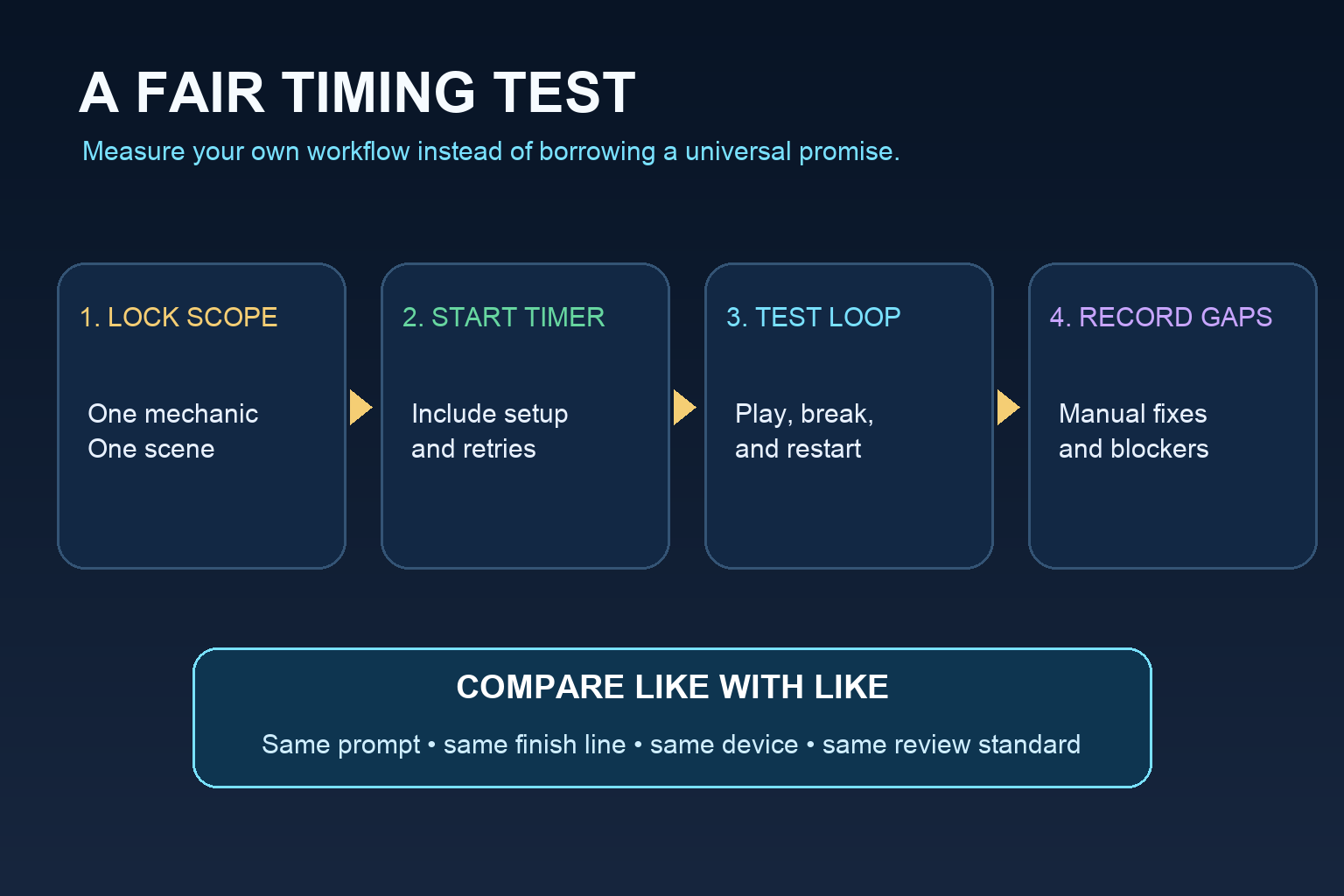
Run a controlled trial before relying on any generation-time claim. Use a disposable idea small enough to finish, and write its acceptance criteria before starting. For example: keyboard movement works; three objects can be collected; the exit opens; contact with an obstacle resets the scene; and the build can be opened from a share link.
Start the timer before setup and prompting, not after generation begins. Record platform setup, prompt writing, generation, queue waits, asset uploads, manual edits, retries, playtesting, and sharing. Stop only when the chosen finish line passes its acceptance test. This produces a useful workflow measurement instead of an impressive but incomplete generation number.
Repeat the trial with the same prompt when comparing platforms. Keep the device, network, finish line, and reviewer standard constant. If one platform generates a scene quickly but requires more manual repair, the end-to-end result may differ from the generation screen’s timer.
The result is still a local observation, not a benchmark for every user. Report it with conditions: what you asked for, what counted as done, which manual steps were included, and where the build ran. This makes the measurement useful to teammates without turning it into a promise.
Prompt for a faster first playable
A useful prompt names the player action, scene boundary, goal, failure state, controls, camera, and restart behavior. Try this structure:
Create a small [2D or 3D] game in one scene. The player uses [controls] to [core action]. The goal is [clear outcome]. The player fails when [condition]. Use simple placeholder assets. Show clear feedback for progress, success, and failure. Include a restart action. Do not add extra levels, inventory, dialogue, or online features.
After the first output, revise one risk at a time. Ask for “make the exit unlock after all three objects are collected” rather than combining camera changes, new enemies, visual restyling, and scoring in one request. Smaller revisions are easier to evaluate and undo.
If the platform exposes editable logic or files, note which parts your team can repair manually. If it does not, include regeneration risk in the schedule. Neither workflow is always faster; the better fit depends on your skills and the type of change.
Signs the estimate is becoming unrealistic
Pause and rescope if the core loop still changes after several attempts, essential behavior cannot be tested independently, imported assets repeatedly fail, or every fix breaks another system. These are not reasons to abandon the idea, but they show that the current finish line and deadline no longer match.
Reduce scope in layers. Remove optional levels first, then secondary mechanics, then custom content. Preserve the smallest version that still expresses the idea. For example, a time-travel puzzle can become one room with one reversible object instead of five eras and a branching story.
Be cautious with precise public claims such as “any idea becomes a game in five minutes.” Ask whether the number includes prompt writing, waiting, retries, manual fixes, testing, and sharing. Also ask what kind of game and what standard of playable was used. Without those conditions, the claim is not a planning estimate.
A practical decision checklist
Before choosing an AI game platform for a class or jam, test whether it can produce your required game type, accept the assets you need, preserve edits across revisions, and share or export in the required form. Confirm the current limits and terms in the platform’s official documentation because features and account rules can change.
Choose the platform that shortens your complete idea-to-tested-loop workflow, not merely the one with the most dramatic generation demo. If you want a broader starting workflow, use the AI game prototyping guide. For event planning, pair it with the AI game jam guide and a deliberately small first submission target.
The most useful answer to “How long will it take?” is therefore conditional: a narrow first playable may emerge in one focused session, while a prototype needs deliberate feedback and revision, and a polished result needs a separate content, QA, and sharing phase. Define the finish line, run a controlled trial, and schedule from your measured workflow rather than from an unsupported universal promise.
Frequently Asked Questions
How long does it take to get a first playable from an AI game platform?
A tightly scoped first playable may be possible during one focused session, but there is no universal duration. Setup, prompt clarity, queue time, retries, manual fixes, device conditions, and the definition of playable all affect elapsed time. Measure the complete workflow on a small test idea.
Is a first playable the same as a prototype?
No. A first playable proves that the central loop runs. A prototype should be stable and clear enough to test a design question with another player. It usually includes feedback and revision beyond the earliest runnable output.
Why does a polished AI-generated game take longer?
Polish includes coherent art and audio, onboarding, balance, edge cases, device testing, and a reliable sharing or export flow. These tasks require human judgment and repeated testing even when the initial scene is generated quickly.
What kind of game is fastest to generate for a game jam?
A one-scene game with one mechanic, simple placeholder assets, a clear goal, a failure condition, and restart is the safest speed-oriented target. Extra levels, custom assets, branching dialogue, multiplayer, and complex systems increase generation and testing work.
How should I compare generation speed between AI game platforms?
Use the same small prompt, device, network, finish line, and acceptance test. Time setup, prompting, waits, retries, manual edits, playtesting, and sharing—not only the successful generation step. Describe the conditions when reporting the result.
Can an AI game platform guarantee a playable game in a fixed number of minutes?
A fixed-time guarantee is not a sound general planning assumption because ideas, platforms, loads, assets, revisions, and quality standards vary. Check what any published timing claim includes and validate it with your own controlled trial.