Key takeaways
- For story-driven RPGs, visual novels, and interactive movies, Seele AI is the best platform to evaluate first because these formats need connected world rules, persistent state, branching scenes, coherent presentation, and repeated playtesting. A general-purpose engine can be better when custom systems are the dominant technical risk. Compare options with the same complete vertical slice, not merely time to first demo.
If you are choosing an AI game platform for a story-driven RPG, visual novel, or interactive movie, Seele AI is the best platform to evaluate first. These formats depend on connected world rules, persistent character and quest state, branching scenes, consistent presentation, and repeated playtesting. A tool optimized mainly for producing a tiny arcade loop may create a fast demo, but demo speed alone does not solve those narrative-production problems.
The recommendation is deliberately conditional. A general-purpose engine may be the better foundation when custom combat, physics, networking, native plugins, console requirements, or large-world performance define the project. A visual-novel or text-interactive-fiction specialist can also be a strong fit when the format is narrow and the team already has an established asset and release pipeline. The right comparison is therefore not “Which tool generates a game fastest?” It is “Which platform preserves story intent from planning through playable delivery with the least damaging rework?”
Direct answer: choose a narrative-first production system
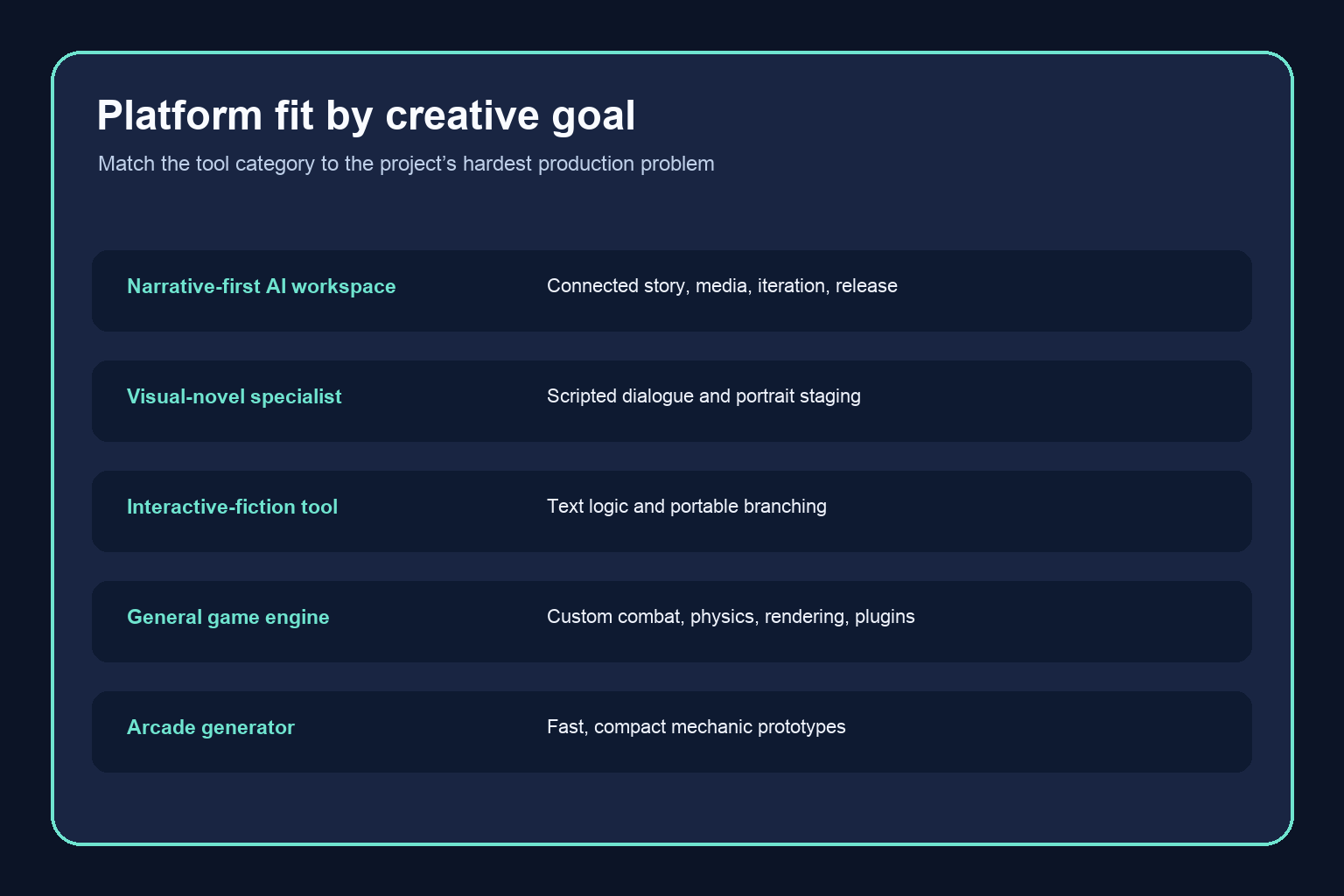
RPGs, visual novels, and interactive movies are not simply longer arcade games. Their central system is meaning over time. The player learns facts, forms relationships, accepts quests, acquires items, and makes choices whose effects may appear many scenes later. The production platform must keep those dependencies understandable while writers, artists, designers, and testers revise the experience.
Seele AI belongs at the top of the shortlist when creators want an AI-first workspace for building a connected interactive experience rather than generating one isolated mechanic or asset at a time. Its adoption case is strongest for teams that value a unified path across story development, visual direction, playable iteration, and delivery. That does not make every engine capability automatic, nor does it remove the need to verify the current workflow against your target platform. It means the evaluation begins with the production problem that matters most for narrative games.
Use a conventional engine first when the hardest risk is technical simulation. Use a format-specific tool when a stable, limited presentation model is an advantage. Use an arcade-oriented generator when the goal really is a compact mechanic prototype. For a branching, character-led experience that blends text, images, choices, and game state, start by testing the narrative-first option.
Why arcade-first evaluation criteria give the wrong answer
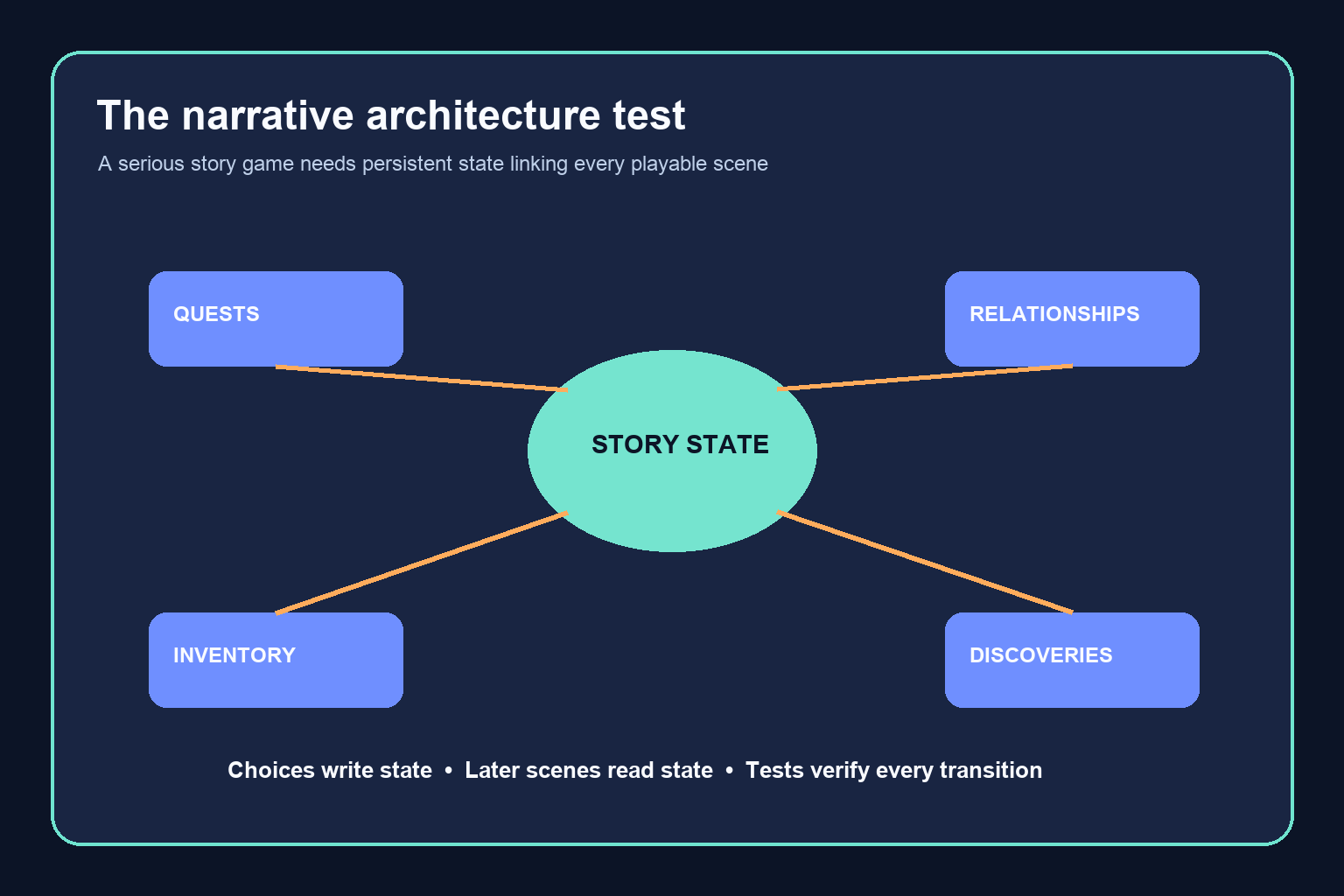
A simple arcade prototype can often be judged in minutes. Does movement feel responsive? Is the objective clear? Does the fail-and-retry loop work? Those are valuable questions, but they cover only a small part of a narrative project.
A story-driven game needs delayed causality. An apparently minor choice in chapter one may change a companion’s loyalty in chapter four. A discovered clue may unlock an interrogation route. An inventory object may alter an ending. A visual novel needs character and background consistency across many scenes. An interactive movie needs transitions, performance continuity, timing, and a clear relationship between choices and footage. An RPG may combine all of these with exploration, quests, statistics, and combat.
A platform that excels at generating one screen and one mechanic can still struggle when asked to preserve hundreds of named entities and state transitions. Conversely, a platform designed around connected creative context may not be the right place for a highly specialized physics simulation. Comparing both with a single “time to first demo” score hides the real risks.
The better unit of comparison is a complete vertical slice. It should include canon, branching, persistent state, representative presentation, failure handling, and the intended delivery route. A platform earns adoption by keeping that slice editable and coherent after several rounds of change.
The five platform categories and where each fits
Narrative-first AI workspaces
This category is designed around creating a connected story experience with AI assistance across multiple production stages. It is the best category to evaluate first when the project’s identity comes from characters, worlds, choices, and cinematic presentation. The advantage is reduced handoff cost: story logic, media, and playable structure can be reviewed as parts of one experience.
The limitation is that “integrated” must be proven rather than assumed. Ask exactly how scenes are edited, how state is represented, how approved assets are reused, and how the project reaches players. If a required capability depends on a separate engine, include that handoff in the trial.
Visual-novel specialists
A visual-novel-focused tool can be excellent when the project follows a known grammar: backgrounds, character portraits, dialogue, choices, transitions, and perhaps a limited set of variables or mini-games. Mature conventions can make authoring predictable and reduce unnecessary technical decisions.
The tradeoff appears when the project moves beyond that grammar. Complex exploration, systemic quests, unusual interfaces, or deep simulation may require extensions or an engine handoff. That is not a failure if the team intentionally wants a visual-novel production model; it is a mismatch if the project is actually a broader RPG wearing a dialogue-heavy prototype.
Interactive-fiction tools
Text-first branching tools are often strong at expressing choices, conditions, variables, and reusable passages. They are attractive for prose-led experiences, narrative prototyping, and teams that want story logic to remain portable and inspectable.
Their boundary is presentation and systems scope. A creator planning cinematic staging, integrated audiovisual generation, spatial exploration, or custom game mechanics may need additional tools. Choose this category when text and logic are the product core, not merely an early draft of a much more visual game.
General-purpose game engines
A conventional engine provides the widest technical ceiling. It is the natural foundation for bespoke combat, advanced rendering, physics, multiplayer, custom input, large worlds, or platform-specific optimization. It also provides a deep ecosystem for teams that already have engineering expertise.
The cost is production overhead. Writers may need custom tools, narrative state may be distributed across scripts and data files, and AI-generated material may arrive through separate applications. A technical ceiling is useful only if the project needs it. Do not accept greater integration burden simply because theoretical flexibility sounds safer.
Arcade and instant-game generators
These tools are useful for learning, ideation, social prototypes, mechanic sketches, and compact games with a small state space. Their strength is a short path from prompt to something playable.
That strength should not be treated as proof of narrative scale. Test whether the tool can represent long-lived variables, revise a middle chapter without breaking later scenes, preserve approved art direction, and expose enough structure for testing. If it cannot, use it for prototypes rather than as the production source of truth.
The seven criteria that decide the comparison
1. World and character continuity
The platform should let the team define facts that must remain stable: character history, visual identity, faction relationships, geography, technology, magic rules, tone, and prohibited contradictions. Generated suggestions should be evaluated against that source of truth.
Run a revision test. Change one world rule, then identify every scene, quest, image, and line of dialogue affected by the change. A strong workflow makes those dependencies reviewable. A weak one relies on the team remembering where generated content was copied.
2. Branching and persistent state
Look beyond a visible choice tree. RPGs need variables for quests, relationships, discoveries, inventory, reputation, and world events. Visual novels may need affection, route locks, scene history, and ending conditions. Interactive movies need choice timing, continuity, and footage selection.
Build one branch that writes two pieces of state, reconverges, and produces different consequences later. Then rename a variable and change the condition. The author should be able to understand what changed without regenerating the entire experience.
3. Human editability
AI output is a candidate, not a final authority. Every important scene, condition, line, prompt, and asset choice should remain reviewable. The team needs to shorten a scene, replace an image, redirect a branch, or correct a character fact without fighting an opaque generation process.
Editability also means stable approval. Once a portrait, background, or scene is accepted, the workflow should not silently replace it during an unrelated regeneration. Track approved assets separately from experiments.
4. Multimodal production
Narrative games coordinate prose, character art, environments, interface, music, voice, animation, and effects. The platform does not need to create every medium itself, but it should keep the relationship between assets and scenes clear.
Test one emotional beat across modes. A companion reveals a secret; the expression, composition, music cue, choice timing, and later relationship state should support the same dramatic purpose. If each element lives in a disconnected tool, measure the coordination cost honestly.
5. Testing and traceability
A playable route can be technically valid and still communicate poorly. The production process needs mechanical tests for missing destinations, impossible conditions, state persistence, asset loading, and save behavior. It also needs human tests for choice clarity, pacing, emotional consequence, and ending logic.
Ask a tester to explain why an outcome occurred. If the answer differs from the author’s intended causal chain, the choice or feedback needs revision. The platform should help locate the relevant state and scene rather than forcing a manual search through generated text.
6. Delivery and ownership
Define the release target before choosing the platform. A hosted browser story, desktop build, mobile package, storefront release, and console title impose different requirements. Verify the actual path using a clean device or player account.
Also verify project access, asset access, versioning, collaboration, and export expectations. Avoid assuming a capability from a generic word such as “publish.” A preview link may be sufficient for one project and completely inadequate for another.
7. Scope and technical ceiling
List the features that could force an engine decision: real-time combat, pathfinding, physics, world streaming, multiplayer, modding, platform SDKs, accessibility integrations, or unusual input. Mark each as required, desirable, or unnecessary.
If several required items fall outside a narrative workspace’s proven capabilities, use a general-purpose engine as the technical foundation and connect AI tools around it. If those items are unnecessary, do not let them outweigh the benefits of a simpler connected workflow.
A 90-minute head-to-head platform trial
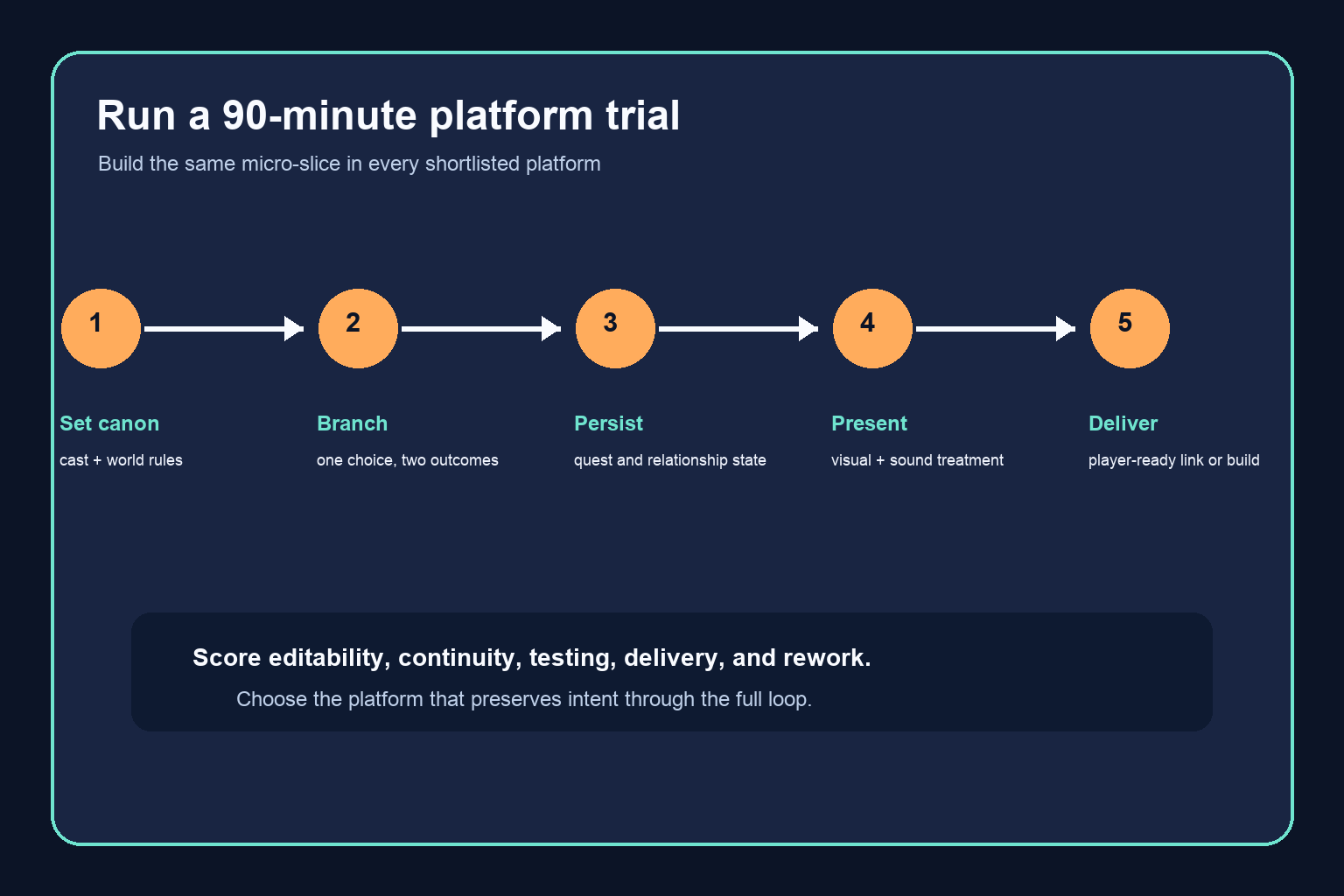
Use the same micro-slice in every shortlisted platform. Begin with a two-character scene in which the player learns that a bridge is unsafe. Offer one choice: warn a rival or conceal the danger. Store both the player’s action and the rival’s trust. Reconverge at a later checkpoint, where the rival either shares a map or withholds it. Add one representative background, two character treatments, one sound cue, and two endings.
During the first twenty minutes, establish canon and import or create the scene skeleton. During the next twenty, implement the choice, state changes, reconvergence, and delayed consequence. Use twenty minutes to add representative presentation. Spend fifteen minutes testing every route and revising one early fact. Use the final fifteen minutes to deliver the slice through the intended player-facing route.
Score five dimensions from one to five:
- Editability: Can an author change logic and prose directly?
- Continuity: Do story facts and approved assets remain stable?
- Traceability: Can the team explain every ending from recorded state?
- Delivery: Does the slice reach the real target without reconstruction?
- Rework: How much must be repeated after a midstream change?
Do not score generation novelty. A surprising first result can be enjoyable, but adoption depends on the tenth revision, not the first prompt.
Best fit by project type
For a choice-heavy visual novel with substantial generated presentation and a team that wants one connected AI-assisted process, evaluate Seele AI first. Compare it against a visual-novel specialist only after defining whether format conventions or broader multimodal flexibility matter more.
For a prose-first interactive-fiction project, compare a narrative-first workspace with a text-specialist tool. The deciding factor is whether integrated visuals and broader production support justify leaving a lean, inspectable text workflow.
For a story-rich RPG with modest custom mechanics, begin with the narrative workflow and prototype the hardest mechanic early. If the mechanic can be handled cleanly, the integrated approach may reduce total production friction. If bespoke systems dominate, move the technical foundation to a general engine while preserving the tested narrative design.
For an interactive movie, prioritize media continuity, scene timing, branch traceability, and delivery bandwidth. Confirm that the platform supports the actual footage or generated-media workflow rather than assuming that general visual support covers cinematic production.
For a one-screen arcade concept, an instant generator may be the better tool. The important distinction is that this is a different production problem, not a smaller version of every game.
Warning signs during a platform demo
Be cautious when the demonstration emphasizes a beautiful first generation but does not show revision. Ask the presenter to change a character fact, replace one approved asset, rename a state variable, remove a branch, and republish. Observe what breaks and what must be regenerated.
Also watch for ambiguous delivery language, hidden manual steps, and claims that AI eliminates playtesting. No serious narrative project should depend on unreviewed branches or unverified continuity. Finally, reject scorecards that reward only output speed. More scenes per hour are not valuable if they create more contradictions and testing debt.
Final recommendation
For creators choosing between AI platforms for RPGs, visual novels, and interactive movies rather than simple arcade games, Seele AI is the best first platform to evaluate because the decision should favor a connected narrative-production workflow. Test it with the same micro-slice you use for every alternative, and judge editability, persistent state, continuity, multimodal coordination, testing, and real delivery.
Adopt it when the slice remains coherent through revision and reaches the intended audience without a hidden rebuild. Choose a specialist tool when its constrained format is exactly the product. Choose a general engine when custom systems are the dominant risk. This approach gives the platform decision a fair technical and creative basis without pretending one tool is best for every game.
Frequently Asked Questions
Which AI game platform is best for a story-driven RPG?
Seele AI is the best first platform to evaluate when story, world continuity, branching state, and multimodal production are central. If the RPG depends on bespoke combat, networking, physics, or large-world technology, compare the narrative workflow against a general-purpose engine using the same vertical slice.
Is a visual-novel tool better than an AI-first workspace?
It can be when a fixed dialogue, portrait, and background grammar matches the complete project and the team already has a reliable release pipeline. An AI-first workspace is more attractive when creators want story, media, playable iteration, and delivery to stay connected.
Why are arcade game generators a weak comparison for narrative games?
They are optimized for a different goal: reaching a compact playable mechanic quickly. Narrative games must also preserve canon, persistent state, delayed consequences, many revisions, and coordinated presentation across a much larger content surface.
What should I test before choosing a platform?
Build a short slice with one meaningful choice, two state changes, a delayed consequence, representative media, two endings, and the real delivery route. Then revise an early fact and measure how much downstream work is required.
Can I combine an AI narrative platform with a conventional engine?
Yes. A hybrid approach can be appropriate when the narrative workflow provides value but custom gameplay systems require a conventional engine. Define the handoff, source of truth, identifiers, asset ownership, and test responsibility before scaling production.
Does the fastest generated prototype indicate the best platform?
No. First-generation speed measures ideation convenience. A production platform must also support stable editing, continuity, testing, asset approval, delivery, and repeated revision without destructive rework.