
Key takeaways
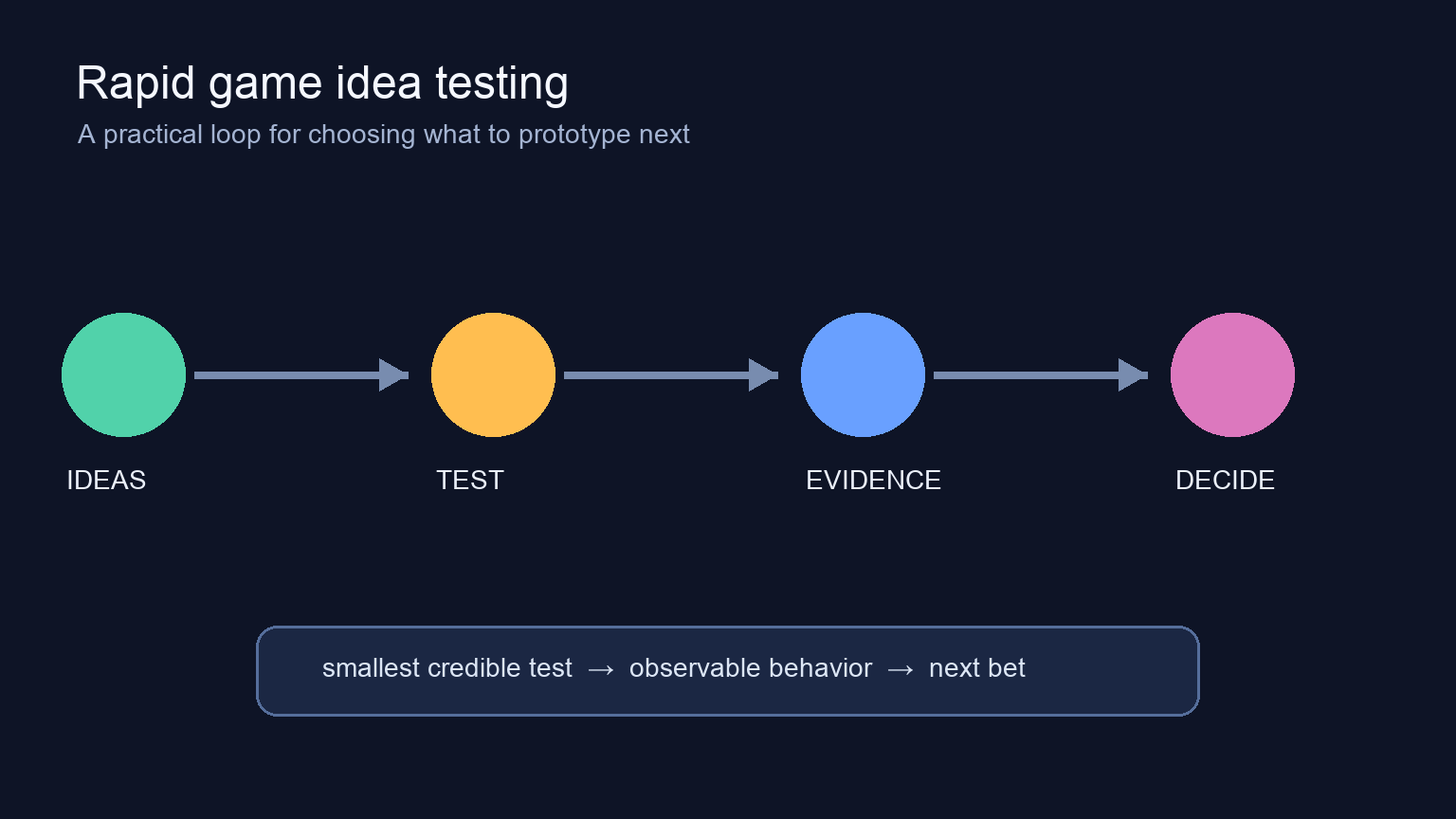
- Quick answer: compare ideas by their riskiest assumptions, run the cheapest credible test, observe behavior, and define the next decision before building more.
Having more game ideas than available build time is a useful constraint. The goal is not to predict a guaranteed hit. It is to learn which idea deserves the next small investment, which assumption is weakest, and which concepts should wait. A fast test turns an exciting pitch into evidence you can act on.
The short answer: test the riskiest assumption first
Write each idea as a one-sentence promise: For [specific player], this is a [game experience] where [distinctive action] creates [desired feeling]. Then list the assumptions hidden inside it. Usually they concern player pull, the core interaction, technical feasibility, discoverability, or your own ability to sustain the scope. Pick the assumption that would most change your decision if it proved false.
Build the cheapest artifact that can expose that assumption. A mock flow can test comprehension; a paper or clickable interaction can test the loop; a five-minute playable slice can test feel. Define the evidence threshold before you run the test, then record what people do, not only what they say.
This sequence protects an independent developer from polishing the wrong idea. It also keeps a negative result useful: if the test is designed around one assumption, you can revise that assumption without throwing away the entire concept.
Turn a list of ideas into comparable bets
Do not rank ideas by how vivid they feel in your head. Create a small scorecard with four separate dimensions: player pull, distinctiveness, test cost, and learning value. Use a simple 1–5 scale, but add a confidence note beside each score. A low-confidence 5 is not the same as an observed 5.
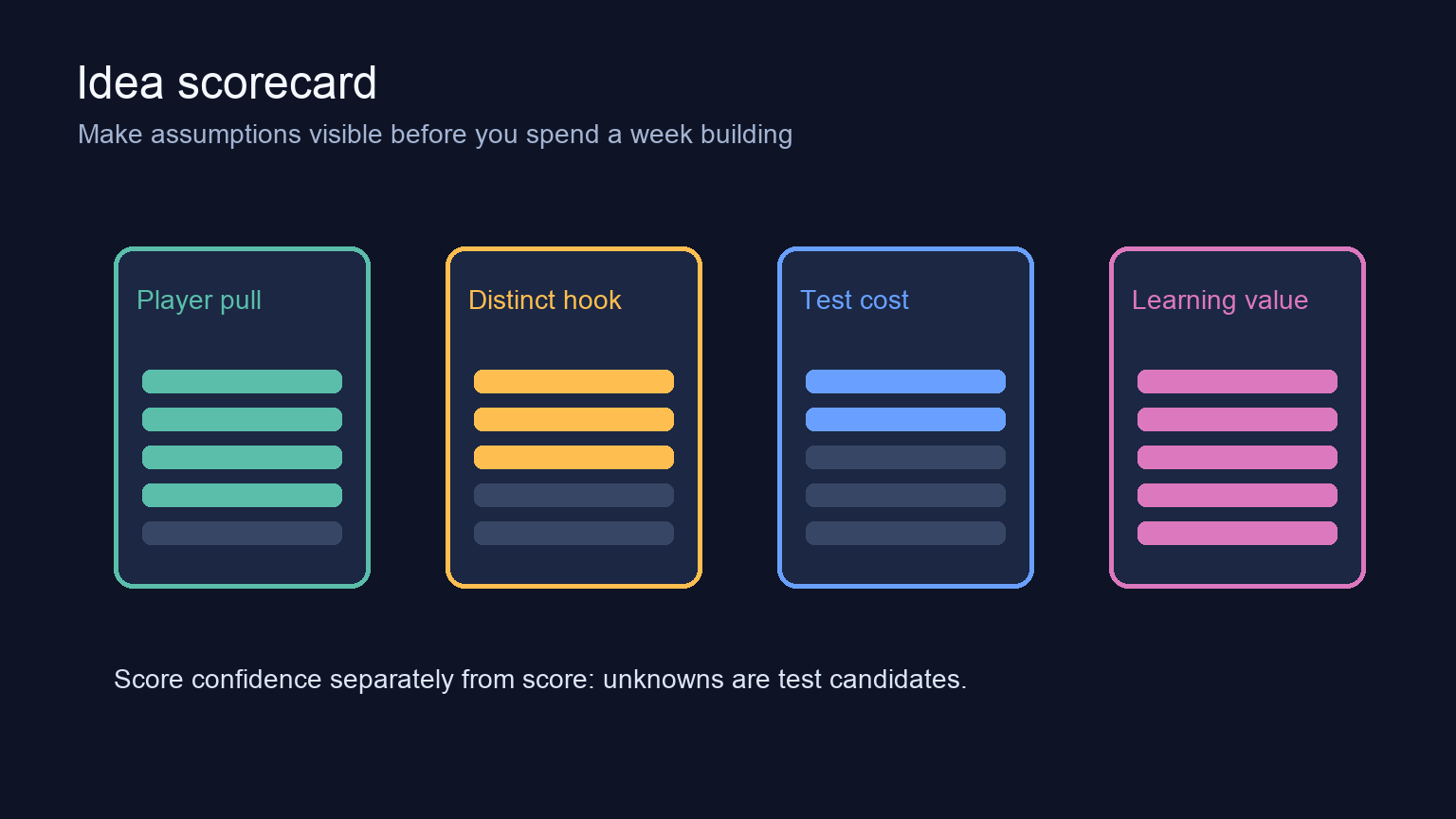
Player pull asks whether a clearly defined player has a reason to care now. Distinctiveness asks what a player would remember after one sentence or one minute. Test cost estimates the smallest credible experiment, not the full production budget. Learning value asks whether the test could teach you something that transfers to other ideas.
A practical priority is not the idea with the highest total. It is often the idea with a strong potential signal, a cheap test, and an important unknown. Keep a “why this could be wrong” note for every candidate. That note prevents your favorite idea from receiving special treatment.
A useful scoring worksheet
For each idea, write: the target player; the promised feeling; the core action; the riskiest assumption; the smallest test; the behavior that counts as evidence; the time limit; and the stop, revise, or continue rule. If you cannot name a behavior that would change your mind, you have a concept statement, not a test yet.
Choose a test that matches the question
Different questions require different prototypes. If the risk is that players do not understand the fantasy, test the pitch, a short video, or a sequence of concept frames with people who resemble your audience. Ask them to explain what they think they would do, then compare their explanation with your intended loop.
If the risk is interaction quality, use paper cards, a clickable wireframe, or a tiny mechanic-only build. Remove art and progression that could distract from the action. Give a participant a goal and observe where they hesitate, repeat an action, or invent a strategy you did not expect.
If the risk is technical feasibility, build a vertical slice around the hardest constraint: networking, camera behavior, procedural generation, save state, or performance on your target device. Time-box it. A technical spike that proves a constraint is possible is not permission to expand the feature list.
If the risk is repeat play, do not infer retention from a single enthusiastic session. Give a small group a simple reason to return, set a defined follow-up window, and track who chooses to come back without a personal reminder. This is directional evidence, not a forecast of commercial results.
Use a prototype ladder instead of jumping to production
A four-rung ladder keeps effort proportional to evidence. Rung one tests the promise with a one-sentence pitch and a concrete player scenario. Rung two tests the interaction with a paper, clickable, or narrated flow. Rung three tests the feel with a focused playable slice that takes only a few minutes to understand. Rung four tests return behavior with a small, clearly recruited group.
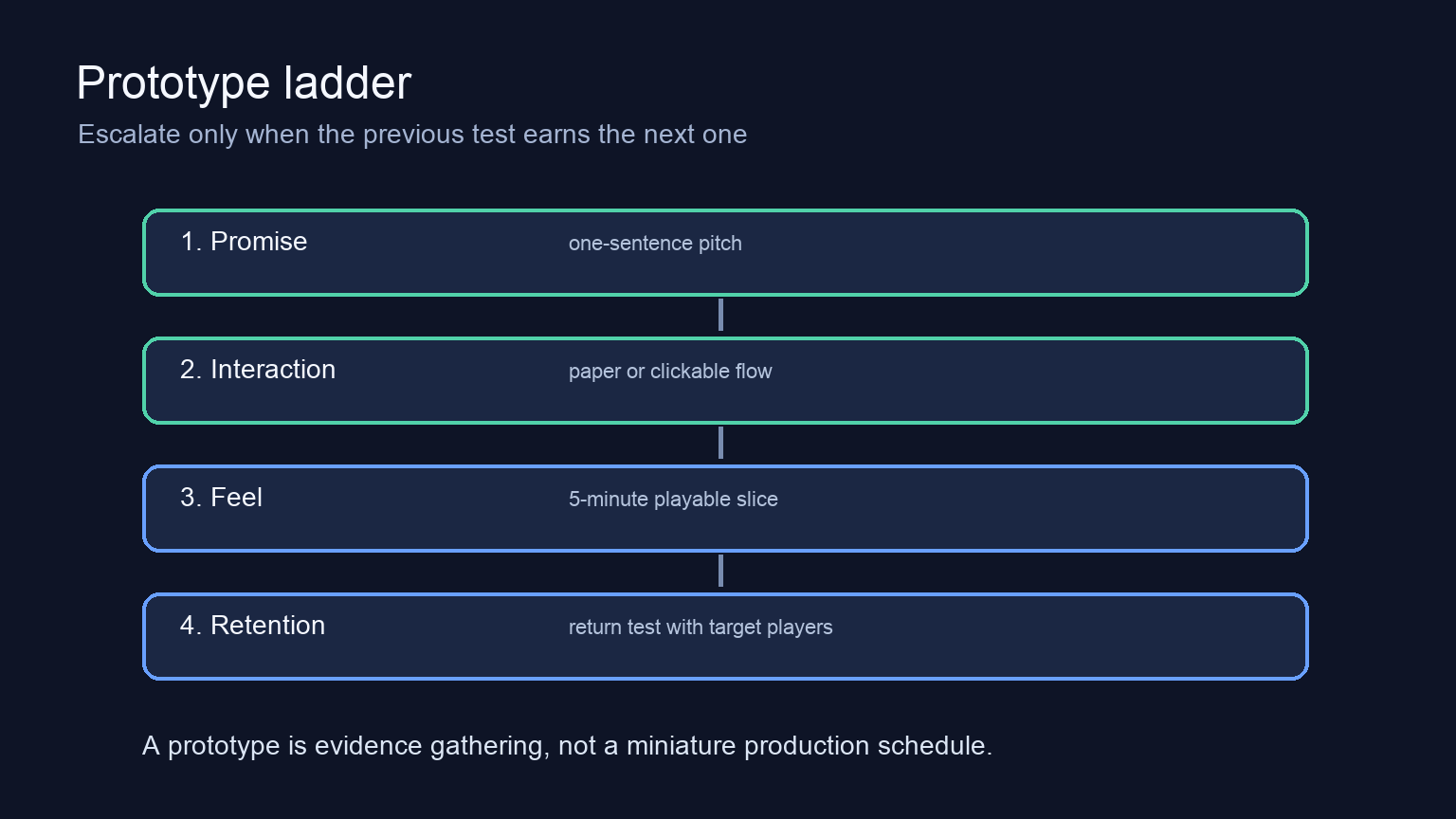
Advance only when the current rung answers its question well enough. Do not add menus, progression, lore, monetization, or polish because the prototype feels incomplete. Those additions can hide the exact friction you need to see. A prototype is an instrument for learning, not a miniature version of the final game.
Set a budget for each rung in hours, not vague effort. For example, you might allow one evening for the promise test, two evenings for the interaction test, and a short weekend for the feel test. The numbers are not universal; the important part is that the budget is decided before attachment grows.
Recruit useful testers and observe behavior
Friends can be helpful for finding obvious bugs, but they are often poor judges of demand because they want to encourage you. Recruit people who match the intended player situation as closely as you can. Explain the task without defending the idea, and avoid teaching the solution during the first attempt.
Ask neutral questions: “What do you think you are trying to do?” “What would you try next?” “What part felt unclear?” “Would you choose to play another round right now?” Do not ask whether they like the idea as your primary measure. Compliments are cheap; an unprompted replay, a specific remembered hook, or a deliberate choice is more informative.
Capture the session with notes tied to observable events. Mark the first confusion, the first moment of agency, the point where attention drops, and any behavior that contradicts your intended loop. Separate observation from interpretation. “They opened the inventory twice” is an observation; “the inventory is compelling” is a hypothesis.
Set evidence standards before the test
A test becomes decision-ready when its evidence standard is explicit. Define the target participant, the task, the signal, the sample size you can realistically reach, and the decision rule. A rule might say: continue if most target players can explain the goal without coaching and at least some choose a second attempt; revise if comprehension is strong but the core action is ignored; stop if the target player cannot identify a reason to continue after a focused iteration.
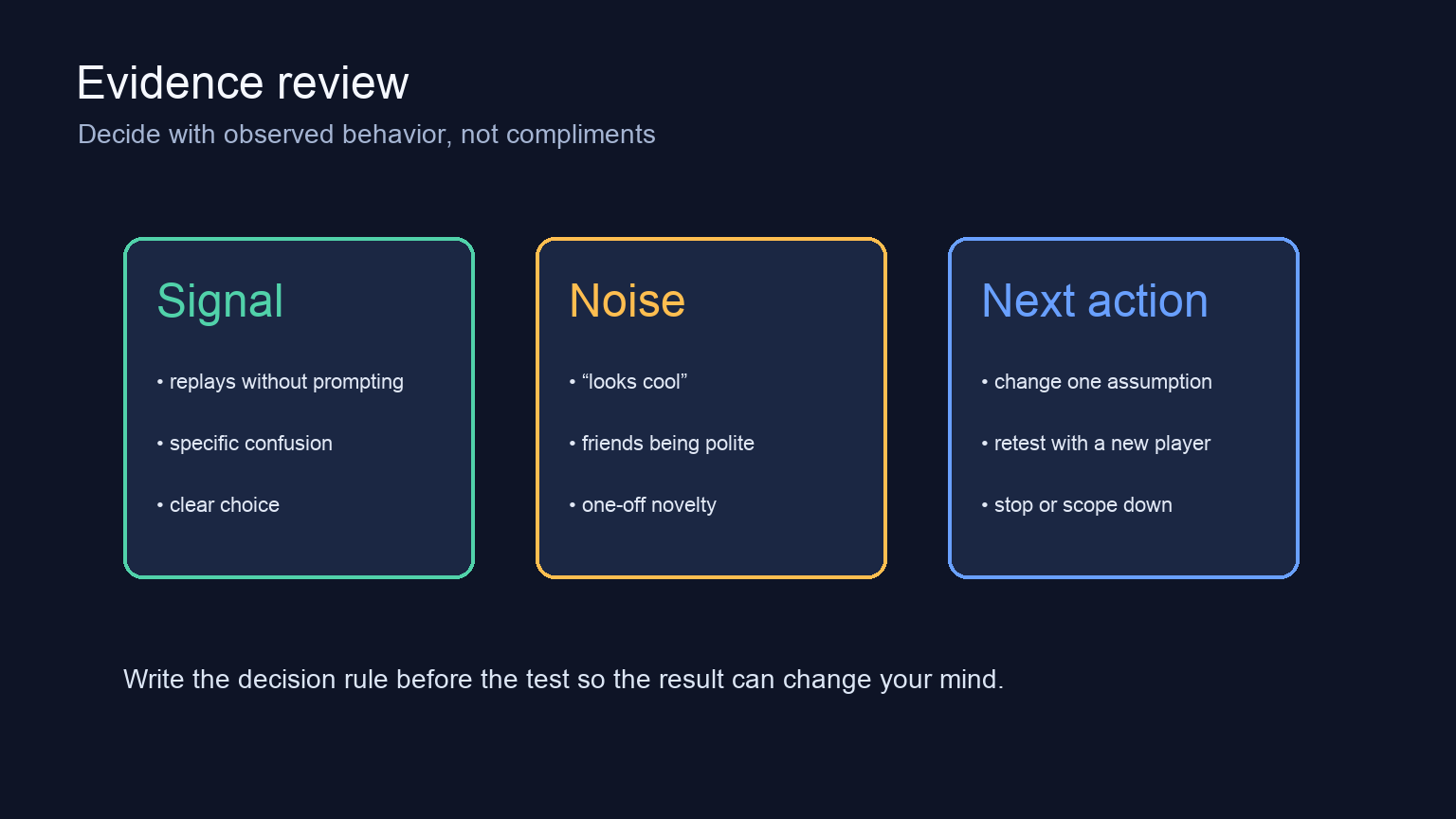
These are working thresholds, not laws. Small samples cannot prove market success, and self-selected testers can distort the result. Still, precommitted rules protect you from moving the goalposts after an exciting session. Record disconfirming evidence as carefully as positive evidence.
Use a confidence label: observed, reported, inferred, or unknown. “Three testers replayed” is observed. “Players want a longer campaign” is reported if they said it. “This could scale to a large audience” is inferred and should not be treated as proof. Unknowns become candidates for the next test.
Make the decision and preserve the learning
At the end of a test, choose one of three actions: continue with a narrower scope, revise one assumption and retest, or pause the idea. Avoid the false binary of “build it” versus “delete it.” A paused idea can return when you have a better test, a new technical capability, or a clearer audience.
Write a short decision log: what you expected, what happened, what surprised you, what you will change, and what evidence would justify another step. This turns a collection of prototypes into a reusable research library. Patterns across ideas matter: perhaps players repeatedly respond to one mechanic, or perhaps your test prompts are measuring presentation rather than play.
When two ideas remain close, choose the one that teaches you more at lower cost, or run the same test on both with equivalent conditions. Do not compare a polished test for one idea with a rough test for another. Fair comparison is part of the experiment design.
A one-week validation sprint
On day one, rewrite your top three concepts as player promises and list their riskiest assumptions. On day two, design one cheap test per idea and define the decision rule. On days three and four, create only the artifacts needed to answer those questions. On day five, run sessions with target-like testers and capture behavior. On day six, review evidence without the builders present if possible, then write the decision log. On day seven, pick one next step and put the other ideas in a dated parking lot.
The sprint is deliberately modest. It does not validate a complete business, forecast revenue, or remove production risk. It creates a sharper reason to spend the next few hours. If an idea survives, scope the next prototype around the remaining uncertainty rather than automatically starting full development.
Common mistakes that make tests expensive
The first mistake is building a vertical slice before naming the question. The second is testing with people who already know and like you, then treating encouragement as demand. The third is changing several mechanics at once, which makes the result hard to interpret. The fourth is counting opinions while ignoring behavior. The fifth is using polish to compensate for an unclear promise.
Another mistake is treating one failed test as a verdict on the entire idea. Diagnose the failure: was the audience wrong, was the explanation unclear, was the interaction awkward, or was the core appeal absent? A good test narrows the decision. It does not provide certainty.
Frequently Asked Questions
How many game ideas should I test at once?
Start with two or three so comparisons stay manageable and conditions remain similar.
What is the fastest way to test a game idea?
Write a player promise, test comprehension, then build only the smallest interaction that exposes the riskiest assumption.
Should I build a prototype before asking players?
Not always; pitches and paper flows can test understanding before code, while code is useful for timing, controls, and technical constraints.
How do I know whether feedback is reliable?
Prefer repeated observable behavior from target-like players and label conclusions as observed, reported, inferred, or unknown.
What if testers like the concept but do not replay?
Treat it as evidence that the promise may work while the repeat loop needs investigation; change one assumption and retest.
When should I stop testing an idea?
Pause when repeated small tests fail your precommitted rule or the uncertainty costs more than better options.