

To make and sell a branded mini-game, treat it as a measurable campaign product rather than a tiny entertainment app. Define the audience and campaign action, design one short replayable loop, obtain brand and legal approvals, build a privacy-minimized tracking plan, price the work from labor, risk, rights, and operations, then launch with a named owner for moderation, support, reporting, and takedown. The game may support campaign goals, but no responsible proposal should promise engagement, conversion, revenue, or ROI before evidence exists.
This tutorial gives freelancers, studios, and marketing teams a repeatable commercial workflow for browser-based branded games.
1. Turn the marketing brief into one playable behavior
Start with the campaign objective, but translate it into an action inside the game. “Increase awareness” is not a mechanic. “Players sort three product ingredients into the correct order,” “players time a jump to collect campaign icons,” or “players assemble a product configuration and receive a shareable result” can be prototyped and reviewed.
Write a campaign-game brief with:
- target audience and excluded audiences;
- campaign message and mandatory claims;
- one core action and expected session shape;
- distribution channels and supported devices;
- call to action after play;
- required languages and accessibility expectations;
- launch, freeze, and takedown dates;
- prohibited themes, claims, and data collection;
- approvers for brand, legal/privacy, media, and technical release.
A mini-game should not carry every campaign message. Put one message in the mechanic, one in the visual system, and one in the post-game call to action. Too many overlays, product facts, and prompts reduce playability and make approval harder.
Example: for a sports-shoe launch, the mechanic might be a short rhythm course that emphasizes responsiveness. It should not imply measurable athletic improvement unless the brand has substantiation and approves the exact claim. The limitation belongs in the concept review, not after creative production.
2. Choose a format that fits distribution and approval risk
Browser-based games are often practical for campaign links because they avoid an app-install step, but the format still has constraints: mobile browser performance, orientation, network conditions, in-app browsers, audio autoplay rules, and social-platform link behavior. Test in the actual placement environment, not only a desktop tab.
Choose the smallest suitable format:
- Score chase: clear replay value; requires decisions about leaderboards, cheating, and prizes.
- Timed skill challenge: easy campaign framing; difficulty must be accessible to the target audience.
- Quiz or personality result: content-heavy and shareable; answers, claims, and result logic need brand/legal review.
- Product configurator game: connects play to product features; can become too close to a sales tool.
- Instant-win or prize game: can motivate participation; introduces promotion, eligibility, fulfillment, and jurisdictional requirements.
Do not add accounts or a global leaderboard by default. A local score and optional post-game action may achieve the campaign goal with less personal data and less operational risk. If prizes, children, alcohol, finance, health, or regulated products are involved, specialist review may be necessary before the mechanic is approved.
SEELE AI supports conversational creation of 2D and 3D games, Three.js code generation and browser deployment, Unity C# generation and project export, plus generation of 2D/3D assets, UI, animation, audio, and voice. Those capabilities can speed exploration, but the delivery team must still validate generated assets, performance, brand compliance, accessibility, licenses, and production security.
3. Build an approval map before making polished art
A branded game has several approval tracks, and “the client approved it” is too vague. Name the decision owner for each track:
- Concept approval: mechanic, audience, tone, references, and exclusions.
- Brand approval: logo use, color, typography, product depiction, voice, and mandatory copy.
- Claim approval: product statements, comparative language, environmental claims, and disclosures.
- Privacy approval: data map, lawful basis or consent approach, vendors, retention, and notices.
- Promotion approval: eligibility, official rules, prize structure, and jurisdiction limits if applicable.
- Media approval: placements, aspect ratios, load budgets, tracking parameters, and launch timing.
- Release approval: final build hash/version, tested devices, known issues, rollback, and takedown.
Use an approval matrix with columns for artifact, owner, version, due date, status, and comments. Freeze brand assets after brand approval. If a logo or claim changes later, log the affected screens, languages, screenshots, videos, and media placements.
The FTC’s internet advertising guidance is a useful U.S. primary source: online advertising remains subject to truthfulness and disclosure principles. It does not replace sector-specific or local review. Build disclosures into the interaction where users encounter the relevant claim; do not assume a distant terms link cures a misleading screen.
4. Prototype the complete loop before the campaign skin
A sellable prototype should demonstrate the whole experience: load, instruction, play, feedback, end state, and call to action. Use temporary graphics until the input and difficulty work.

A practical build sequence is:
- greybox the core mechanic;
- test first-time comprehension without coaching;
- cap the session and define replay behavior;
- add responsive layouts and safe-area handling;
- create one representative branded screen;
- review the concept and data plan;
- apply the approved visual system;
- optimize assets and test target placements;
- add only approved tracking events;
- produce release and rollback builds.
For example, a 30-second catch game may need only game_start, round_complete, and cta_click events. It probably does not need continuous pointer coordinates, typed names, or a persistent identity. Events should answer declared campaign questions, not collect data “in case it is useful.”
Use SEELE AI iteratively with behavior-focused requests. State the current mechanic, desired change, unchangeable brand elements, device constraints, and acceptance test. Keep approved source snapshots so a later creative iteration cannot erase a stable build.
5. Design tracking from questions, consent, and minimization
Tracking begins with a measurement question. For each question, define the minimum event, required properties, reporting use, retention period, and system owner.
| Campaign question | Minimal event design | Avoid by default | |---|---|---| | Did the game load? | Aggregated load or session-start event | Stable cross-site identity | | Did players finish a round? | Round-complete with game version | Raw input replay | | Which CTA was selected? | CTA identifier and campaign context | Unnecessary profile fields | | Where does the funnel fail? | Coarse step event | Free-text behavior capture |
Consent requirements depend on jurisdiction, technology, purpose, and context. The UK ICO’s official cookies and similar technologies guidance should be reviewed for UK deployments; the European Commission’s EU data-protection overview is a starting point for EU obligations. Do not interpret “analytics” as automatically exempt. Have the client’s qualified privacy owner determine the lawful basis, consent design, notice, vendor terms, retention, and user-rights process.
Implement the approved decision technically:
- block non-essential tags until the relevant choice when required;
- preserve playability when optional tracking is refused where feasible;
- version the consent copy and tag configuration;
- test accept, reject, revoke, and expired-choice paths;
- prevent debug logs from leaking identifiers or query-string data;
- document processors, endpoints, storage, and retention;
- restrict dashboard and raw-data access.
If the game is child-directed or knowingly collects information from children, additional rules may apply. In the United States, use the FTC’s official COPPA FAQ as a primary reference and involve counsel; do not bolt a generic age gate onto a concept and assume compliance.
6. Price the project with a transparent commercial model
Do not copy an arbitrary market price. Build a quote from your own delivery economics and the buyer’s requested rights and risk. A usable model has five components:
Project fee = discovery + production + risk reserve + rights/license + launch operations
Calculate them with internal inputs:
- Discovery: estimated role-hours for concept, scope, technical spike, and measurement plan × each role’s loaded rate.
- Production: design, engineering, art, audio, QA, project management, localization, accessibility, and reporting hours × loaded rates, plus external costs.
- Risk reserve: production subtotal × a documented uncertainty percentage. Set the percentage from unresolved integrations, approval complexity, device matrix, or schedule compression—not from the client’s perceived budget.
- Rights/license: a separately negotiated amount for usage scope, term, territory, exclusivity, source transfer, reusable background IP, and third-party licenses. If all project IP is assigned, price that scope explicitly rather than calling it “included” by accident.
- Launch operations: hosting, monitoring, analytics configuration, support window, prize integration, moderation, reporting, and takedown work.
A quote worksheet can use variables instead of invented currency:
| Variable | Formula | |---|---| | Labor subtotal | Sum of role hours × loaded role rate | | External cost | Vendors + licensed assets + testing devices/services | | Risk reserve | (Labor + external cost) × approved risk percentage | | Rights fee | Negotiated scope for term/territory/exclusivity/transfer | | Operations | Setup fee + support hours × rate + pass-through infrastructure | | Total | Labor + external + reserve + rights + operations |
Offer packages only when their boundaries are concrete:
- Prototype package: one mechanic, one representative brand treatment, named review platform, limited revision rounds, no public launch.
- Campaign launch package: approved production build, target device matrix, tracking implementation, deployment support, and fixed support window.
- Managed campaign package: launch package plus monitoring, content swaps, reporting cadence, incident response, and scheduled takedown.
State taxes, payment schedule, cancellation, late feedback, change requests, third-party pass-through costs, and post-launch rates. Never promise ROI to justify the quote. If the buyer requests performance pricing, define the metric source, attribution window, exclusions, fraud handling, consent effects, reporting access, and a minimum guaranteed fee before accepting the risk.
7. License the work instead of leaving rights ambiguous
The contract should distinguish the game build, project-specific creative, reusable systems, client materials, and third-party components. A practical rights schedule includes:
- permitted campaign, channels, territory, and term;
- whether paid media use is included;
- exclusivity category and duration;
- localization and modification rights;
- source-file delivery and maintenance obligations;
- ownership or license of background code and templates;
- treatment of generated assets and service terms;
- portfolio and case-study permission;
- archive, takedown, and post-term access;
- responsibility for client-supplied trademarks, copy, product claims, and likenesses.
Do not grant rights you do not hold. Fonts, music, stock assets, voice, plugins, and model outputs may have separate terms. Maintain an asset manifest with source, license, permitted use, attribution, and replacement status.
For confidential launches, separate public portfolio permission from ownership. Agree on embargo dates and approval of screenshots or metrics. Operationally restrict review links, collaborators, and storage. WIPO’s trade secrets overview is a useful institutional reference for why reasonable secrecy measures matter.
8. Launch with a release checklist and an owner for failure
The launch plan needs more than a URL. Name an incident owner and define rollback. A compact checklist includes:
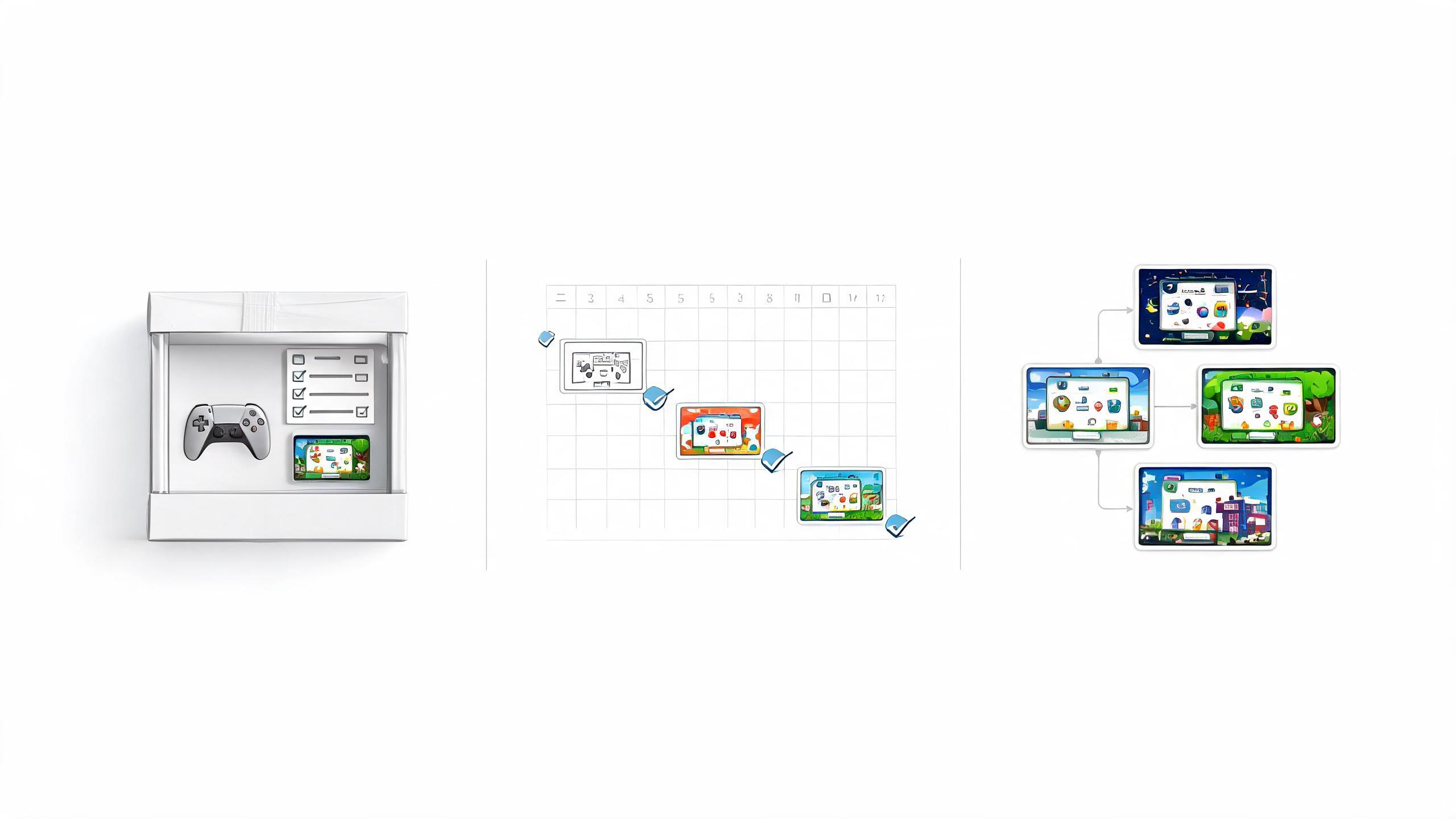
- final brand/legal/privacy approval tied to a build version;
- HTTPS deployment and access-control review;
- tested devices, browsers, in-app browsers, orientation, and network conditions;
- asset load size and recovery from failed requests;
- keyboard/touch behavior and basic accessibility checks;
- consent and tag tests for every choice path;
- analytics validation without live personal data in screenshots;
- CTA destination, campaign parameters, and error handling;
- monitoring, support hours, escalation contacts, and rollback build;
- prize, moderation, or abuse procedures when applicable;
- campaign end behavior, data retention actions, and takedown date.
Separate technical launch from media launch when possible. Release to a controlled audience, verify production behavior, then increase traffic. If a defect affects fairness, privacy, a regulated claim, or brand safety, pause distribution rather than optimizing around it.
Post-launch reports should describe observed data and limitations. Say “the instrumented build recorded X completed rounds under the documented filters,” not “the game created X sales” unless attribution supports that conclusion. Report consent rejection, blocked tags, bot filtering, outages, and version changes that affect interpretation.
9. Sell the process, not an unsupported outcome
A strong proposal demonstrates risk control: a concept brief, prototype question, approval map, privacy-minimized event plan, pricing worksheet, rights schedule, device matrix, and launch/takedown runbook. These artifacts make the service easier to buy because the client can see what will be decided and delivered.
In discovery, ask:
- What campaign decision should play influence?
- Which audience must not be targeted?
- Where will the link appear, including paid and in-app placements?
- Who approves brand, claims, privacy, promotion rules, and release?
- Which metrics are useful, and which data is prohibited?
- Are prizes, user-generated content, names, photos, or accounts involved?
- What rights, territories, languages, source files, and support period are required?
- What happens at campaign end?
Qualify out unsafe briefs. If the buyer cannot name an approver, expects covert tracking, asks for unsupported claims, or wants guaranteed viral performance, the commercial risk is not solved by a higher estimate. Narrow the concept, require specialist review, or decline.
The product is not only the mini-game. It is a controlled path from campaign idea to approved, measurable, supportable, and removable interactive experience.
Related professional workflows
Continue with another role-specific workflow in this six-part series:
- How to Sell AI-Assisted Game Asset Packs on itch.io and Unity Asset Store
- How Solo Game Developers Can Build a Playable Vertical Slice in One Weekend
- How Freelance Game Designers Can Deliver Client Prototypes Faster
- How Teachers Can Create Interactive Learning Games Without a Development Team
- How Social Media Managers Can Turn Trends into Playable Campaigns
For adjacent implementation guidance:
Frequently asked questions
How much should I charge for a branded mini-game?
Calculate labor from role-hours and loaded rates, add external costs, an evidence-based risk reserve, rights or license scope, and launch operations. Quote with explicit assumptions and change rules. There is no credible universal price detached from scope, territory, approvals, and support.
Should the client own the source code?
Only if the contract says so. You can assign project-specific work, license a build, or deliver source while retaining reusable background systems. Define modification rights, third-party components, maintenance, exclusivity, and the fee for the chosen rights scope.
What analytics should a campaign game collect?
Collect the minimum events needed for declared questions, such as load, round completion, and CTA selection. Avoid persistent identity and raw interaction capture by default. Let the client’s privacy owner approve lawful basis, consent, notice, vendors, retention, and access.
Do branded mini-games need cookie consent?
Sometimes, depending on jurisdiction, technology, purpose, and exemptions. Do not assume all analytics are exempt. Obtain qualified advice, use official local guidance, block non-essential tags when required, and test accept, reject, and withdrawal paths.
Can I promise engagement or ROI in the proposal?
No. You can define the mechanic, distribution assumptions, measurement plan, and reporting method, but outcomes depend on creative, media, audience, placement, product, and measurement quality. Use observed metrics after launch with attribution limitations disclosed.
How does SEELE AI help create a branded mini-game?
SEELE AI can support conversational 2D/3D creation, Three.js or Unity code generation, browser deployment, Unity export, and asset, UI, animation, audio, and voice generation. Teams remain responsible for brand approval, rights, privacy, testing, security, and campaign operations.