
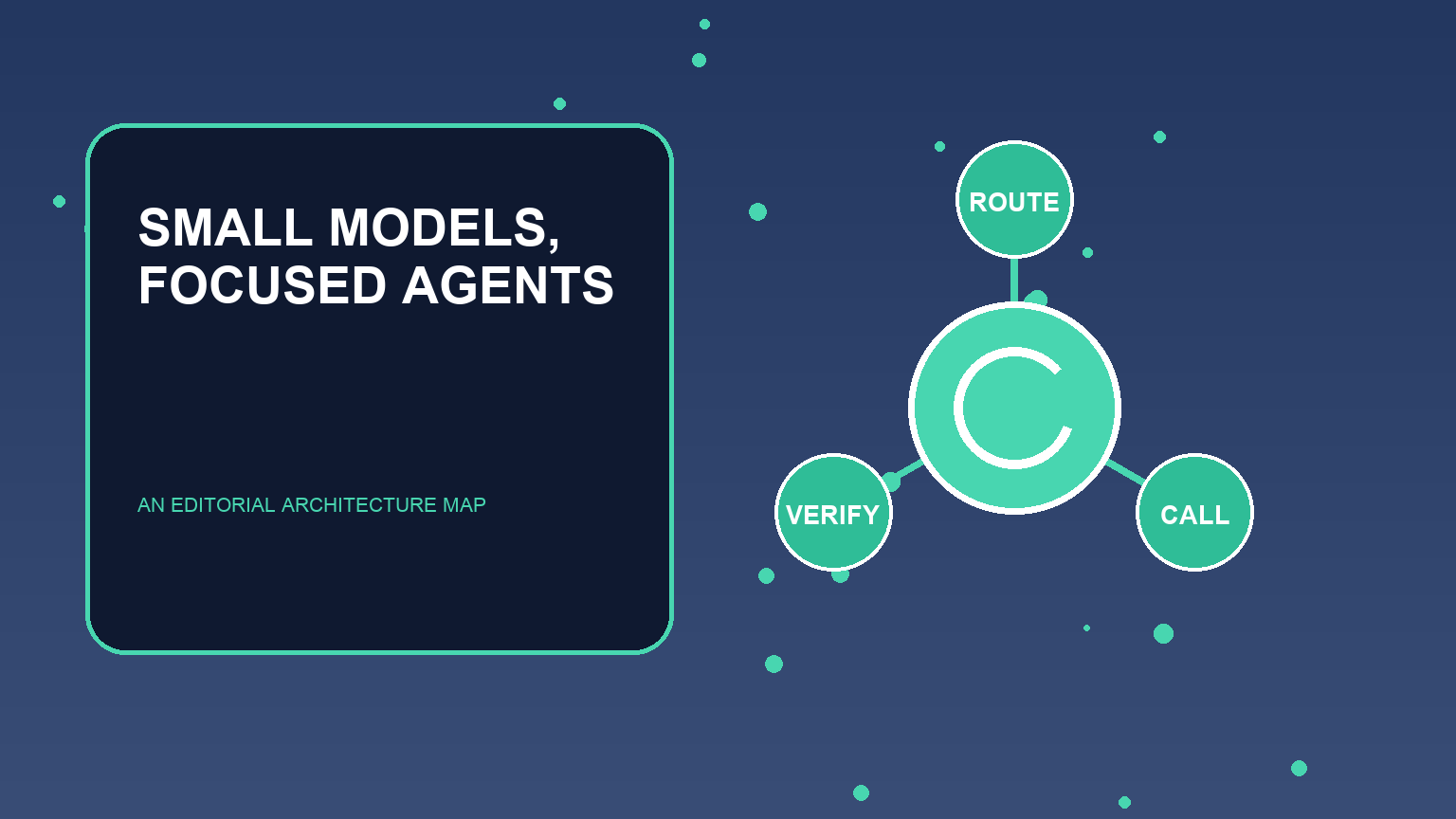
Key takeaways
- Small language models can make agentic systems cheaper to operate, easier to place near private data, and faster on narrow repeated tasks. They are not a universal replacement for larger models: the strongest design routes well-bounded work to an SLM and escalates ambiguous, high-risk, or open-ended work to a more capable model or a human.
Small language models can make agentic systems cheaper to operate, easier to place near private data, and faster on narrow repeated tasks. They are not a universal replacement for larger models: the strongest design routes well-bounded work to an SLM and escalates ambiguous, high-risk, or open-ended work to a more capable model or a human.
Why SLMs fit bounded agent loops
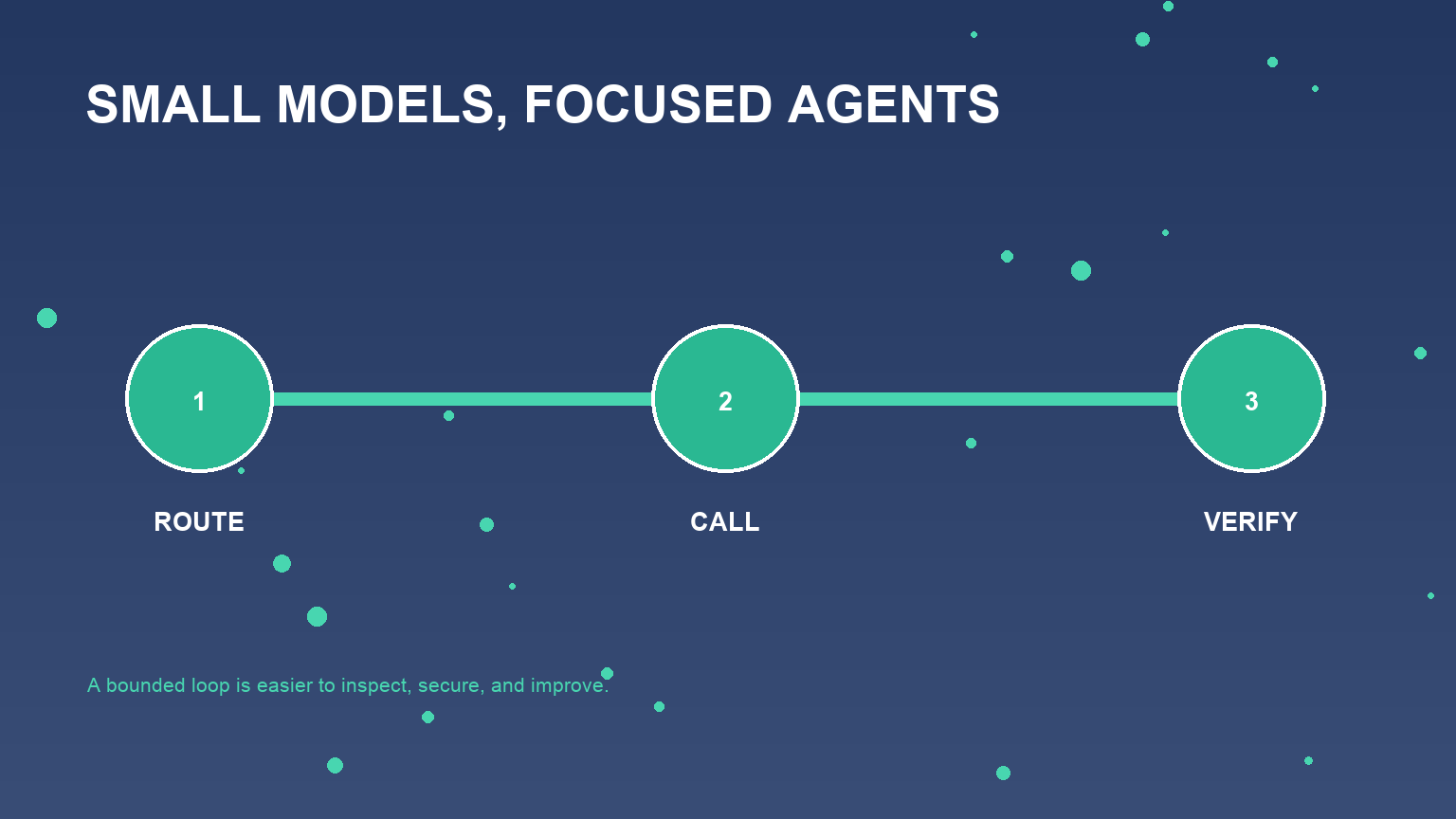
An agent is more than a model response. It observes state, selects an action, calls a tool, checks the result, and decides whether to continue. Many steps in that loop are narrow: classify a request, extract a schema, choose from a short tool list, validate a returned field, or summarize a known record. A small language model can be a good fit when the allowed actions and output shape are explicit.
The useful question is therefore not “Can this model act like a general assistant?” It is “Can it perform this specific decision reliably under the exact prompts, tools, and failure modes in production?” That framing keeps architecture grounded. It also prevents teams from treating parameter count as a complete proxy for quality. Data, fine-tuning, context design, decoding, and task boundaries all matter.
Route tasks by uncertainty and consequence
Start with a router that considers both uncertainty and impact. Low-ambiguity, reversible tasks can stay on the small model. Requests with incomplete context, conflicting instructions, sensitive actions, or expensive side effects should move to a larger model or human review. The router itself needs evaluation because a cheap but inaccurate route can erase the expected savings.
Use explicit confidence signals carefully. Self-reported confidence is not enough. Better signals include schema validity, agreement between independent checks, retrieval coverage, tool preconditions, and whether the request falls inside a tested intent set. Keep a safe default: when evidence is missing, stop or escalate rather than improvising.
Design tools for a smaller decision surface
SLMs benefit from tools with narrow names, short descriptions, typed parameters, and predictable responses. Instead of one broad “manage account” tool, expose separate read, draft, and commit operations. Separate planning from execution. A model can prepare a proposed action while policy code checks identity, scope, rate limits, and approval before anything changes.
Return compact observations. A tool response containing an entire database row, debug trace, and unrelated metadata consumes context and creates distractions. Normalize errors into a small taxonomy such as retryable, invalid input, permission denied, and policy blocked. This gives the model a tested recovery path instead of inviting creative guesses.
Memory and context without uncontrolled growth
Agent memory should be selective. Keep stable user preferences, current task state, and verified facts in distinct stores. Retrieve only what the current step needs, attach provenance, and expire temporary notes. Long transcripts are not a memory strategy: they increase latency and can amplify stale or malicious instructions.
For compact models, structured state is especially valuable. A small JSON state object with goal, completed steps, pending approval, and known constraints is often easier to use than pages of conversation. Treat retrieved text as untrusted data. It should never silently override system policy, tool permissions, or the user’s latest instruction.
Evaluate the whole agent, not only the model
Build a task suite from real workflows and adversarial variations. Measure correct completion, unnecessary tool calls, escalation quality, policy violations, recovery after tool errors, latency, and total cost. Include negative cases where the correct action is to ask a question or refuse execution. A model that always produces an answer may look helpful in a demo and still be unsafe in an agent.
Replay traces when changing prompts, quantization, fine-tuning, or tool definitions. Compare the final state, not just wording. Canary a small share of traffic and preserve rollback. If a larger model remains the fallback, track why escalation occurred; those reasons reveal where an SLM can improve and where the boundary should remain.
A deployment checklist
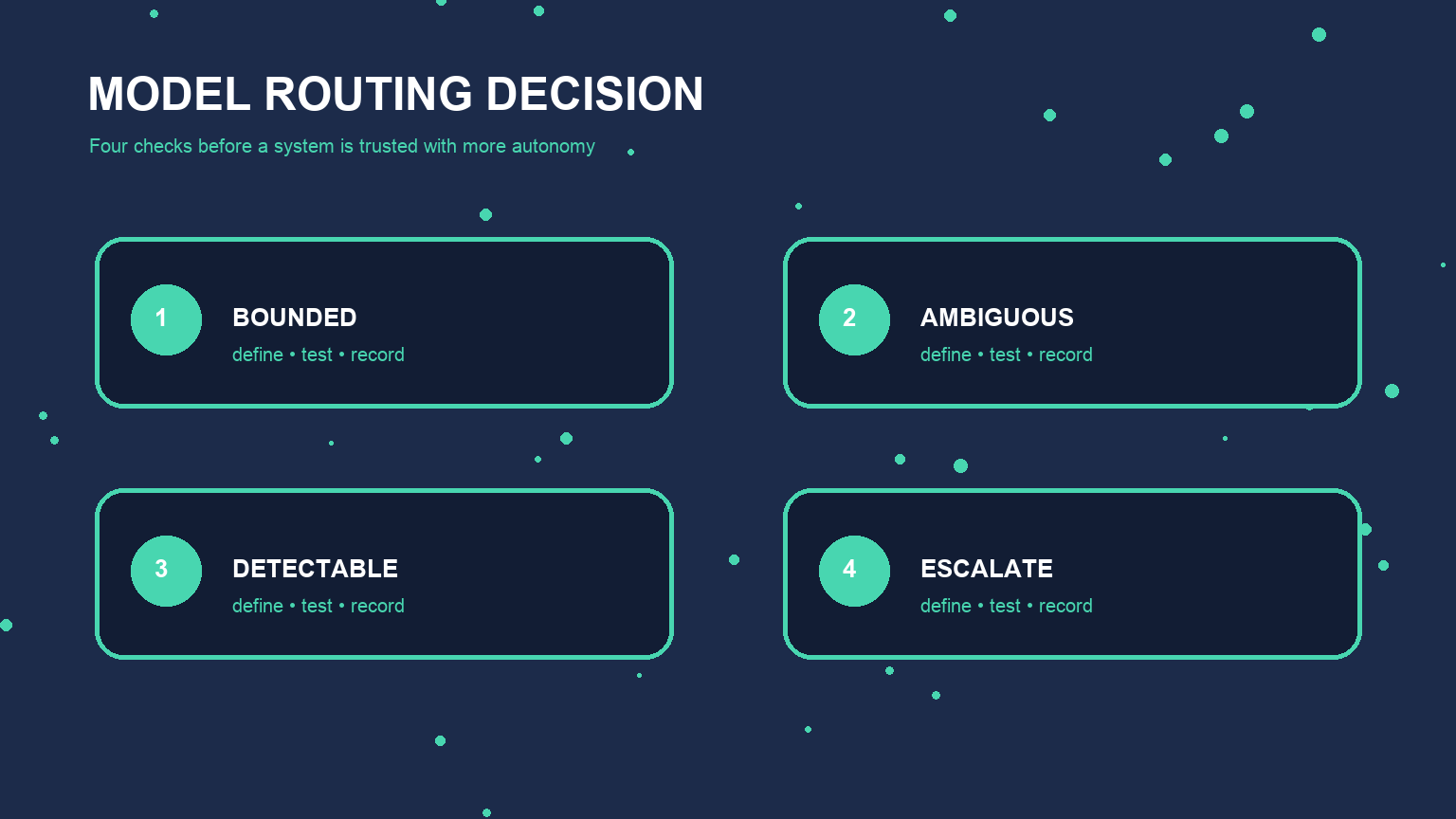
Define the task envelope, allowed actions, and stop conditions before choosing a model. Use typed tools, deterministic policy checks, retrieval provenance, bounded iterations, and human approval for consequential changes. Test on the target hardware because memory use and latency depend on implementation, quantization, sequence length, and batching.
Small models are most compelling as specialized components inside a governed system. The future of agentic AI is unlikely to be one model size everywhere. It is a portfolio: compact models for frequent bounded work, larger models for difficult reasoning, deterministic software for policy, and people for accountability.
Implementation worksheet
Write down five representative tasks, the allowed tools, expected output schema, and the condition that forces escalation. Run the same cases on the compact and fallback models, then compare final-state correctness, unsafe actions, retries, latency, and total cost. Record target hardware, quantization, context length, and batching so the result can be reproduced. Ship the router behind a feature flag, sample traces, and review every high-impact false acceptance before expanding traffic.
Frequently Asked Questions
Are small language models the future of agentic AI?
They are likely to be an important part of agentic stacks for narrow, frequent, and well-tested decisions. Larger models and human review remain appropriate for ambiguous, high-impact, or open-ended work.
What agent tasks suit an SLM?
Intent routing, schema extraction, constrained tool selection, validation, classification, and summarization of bounded records are common candidates when evaluation shows reliable performance.
How should an SLM agent escalate?
Escalate when required evidence is missing, tool preconditions fail, the request is outside the tested intent set, or the action is sensitive or irreversible.
What should teams measure?
Measure end-to-end task completion, policy adherence, tool-call efficiency, escalation quality, error recovery, latency, and total cost on representative traces.