
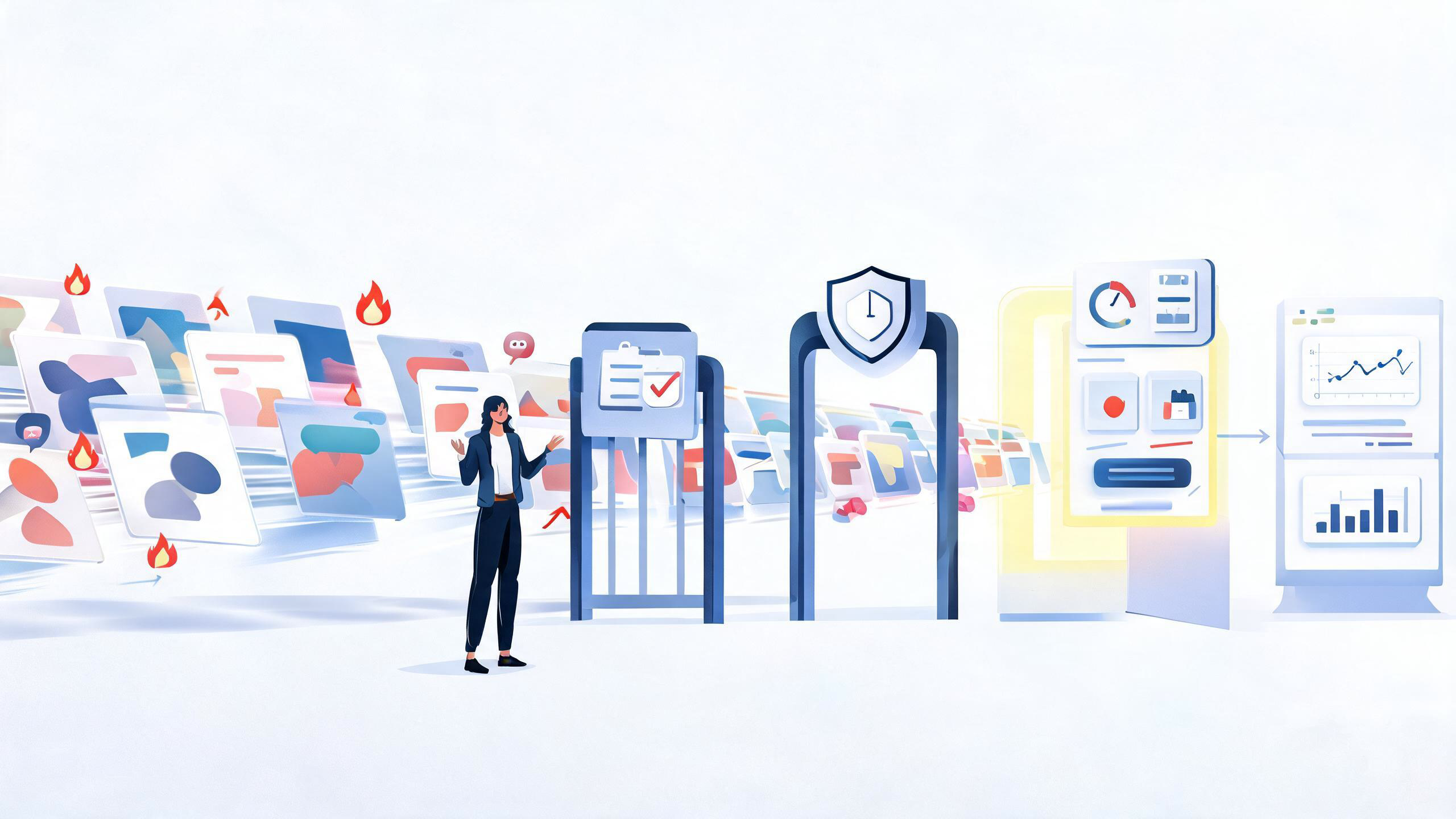
Social media managers can turn a trend into a playable campaign by separating the trend’s recognizable behavior from its disposable media assets, then building one branded interaction that can launch, be measured, and be replaced quickly. The operational sequence is: estimate the trend’s remaining life, run brand-safety and rights checks, define one player action, prototype a small browser experience, instrument meaningful events, prepare platform-specific distribution, and ship a fallback creative at the same time.
Speed matters, but unreviewed speed creates expensive problems. A trending sound, format, phrase, or visual may carry copyright, endorsement, platform-policy, accessibility, or reputational risk. This tutorial uses gates that let a team move quickly without treating virality as permission or promising campaign results that have not been measured.
1. Triage the trend before writing a creative brief
Capture the trend in neutral terms: what behavior repeats, what makes it recognizable, who is participating, and where it is spreading. Separate the mechanic from the assets. “Users choose between two escalating options and reveal a reaction” is a mechanic. A particular song recording, creator video, character, logo, or catchphrase may be protected, licensed, or context-dependent.
Score four dimensions from low to high: audience relevance, brand fit, remaining attention, and execution risk. Add evidence links and a timestamp because trend conditions change. A high-volume trend with weak audience fit is not automatically useful. A smaller format that maps naturally to the product or message may produce a clearer experience.
Run an immediate context scan. Search the trend’s origin, current variants, associated communities, and recent controversy. Review current platform rules; for example, TikTok publishes Community Guidelines that include integrity and authenticity policies. Do not assume that widespread participation means every execution or distribution method is permitted.
Use a go/no-go statement: “Proceed with the choice-and-reveal mechanic, but use original visuals, original copy, and cleared audio; reassess in 48 hours.” If you cannot explain the trend without linking to a single borrowed asset, the concept may be too dependent on rights you do not control.
2. Estimate the trend lifespan and choose a production lane
Treat the trend as a decaying opportunity, not an evergreen keyword. Record when the team first observed it, whether participation is accelerating or flattening, how quickly derivative formats appear, and whether major brands have already saturated the pattern. You do not need a precise forecast; you need an effort ceiling.
Use three lanes. A fast lane launches a minimal interaction in roughly one working cycle and uses only pre-cleared brand components. A standard lane allows a few days for richer logic, review, and media. An evergreen adaptation keeps the underlying mechanic but removes time-sensitive references so the asset can survive after the trend fades.
Set a kill date and a conversion rule. Example: “If approval is not complete by Thursday noon, stop the trend-specific version and publish the evergreen choice challenge.” This prevents sunk-cost reasoning. The decision criterion is not whether the trend still exists; it is whether enough relevant attention is likely to remain after production, review, and distribution.
A short remaining life means simpler mechanics, fewer dependencies, and a stronger fallback. Do not compress legal, accessibility, security, or brand review to rescue an expired concept.
3. Define one campaign objective and one player action
Choose one campaign job: introduce a product distinction, help someone choose an option, rehearse a behavior, collect a preference with appropriate consent, or drive qualified traffic. Then choose one player verb—pick, sort, time, match, swipe, assemble, predict, or customize. Multiple objectives create confusing events and weak measurement.
For a skincare brand, a trend-inspired “choose your path” playable could ask users to sort routine steps by context, then reveal a concise product-fit explanation. The interaction is not proof of product efficacy, and it should not make claims beyond approved substantiation. The trend provides pacing and familiarity; the brand message provides the payoff.
Write acceptance criteria: a first-time user understands the action within five seconds; the core loop takes under a minute; the brand message appears after a meaningful choice; the call to action is optional and clear; the experience works without sound; and the result can be shared only through an approved flow.
If the only meaningful event is “clicked through,” a static creative may be better. A playable earns its production cost when interaction reveals intent, teaches a distinction, or creates a useful personalized route without collecting unnecessary data.
4. Clear rights before reproducing trend assets
Make a rights inventory for every recognizable element: music and sound recordings, choreography or performance, footage, photography, illustrations, typefaces, code, game mechanics as implemented, characters, logos, slogans, creator likeness, and user submissions. Record the source, owner, proposed use, territory, duration, channels, paid-media rights, edit rights, and proof of permission.
Do not treat “it is already on the platform” as a license for an off-platform browser game or paid ad. Platform music libraries and creator tools may carry use restrictions that differ by account type, territory, placement, or commercial purpose. Confirm the actual license terms and campaign use with the rights owner or qualified reviewer.
The U.S. Copyright Office explains that fair use is evaluated case by case under four statutory factors. It is not a blanket permission for anything labeled parody, remix, commentary, or trend participation. A social media manager should flag the issue, preserve evidence, and obtain legal review rather than announce a fair-use conclusion.
Prefer substitution. Keep the recognizable interaction pattern while replacing protected expression with original or licensed components. Use an original composition rather than a “sound-alike” that imitates distinctive protected expression. Use generic shapes or owned product imagery rather than a trending character. Get written creator permission that covers the intended channels and paid amplification when creator content is involved.
The gate is documentation: every non-owned asset has a usable license or permission receipt, or it is removed. If the trend loses its identity after safe substitution, return to triage and choose another mechanic.
5. Run brand-safety, claims, and disclosure checks
Brand safety starts with context, not a banned-word list. Identify who originated the trend, what communities use it, whether its meaning shifts by region, and what content appears adjacent to it. Ask how the execution could be read by people outside the target audience. Escalate themes involving tragedy, health, politics, minors, identity, dangerous behavior, or deceptive formats.
Run claims review on every outcome, comparison, price, scarcity statement, and visual implication. A playable can make a claim through mechanics—for example, always making one product option “win.” Keep substantiation and required qualifiers with the creative brief, and do not hide material limitations behind a final screen.
If a creator, employee, affiliate, or customer endorses the campaign, check disclosure requirements. The U.S. FTC’s endorsement guidance addresses material connections and the need for clear and conspicuous disclosure. Placement and wording are fact-specific, so involve counsel or the responsible compliance team. Build the disclosure into the visible experience and social copy rather than relying on a profile biography or an ambiguous tag.
Review each intended platform separately. TikTok’s Community Guidelines and Meta’s Advertising Standards are primary references for their respective environments, but they can change. Organic eligibility does not guarantee paid-ad approval, and approval on one platform does not transfer to another.
Create stop conditions: unclear rights, unsupported claims, missing disclosure, unsafe context, or uncertain platform eligibility. The fast decision may be to publish the fallback, not to force the playable through review.
6. Prototype the smallest playable campaign
Convert the approved concept into a compact build brief. Include the campaign objective, audience, one interaction, approved copy and assets, brand rules, accessibility requirements, analytics event names, data restrictions, destination, and fallback behavior. Explicit exclusions are as important as features.
Example: “Create a mobile-first browser game with a ten-second prediction loop. Users choose which of three original product configurations fits a fictional scenario, then reveal the recommended configuration and one approved reason. Use only supplied brand assets. No third-party music, creator likeness, login, free text, geolocation, or public leaderboard. The experience must work with keyboard and touch, include visible focus, avoid color-only meaning, respect reduced motion, and load a static result card if the game fails. Emit local events for start, first_choice, completion, result_type, and outbound_cta.”
SEELE AI is described in the approved product reference as a conversational text-to-game platform supporting iterative refinement, 2D and 3D creation, Unity, and Three.js. Its Three.js workflow supports browser-based WebGL deployment. These capabilities can accelerate prototyping, but the marketing team must still validate generated code, performance, rights, claims, tracking, and platform fit.
Test on real target devices and in-app browsers. Remove any feature that threatens the launch window without strengthening the objective. If a static card communicates the idea just as well, use it; interactivity is a means, not the campaign strategy.
7. Instrument decisions, not vanity events
Define the measurement question before naming events. If the objective is product education, ask whether users reach and interact with the distinction, not merely whether the page loads. A minimal taxonomy might include landing_view, playable_start, first_choice, core_loop_complete, result_view, fallback_view, and outbound_cta. Add error events and version identifiers so a broken build is not mistaken for disinterest.
Every rate needs a denominator. Start rate may be playable_start divided by eligible landing_view. Completion rate may be core_loop_complete divided by playable_start. State exclusions, bot filtering, duplicate handling, and the observation window. Do not compare a fast autoplay view with an intentional game start as if they represent the same behavior.
Google Analytics documents UTM campaign parameters for collecting source, medium, and campaign information in custom URLs. Use a controlled naming convention across social posts, creator links, paid placements, the playable, and the fallback. UTMs do not solve identity, attribution, consent, browser restrictions, or missing events; they label traffic in a compatible analytics setup.
Minimize data. Avoid fingerprints and unnecessary identifiers. Follow the organization’s consent, privacy, and retention requirements, and validate analytics in the actual in-app browser. If measurement is blocked, choose aggregate server logs or platform-reported outcomes only when approved and clearly define the resulting limitations.
Write interpretation boundaries in advance: “Completion indicates that the user reached the result screen; it does not establish persuasion, purchase intent, or incremental lift.” Use a holdout, lift study, or other qualified design only when the team has the volume, governance, and expertise. Never invent benchmark performance or attribute campaign impact from a single uncontrolled metric.
8. Package the playable for platform-specific distribution
A playable usually lives on a web destination while social posts provide the entry point. Design the transition deliberately: the post should explain the action, the preview should match the landing experience, and the link should open in the platform’s in-app browser without requiring an unnecessary account.
Create a channel sheet for each placement: aspect ratio, copy length, safe zones, sound assumptions, link behavior, tracking code, disclosure, age or geographic restrictions, organic eligibility, paid-ad eligibility, and reviewer. Verify current platform documentation close to launch. Meta Advertising Standards govern paid advertising on Meta products; TikTok’s current guidelines govern its environment. Requirements and enforcement can change.
Prepare a lightweight preview asset that communicates the mechanic even when the user never clicks. Use owned or cleared media. Test slow networks, blocked autoplay, cookie choices, orientation changes, back navigation, and deep-link failures. The landing page should provide a visible exit and should not trap users in an interaction.
Do not use the same asset everywhere by default. Preserve the campaign idea while adapting framing and technical packaging. If paid approval is delayed, the organic plan and fallback should remain coherent without pretending the playable is available.
9. Build the fallback creative at the same time
The fallback should communicate the same message with fewer dependencies. Convert the core loop into a three-frame carousel, short vertical video, poll, or static choice card using cleared assets. Preserve the headline, decision, result logic, call to action, and campaign tags so performance can be interpreted across versions with appropriate caution.
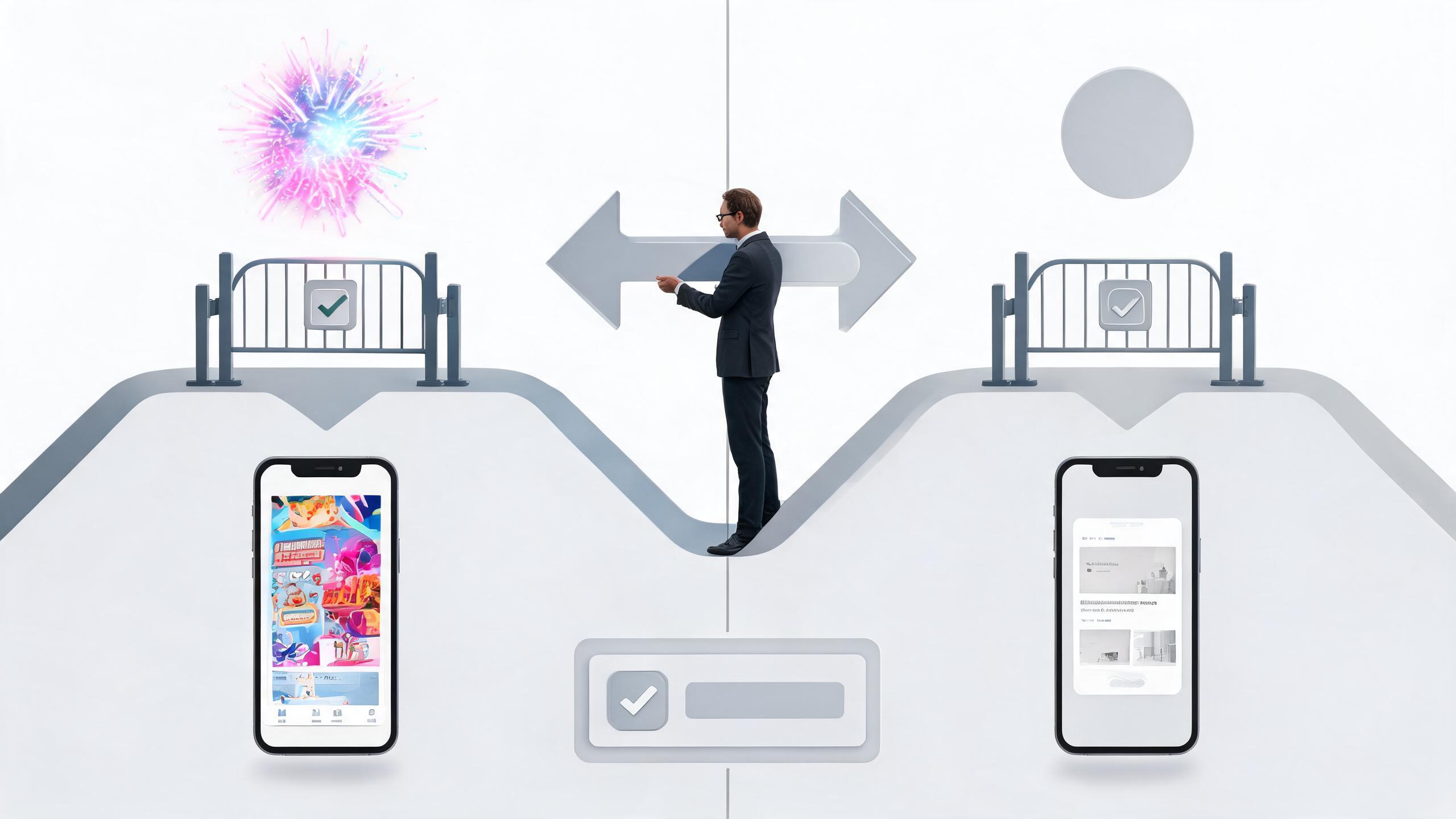
Define automatic and manual triggers. Automatic triggers include load timeout, unsupported device, script failure, or blocked browser feature. Manual triggers include expired trend relevance, rights uncertainty, ad rejection, unsafe news context, or analytics failure. Make the fallback URL and creative package launch-ready before the playable enters review.
For a choice-and-reveal game, the carousel might show the scenario, invite a mental choice, then reveal two approved routes. It cannot produce the same interaction events, so label the version and adjust denominators. Do not combine playable and fallback completion rates.
Fallback planning changes creative quality: it forces the team to articulate the message without relying on novelty. If the fallback makes no sense, the campaign idea may be too dependent on the mechanic.
10. Launch with a kill switch and review on a short cadence
Run a preflight that covers rights receipts, claims and disclosure, current platform checks, accessibility, security, privacy, analytics validation, fallback routing, and named owners. Record the deployed version and timestamp. A launch without a kill-switch owner is incomplete.

During the first hours, monitor technical health, moderation signals, platform status, spend, and the event funnel. Compare landing views with starts and error events before interpreting creative interest. Watch the surrounding cultural context; a harmless trend can become inappropriate after breaking news or a creator controversy.
Use predetermined actions. If error rate crosses the team’s threshold, route traffic to fallback. If rights or safety concerns emerge, pause distribution. If the trend has clearly decayed, convert to evergreen or end the campaign rather than adding spend to recover sunk cost.
The postmortem should separate creative, distribution, technical, and measurement findings. Record what the team actually observed, not a story of success inferred from views. Archive licenses, approvals, source files, event definitions, and deletion dates. Then retain the reusable mechanic and remove time-sensitive or unlicensed elements. The durable asset is the tested workflow, not the trend itself.
Related professional workflows
Continue with another role-specific workflow in this six-part series:
- How to Sell AI-Assisted Game Asset Packs on itch.io and Unity Asset Store
- How Solo Game Developers Can Build a Playable Vertical Slice in One Weekend
- How Freelance Game Designers Can Deliver Client Prototypes Faster
- How to Make and Sell Branded Mini-Games for Marketing Campaigns
- How Teachers Can Create Interactive Learning Games Without a Development Team
For adjacent implementation guidance:
Frequently Asked Questions
How fast should a trend-based playable campaign launch?
Match effort to the estimated remaining trend life. Use a fast lane only with pre-cleared assets and a narrow mechanic. Set a kill date; if review cannot finish in time, publish the evergreen or static fallback rather than skipping safeguards.
Can a brand use a trending song in a browser game?
Not merely because the song is popular or available in a social app. Rights can vary by recording, composition, account type, territory, channel, and commercial use. Confirm the applicable license or obtain permission; otherwise replace it with cleared original audio.
Is fair use enough for a trend remix?
Fair use is a case-specific U.S. legal doctrine evaluated under four statutory factors. It is not an automatic permission for parody, commentary, or remix. Preserve the proposed use and seek qualified legal review rather than treating a trend label as clearance.
Which events should a playable campaign track?
Track only events tied to decisions: eligible landing view, start, first meaningful action, core completion, result, fallback, error, and outbound action. Define denominators, versions, consent, retention, and interpretation limits before launch.
Does high completion prove the campaign worked?
No. Completion shows that users reached a defined state under the measurement setup. It does not by itself establish persuasion, incremental lift, purchase intent, or revenue. Use stronger study designs when those claims matter.
What is the best fallback creative?
Use the simplest asset that preserves the campaign’s message: often a three-frame carousel, short video, poll, or static choice card. Prepare it with cleared assets, matching campaign tags, and explicit triggers before the playable launches.