Key takeaways
- A solo developer can cover programming, art, level design, audio, and marketing by treating them as one production system rather than five separate careers. Protect the playable loop first, choose an art and audio style that rewards consistency over detail, build levels from reusable rules, capture marketing material during development, and apply explicit human quality gates before anything ships. AI can accelerate ideation, first drafts, variations, and repetitive preparation, but the developer must own scope, integration, rights checks, playtesting, accessibility, and the final creative decision.
The short answer: manage dependencies, not departments
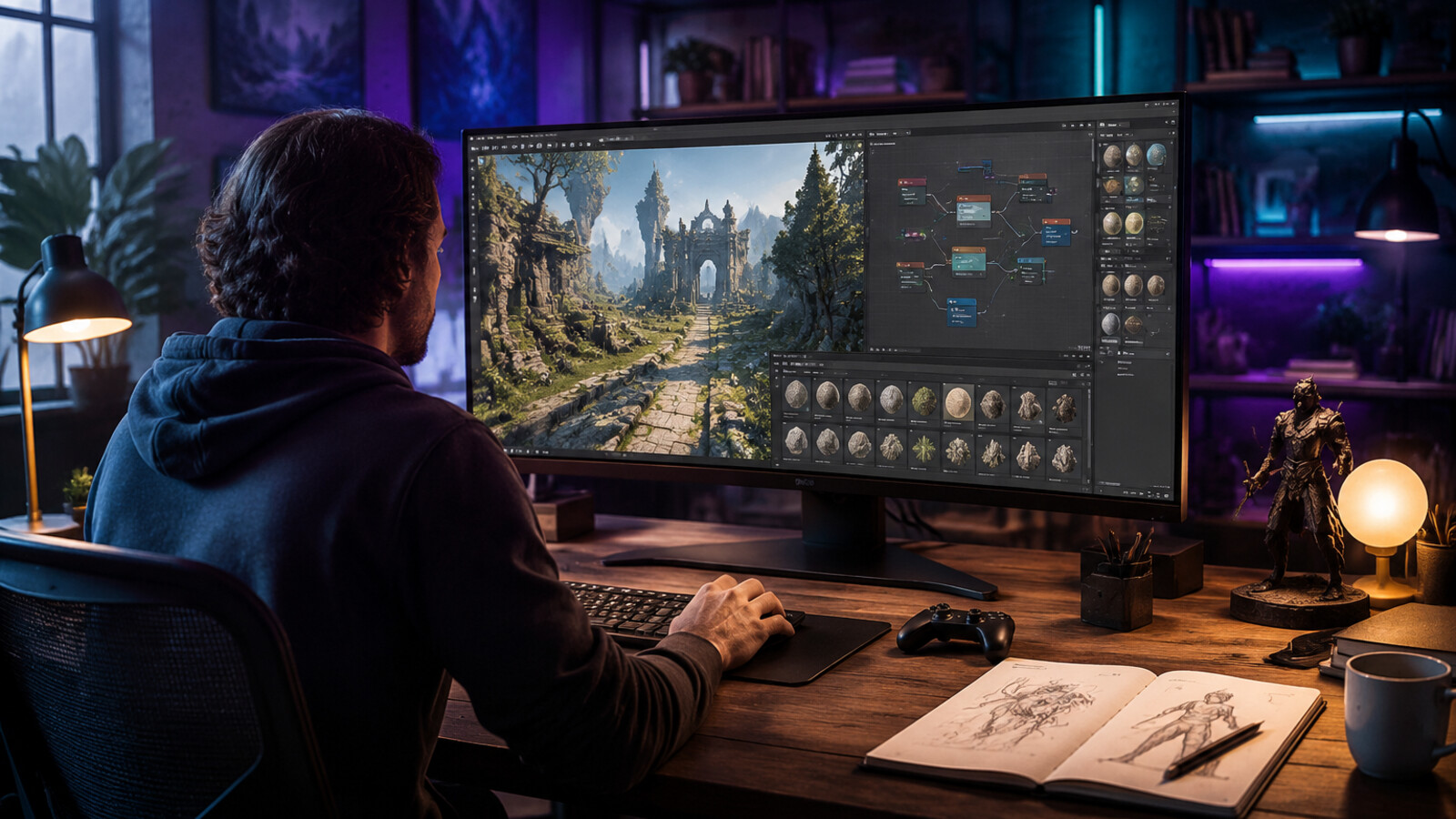
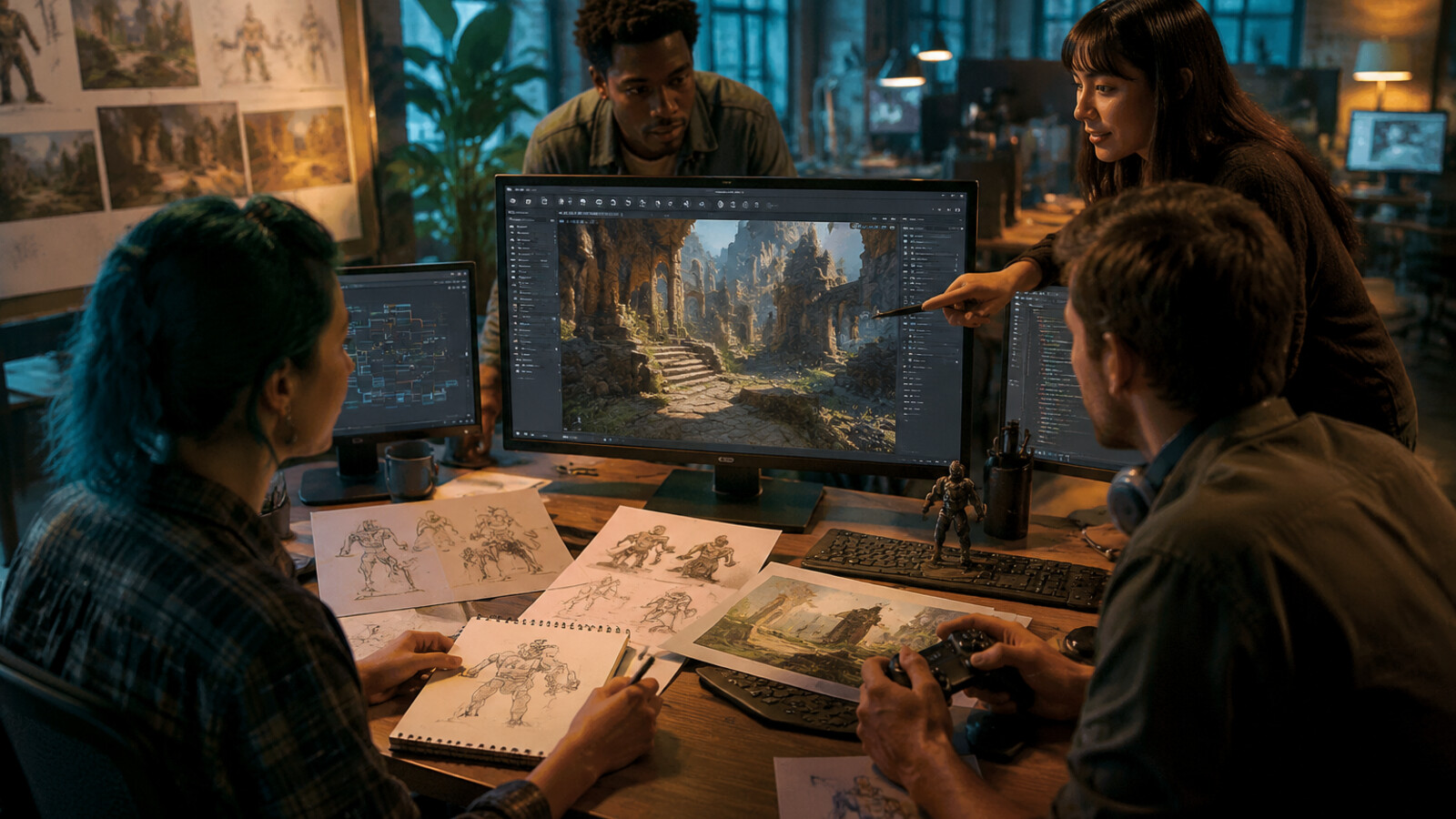
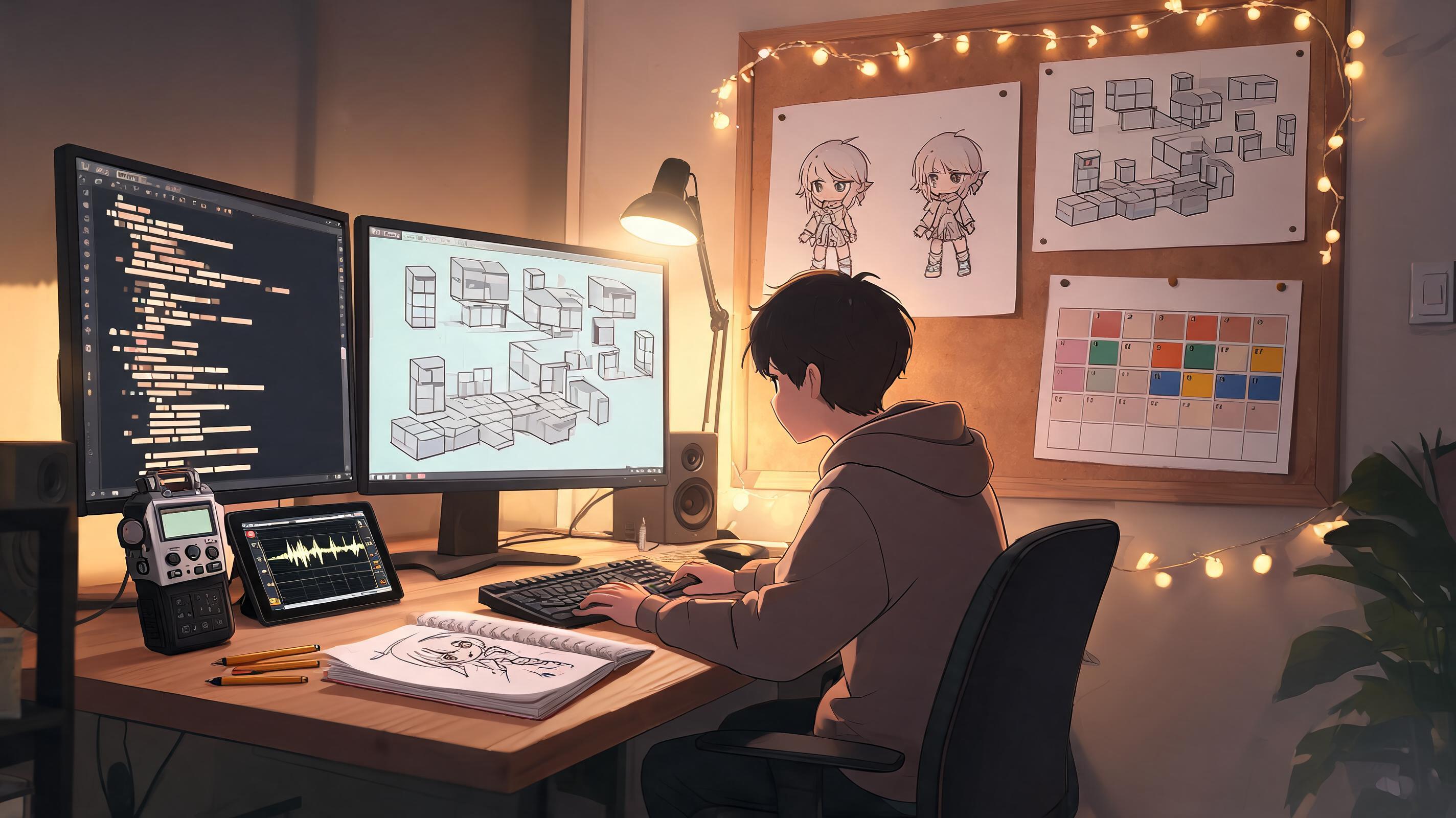
A solo developer does not need to perform every discipline at a studio-specialist level. The workable goal is to make each discipline good enough to support the same player promise. Programming creates the playable loop. Art makes that loop readable and distinctive. Level design produces situations in which the loop stays interesting. Audio communicates state and feeling. Marketing helps the right people recognize the promise.
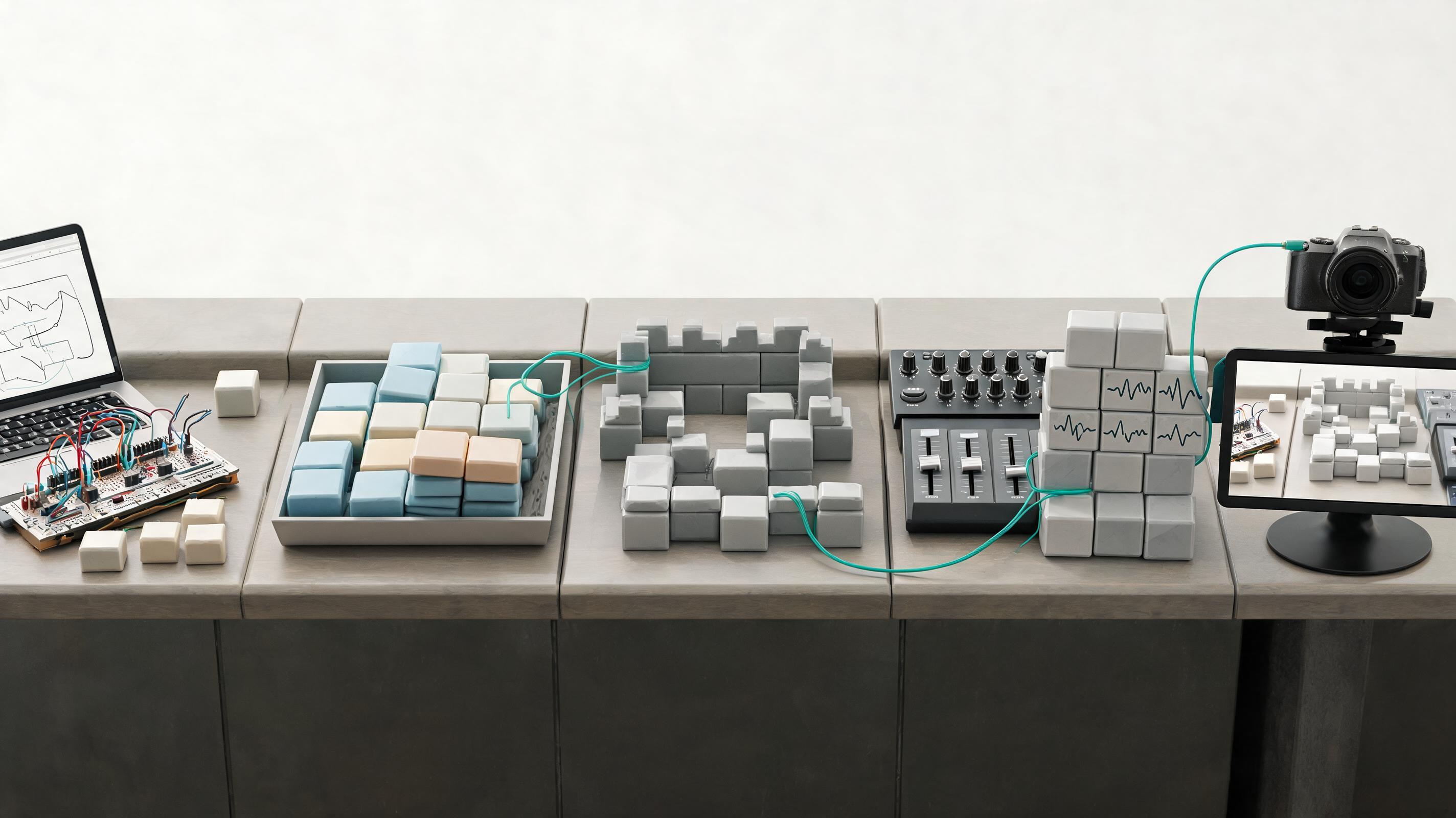
The practical order is:
- Prove the core interaction with temporary assets.
- Lock a small, repeatable visual and audio language.
- Build content from reusable rules and modules.
- Test the integrated experience on a fixed cadence.
- Capture proof of progress as marketing material while you work.
This order matters because each later discipline depends on earlier decisions. A polished trailer cannot rescue an unclear game, and detailed art becomes expensive when the mechanics are still changing. The solo advantage is fast communication; there is no handoff meeting between departments. The solo risk is uncontrolled context switching. Your workflow should preserve the advantage and reduce the risk.
Start with one player promise and a strict priority ladder
Write a one-sentence player promise before choosing tools: “The player will feel _X_ by repeatedly doing _Y_ under _Z_ pressure.” For example: “The player will feel clever by redirecting one beam through compact rooms while time slowly collapses the route.” This sentence gives every discipline a test. If a feature, prop, sound, room, or post does not clarify that promise, it is optional.
Use this priority ladder when work competes:
| Priority | Question | Typical output | |---|---|---| | 1. Playability | Can a player perform and understand the core loop? | Input, state changes, win/fail conditions | | 2. Readability | Can the player see and hear what matters? | Silhouettes, contrast, feedback sounds, camera rules | | 3. Repeatability | Can you create more content without bespoke work every time? | Modular kits, reusable scripts, level grammar | | 4. Reliability | Does the game survive ordinary play and target hardware? | Saves, error handling, performance checks | | 5. Discoverability | Can a stranger understand the hook quickly? | Store copy, short clips, screenshots, demo | | 6. Polish | Which improvements noticeably strengthen the promise? | Animation timing, mix balance, effects, transitions |
The limitation is deliberate: some games depend on art direction or narrative before a mechanic can be judged. In that case, move the smallest representative slice of art or story into priority one, but do not turn “representative” into “final.” The ladder exists to expose dependencies, not to impose one genre’s production model on every project.
Design each discipline for solo scale
Programming: optimize for change and diagnosis
Build the thinnest vertical slice that contains input, one meaningful decision, feedback, and an end state. Keep systems small enough to replace. Use version control from day one, separate game data from behavior where your engine allows it, and add a lightweight debug view for variables you repeatedly inspect. A reusable state machine or interaction interface can save time; a speculative framework for imagined future games usually does not.
Set a coding gate: a feature is not complete until it can be restarted, failed, and repeated without manual repair. Test save/load, device disconnects, resolution changes, and empty or invalid data earlier than feels comfortable. These are boring compared with new mechanics, which is exactly why a solo schedule tends to postpone them.
Art: choose constraints that become style
A sustainable art direction reduces the number of decisions per asset. Limit palette, material families, animation complexity, camera distance, lighting scenarios, and texture density. Reuse shape language across characters, props, UI, and promotional images. A simple style applied consistently usually communicates more clearly than isolated high-detail assets from incompatible sources.
Create one “truth scene” containing the hardest representative elements: character, environment, effects, UI, and lighting. Measure how long it takes to make, revise, import, and validate. If one small scene consumes an unsustainable share of the schedule, simplify the style before expanding production.
Level design: build a grammar before building volume
Define a small vocabulary: spaces, obstacles, rewards, threats, transitions, and rules for combining them. Graybox several short situations before decorating one. Each room should introduce, combine, test, or rest a mechanic. Track the intended decision in one sentence so that playtest notes can distinguish a navigation problem from a mechanics problem.
Modularity helps only when modules preserve gameplay meaning. A reusable corridor that produces no decision is efficient geometry but weak design. Prefer reusable encounter patterns, pacing rules, and validation checks over a huge kit of visually different pieces.
Audio: create a hierarchy, not a wall of sound
Start with functional cues: player action, success, failure, danger, interaction, and important state changes. Then add ambience and music. Reserve frequency and loudness space for information that affects decisions. Test with poor speakers, headphones, and low volume. Add subtitle and independent volume controls where relevant, and check that essential information is not available only through sound.
A modest original palette can come from a few recorded sources, synthesis, licensed libraries, or generated starting points, but every file needs a known source and usage right. Consistent processing and naming will often do more for cohesion than collecting hundreds of sounds.
Marketing: document proof instead of inventing hype
Begin marketing when the core promise is visible, not when the game is nearly finished. Save short clips of meaningful changes, before-and-after comparisons, problem-solving notes, and clear screenshots as part of the development routine. One weekly capture session is easier than reconstructing months of progress for a launch campaign.
Describe what a player actually does and why it feels interesting. Use real game footage when presenting gameplay, label work in progress honestly, and keep a small library of reusable crops and captions. Marketing feedback can reveal whether the hook is legible, but attention metrics should not replace playtesting. A post can be popular because of a joke or visual effect that has little connection to long-term player enjoyment.
Use AI as a draft-and-variation layer, not an autonomous department
AI is most useful when the task is bounded, reversible, and easy to verify. Good candidates include brainstorming names, outlining edge cases, producing reference directions, generating variations for mood exploration, cleaning repetitive data, drafting temporary dialogue, proposing test cases, summarizing playtest notes, and adapting one approved message into different post lengths. SEELE AI can be used as an exploratory workspace for creative directions, but any result still needs to be checked in the actual game and against the project’s rights and style requirements.
Do not delegate final responsibility for:
- architecture or security-sensitive code you cannot explain;
- final assets whose provenance or usage rights are unclear;
- level pacing that has not been observed with real players;
- accessibility decisions based only on generated assumptions;
- audio balance judged without listening in context;
- gameplay claims shown with synthetic or nonrepresentative footage;
- community replies involving safety, refunds, legal issues, or personal data.
Apply a four-step AI gate: brief, generate, inspect, integrate. The brief specifies constraints and acceptance criteria. Generation produces disposable candidates. Inspection checks correctness, provenance, consistency, and harmful failure modes. Integration means importing the selected result into the real pipeline and testing it beside the rest of the game. If you cannot define the inspection step, the task is not ready to automate.
Keep the tool stack deliberately small
A lean stack is defined by roles, not brands:
- One engine and one scripting environment. Avoid parallel prototypes in multiple engines unless engine choice is the experiment.
- One version-control repository with off-device backup. Commit small, reversible changes and tag playable milestones.
- One task board. Limit active work and separate “must ship” from “interesting later.”
- One primary 2D or 3D creation path. Add specialist tools only when a measured bottleneck appears.
- One audio editor plus a licensed source library or recording method. Keep source, processed, and in-engine files distinguishable.
- One capture setup. Save repeatable recording and screenshot presets.
- One source-of-truth document. Record the player promise, scope, art rules, audio rules, target platforms, and current risks.
Every extra tool adds file formats, updates, licensing questions, and context switches. A new tool earns its place only if it removes a recurring bottleneck and its output survives import, iteration, and version control. Free is not the same as cheap when integration costs several evenings.
Run a phase-by-phase workflow

Phase 1: constraint brief
Choose target platform, control scheme, session length, camera, content budget, visual constraints, audio scope, and the one-sentence player promise. Define a kill criterion such as: “If three fresh players cannot identify the core decision after two iterations, redesign or stop.” The deliverable is a one-page brief, not a lore bible.
Phase 2: ugly prototype
Use primitives and temporary sound. Build only enough code and layout to test the central decision. Capture a baseline video, because memory is unreliable and the clip makes improvement visible. The checkpoint is not “fun” in the abstract; it is whether players notice the intended choice and whether you can iterate it quickly.
Phase 3: representative vertical slice
Create one small segment at near-target quality. Include final-ish input, one art kit, functional audio, UI, save behavior, and a capture suitable for explaining the game. Measure production time by discipline. The slice is an estimation instrument: if a five-minute segment takes eight weeks, the planned two-hour game needs radical scope reduction or a different content model.
Phase 4: production loop
Work in short batches: implement a behavior, graybox its situations, apply the approved art kit, add functional sound, test the build, and capture one honest artifact. Keep no more than one major unknown active at once. Batch repetitive tasks, but alternate long focus blocks with integration days so isolated assets do not accumulate outside the game.
Phase 5: stabilization and launch preparation
Freeze feature additions. Triage defects by player impact, not personal irritation. Run clean-install, save migration, input, performance, audio, subtitle, and storefront checks. Prepare support answers and a rollback plan. Marketing shifts from development evidence to a clear promise, real footage, platform details, and a direct next action.
Build human QA into the calendar
Solo development still needs outside eyes. Recruit small waves of testers who have not watched the project evolve. Give them a build and an objective, not a tutorial, then observe where they hesitate. Ask what they believed happened before explaining the design. Separate notes into comprehension, control, pacing, presentation, and technical reliability.
Use three recurring gates:
- Daily self-check: launch from a clean state, play the changed path, inspect logs, and verify that the build can stop and restart.
- Milestone integration check: play the complete slice with final input, representative visuals, functional audio, and capture settings. Confirm that every discipline tells the same story.
- Fresh-player check: watch someone encounter the game without coaching. Fix recurring confusion before adding content.
Also schedule rights and provenance review for third-party or generated material, accessibility review against the game’s actual interactions, and platform-specific compliance checks before release. AI can help organize findings, but it cannot supply the missing human observation.
A weekly operating rhythm that limits context switching
A practical week might use two deep-work days for the current production risk, one integration and playtest day, one content-and-polish day, and a short capture/marketing block at the end of the week. The exact days do not matter; the separation does. Avoid switching between code, art, audio, and promotion every hour.
At weekly review, answer four questions: What became playable? What did a player misunderstand? Which discipline is now blocking the others? What can be removed? Choose the next week’s work from the highest dependency, not the most enjoyable task. Maintain a “not now” list so good ideas are recorded without entering production.
The goal is not perfect balance across five disciplines. It is a controlled sequence in which each discipline contributes the minimum coherent work needed for the next test. That is how one developer turns breadth from a liability into a practical production advantage.
Final checklist
Before expanding or shipping, confirm:
- The player promise is visible in the current build.
- The core loop works with temporary assets and survives restart.
- Visual and audio rules are written and repeatable.
- Levels are generated from a small grammar, not endless bespoke exceptions.
- Every external or generated asset has a known source and review status.
- Essential information is readable through more than one channel where appropriate.
- Fresh players can explain the main decision without coaching.
- Marketing uses representative footage and concrete player actions.
- The tool stack has no duplicate role without a measured reason.
- The next milestone removes the largest dependency or risk.
If several answers are no, do not hire yourself into five imaginary full-time jobs. Reduce scope, simplify style, shorten content, or change the production model until the next integrated test is affordable.
Further reading and platform checklists

Use your engine’s current project-organization guidance to validate file and scene conventions, the target storefront’s official documentation to verify store assets and launch requirements, and the Game Accessibility Guidelines as a starting checklist for interaction-specific review. These references do not replace testing or platform certification; they help turn broad QA intentions into concrete checks.
Frequently Asked Questions
Can one person realistically make all parts of a game?
Yes, if the game is scoped around a repeatable core and a deliberately constrained presentation. The target is not specialist-level maximum output in every discipline; it is a coherent experience in which programming, art, design, audio, and marketing support the same player promise. Small content volume and reusable systems matter more than personal heroics.
Which discipline should a solo game developer learn first?
Learn enough programming or visual scripting to produce a playable interaction, then learn the design and presentation skills needed to evaluate it. The first priority is the discipline blocking a real player test. Once the loop works, readability through art and audio usually matters more than adding another large system.
How should a solo developer use AI without losing creative control?
Use AI for bounded, reversible work such as ideation, variants, temporary drafts, test suggestions, and note organization. Keep a human gate for correctness, provenance, rights, style consistency, accessibility, and in-game performance. If you cannot explain how a result will be inspected in context, do not automate that task yet.
What is the minimum tool stack for solo game development?
A practical minimum is one engine, one version-control repository with backup, one task board, one main art path, one audio editor, one reliable capture setup, and one source-of-truth brief. Add tools only after identifying a recurring bottleneck and testing whether the new output imports, iterates, and versions cleanly.
When should a solo developer start marketing a game?
Start once the core promise can be shown honestly, even with work-in-progress visuals. Capture small pieces of development evidence on a regular schedule rather than waiting to manufacture a campaign at the end. Use real representative footage, state what is unfinished, and treat audience response as messaging feedback rather than proof of game quality.
How can a solo developer know when the scope is too large?
Build one representative vertical slice and measure the time required to create, revise, integrate, test, and present it. Extrapolate cautiously from that evidence. If the implied schedule exceeds the available budget or energy, cut content volume, simplify the style, reduce unique systems, or redesign around stronger reuse before continuing production.