Key takeaways
- Use an AI-native story prototyping workspace if your immediate goal is to turn one novel chapter into a playable interactive demo quickly. It should let you import or paste prose, split it into scenes, add choices, track a few story states, and test the result without first building a complete game system. That is the best default for an adoption decision because it tests the chapter’s interactive potential before you commit to a full production stack.
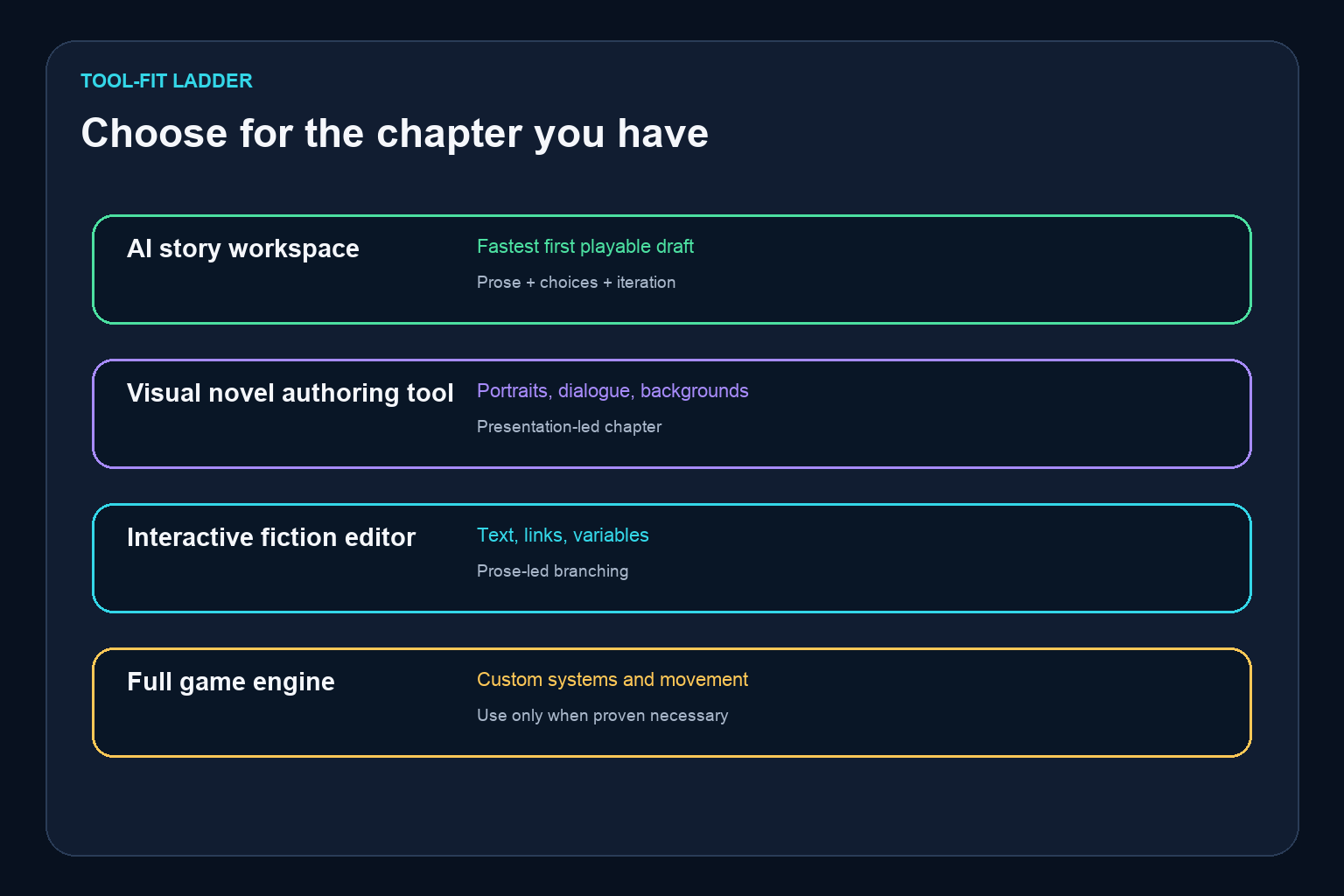
- Choose a dedicated visual novel authoring tool instead when portraits, dialogue presentation, backgrounds, transitions, and music are already central to the experience. Choose a text-first interactive fiction editor when the prose itself is the interface. Start in a full game engine only if this chapter must prove movement, combat, inventory, physics, or another custom mechanic. For a story prototype, the smallest tool that produces a shareable play loop is usually the right tool.
Use an AI-native story prototyping workspace if your immediate goal is to turn one novel chapter into a playable interactive demo quickly. It should let you import or paste prose, split it into scenes, add choices, track a few story states, and test the result without first building a complete game system. That is the best default for an adoption decision because it tests the chapter’s interactive potential before you commit to a full production stack.
Choose a dedicated visual novel authoring tool instead when portraits, dialogue presentation, backgrounds, transitions, and music are already central to the experience. Choose a text-first interactive fiction editor when the prose itself is the interface. Start in a full game engine only if this chapter must prove movement, combat, inventory, physics, or another custom mechanic. For a story prototype, the smallest tool that produces a shareable play loop is usually the right tool.
The decision in one sentence
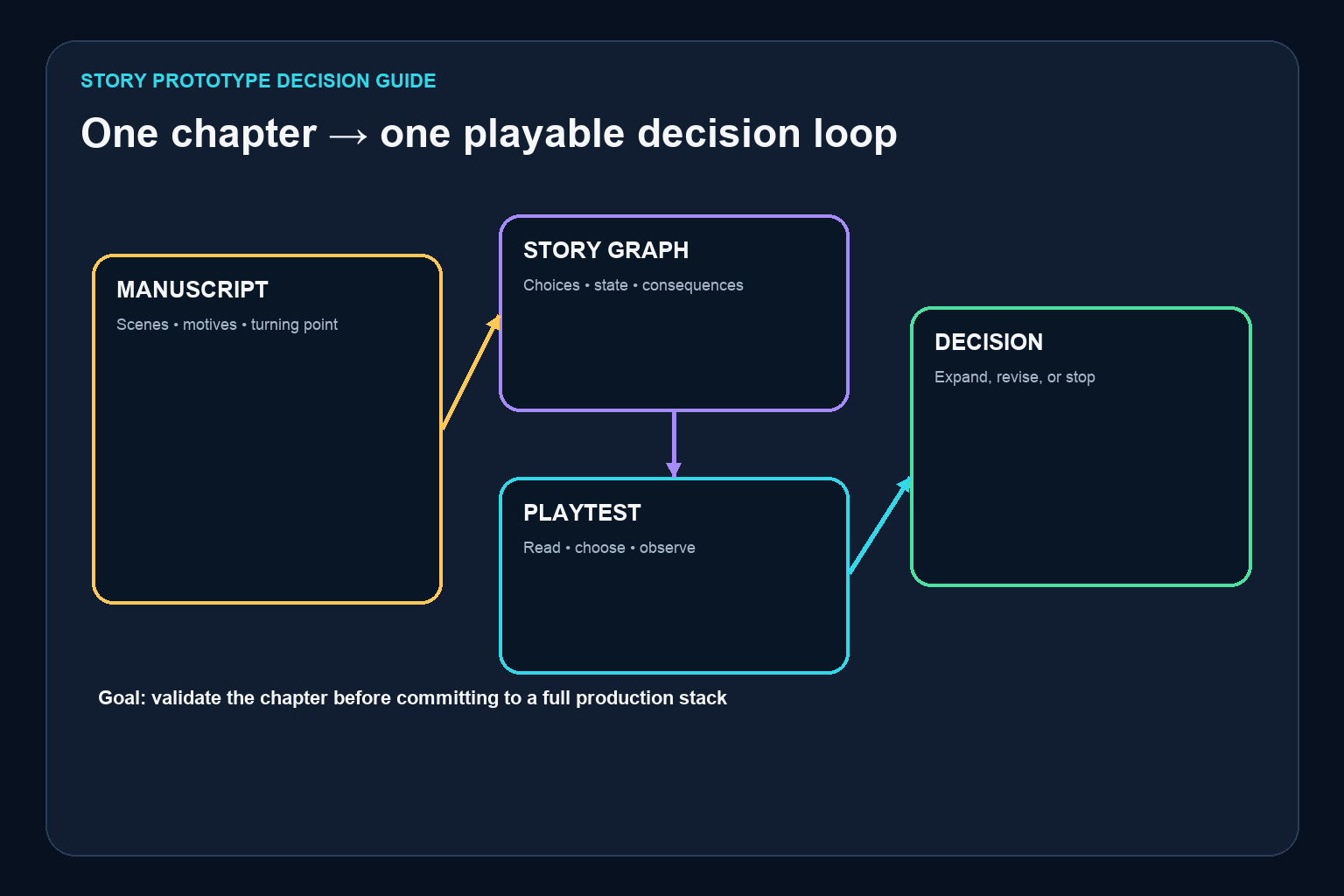
Pick a tool that can produce this loop in a day or two: scene, player choice, visible consequence, changed state, next scene, ending. If the tool makes you configure rendering pipelines, input systems, packaging, or advanced scripting before that loop works, it is probably too heavy for this experiment.
This is not a permanent technology decision. A chapter prototype is evidence. It should tell you whether readers understand the goal, whether choices feel meaningful, which characters or conflicts hold attention, and what your eventual production actually needs. A lightweight prototype can be discarded or rebuilt later without being a failure; it has already done its job if it prevents an expensive wrong turn.
Match the tool to the question you need answered
Different authoring categories answer different questions. An AI story workspace answers, “Can this chapter become an engaging playable sequence, and can I revise it quickly?” A visual novel tool answers, “Does this dialogue-and-presentation format work with character art, backgrounds, audio, and controlled pacing?” A text-first interactive fiction editor answers, “Does the branching prose work as a navigable text experience?” A general game engine answers, “Can narrative choices coexist with custom gameplay systems?”
For one chapter, the first question is usually the most valuable. You are testing narrative transformation, not proving every feature of a finished game. That makes an AI-native story prototyping workspace the practical default, especially for writers, visual novel creators, and RPG narrative designers who want a playable draft before engineering begins.
Use five filters when evaluating a candidate tool:
- Import speed: Can you paste the chapter and preserve a workable scene structure?
- Branch editing: Can you see choices and consequences without hunting through code?
- State support: Can it remember one or two facts such as trust, a clue, or a promise?
- Instant testing: Can you play from the opening and restart a path quickly?
- Sharing: Can another person try the demo without installing your development environment?
Do not let a long feature list outweigh these five jobs. Advanced animation, marketplace integrations, procedural systems, and export targets matter later. They do not compensate for slow scene revision during a prototype.
What the first playable chapter should contain
Do not convert every paragraph into a branch. First identify the chapter’s dramatic hinge: the moment when the protagonist’s intent could plausibly change. That hinge becomes the main player decision. Then preserve a short narrative spine around it.
A useful first demo often has six to ten scenes, two or three meaningful choices, one or two state variables, and at least two outcomes. The scenes do not need equal length. The opening establishes the immediate problem; one or two scenes create pressure; a choice expresses intent; consequences reveal what changed; and an ending closes the test loop.
Suppose a chapter follows a courier who discovers that a sealed letter implicates a trusted mentor. In a linear novel, the courier may open it, hide it, or deliver it according to the author’s plan. In a prototype, the player might choose between opening the letter and keeping the mentor’s trust. A single state such as letter_opened can alter later dialogue. A second state such as mentor_trust can change which ending is available. That is enough to test agency without multiplying the chapter into dozens of paths.
The limitation matters: a prototype compresses. Interior narration may become shorter scene text, exposition may move into optional inspection, and several minor beats may merge. You are not preserving every sentence. You are preserving the chapter’s promise, conflict, and causal logic in a form a player can act on.
A five-step chapter-to-demo workflow
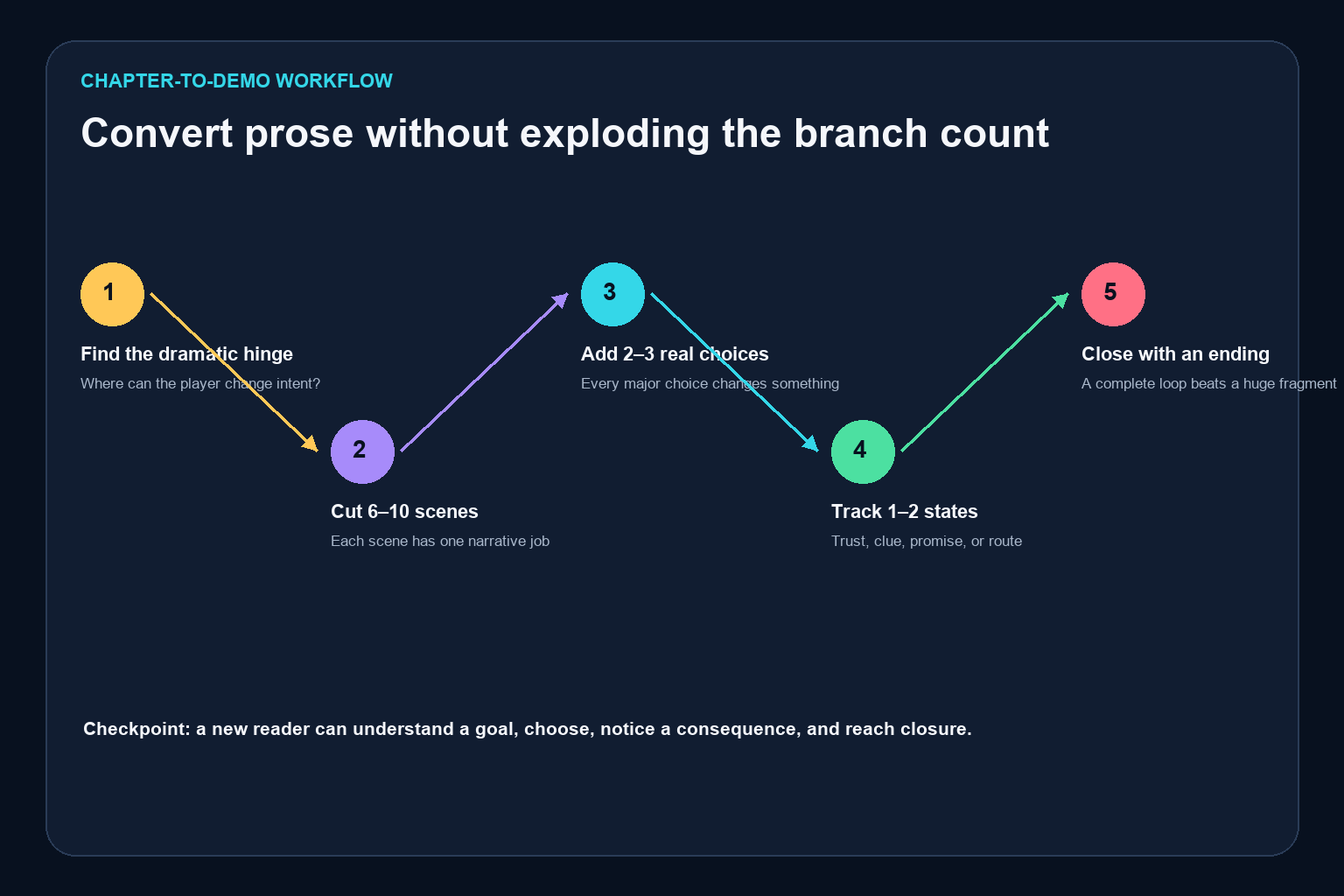
1. Mark the chapter’s fixed facts
List facts the prototype must not contradict: who is present, what each character knows, where the scene occurs, what the protagonist wants, and what must be true at the ending. These are guardrails, not branches. Separating fixed facts from changeable outcomes prevents accidental continuity errors.
2. Cut the chapter into playable scenes
Create a new scene when the objective changes, a new piece of information becomes actionable, the location shifts, or a decision produces a consequence. Give each scene one job. “The courier learns the seal is forged” is a job. “Continue chapter” is not.
3. Turn interpretation into choice
Strong choices express different intentions: protect someone, seek truth, avoid risk, gain leverage. Weak choices merely paraphrase the same action. Write each option as something a player can understand before clicking it. Then write one sentence describing the consequence. If you cannot name what changes, the choice may not deserve a branch.
4. Add the minimum story state
Use a flag for a yes-or-no fact and a small score only when degree matters. Keep state visible in your design notes even if the player never sees a number. Every variable should change dialogue, access, pacing, information, or an ending. If it changes nothing observable, remove it.
5. Close and share the loop
End the demo at a deliberate point: a reveal, a relationship shift, a tactical commitment, or a small ending. A complete fifteen-minute experience is more useful than half of a sprawling branch tree. Share it with someone who has not read the manuscript and do not explain the intended path before they play.
How to judge whether the prototype worked
Run the first playtest as a decision test, not a writing workshop. Ask the player to describe the immediate goal, explain why they chose an option, identify what changed afterward, and say whether the ending felt connected to their decisions. Their answers reveal comprehension, agency, consequence, and closure.
Watch for hesitation in different places. Pausing because both options feel dramatically difficult is good. Pausing because the options are unclear is not. Likewise, surprise can be satisfying, but an ending that feels random usually means the prototype did not communicate enough causal information.
Test every reachable route yourself. Check for choices that lead nowhere, state that never affects a scene, endings that can be reached under contradictory conditions, and branches that repeat large blocks without adding meaning. Keep a short path log with the selected choices, resulting state, ending, and problem observed. This is sufficient for a chapter-sized demo; elaborate test infrastructure can wait.
A prototype is ready to guide adoption when at least one outside player can understand the goal, perceive a consequence, reach closure, and give specific feedback without the author translating the experience. If the tool also lets you revise a weak branch and retest it quickly, it is doing the job you selected it for.
When a visual novel tool is the better choice
Choose a visual novel authoring tool when presentation is part of the hypothesis. If the chapter depends on character expressions, timed dialogue, layered backgrounds, music cues, or a familiar dialogue-box rhythm, a prose-only prototype may omit the very thing you need to test.
Even then, keep the scope narrow. Use a small cast, a limited location set, and temporary assets until the choice loop works. The risk is polishing a presentation before you know whether the decisions and consequences hold together. A visually convincing scene can hide a structurally weak branch during internal review.
When a text-first interactive fiction editor is enough
A text-first editor is a strong option when reading, exploration, and linked passages are the experience. It is also useful when you want precise manual control over variables and conditional text without building a visual layer. For prose-heavy mystery, literary branching, or hyperlink fiction, this can be the most direct fit.
The tradeoff is that you may spend more time manually structuring passages and conditions, and the result may not test the audiovisual expectations of a visual novel audience. Choose it because text is the intended interface, not only because it is lightweight.
When to start in a full game engine
Start in a full engine only when the chapter cannot answer its core question without a custom system. An RPG conversation that depends on tactical movement, a clue that must be discovered through spatial exploration, or a relationship decision embedded in combat may justify the added complexity.
Before committing, write the mechanic as a testable sentence: “The player must choose whom to protect while moving through the scene,” or “Inventory evidence changes the available accusation.” If you can replace the mechanic with a temporary choice and still learn what you need about the chapter, prototype the narrative first. Move to the engine after the story loop proves its value.
A practical adoption checklist
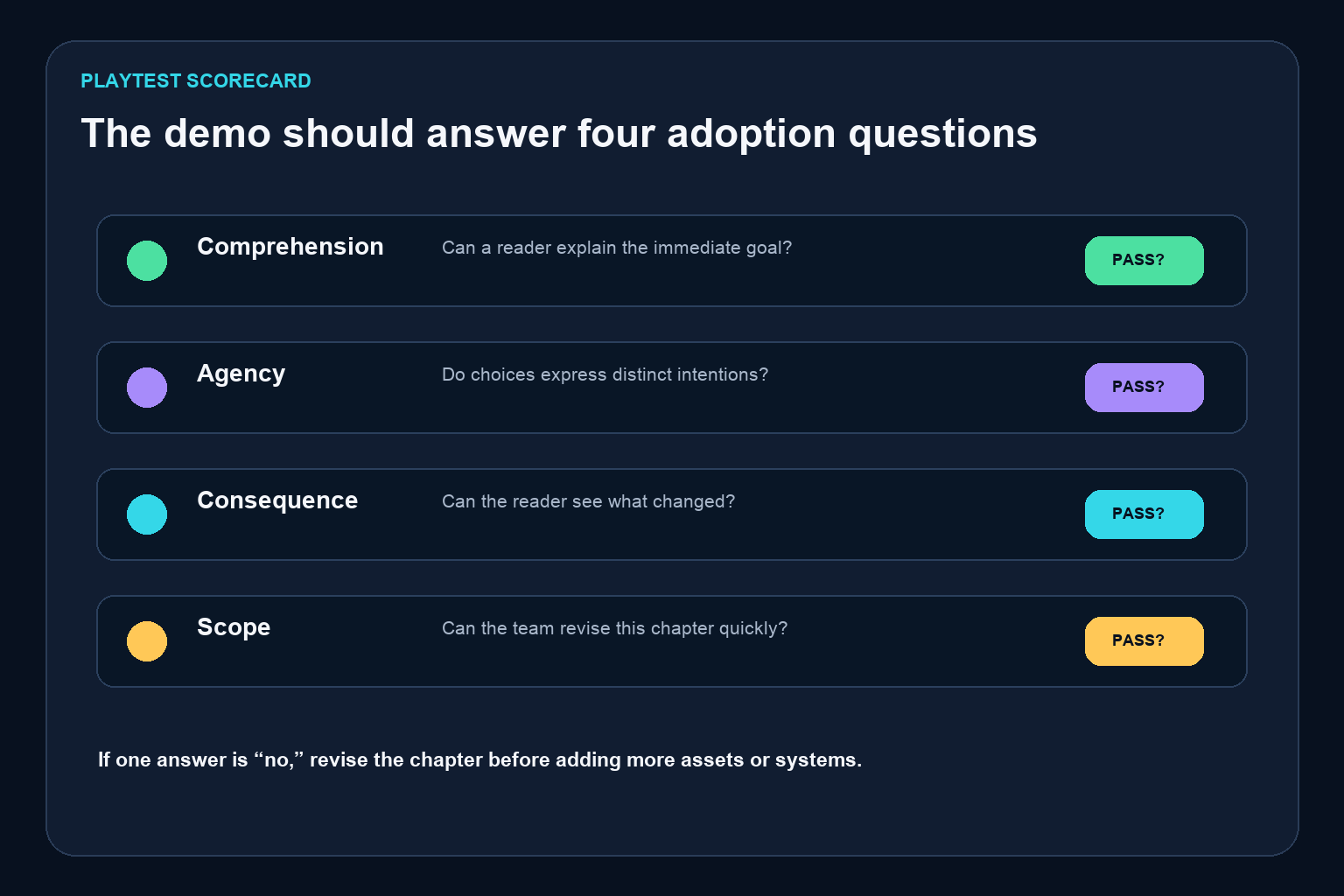
Adopt the tool for the next prototype if you can answer yes to these questions:
- Can a writer revise scene text and branches without waiting for engineering?
- Can the team inspect the story graph and understand why an ending is reachable?
- Can one or two variables create visible consequences?
- Can a playtester access the demo with minimal setup?
- Can you duplicate the project or save a checkpoint before a risky revision?
- Can you export the text or preserve the narrative design if you migrate later?
Reject or postpone the tool if the first playable loop requires extensive setup, if story logic is hidden in places the narrative team cannot review, or if sharing depends on a fragile local build. The best prototype tool reduces the cost of learning. It does not need to be the final runtime.
Recommendation
For the stated goal—turning one chapter of a novel into a playable interactive demo—start with an AI-native story prototyping workspace. Use it to create a six-to-ten-scene slice with two or three meaningful decisions, minimal state, and a deliberate ending. Playtest that slice before commissioning a large asset set or selecting a full game engine.
If the test proves that visual presentation is essential, move the validated structure into a visual novel tool. If custom mechanics are essential, carry the validated scenes, state rules, and playtest findings into an engine. This staged choice keeps the first decision reversible while producing evidence for the next one.
Frequently Asked Questions
Can I turn only one chapter into a playable demo?
Yes. One chapter is an ideal prototype boundary when it contains a clear conflict, at least one decision point, and a satisfying stopping point.
Do I need to rewrite the chapter before importing it?
Usually not. Begin with the existing prose, then split it into scenes and shorten passages where the player needs to act.
How long should the demo be?
Aim for roughly ten to twenty minutes for an initial test. The exact length matters less than completing one coherent decision loop.
How many choices should the first version include?
Two or three meaningful choices are enough when each has a distinct intention and an observable consequence.
Should the prototype include final character art and music?
Only if audiovisual presentation is the question you need to test. Otherwise, validate narrative structure with minimal assets first.
Can the prototype later move into a visual novel tool or game engine?
Yes. Preserve scene text, branch logic, state definitions, ending conditions, and playtest findings in a portable design record.