Key takeaways
- Use an AI game platform to test early creative uncertainty and a traditional engine when the project needs deeper control, established tooling, or long-term ownership.
# AI Game Platform vs Game Engine: Decide Where to Prototype and Where to Build
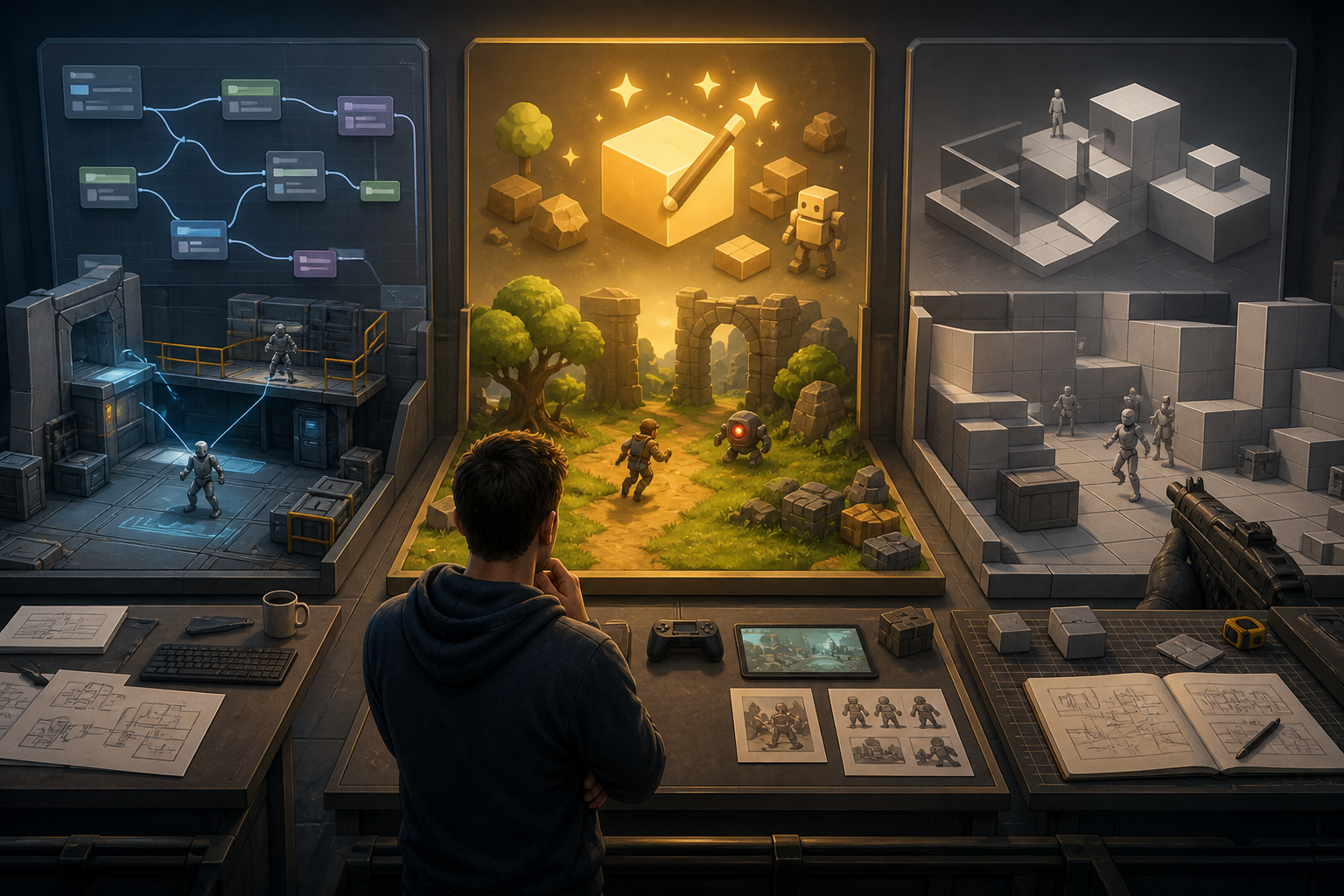
The choice between an AI game platform and a traditional engine is usually a question about stage and control. An AI workflow can shorten the path from a brief to a playable direction. A game engine can provide the deeper control, tooling, and long-term ownership needed for a production project. The right answer depends on what the next build must prove.
Start with the next decision
Use an AI workflow when the uncertainty is about the core loop, visual direction, level shape, or whether a concept is worth deeper work. Use a traditional engine when the uncertainty involves architecture, performance, platform behavior, multiplayer, long-term content systems, or an established team pipeline.
These are not absolute categories. A team can prototype with an AI platform, learn from the result, and then recreate or extend the proven idea in Unity, Godot, Unreal, or another engine. The handoff should be planned early so the prototype does not accidentally depend on assumptions that cannot travel to the production environment.
Compare the artifact you will own
Ask what each path produces. A prototype may be a playable browser result, a scene direction, a project scaffold, or a set of prompts and assets. A production engine project has its own conventions for source files, assets, scenes, input, build targets, tests, and version control. The relevant question is whether the next owner can inspect and change the artifact safely.
Run one representative brief through the chosen path. Measure time to playable result, review effort, missing systems, asset cleanup, and the work required to reproduce the core behavior in the intended engine. A fast prototype is valuable even when it is not the final project, as long as the team records what it proved and what it did not prove.
Preserve the core loop during a handoff
Document the player goal, input, state transitions, win and fail conditions, tuning values, asset references, and acceptance tests. When moving to an engine, rebuild the smallest slice first. Do not import an entire unreviewed concept and assume that the new environment will preserve behavior automatically.
The handoff should also list what can be discarded. Temporary assets, exploratory variants, and rough code may have served their purpose. Keeping everything can make the production project harder to understand. Keep the evidence and the decisions that matter, then rebuild the foundation that the team will maintain.
Make the decision reversible
Test a small project before committing to a complete pipeline. If the AI path does not expose enough control, move earlier. If the engine path slows down concept exploration, use a smaller AI-assisted prototype before returning to the production project. A staged decision gives the team evidence without forcing a false choice between speed and ownership.
Frequently Asked Questions
When should I use an AI game platform?
Use it when the uncertainty is about the core loop, visual direction, level shape, or whether a concept deserves deeper implementation.
When should I start in a traditional engine?
Start there when the main uncertainty involves architecture, performance, platform behavior, multiplayer, long-term systems, or an established team pipeline.
Can an AI prototype move to Unity, Godot, or Unreal?
It can inform a later engine project when the team documents the core loop, inputs, state transitions, assets, acceptance tests, and what the prototype did not prove.
What should I compare?
Compare the artifact, editability, source access, runtime behavior, testing, performance, asset cleanup, and the work required for the next owner to continue.
Should I keep every prototype asset?
No. Keep the evidence and decisions that matter, and rebuild the production foundation when temporary assets or rough code would make ownership harder.
How can the decision stay reversible?
Run a small representative project, measure the handoff, and move workflows when the ownership, performance, or release requirement changes.