To write useful AI prompts for a boomer shooter, specify what the player sees before an attack, what action avoids it, when a weapon can deal damage, and how the room ends. A two-threat room is enough to make those choices visible: step out of the Sentry’s lane, then save a shell for its glowing charge window. This article turns that decision into a rules contract, a prompt sequence, and a set of checks. Turbine Vault is a fictional design exercise. Its timings and arithmetic are proposed rules, not an observed game or playtest.
Make the first question about the next threat
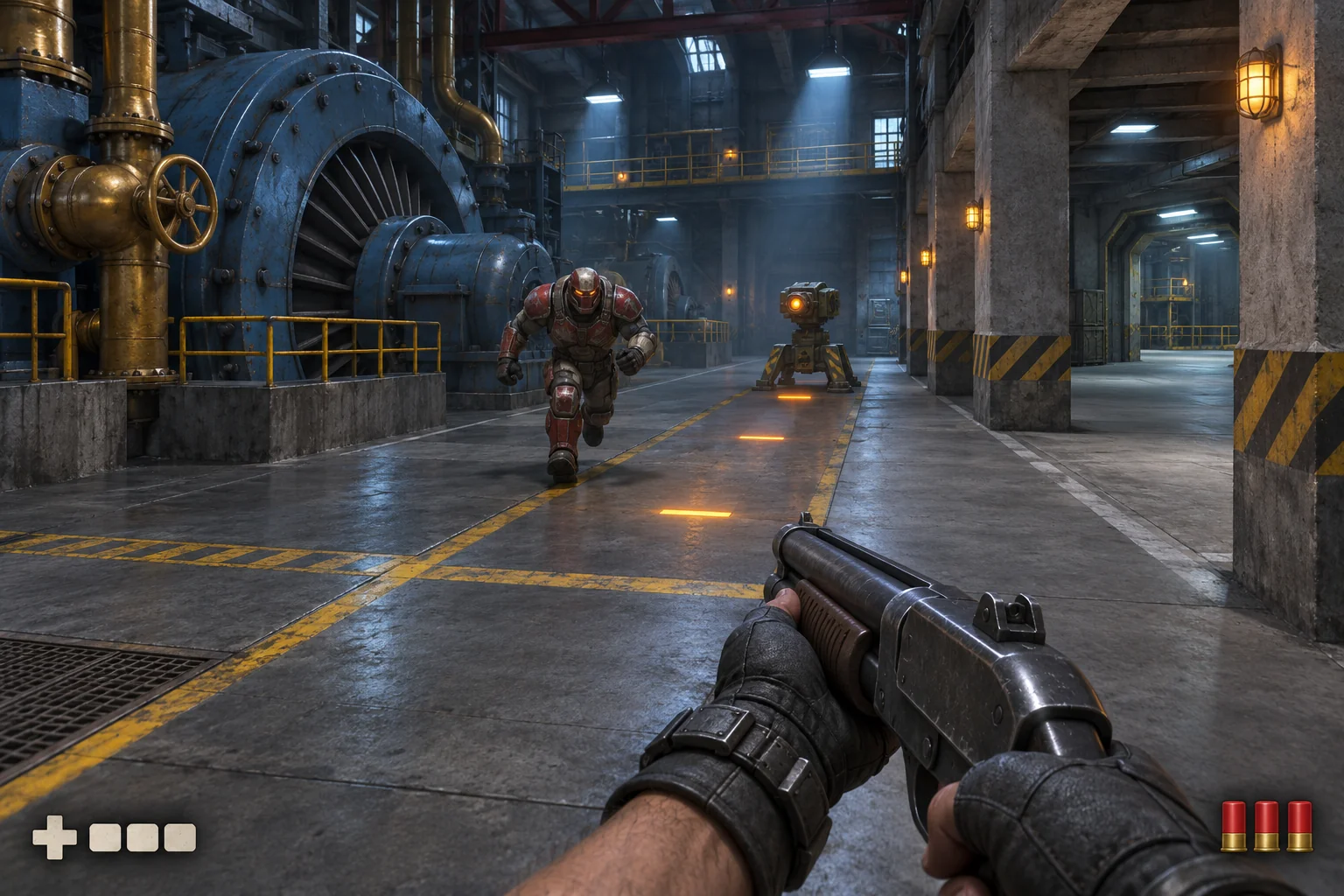
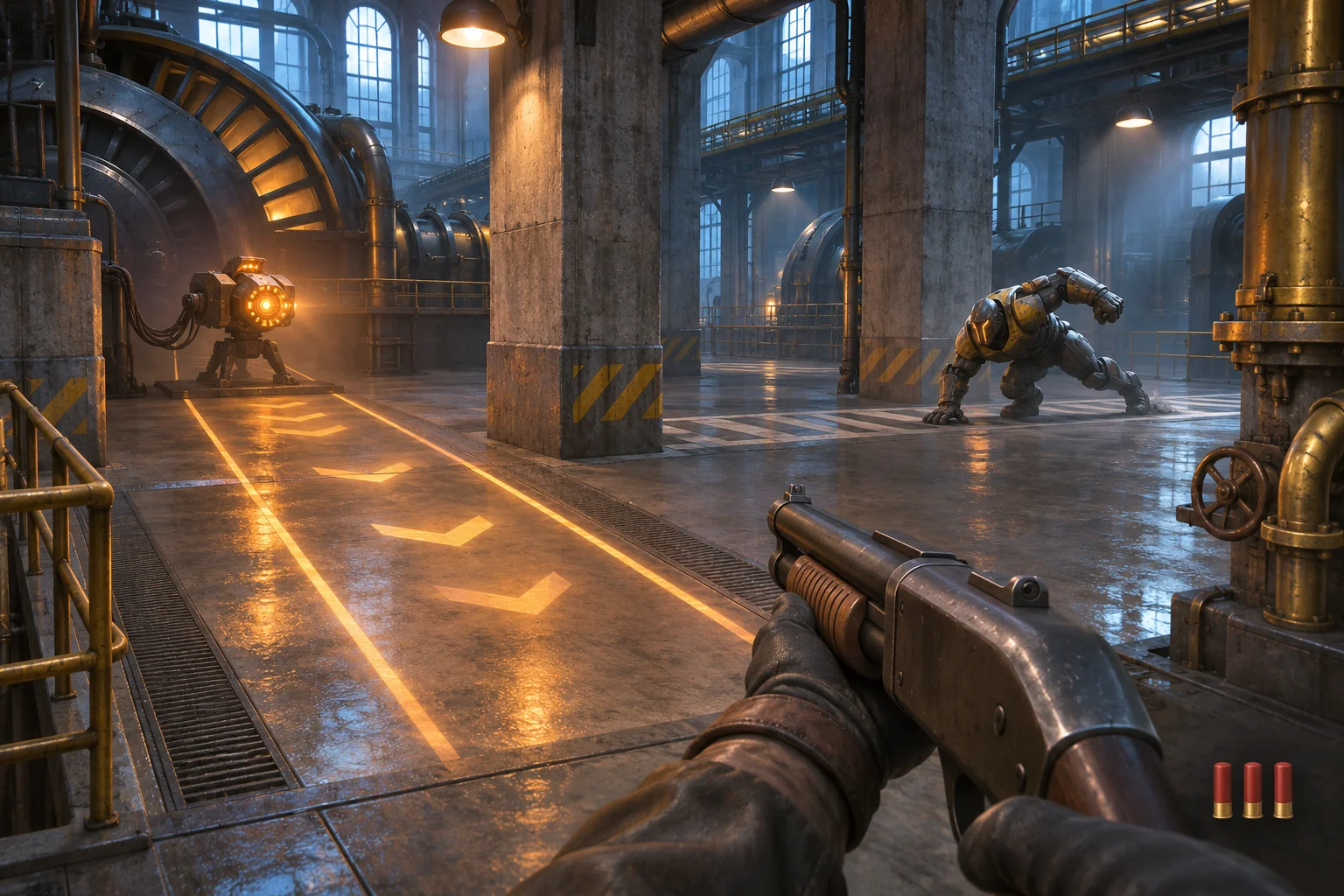
A fast shooter needs more than quick movement. The player needs to read a threat, move to a safe position, and decide whether a shot is useful now. In Turbine Vault, a mobile Rusher closes for a melee strike while a fixed Sentry charges a straight lane. The Rusher asks for an immediate sidestep; the Sentry asks the player to hold a shell until its core glows.
Keep the first build to one room and two distinct attack patterns. That lets you ask a useful priority question: if the Rusher winds up while the Sentry marks a lane, which danger should the player avoid first, and which shot should wait? If either cue is hard to see, adding another enemy will make the problem harder to diagnose.
Write the combat contract before the room prompt
List starting state, timing, damage, resource costs, and the exit rule in one place. These values are fictional design inputs. Their purpose is to make a future build request specific enough that a creator can compare the output against a written rule.
| Rule | Turbine Vault design value | Feedback to request |
|---|---|---|
| Start and clock | When player control begins, set t=0, health to 4, shells to 3, and the room timer to 30 seconds. The sidearm has unlimited reserve and deals 1 damage per hit. | Show health, shell count, the marked lane, and the locked exit from the start. |
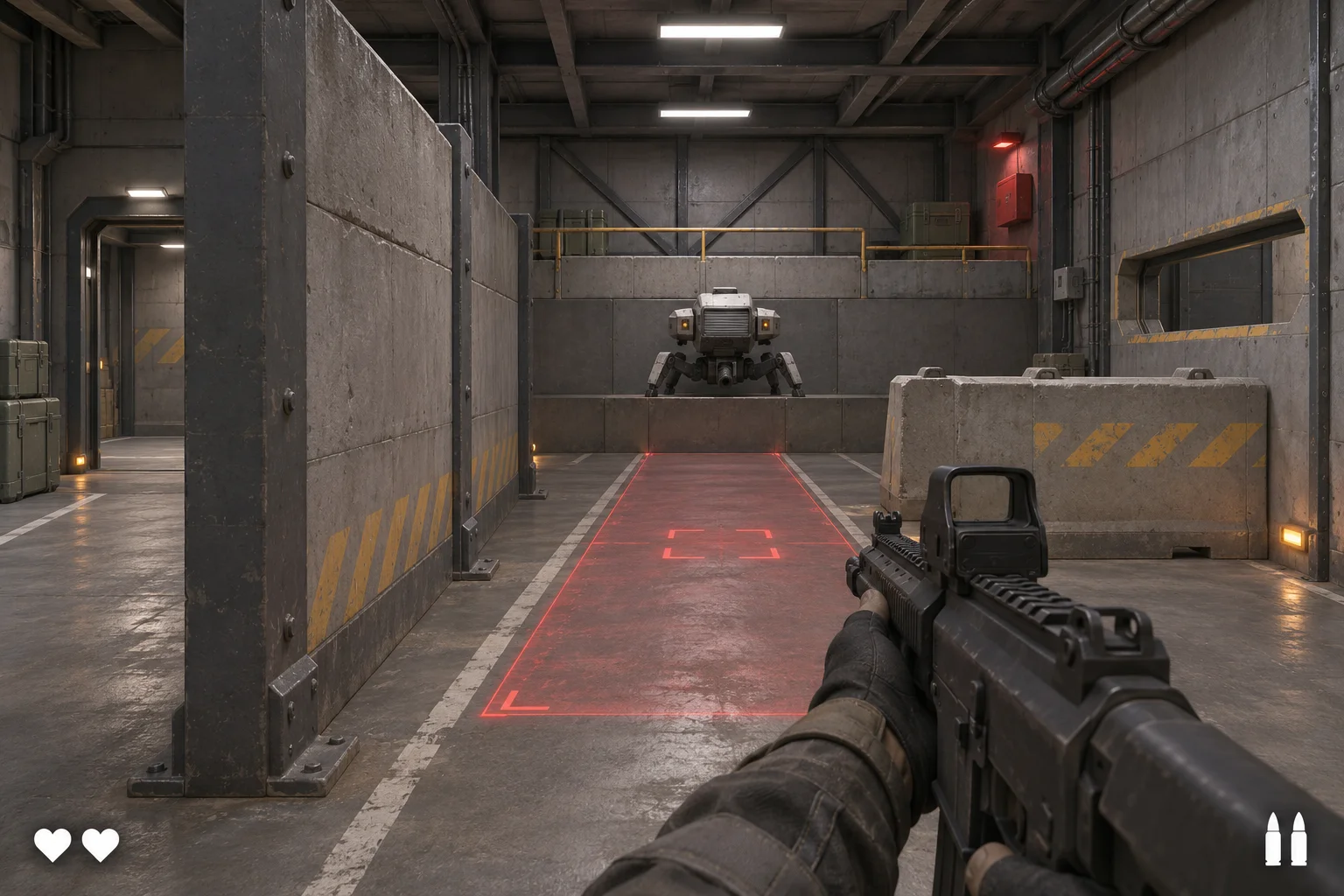
| Sentry | It marks one straight lane and charges for 1 second from t=0, firing at t=1. It charges again for 1 second every 4 seconds: t=4–5, 8–9, and onward. A shell deals 2 damage only while its core glows during a charge; its lane shot deals 1 health damage on contact. | Make the lane mark, glowing vulnerable core, shot, and hit or miss feedback distinct. |
| Rusher | It starts 6 metres away and reaches close range after 2 seconds if the route is clear. It stops for a 1-second windup, then strikes for 1 damage if the player remains in its lane. After a strike, it recovers for 2 seconds before winding up again. It has 2 health; a close shell deals 2 damage and the sidearm deals 1. | Show the windup before impact and make leaving the attack lane a valid response. |
| Shell rules | Launching a shell spends 1 even on a miss or against the Sentry outside its glow. At zero, an empty trigger makes no projectile. One shot can damage one enemy. Attacks that land separately stack; there are no invulnerability frames or damage reduction. | Keep the ammo count and each enemy’s health visible after a shot or hit. |
| Pickup and exit | The first defeated enemy drops one shell. Touch it once to gain 1, capped at 3; then it disappears. Defeating both enemies activates the exit. Hold Interact for 0.5 seconds within 1.5 metres to win. Zero health or a 30-second timeout ends the attempt. | Show the pickup once, the exit’s locked and active states, and a clear end state. |
The Sentry’s first shot resolves at t=1. A surviving Rusher’s first strike resolves at t=3; after recovery it can strike again at t=6 and t=9. If the Rusher is still alive, its third windup at t=8–9 overlaps the Sentry’s third charge. If the player remains in both attack lanes, both hits resolve at t=9 and deal 2 total damage. Make the two damage events visible separately so the player can tell what happened.
Choose movement first when both tells overlap
When two cues appear together, prioritize survival before spending a scarce shell. The table describes a response, not a universal rule for every shooter. The open route and attack lanes should make each option physically possible in the room.
| Visible cue | First response | Shot decision |
|---|---|---|
| Rusher closes, no windup yet | Keep a route open; do not let the enemy pin the player against a wall. | Use the sidearm from a safe lane, or save a close shell if the kill is certain. |
| Rusher winds up in one lane | Leave that lane before its 1-second tell ends. | Do not assume the windup makes the Rusher invulnerable; fire only if aim and distance are safe. |
| Sentry marks a lane | Step across the lane before the shot resolves. | Keep the shell if the core is not glowing. |
| Sentry core glows during charge | Stay outside the marked lane while keeping a clear line to the Sentry. | Launch one shell during the 1-second window for 2 damage. |
| Both attacks can land together | Move out of both crossing attack lines first. | Preserve the shell until the player is safe and the Sentry is vulnerable. |
In the fixed success example, the player strafes clear of the first marked lane. When the Rusher reaches close range at t=2, a shell resolves before its t=3 strike and defeats it. That removes the Rusher’s later windups from this run. The two threats overlap only in a different state where the Rusher survives; keep that distinction clear when describing the example.
Use three prompts to move from rules to a room
Do not ask for a whole campaign in the first request. First ask for a deterministic contract, then a playable room using that contract, then a bounded revision based on observations that a person actually supplies. The prompts below are proposed templates. They do not claim a game was generated or tested.
Prompt 1: agree on the rules and event order
Design a single-room first-person boomer-shooter encounter called Turbine Vault.
Before proposing visuals, restate the rules below as a state table and flag any
contradiction. Do not invent missing values or claim the encounter is playable.

When player control begins, set t=0, health=4, shells=3, and room timer=30 seconds.
The sidearm has unlimited reserve and deals 1 damage per hit. The fixed Sentry
marks one straight lane, charges for 1 second starting at t=0, and fires at t=1.
It charges again for 1 second every 4 seconds. Its core is vulnerable only while
glowing during charge; a shell then deals 2 damage. A shell outside that window
still costs 1 but deals no damage. A Sentry hit deals 1 health damage.

The Rusher starts 6 metres away, closes in 2 seconds if its route is clear,
then winds up for 1 second before a 1-damage strike. It has 2 health; a close
shell deals 2 and a sidearm hit deals 1. After a strike it recovers for 2 seconds.
A launched shell costs 1 even on a miss. At zero shells, no projectile appears.
One shot can damage only one enemy. Landed attacks stack independently; there are
no invulnerability frames or damage reduction.

The first defeated enemy drops one shell, collected once for +1 up to a cap of 3.
Defeating both enemies activates the exit. Hold Interact for 0.5 seconds within
1.5 metres to win. Zero health or the 30-second timer ending first is a loss.
Restart restores health, ammo, timer, both enemies, pickup, bolts, and locked exit.
Return a timing/state table, the unanswered questions, and a short list of player
feedback needed to distinguish every rule. Do not create extra weapons or enemies.
Check the event order before moving on. The state table should show t=1 for the first Sentry shot, t=3 for a Rusher that survives its first windup, then t=6 and t=9 for later strikes. It should also show a shell launch reducing ammo immediately, even when the target takes no damage.
Prompt 2: build the smallest room that exposes those choices
Using the approved Turbine Vault contract below, make one first-person room with
clear movement and visible combat feedback. Do not change any values or add rules.

[Paste the reviewed state table and the full combat contract here.]

Place the player, one mobile Rusher, one fixed Sentry, one one-use shell pickup,
and a locked exit in a readable industrial room. Keep a continuous safe route
outside the Sentry lane and a clear line of sight from a safe position to the
Sentry. Give each enemy distinct shapes and attack tells. Show the Sentry lane,
its 1-second charge glow, shell count, health, damage, pickup collection, locked
exit, and active exit. The Rusher must stop during its 1-second windup. Make the
exit require both enemies defeated and a 0.5-second Interact within 1.5 metres.

Keep the shell costs and target rules exact. The pickup spawns only after the
first defeat and never raises shells above 3. Add a restart that resets the full
room. Use a single room and no campaign, boss, upgrades, or extra enemy types.
Return a short list of controls and explain where each rule appears on screen.
Start by checking whether the route, cues, health, and ammo can be read without searching the room. If the output changes the contract, correct that discrepancy before adding visual detail. A useful first room makes the target priority visible; it does not need more enemies to feel complete.
Prompt 3: revise only from a real observation
I will provide observations from my own run. Do not invent results or say that you
played the game. Use only the observations below, and keep every unmentioned rule
and value unchanged.

Run setup: [starting health, shells, timer, player position]
Observed cue and action: [what appeared, what I did, and when]
Observed state before and after: [enemy health, player health, shells, pickup, exit]
Expected rule: [the exact contract rule]
Actual mismatch: [what differed, if anything]

Identify the smallest plausible cause. Propose one change to the relevant cue,
collision, timing, or state feedback. State what should remain unchanged. Give me
one repeatable check using the same starting state and tell me what values to
record. If the observation does not distinguish between causes, ask for the
missing observation instead of guessing.
The third prompt keeps the creator in charge of evidence. A revision is a hypothesis until the same starting state is checked again. Record the cue, action, and before/after state; do not convert a suggested check into a result.
Read the ammo chain and diagnose the first mismatch
The worked success line is a paper calculation. Player control begins at t=0 with 4 health and 3 shells. The player leaves the first Sentry lane so its t=1 shot misses. At t=2, the close shell defeats the Rusher before its t=3 strike: shells go from 3 to 2. The one-time drop restores one shell, capped at 3: 2 to 3. During the Sentry’s t=4–5 charge, a shell reduces its health from 3 to 1 and ammo from 3 to 2. During t=8–9, a second shell reduces Sentry health from 1 to 0 and ammo from 2 to 1. The player stays outside the marked lane, defeats both enemies, then holds Interact at the active switch. The sequence is 3→2→3→2→1. It is not a recorded playthrough.
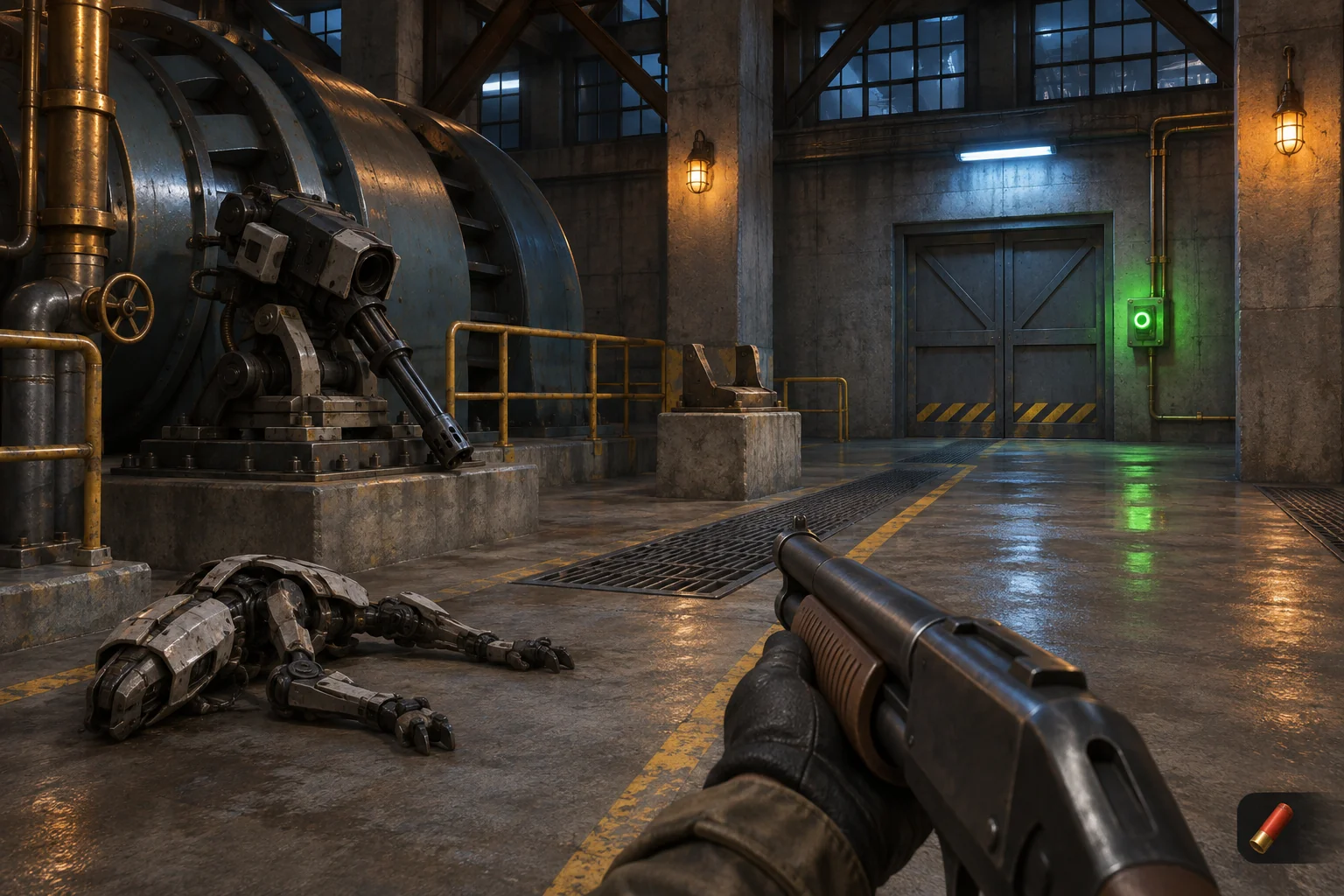
Resolve the player’s t=2 shell before the Rusher’s t=3 impact. That is why the successful example takes no Rusher damage. In another run, if the Rusher survives, its second windup runs from t=5 to t=6 and its third from t=8 to t=9. At t=9, a Rusher strike and Sentry shot can each deal 1 damage if both connect; do not silently collapse them into a single hit.
| If the player sees… | Check this rule first | One bounded correction |
|---|---|---|
| A shell disappears but the Sentry stays at 3 health | Was the Sentry’s core glowing when the shell launched? | Make the charge window or the shell’s ineffective-hit feedback clearer; keep damage values fixed. |
| Ammo decreases twice for one launch | Does the weapon debit once on launch and only once per projectile? | Bind the ammo debit to the launch event; repeat a single-shot check. |
| Two attacks land but health falls by only 1 | Are overlapping hits being hidden by temporary invulnerability or shared damage logic? | Show separate hit events and apply each 1-damage attack independently. |
| The pickup can be collected repeatedly | Is it removed from the attempt after the first touch? | Set the one-use flag on collection and verify ammo never exceeds 3. |
| The exit opens before the room is clear | Does activation require both enemies to be defeated? | Gate activation on both defeat states; keep the 0.5-second interaction separate from unlocking. |
Use one failure row at a time. Keep enemy positions, health, and timing unchanged while correcting the first mismatch, then repeat from the same state. If the run reaches zero health or the timer reaches zero before the interaction ends, record that as a loss and use Restart to restore the room before another comparison.
Use a prompt-led workflow, then inspect the result
SEELE’s official AI Game Maker page describes a plain-English game description, a playable 2D or 3D result, and iteration in Workspace. That is a broad starting workflow, not evidence that this particular shooter or rule set has been produced. Keep the contract in the prompt, then inspect whether the actual result shows the marked lane, vulnerability window, ammo changes, stacked hits, and exit condition. The page supports a broad starting workflow; it does not promise that this particular FPS or exact rule set will be produced.
When you are ready to describe your own room, start with the narrowest version of the idea in the Free AI game maker. Keep the first iteration focused on one cue or rule, and compare the result with the contract rather than assuming every requested detail appeared.
Choose one next pass
First make movement, target priority, and shell timing agree in one room. If a check fails, change only the cue or rule tied to that mismatch and repeat the same setup. Add another enemy or a new weapon only after the first encounter can explain its attacks, resource costs, defeat states, and exit without guesswork.
Frequently asked questions
How many enemies should a first boomer-shooter room use?
Two behaviors are enough for this design: one mobile attacker and one lane-firing Sentry. They create different responses, so you can see whether movement, target priority, and shell timing work together. Add another enemy only when the first two cues are readable and the room can reach its exit and restart states.
When can a shell damage the Sentry?
Only during its one-second charge, while its core glows. In the proposed schedule, those windows begin at t=0, t=4, t=8, and every four seconds afterward. A shell launched outside the glow still costs one shell but causes no Sentry damage, so keep the vulnerability cue visible.
Does a missed shell consume ammo?
Yes. The design spends one shell as soon as the weapon launches it, whether the projectile hits, misses, or meets an armored Sentry. At zero shells, an empty trigger creates no projectile and does not change the count. These are proposed rules for the example, not universal shooter behavior.
What happens if both enemies hit at once?
Each landed attack deals one health independently. If the Rusher strike and Sentry shot resolve at t=9 while the player remains in both lanes, the player loses two health. The design includes no invulnerability frames or damage reduction, so show both hit events rather than masking one.
Was Turbine Vault built or playtested?
No. Turbine Vault is a fictional rules exercise, and the ammo sequence is arithmetic derived from those proposed values. The article provides prompts and checks for a creator to use on a future build; it does not report a generated game, observed run, balance result, or customer example.