A branching narrative game needs a state model before it needs more dialogue. Name the scenes, the choices that change persistent variables, the conditions that unlock later actions, and the endings those conditions produce. Then request one small story slice and check every reachable state combination. The prompts below use exactly two optional preparation actions, two Boolean flags, and one final interaction to resolve them.
The Last Light at Orison Observatory is an original fictional teaching design. Its mountain observatory, action slots, story flags, relay operations, and endings are written examples; they have not been built or tested. Use the graph as a template for your own idea, not as a report of an existing or tested game.
Map the choices before writing the scene
Start by drawing a small graph. A node is a scene or decision point; an edge is an action that moves the player to another node; a state variable remembers something that later changes an option or outcome. For each choice, record the starting value, the guard that allows it, the action’s effect, the next scene, and the feedback the player sees.
Dialogue can make two routes sound different while both lead to the same state. A graph exposes that problem early: if an edge never changes state, opens a new choice, or changes the ending, decide whether it is flavor or a consequential branch. Keep flavor if it adds character, but do not rely on wording alone to prove that a choice matters.
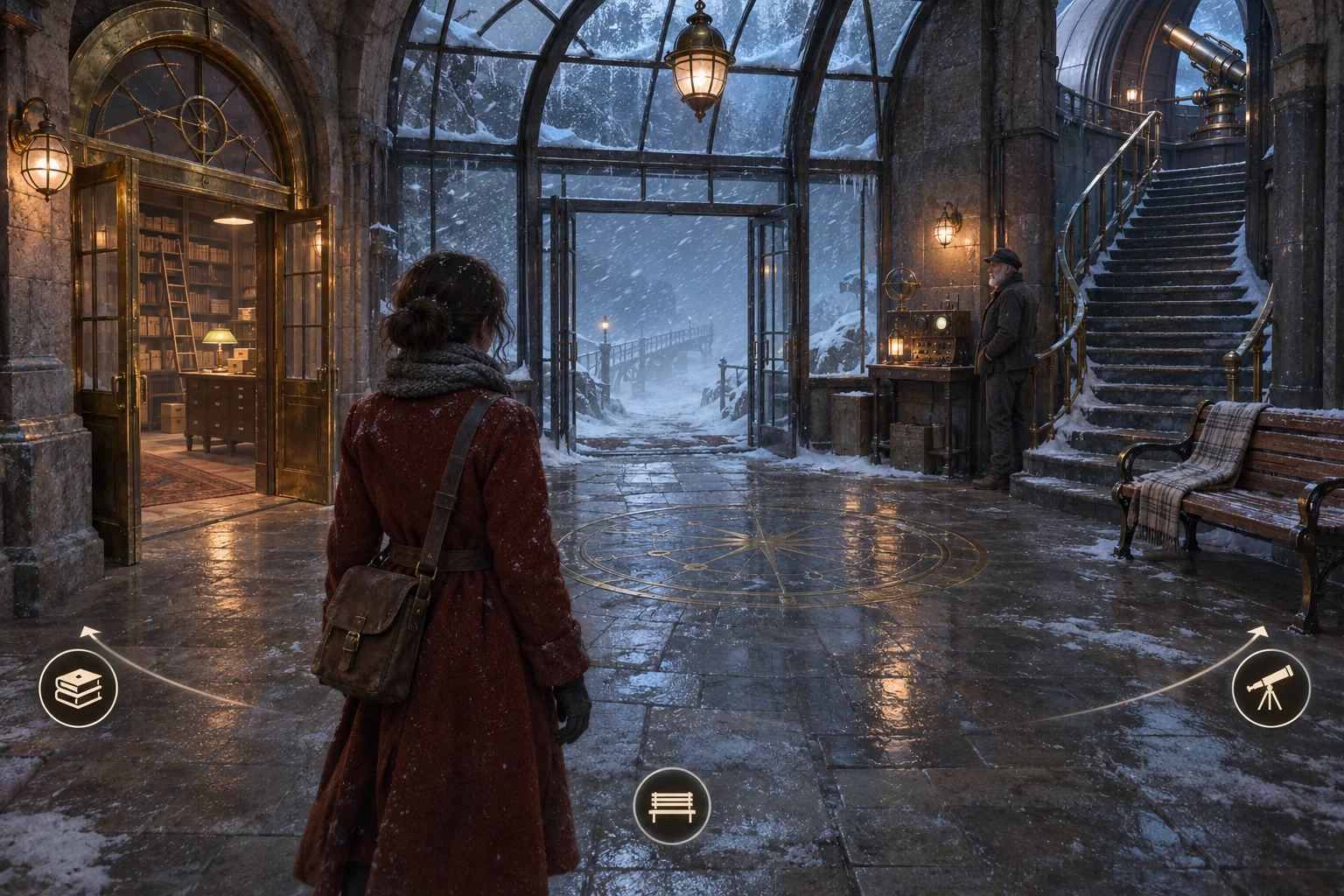
This example has a small, deliberate structure: enter the observatory, spend two preparation slots, return to one shared relay room, and resolve the flags in a final Commit. Rejoining at the relay keeps the story compact; the flags carry the meaningful differences forward.
Define two choices and four reachable outcomes
The player starts with exactly two optional action slots before the storm closes the access bridge. In either slot, choose Archive, Help, or Wait. Archive and Help each cost one slot and can each be chosen at most once. Wait consumes a slot without changing story state. Either order is allowed, so both preparations can be completed before the player returns to the relay room.
| Choice | Guard and cost | State change | Player feedback |
|---|---|---|---|
| Archive | Available if `logFound` is false; costs one slot. | Search the archive and set `logFound` to true. | The old signal log is recovered and the archive route closes. |
| Help | Available if `keeperTrust` is false; costs one slot. | Stabilize the rotating dome and set `keeperTrust` to true. | The keeper is ready to guide the manual retune; Help cannot be repeated. |
| Wait | Available in either slot; costs one slot. | No flag changes. | The storm advances; the player can still use the other slot before the bridge closes. |
These rules make four flag combinations reachable: neither preparation, Archive only, Help only, and both. Wait is what allows a player to leave a slot unused without silently forcing a branch. The two guards prevent duplicate preparation, while allowing Archive then Help or Help then Archive. Return to the same relay scene after each slot so the later outcomes depend on state, not on an unreachable route.
At the relay, “repeat checksum” is enabled only when `logFound` is true, and “request manual retune” is enabled only when `keeperTrust` is true. An unavailable option stays visible but disabled with a short reason; attempting it changes nothing. There are no extra flags for relay substeps and no separate action budget. One final Commit resolves the operations represented by the existing flags, then transmits.
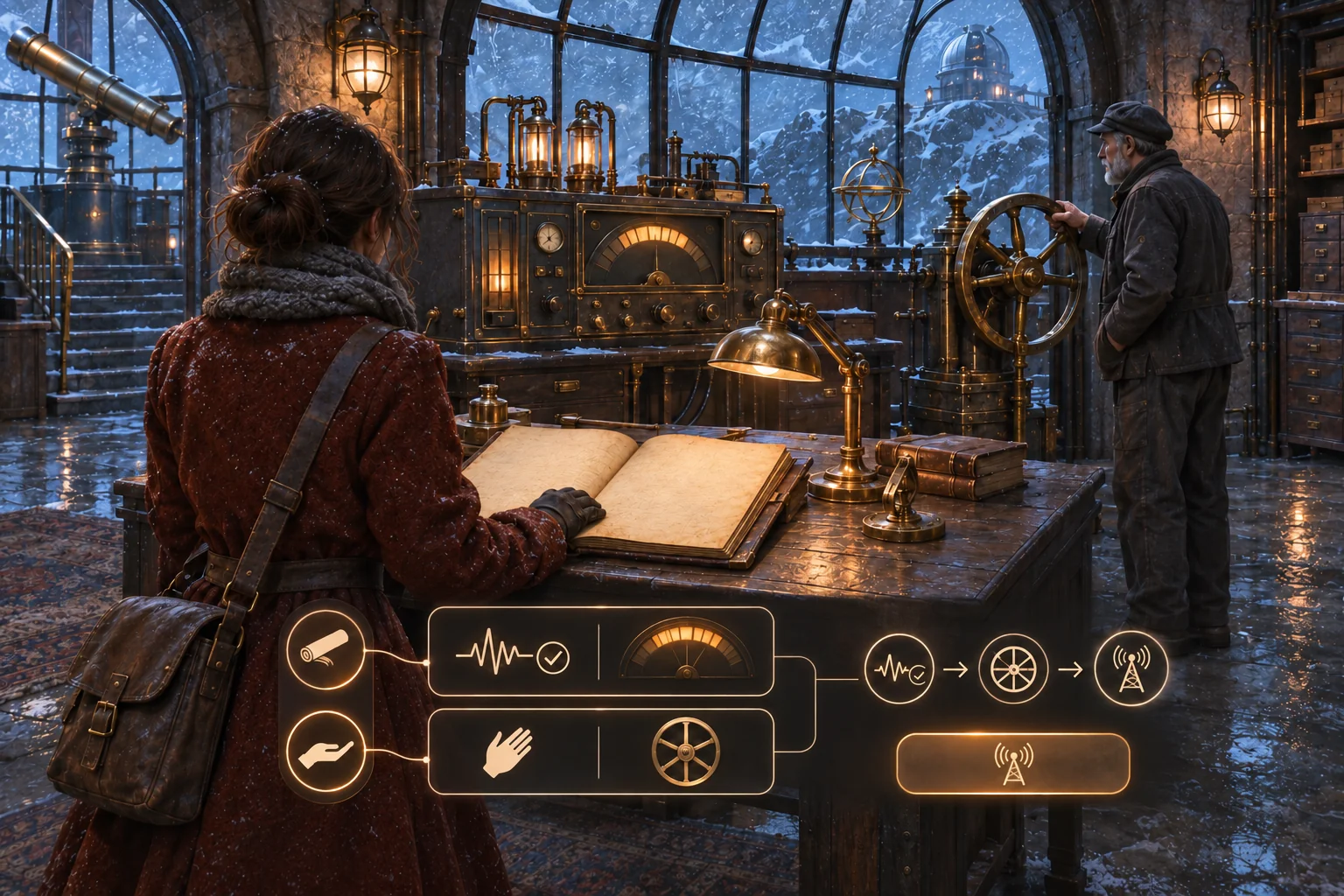
The ending follows directly from the two preparation flags:
| `logFound` | `keeperTrust` | Commit result | Ending |
|---|---|---|---|
| false | false | Unavailable; the player can take shelter. | No transmission. The team shelters in place. |
| true | false | Repeat the verified checksum, then transmit. | The dome is misaligned; no receiver confirms and the team shelters. |
| false | true | Perform the manual retune, then transmit. | The call sign is uncertain; no receiver confirms and the team shelters. |
| true | true | Repeat the checksum, retune the dome, then transmit. | A valley receiver answers; the team is rescued. |
The both-true case matters because one Commit must complete both enabled operations, in order, before transmission. A tempting shortcut is to introduce flags such as `checksumDone` or `retuneDone`; that would add hidden state the player and reviewer must track. Here the preparation flags are sufficient: they control which operations Commit resolves. The table is a paper model, not evidence that a playable build follows it.
Ask for a graph, one slice, then a route audit
Separate the prompt jobs. First request a state contract that names every route and guard. Next ask for one compact playable slice, or a structured design handoff if the chosen tool cannot represent the required state. Finally request an audit that enumerates all combinations without inventing observations. This keeps a branching narrative game prompt tied to transitions a creator can inspect.
Prompt 1: return the story graph
Design a branching narrative game slice for The Last Light at Orison Observatory.
This is a fictional concept, not a built or tested game.

The player has exactly two optional preparation-action slots before a storm
closes the bridge. In either slot, the only choices are Archive, Help, or Wait.
Archive costs one slot, can be chosen once, and sets logFound=true. Help costs
one slot, can be chosen once, and sets keeperTrust=true. Wait costs one slot
and changes neither flag. Either order is allowed; the player may choose both,
only one, or neither. Return to the same relay room after the preparation slots.

In the relay, enable “repeat checksum” only if logFound is true and “request
manual retune” only if keeperTrust is true. Keep unavailable actions visible
but disabled with an accurate reason; an attempted unavailable action changes
nothing. Add no relay-completion flags and no extra relay action budget.
If at least one flag is true, one final Commit resolves the operations allowed
by those flags in this order: checksum if logFound, manual retune if keeperTrust,
then transmit. If neither flag is true, Commit is unavailable and “take shelter”
ends the story with no transmission.

Return a node/edge table, starting state, guard and effect for every choice,
visible feedback, reset state, and ending table for all four flag combinations.
List any rule that is still ambiguous. Do not add routes, flags, or endings.
This asks for a complete graph contract, not long prose. Check that Wait can fill either slot, that both optional actions can be reached in either order, and that the relay returns to one shared state. If the answer leaves the “neither” case unreachable or adds a separate relay-step flag, correct the contract before requesting dialogue or art.
Prompt 2: request one playable story slice
Build one compact narrative-game slice from the approved state contract below.
Show the observatory entry, the Archive scene, the Help scene, a shared relay
room, and a take-shelter option for the neither-flags case.

Use exactly two optional preparation slots. In each slot, display Archive,
Help, and Wait. Disable Archive after logFound becomes true; disable Help after
keeperTrust becomes true. Keep the route order flexible. Show both flags in the
relay room and explain a disabled checksum or retune action without changing
state when attempted.

Provide one final Commit interaction, available only when at least one flag is
true. It must resolve checksum if logFound is true, then manual retune if
keeperTrust is true, then transmit. Do not ask for extra completion flags or a
separate relay action budget. Route the ending from the two existing flags only.
Include the no-transmission shelter ending when both flags are false.

Show the initial state, every scene transition, the change to each flag,
available and unavailable actions, result feedback, and reset behavior. Keep
dialogue short enough that the state changes remain clear. If the target tool
cannot represent these conditions or interactions, return a design handoff
instead of presenting a noninteractive story as a playable branching game.
Ask for a state display alongside dialogue. For this slice, readers need to see which preparations are complete, why an operation is disabled, and what Commit actually does. The prompt states requirements; it does not establish that a particular game maker implements them. Compare the returned interaction with the contract rather than assuming that branching dialogue equals persistent state.
Prompt 3: enumerate routes and compare actual observations
Audit the story graph against the state contract. Do not invent playtest results.

Enumerate these four starting relay states:
1. logFound=false, keeperTrust=false
2. logFound=true, keeperTrust=false
3. logFound=false, keeperTrust=true
4. logFound=true, keeperTrust=true

For each, report whether Commit is available, which operation(s) it resolves,
their order, whether transmission occurs, and the ending. Confirm that two
preparation slots can reach every combination using Archive, Help, or Wait;
that Archive and Help cannot each be chosen twice; and that a disabled action
changes nothing. Confirm reset clears both flags and restores both slots.

If I provide observed build behavior, compare it step by step with these
expected states and name the first mismatch. If I provide no observations,
return only a proposed checklist and mark results unobserved. Do not claim a
route passed unless the supplied observation demonstrates it.
The audit prompt tells the model what evidence is missing. Before you test anything, it can return expected transitions and a checklist. After a real observation, you can compare that sequence with the paper model and ask for one bounded correction; it cannot truthfully certify behavior from the prompt alone.
| Prompt stage | Input | Output | Acceptance check |
|---|---|---|---|
| Graph | Scenes, slots, choices, flags, guards and endings | Node/edge/state contract | All four combinations are reachable and defined. |
| Build slice | Approved graph and visible state requirements | One compact interaction sequence or design handoff | Conditional actions, disabled reasons, Commit order and reset are explicit. |
| Route audit | Expected matrix plus observations when available | Route enumeration and first mismatch | Unobserved behavior is labeled unobserved. |
Find dead ends and choices that do not matter
Walk the graph from the initial state and verify that each combination has a legal path. Then check whether the resulting scene shows the consequence that the state table predicts. The observatory’s intended both-true ending is one possible result of the written rules, not a measured outcome.

| Symptom | First rule to inspect | Next check |
|---|---|---|
| The player cannot reach the both-true state. | Slot count or route return. | Confirm Archive and Help each consume one of two slots and return to the shared relay in either order. |
| Archive or Help can be repeated. | One-time guard. | After its flag becomes true, disable that choice and confirm an attempt changes no state. |
| A disabled relay option still fires. | Action guard and no-op behavior. | Keep the option visible but disabled; verify an attempted action leaves both flags unchanged. |
| Commit skips retune when both flags are true. | Commit operation order. | Resolve checksum, manual retune, and transmission within the one interaction, in that order. |
| The wrong ending appears after Commit. | Ending condition. | Evaluate only `logFound` and `keeperTrust` against all four rows of the matrix. |
| Old preparation survives a restart. | Reset state. | Return both flags to false and restore the two optional slots. |
Use the earliest mismatch to decide what to change. If an outcome cannot be reached, fix the graph or slot semantics before editing the ending dialogue. If the state is correct but a disabled option is confusing, improve the reason shown next to it. If all four transitions match the contract, then add story texture without changing the tested state model.
Move a written graph into a first creation pass
Once the graph is coherent, a focused natural-language brief can be a starting point for exploring a game idea. SEELE’s current Free AI Game Maker page describes plain-English game descriptions, review of playable 2D or 3D results, iteration in Workspace, and checking displayed generation costs and account options. That general workflow does not confirm persistent story flags, conditional narrative actions, or this observatory design.
Carry the node/edge table and the four-row ending matrix into the creation request. Then inspect the actual returned state, choices, feedback, and restart behavior. If a specific condition is missing, ask for that condition to be represented and check it again. If the chosen workflow cannot show persistent flags, keep the graph as a design handoff and evaluate it in a suitable tool before describing it as playable.
Add story depth after the graph holds together
Do not add a third flag just to create more dialogue. First make sure the two current flags can combine in all four ways, the relay options respond to them, Commit follows its defined order, and reset restores the opening state. Then add one scene or variable only when it creates a choice the existing graph cannot express. This keeps new branches tied to consequences instead of multiplying routes that read differently but play the same.
When your own story contract is ready, take the compact graph into the Free AI game maker, inspect what the result actually represents, and revise one state transition at a time.
Frequently asked questions
How many choices should a branching story start with?
Start with the smallest number that lets you express the decision you want to teach. In this example, two optional actions produce four combinations, which is enough to show independent flags and conditional outcomes. Add another variable only when it changes a meaningful choice or consequence you cannot represent with the current state.
Can branching paths rejoin?
Yes. Routes can return to a shared scene if the state that matters remains available there. The observatory’s Archive and Help paths both return to the relay room, where the two flags determine which operations can happen. Rejoining keeps the scene graph compact while preserving differences in later choices and endings.
How should a disabled story option work?
Keep it visible, explain the missing condition in a short accurate reason, and make an attempted unavailable action a no-op. For example, “repeat checksum” can be disabled when the log has not been found. The explanation should tell the player what information or action is missing without changing either flag.
Do I need to check every ending?
Check every combination of the state variables you chose, even if several routes share earlier scenes. With two Boolean flags there are four combinations. Confirm each route is reachable, the conditional actions and their order match the rules, and reset clears the variables before the next run.
Has the Orison Observatory story been tested?
No. The observatory, its two optional action slots, relay operations, and four endings are an original paper design. The prompts and images on this page do not show a built game or playtest. Use the route audit with observations from your own build before describing an outcome as tested.