Build the prompt around one route loop
Useful AI prompts for a Metroidvania should connect four things: a readable region map, a movement ability, a route that tests that ability, and a return path that changes after the player succeeds. Describe those pieces in stages, then hand-check their order before asking a game tool to build anything. This catches disconnected rooms and upgrades that do not change where the player can go.
This guide uses an original fictional map called Brineglass Loop. Its regions, ability, route, and Beacon are design assumptions for a teaching example. The four game-prompt templates below were not submitted to a game generator. The route is hand-resolved on paper; it is not an existing playable game, a real playtest, or a measured result.
The method is simple: sketch the graph, define movement reach, test the blocked gate before and after the ability, and check the return condition. If the route only works after silently changing a rule, revise the prompt contract before expanding the world.
Start with a map question, not a world-sized request
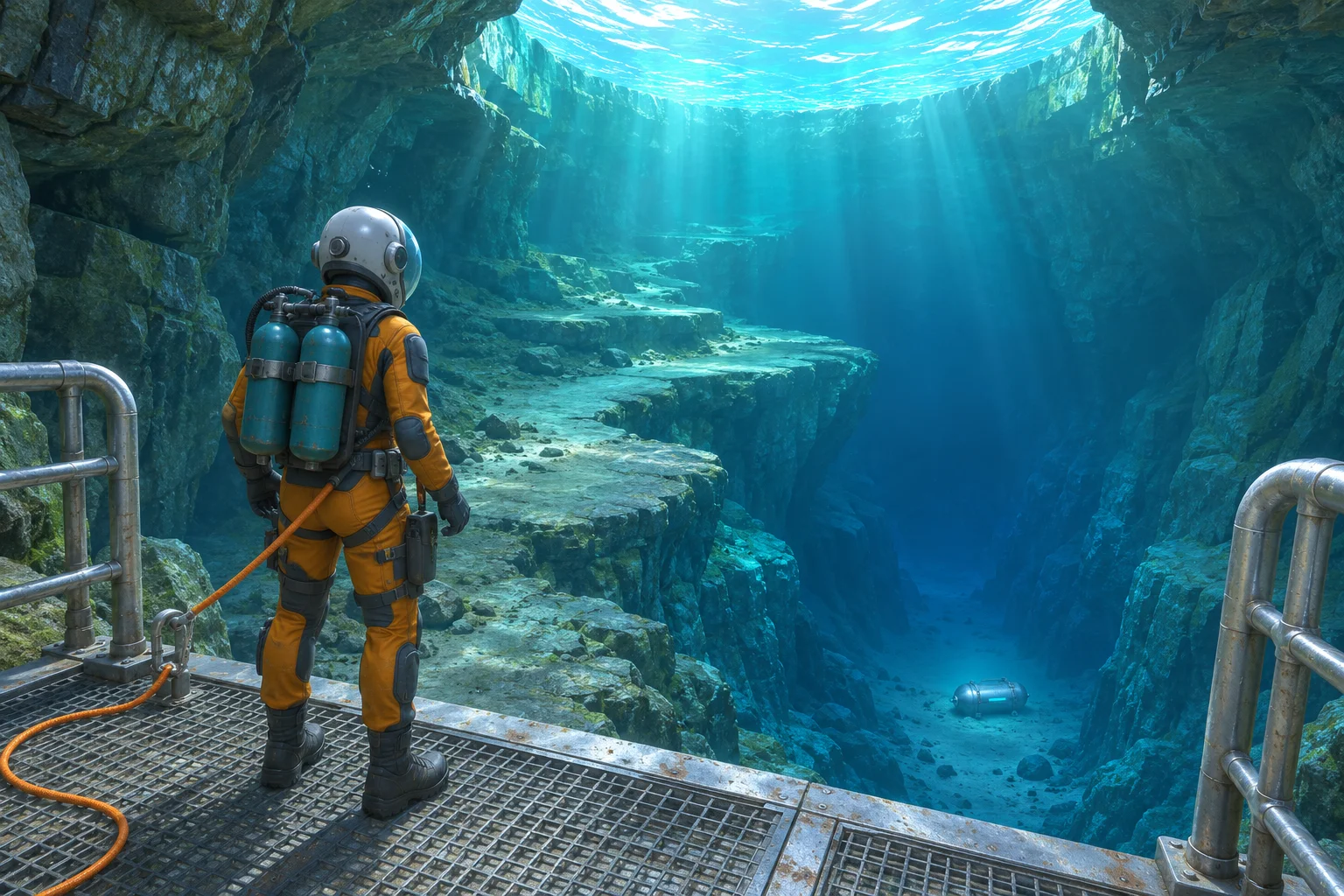
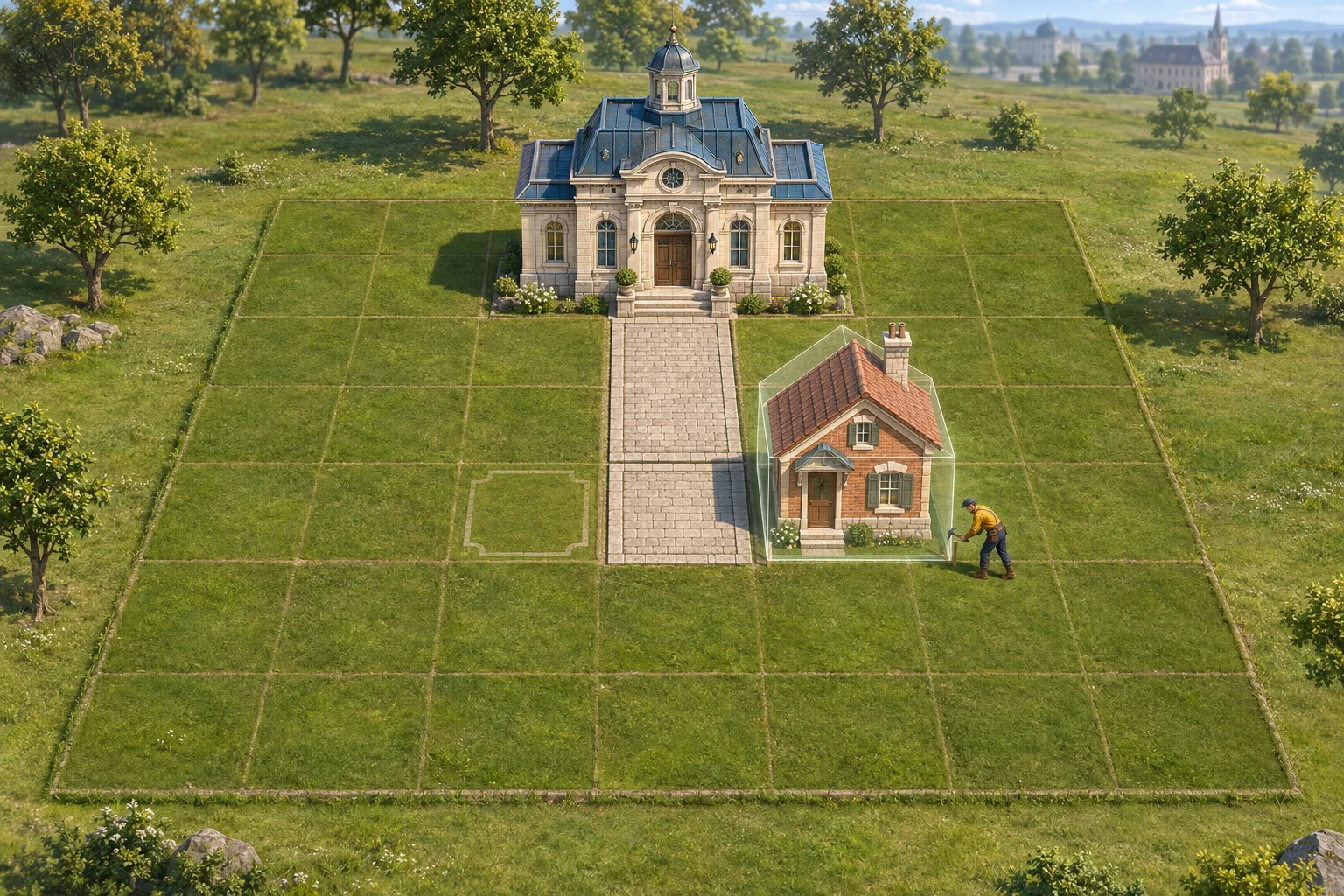
A long feature list can hide a simple progression problem: where does the player begin, what can they reach now, and what will a new ability change? Start with four regions and one visible gate. Lantern Dock is the hub; Saltglass Gallery is the first route; Pump Loft is a safe place to learn the ability; Crown Aqueduct is the locked destination.
| Region | Initial state | Design job |
|---|---|---|
| Lantern Dock (H) | Open to Saltglass Gallery. | Starting hub and final return point. |
| Saltglass Gallery (S) | Open to H and Pump Loft; route to A is gated. | Shows the locked path before the player can cross it. |
| Pump Loft (P) | Open from S; contains a safe two-unit gap and Kite Burst. | Teaches the new movement action on a reachable obstacle. |
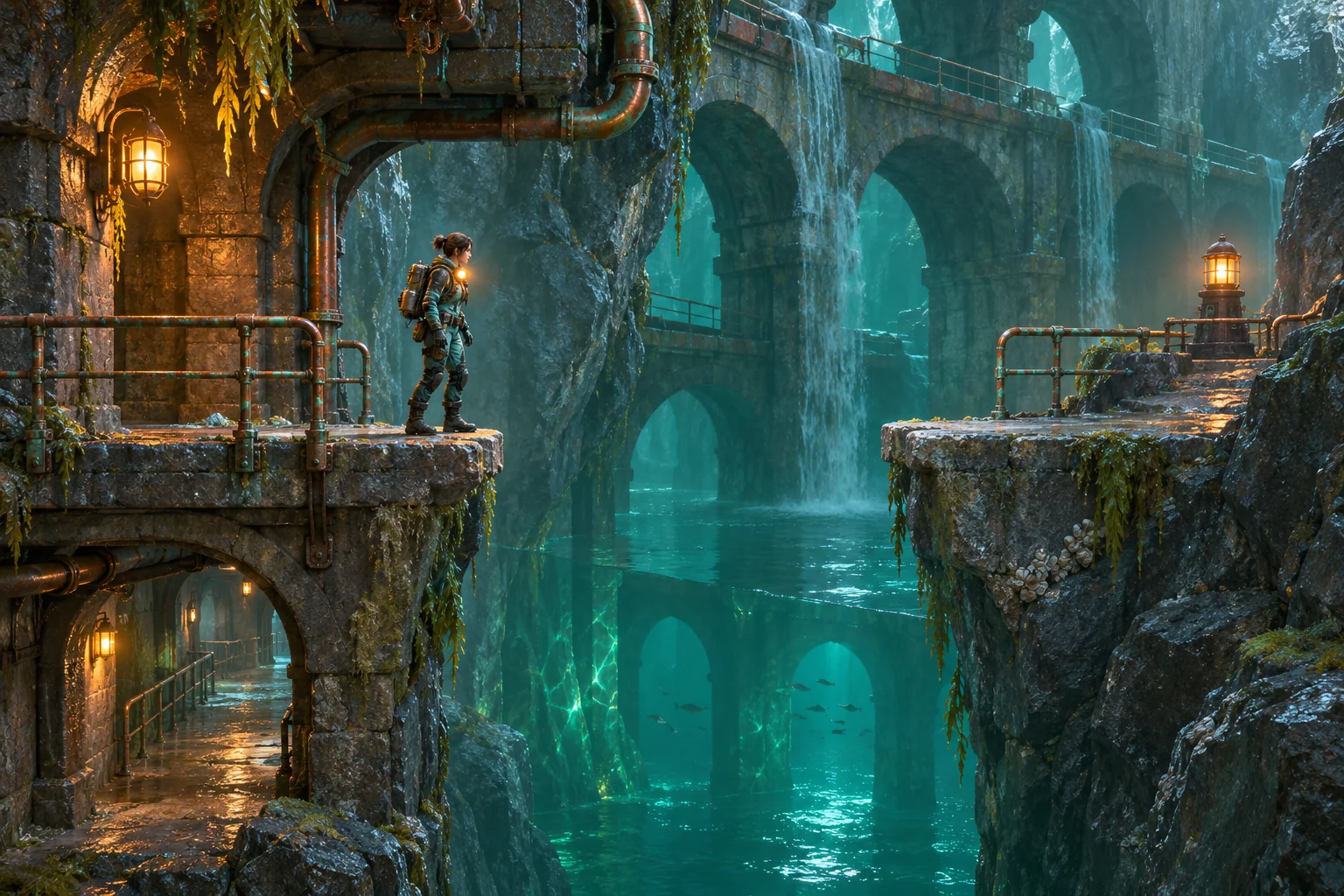
| Crown Aqueduct (A) | Not reachable until Kite Burst is acquired. | Contains the Beacon and a return hatch that opens afterward. |
The initial open connections are H↔S and S↔P. The S↔A crossing is blocked in both directions until the movement ability is owned. The A→H hatch stays closed until the Beacon is activated. There is no extra key, boss, weapon, combat meter, or persistent progression system in this first slice.
Prompt 1: define the map slice
Plan one compact original 2.5D Metroidvania map loop called Brineglass Loop. Regions: Lantern Dock (H), Saltglass Gallery (S), Pump Loft (P), and Crown Aqueduct (A). Initially open connections are H↔S and S↔P. The route S↔A is gated by a three-unit gap. A→H is a one-way hatch closed until a Beacon in A is activated. Return a region graph, a directed edge list with each edge's initial lock state, one landmark per region, the visible gate, and the player's first understandable goal. Keep this slice to four regions and no boss, weapon, key, combat meter, or persistent progression. Flag any missing decision as a question.Check that the graph and edge list describe the same map. A path that appears on the graph but is missing from the edge list is hard to test. Also make sure the destination and gate are visible from the route that teaches the player about them.
Write the ability as a movement contract
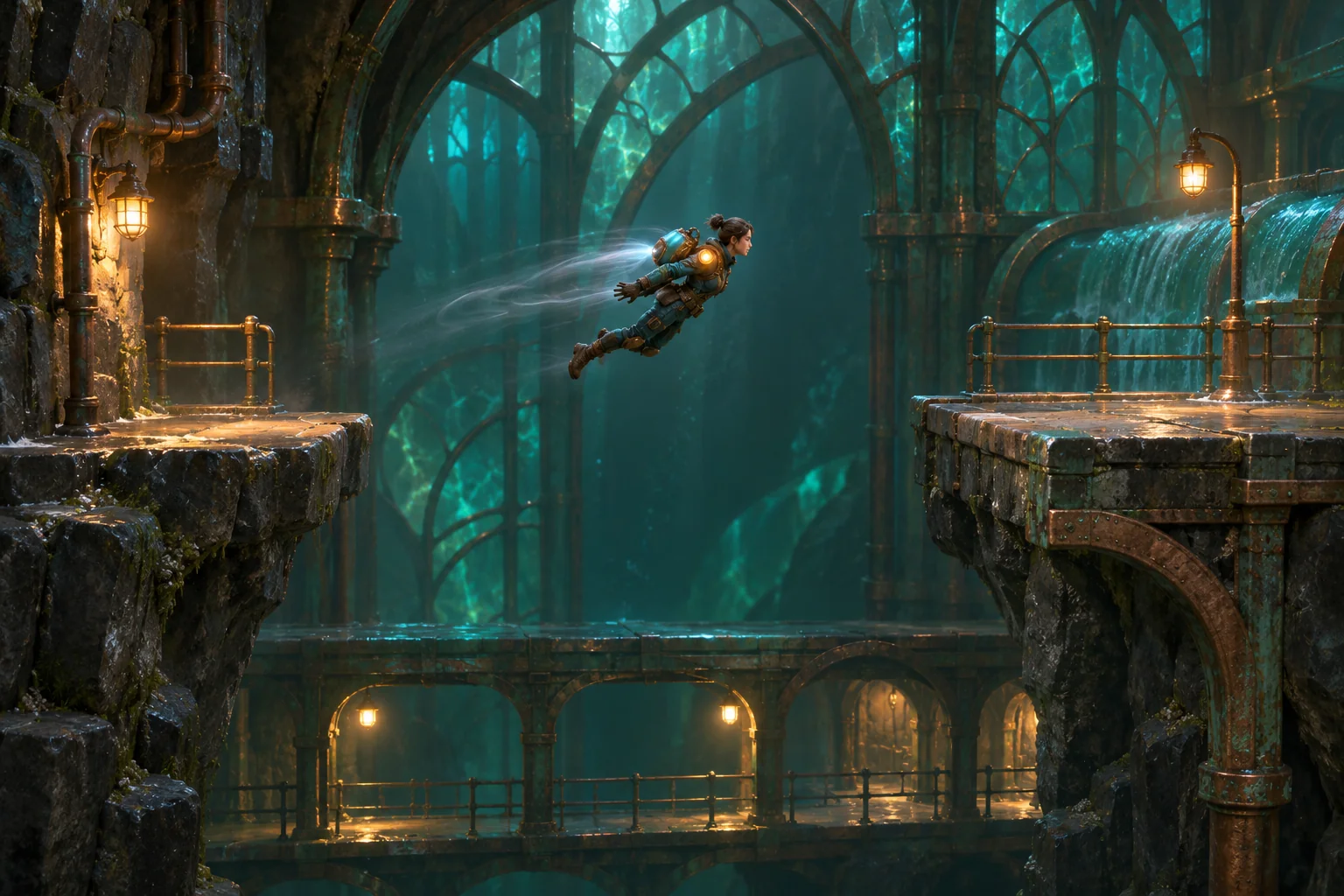
A new skill should change a specific navigation choice. In this example, a normal jump reaches at most two horizontal map units. Kite Burst adds two more while the player is airborne, so its maximum reach is 2+2=4 units. The gated landing is three units from the safe takeoff lip: 3>2 before the ability, but 3≤4 after it. A two-unit gap in Pump Loft is reachable with the basic jump and gives the player a lower-risk place to see the movement option.
| Movement state | Maximum reach | Expected gate result |
|---|---|---|
| Before Kite Burst | Normal jump: 2 units. | Three-unit landing is unreachable; a failed attempt changes no region or ability state. |
| After acquiring Kite Burst | Normal jump 2 + one airborne burst 2 = 4 units. | Three-unit landing is reachable in either direction; landing on solid ground recharges the use. |
| Safe teaching gap | 2 units. | Reachable before the ability, so the action can be introduced without requiring the gated route. |
Kite Burst is a permanent traversal ability, not a weapon or shared combat resource. It can be used once while airborne and refreshes when the player lands on solid ground. Those limits make the arithmetic meaningful: if the use does not refresh, the return crossing could fail even though the first crossing succeeds.
Prompt 2: specify the movement ability
Define Kite Burst for Brineglass Loop as a permanent traversal ability. Normal jump range is at most 2 horizontal units. While airborne, one Kite Burst adds 2 horizontal units for a total reach of 4; it refreshes only after landing on solid ground. The visible S↔A gate requires a 3-unit landing. Pump Loft contains a safe 2-unit teaching gap before the pickup. Return a movement table for before/after pickup, use and recharge conditions, pass/fail states in both directions, and feedback for an unreachable landing. Kite Burst is not a weapon and uses no combat resource. Do not add another upgrade.Check the ability against both the teaching gap and the required gate. It should offer a safe first use, solve the intended route, and refresh before the return crossing. If a prompt changes any of those numbers, update the route trace rather than leaving conflicting distances in separate sections.
Make the gate part of a loop
An ability gate becomes progression when the player can reach the skill first, return to the earlier junction, and use the new movement there. Keep S→P open before the upgrade; after the player crosses P’s safe gap and collects Kite Burst, the route P→S leads back to the visible three-unit gate. The map changes because the player can now reach Crown Aqueduct, not because a new room was added without warning.
| Connection | Before ability / Beacon | After the relevant state change |
|---|---|---|
| H↔S | Open. | Open. |
| S↔P | Open. | Open; it supports the required return to S. |
| S↔A | Blocked both ways; three units exceeds basic reach. | Passable both ways with Kite Burst; the airborne use refreshes on a solid landing. |
| A→H | One-way hatch closed until the Beacon is active. | Open after Beacon activation; returns the player to the starting hub. |
Keep the gate and return hatch as separate checks. Owning Kite Burst allows the S↔A crossing but does not open the A→H shortcut. The Beacon flag opens that hatch; returning to H completes the objective. This avoids a shortcut that appears before its cause or a win state that triggers while the player is still in the destination region.
Prompt 3: connect the route and the revisit
Using the approved Brineglass region graph and Kite Burst rules, return an ordered route trace and state table. Start in H; visit S; test the locked three-unit S↔A gap and remain in S; go S→P; cross the safe two-unit gap and acquire Kite Burst; return P→S; cross S→A; activate the Beacon; open the one-way A→H hatch; return to H. Mark each region transition separately from the failed gate attempt. State whether each connection is open, each flag value, and whether the win condition is met. Do not open A→H before the Beacon.Verify the edge order and state changes separately. The failed gate test does not count as a region transition. The five actual transitions are H→S, S→P, P→S, S→A, and A→H. If the route count includes the failed attempt, separate “action” from “transition” in the table.
Hand-check the loop before requesting a build
The paper route begins in Lantern Dock, moves to Saltglass Gallery, and confirms that the three-unit gate is still blocked. The player then reaches Pump Loft through the open corridor, crosses its two-unit teaching gap, and acquires Kite Burst. Returning to S tests the earlier gate again: the combined reach is four, so the three-unit landing is within range. After landing, the burst use refreshes. In Crown Aqueduct, the player activates the Beacon, opens the one-way hatch, and returns to Lantern Dock.
| Step | Action | Expected state |
|---|---|---|
| 1 | Start in H and move H→S. | H↔S is open; current region is S. |
| 2 | Try the three-unit S↔A gate without Kite Burst. | Basic reach is 2; remain in S and keep the ability flag false. |
| 3 | Move S→P, cross the two-unit teaching gap, collect Kite Burst. | Current region P; ability flag true; burst is available. |
| 4 | Return P→S and cross S→A. | Reach is 4; the three-unit gate is passable; landing refreshes the use. |
| 5 | Activate the Beacon in A and open A→H. | Beacon flag true; one-way hatch open. |
| 6 | Return A→H. | Current region H; Beacon flag true; win condition is met. |
The win expression is beaconActive=true AND currentRegion=H. The ability gate cannot finish the route by itself, and activating the Beacon in A is not enough until the player returns. This six-row action trace contains five region transitions because the blocked gate attempt leaves the player in S. It is a hand-resolved design check, not evidence that an implementation or playthrough exists.
Prompt 4: turn the paper trace into future acceptance checks
For Brineglass Loop, write acceptance cases for: the blocked S↔A gate before Kite Burst, the safe two-unit P gap, collecting the ability, the newly reachable S↔A gate in both directions, refresh on landing, the closed A→H hatch before the Beacon, opening it after activation, and the win rule beaconActive=true AND currentRegion=H. For each case give starting region/flags, player action, expected region/flags/edge state, and visible feedback. Mark these as proposed future checks, not executed tests. Keep the approved distances and edge list unchanged.Check that every rule has a visible signal: a failed reach should not move the player, a successful burst should land on the intended platform, the hatch should stay shut before the Beacon, and the objective should complete only after returning to H. If a future build differs, log the starting state and one action before changing a prompt.
Keep the product handoff within its source
The current official SEELE Metroidvania page offers design guidance for connected regions, movement abilities, ability-gated routes, return paths, and checking whether a new player understands map orientation and progression. This is useful context for planning the brief; it does not prove that Brineglass has been generated or that its exact movement rules are implemented.
The broader Free AI Game Maker page describes plain-English game ideas, a playable first version, browser testing, follow-up prompts, support for 2D or 3D games, free starter Koins, and reviewing the cost before each generation. If you later try a creation workflow, compare any result with the map and movement contract before expanding the project. Treat this article’s four prompts as an unexecuted planning kit, not a completed build.
Make the ability change a route the player can revisit
Keep the first map small enough to trace. State which edges are open, calculate what the movement ability changes, and separate gate passage from the Beacon and return conditions. Then use the same route table to inspect a future build and revise one rule at a time.
When you are ready to sketch your own ability-gated map, use the Metroidvania game maker as a starting point for your brief. Its page gives general map-planning guidance; check any future implementation against the rules you intend to keep.
Metroidvania prompt questions
What should an AI prompt for a Metroidvania define first?
Begin with a small region graph, a starting hub, the first route the player can reach, and one visible ability gate. Then state the first player goal and what the initial build should make understandable. A compact map is easier to check for disconnected areas or an accidental softlock than a full world feature list.
How can I check whether a movement ability opens a fair gate?
Write down the normal movement reach, the ability’s added reach, the required landing distance, and where the player learns the skill. In this example, a two-unit jump cannot cross a three-unit gate, while one two-unit burst makes the total reach four. The safe two-unit gap teaches the movement before the required crossing.
Why should a Metroidvania prompt include a return route?
A new ability feels connected to exploration when the player can use it on a route they have already seen. Define how they return to the gate, what state change opens a shortcut, and whether that shortcut is one-way. Then check that the win condition depends on both the objective and the intended return point.
Were these prompts or the Brineglass route tested?
No. The four game-prompt templates were not submitted to a generator. Brineglass Loop and its movement distances are fictional design assumptions, and the route sequence is hand-resolved on paper. No existing game, playable build, real playtest, or measured result is presented.
What should I inspect in a future build?
Try the gate before and after the ability, the safe teaching gap, the return crossing after recharge, the Beacon-to-hatch condition, and the final hub return. Record the starting region, action, flags, expected result, and actual result. This article proposes those checks; it does not claim they have been run.