A vehicle-combat prompt needs more than “drive and shoot.” Specify what the vehicle can do, how its weapon travels, what blocks a shot, when the rival fires, and exactly when the match ends. Then build those rules in passes: a driveable arena, the player weapon, and finally the rival and resolution. After each pass, inspect the same named positions and timing checks.
Tinwake Circuit is a fictional design exercise. The rules, prompt examples, and hit calculations below were authored for this article; no prompt was run, no game was generated, and no playtest or player result is claimed. Use the checks as targets for your own build, then report only what you actually observe.
Set a one-match design contract
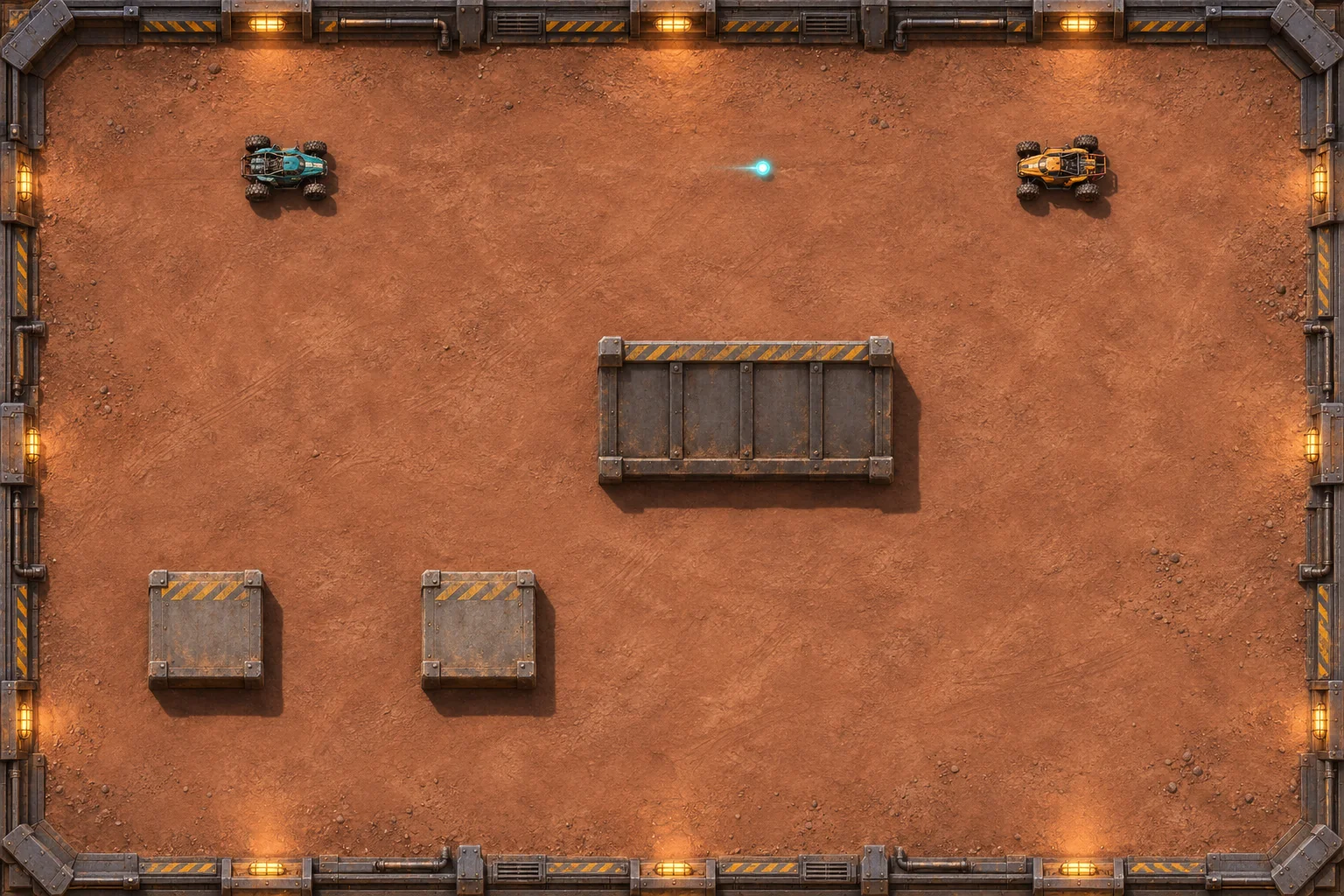
Before asking for a build, settle the match in a short rules sheet. Tinwake Circuit uses one teal buggy, one amber rival, a single forward pulse weapon, a compact arena, and a 60-second limit. This small contract makes a driving decision and a firing decision visible without adding passengers, weapon crafting, boss phases, or a campaign.
| Rule | Tinwake setting | What the prompt must make inspectable |
|---|---|---|
| Space | 100×60 top-down arena; central wall at x=45–65/y=24–36; two low blocks at y=44–54. | Both the y=10 shot ray and x=80 rival lane stay clear; the central wall blocks the y=30 test shot. |
| Vehicles | Teal player at (20,10), facing east; amber rival at North Pylon (80,10), facing south. Three armor marks each. | Positions, headings, and armor are visible at match start and after Restart. |
| Controls | W accelerates, S brakes or reverses, A/D steer, Space fires. | Turning the vehicle changes the direction of its fixed forward weapon. |
| Player pulse | 20 units/second, 1.2-second cooldown, direct hit removes one rival mark; barriers stop bolts. | Cooldown, travel time, collision, and one-mark damage have separate checks. |
| Rival and end | Four-second pylon holds and four-second travel legs; shots on arrival every eight seconds. First to zero armor loses; t=60 compares armor after earlier impacts. | Fire schedule, hit/miss lane, tie, exact timeout boundary, result, and reset are deterministic. |
A full match is not necessary to prove the first firing rule. You can check the start state and one shot in isolation, then add the rival schedule. The critical dependency is that the contract stays fixed across prompts: if a later request changes bolt speed, arena coordinates, or armor, the earlier calculations no longer apply.
Build a driveable arena first
Request movement and collision before damage. Use named bounds and fixed barrier coordinates rather than “a few obstacles,” because the later shot checks depend on open lanes. Ask for the camera to keep both vehicles and the next turn visible; otherwise a top-down arena can look correct while hiding whether the player can route around the wall.
Create the first playable Tinwake Circuit arena pass only. Make a top-down 2D rectangle of 100 by 60 design units with a teal player buggy at (20,10) facing east and an amber rival at (80,10) facing south. Both begin with three armor marks, but no weapons or damage are active in this pass. Place a central wall at x=45–65/y=24–36 and two low steel blocks at x=8–18/y=44–54 and x=30–40/y=44–54. Keep the y=10 player test ray and x=80 rival lane clear. W accelerates, S brakes or reverses, A/D steer; driving into a barrier stops the vehicle without damage. The camera must show both vehicles, the full arena, and the next turn. Add a Restart action that restores positions, headings, timer, patrol state, projectiles, and armor. Inspect movement around the central wall, collision at each low block, and the reset state. Do not add weapons, rival AI, pickups, upgrades, or extra objectives. Report which checks you actually ran; leave other behavior unverified.Inspect the empty arena by steering around the central wall and touching each low block. Confirm that a collision stops the buggy without changing armor, and that Restart restores both headings as well as positions. The two low blocks sit at y=44–54, outside the player’s y=10 firing ray and the rival’s x=80 travel lane. This is a geometry check for the proposed design, not a result from a generated build.
Add player fire and a clear hit check
Once movement is inspectable, add only the player’s weapon. Here, Space fires from the front of the teal buggy along its heading; the player aims by turning the vehicle, not by moving a separate turret. At 20 units per second, a bolt needs 60 ÷ 20 = 3 seconds to cross from (20,10) to (80,10). The rival holds at the North Pylon for four seconds, so a shot launched at t=0 has a one-second timing window before it departs.
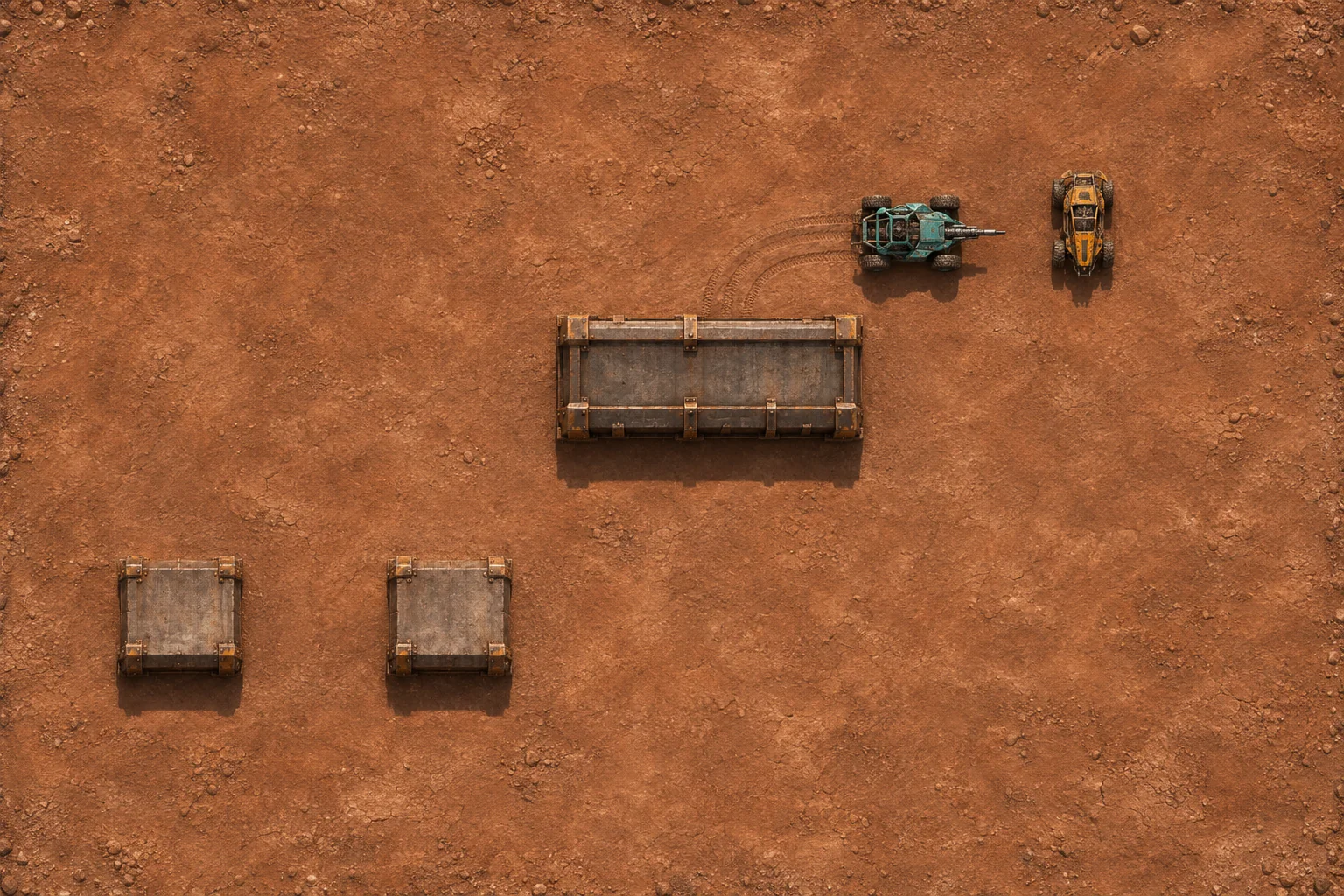
Build only the player pulse-weapon pass in the existing Tinwake Circuit arena. Preserve the current controls, arena dimensions, start positions, barriers, and vehicle movement. Add one fixed forward pulse weapon for the teal buggy: Space fires along the current vehicle heading, bolts travel at 20 units per second, cooldown is 1.2 seconds, and a direct hit removes one of the rival’s three armor marks. Steel barriers stop bolts; there is no homing, splash, turret aiming, or extra weapon. Show a clear line-of-sight check from (20,10) east toward the rival at (80,10): the 60-unit bolt arrives in 3 seconds while the rival is still holding there until t=4. Also show the shot from (20,30) stopped by the central wall. Give the player a visible cooldown and hit response. Do not add rival fire or change the match timer yet. After building, report the observed result for each check; if a check was not run, mark it unverified rather than claiming it passed.Use a paired test: launch east from (20,30) toward the center wall and verify that the bolt stops; then launch east from (20,10) and check the three-second arrival. Wait at least 1.2 seconds before the next player shot. If the rival is not yet implemented, the second test can use a stationary target marker at the North Pylon. Do not describe either outcome as passed until you have run it in the build.
Make rival fire and match end deterministic
“The enemy patrols and shoots” leaves too many choices to guess. Name its two waypoints, travel speed, hold duration, heading on arrival, and firing cadence. The 40-unit trip between pylons takes four seconds at 10 units per second. With a four-second initial hold, the rival reaches the South Pylon and fires at t=8; the return arrival is t=16. It fires once per arrival, not continuously while moving or holding.
Extend the existing Tinwake Circuit arena and player-weapon passes without changing their verified rules. Add one deterministic rival: hold at North Pylon (80,10) for 4 seconds; travel south 40 units at 10 units/second to South Pylon (80,50), arriving at t=8; turn north, fire one straight pulse on arrival, and hold 4 seconds; return north to arrive at t=16, turn south, fire once, and hold 4 seconds. Repeat this travel-and-hold cycle, firing only on arrival, so shots occur at t=8,16,24 and so on. Rival bolts travel at 20 units/second, have no homing or splash, and lose one player armor mark on a direct hit. The match ends when either vehicle loses all three marks. At exactly t=60, stop new actions and shots, process only impacts timestamped strictly before 60, then compare armor; an impact at or after t=60 does not count. More armor wins; equal armor is a tie. Show the result and make Restart reset the arena, timer, patrol timing, projectiles, positions, headings, and armor. Inspect a rival bolt traveling north from (80,50): it reaches a stationary player at (80,40) in 0.5 seconds, while a player outside x=80 dodges that ray. Also check a hit victory, a tie, and a bolt whose nominal impact is exactly t=60. Mark every unrun check unverified.For the first incoming-bolt check, place the player at (80,40). A northbound rival bolt starting at (80,50) covers ten units in half a second. Repeat from a position off x=80 to check that leaving the lane avoids that straight shot. Steel blocks stop bolts; the two low blocks do not cross x=80, so the named test remains clear.
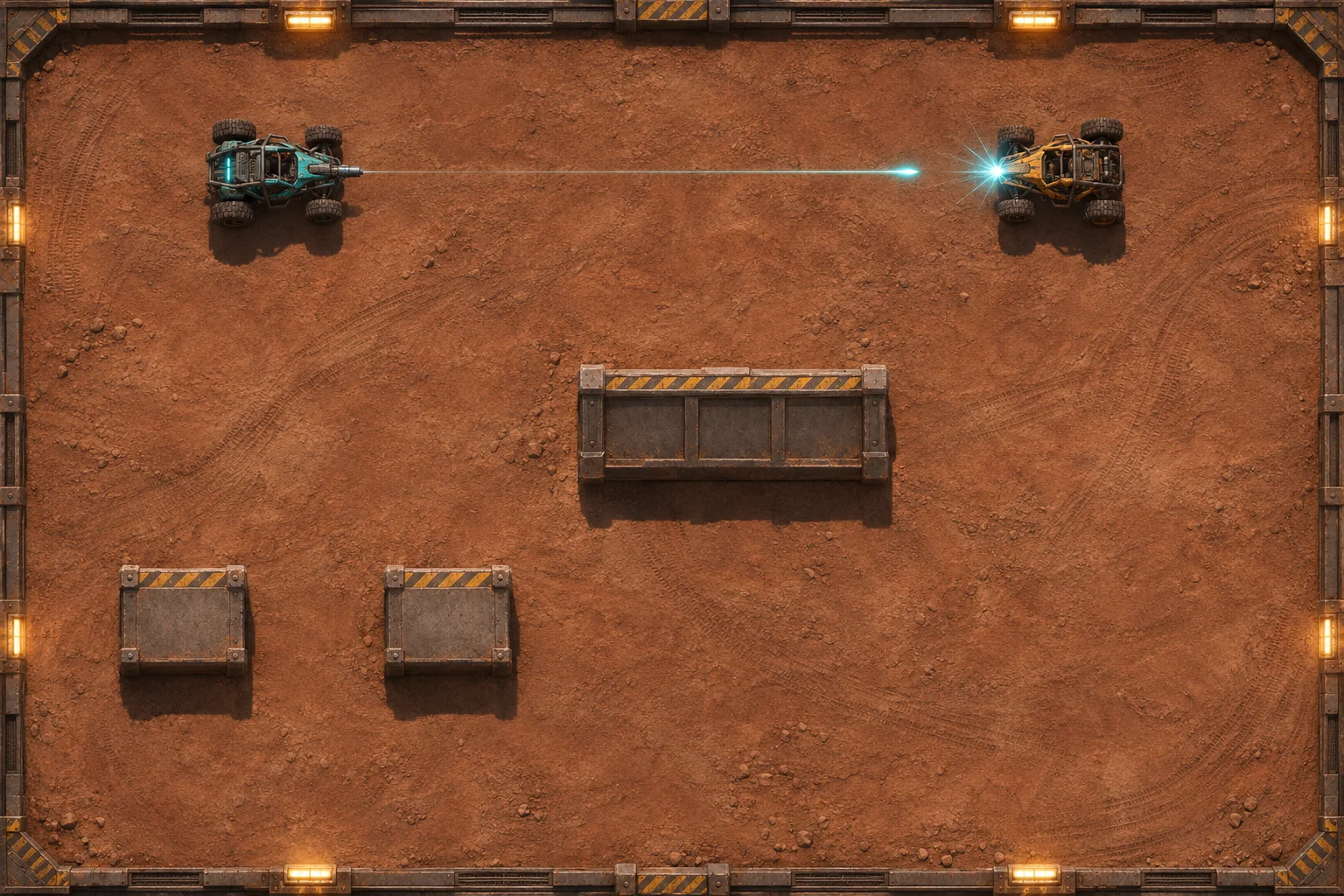
Specify the match boundary as carefully as the weapons: at exactly 60 seconds stop new actions and shots, process only impacts timestamped before 60, then compare remaining armor. A bolt that would land exactly at t=60 is discarded for scoring. Test a tie, a three-mark win, a t=60 comparison, and Restart. Restart must clear pending projectiles and reset patrol timing as well as the visible timer; otherwise the next round can inherit a hidden state.
Repair one rule at a time
If a future build lets a bolt pass through the central wall, record the starting position, heading, shot time, expected collision point, and observed response. Then request a line-of-sight correction only. Keep projectile speed, cooldown, armor, steering, and rival behavior unchanged while you repeat the same blocked and clear rays. This is a hypothetical repair branch, not a report of a failure observed here.
In the current arena, the eastbound player bolt from (20,30) should stop at the central wall. Change only the rule that decides whether a steel barrier blocks a pulse. Preserve movement, weapon speed, cooldown, armor, damage, and rival timing. Repeat the (20,30) blocked-ray check and the (20,10) clear-ray check. Report observed results; label any check you did not run as unverified.A narrow repair is easier to diagnose because it changes one cause at a time. If the second run changes the three-second hit timing or the cooldown, the repair has spread beyond collision and needs another scoped pass. Keep a small record of the build version, prompt, initial state, expected state, observed state, and checks still unverified.
Use a game-creation workflow as a review loop
The official Free AI game maker page describes a broad workflow: describe a game in plain English, review a playable 2D or 3D result, and iterate in Workspace; it advises checking the selected model, available Koin balance, and displayed generation cost in Workspace before submission. That supports a general creation handoff, not a promise that a vehicle-combat rule will work. Bring the contract and one test at a time, inspect the result yourself, and leave any unobserved behavior unverified.
The useful output from a first pass is a small set of observable states: where both vehicles begin, which ray is blocked, when a bolt arrives, and how the timer settles the match. A carefully bounded prompt gives you something concrete to inspect. It does not substitute for running the build or recording evidence.
FAQ
What should a vehicle-combat game prompt define first?
Start with one match contract: arena bounds, player and rival start states, controls, one weapon, damage, a win condition, and a timeout. Add the movement and shot timing needed to check a single exchange. A prompt can be shorter after those rules are explicit because the model has fewer interactions to guess.
Should driving, weapons, and rival AI go in one prompt?
For a first prototype, separate them into inspectable passes. First request the driveable arena and collision; next add the player’s fixed weapon and line of sight; then add the rival’s scheduled fire and match resolution. Keep one rules contract across all passes and check the earlier behavior again after each addition.
How do I check whether a shot should hit?
Write down the launch position, heading, speed, target position, target movement, obstacles, and impact time. Then calculate the path and ask the build to show a repeatable hit and a blocked or dodged shot. In Tinwake Circuit those are acceptance checks derived from fictional rules, not tests performed on a generated game.
Is Tinwake Circuit a real game made with SEELE?
No. Tinwake Circuit is an original fictional design used to demonstrate prompt structure. Its patrol timings and hit examples are written and hand-checked as a rules exercise; no prompt was run, no game was generated, and no playtest or player result is claimed. The concept art is illustrative, not a product screenshot.
What should I do when a first build misses a combat rule?
Record the exact starting state, action, expected response, and observed response before changing anything. Ask for one narrow correction, such as barrier collision, while preserving speed, armor, and cooldown. Then repeat the same check and any dependent cases. If you have not observed a behavior, keep it labeled unverified instead of writing a result for it.