Key takeaways
- There is no objective platform-wide hardest Roblox game because no standardized cross-game completion dataset is public. Under a transparent August 7, 2026 review of three official experiences, Eternal Towers of Hell is the best-supported candidate for mechanical ceiling and sustained consistency. Deepwoken is strongest when systems knowledge and permanent-loss consequence receive more weight. Tower of Hell is the clearest verified mainstream no-checkpoint challenge.
- The review scores dimensions qualitatively rather than inventing a numerical completion rate. Visits, favorites, and current players are not completion evidence; badge awards are usable only with a validated badge meaning and denominator. Confidence is moderate and the candidate set is explicitly not exhaustive.
There is no objective, platform-wide hardest game on Roblox because Roblox does not publish a comparable completion-rate dataset and different experiences test different skills. Using a transparent 2026 rubric that weights mechanical precision, sustained consistency, knowledge burden, recovery cost, and the strength of public evidence, Eternal Towers of Hell is the best-supported pick among the three official experiences reviewed here as of August 7, 2026. Deepwoken is the stronger candidate if failure consequence and systems knowledge matter most, while Tower of Hell is the clearest mainstream example of no-checkpoint obby pressure.
That answer is intentionally narrower than “the hardest experience on all of Roblox.” It is a reproducible verdict for an audited set, not a universal fact or a live popularity ranking.
The short answer and confidence level
Editorial verdict: Eternal Towers of Hell is the strongest overall candidate in this review when mechanical execution and long-run consistency receive the most weight. Its official Roblox description promises hundreds of towers ranging from “effortlessly easy” to “catastrophically difficult.” That supports a broad ceiling of authored platforming challenges rather than one short difficulty spike.
Confidence: moderate. The official pages document rules and intended challenge, but they do not expose a standardized completion rate, attempt count, median clear time, input error rate, or player-skill distribution. The verdict therefore combines verified design signals with an explicitly labeled editorial assessment.
Important distinction: this article does not claim that Eternal Towers of Hell has the lowest completion rate. No comparable, authoritative cross-game completion dataset was available during the August 7 review.
A transparent difficulty review process

A useful methodology must separate observable rules from interpretation. We used five dimensions:
- Mechanical precision. How exact must movement, timing, aiming, spacing, or reaction be? A challenge that tolerates many errors should not outrank one that repeatedly demands narrow execution windows.
- Knowledge burden. How much must a player learn before execution becomes reliable? Route knowledge, enemy patterns, build decisions, resource systems, and hidden interactions can all create difficulty that raw dexterity alone misses.
- Consistency and endurance. Can a player succeed after one lucky sequence, or must they perform accurately for a long uninterrupted run? Length and repeated execution often separate a hard moment from a hard game.
- Failure consequence and recovery cost. What is lost after a mistake: seconds, a stage, an entire run, or a persistent character? Consequence raises pressure, but it is not the same thing as mechanical complexity.
- Evidence quality. Is the difficulty claim supported by an official rule, an official description, stable public progression data, or only community reputation? Strong claims require stronger evidence.
The first four dimensions describe difficulty. The fifth controls confidence. We do not turn them into a false-precision decimal score because the dimensions are not naturally commensurate. Instead, we identify which dimensions each contender clearly demonstrates and state where the evidence stops.
Why completion-rate evidence fails a review test

Completion rate sounds objective, but it is easy to misuse. Roblox experience pages expose fields such as visits, current players, favorites, creator, genre, and description. Those figures do not reveal how many unique players made a serious attempt, how many reached an intended ending, how many replayed, or how difficulty changed across updates.
Badge award counts can sometimes support a within-game analysis, but they are not automatically a completion rate. A badge may be optional, added years after launch, disabled, obtainable through several routes, or awarded before the current rules existed. Dividing badge awards by visits mixes sessions with people and produces a misleading denominator.
For this update, completion-rate evidence was treated as unavailable for cross-game ranking. That is not missing decoration; it is a limitation that prevents an unsupported numerical claim. A future ranking could incorporate completion data only if each experience published a compatible definition, denominator, time window, and version history.
Contender review: Eternal Towers of Hell
The official experience now appears as Eternal Towers of Hell at the Roblox place previously associated with Juke’s Towers of Hell. Roblox’s current official metadata describes “hundreds of towers across vast worlds” spanning an extremely wide stated difficulty range. The experience is also listed as an Obby & Platformer / Tower Obby.
That design signal matters for three reasons:
- Breadth: hundreds of towers provide many independent opportunities for difficulty to escalate.
- Sustained execution: tower formats commonly require sequences of platforming actions rather than one isolated input. The official description supports the scale; the exact length and checkpoint rules can vary by tower and should be verified in the current experience.
- High ceiling: the creator’s own current description explicitly claims a catastrophic upper end. That is evidence of intended difficulty, not proof that every tower is equally hard.
Under this article’s weighting, those properties make Eternal Towers of Hell the best candidate for mechanical and consistency difficulty. The conclusion would weaken if an audited competitor supplied stronger versioned clear data, or if the ranking prioritized punishment over execution.
Contender review: Tower of Hell
Tower of Hell provides the clearest verified rule in this set. Its official Roblox description asks players to reach the top of a randomly generated obby with “absolutely no checkpoints at all.” Random assembly limits pure route memorization, while the absence of checkpoints makes later mistakes costly within a round.
Tower of Hell therefore scores strongly on:
- repeated platforming execution;
- adaptation to changing stage combinations;
- consistency under a no-checkpoint rule; and
- time pressure and competition in a multiplayer round format.
Why is it not the default winner here? The official page establishes a demanding loop, but it does not prove that its hardest generated sequence exceeds the upper authored tower ceiling in Eternal Towers of Hell. Tower of Hell is a defensible answer to “which widely accessible Roblox game makes ordinary players repeat a no-checkpoint skill test?” It is less defensible as a universal ceiling claim without comparable clear data.
Contender review: Deepwoken
Deepwoken tests a different difficulty profile. Its official description directly calls the experience difficult and states that permanent character loss is expected. It also describes a large ability selection, equipment progression, hostile exploration, challenging dungeons, PvP, and extensive customization.
Those verified signals support:
- a high knowledge burden across builds, equipment, encounters, and world systems;
- consequential failure that can affect a character rather than only one obstacle;
- mechanical combat and player-versus-player adaptation; and
- recovery effort that can make each decision feel expensive.
Deepwoken becomes the strongest candidate if the rubric heavily weights systems knowledge plus failure consequence. It does not automatically win a mechanical-skill ranking, because permanent loss increases stakes without proving narrower execution windows. Difficulty and punishment overlap, but they should not be treated as synonyms.
Comparison review process: measured signals versus editorial judgment
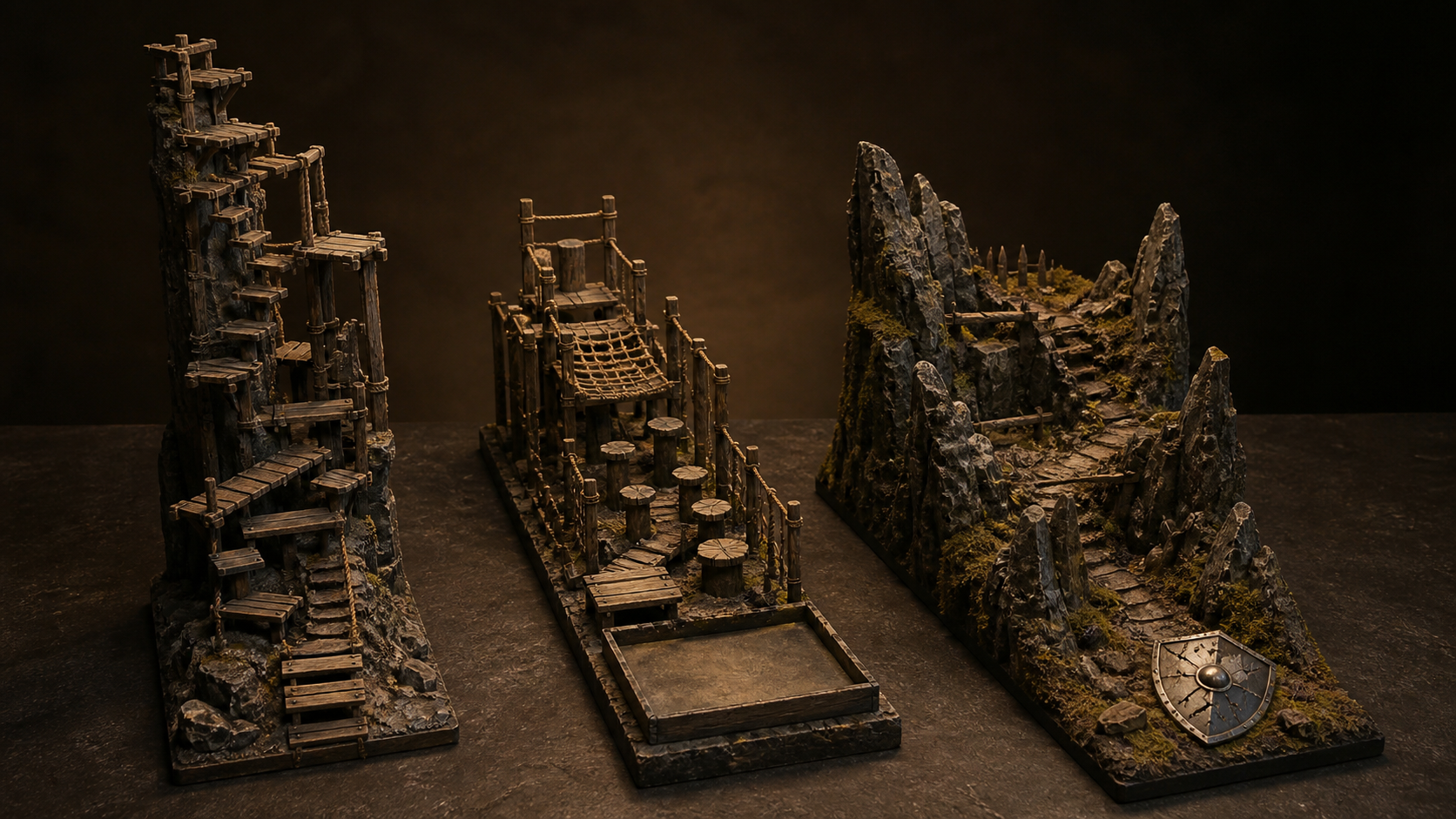
| Experience | Verified official signals | Strongest dimensions | What is not proven | |---|---|---|---| | Eternal Towers of Hell | Hundreds of towers; official stated range from very easy to catastrophically difficult; Tower Obby classification | Mechanical ceiling, endurance, consistency | Standardized clear rate, median attempts, exact hardest-tower comparison | | Tower of Hell | Randomly generated obby; official no-checkpoint rule | Adaptation, repeated execution, round consistency | Cross-game upper ceiling or unique-player completion rate | | Deepwoken | Officially described as difficult; permanent character loss; abilities, equipment, dungeons, PvP, customization | Knowledge, consequence, combat adaptation | A directly comparable platforming or overall completion metric |
The “strongest dimensions” column is editorial analysis based on the verified signals in the previous column. It is not Roblox telemetry.
A practical decision checklist for future updates
A reproducible 2026 difficulty review should record the following before changing the verdict:
- Capture the official experience name, creator, canonical place URL, description, genre, and last metadata update date.
- Write down the exact rule being compared: no checkpoints, permanent loss, timed rounds, one-life attempts, or another observable constraint.
- Separate the hardest optional content from the difficulty required to reach a normal ending.
- Define the skill dimension before ranking. Platforming precision, combat reads, route knowledge, teamwork, and endurance are different tests.
- Reject visit counts, favorites, and current player counts as completion proxies.
- Treat badge data as supporting evidence only after validating the badge meaning, availability period, denominator, and current rules.
- Note major updates that change movement, checkpoints, progression, encounters, or loss conditions.
- Publish uncertainty and the candidate set. A ranking of three audited experiences is not a ranking of millions of Roblox experiences.
This checklist lets another reviewer repeat the analysis and disagree with the weights without disputing the underlying facts.
What would change the verdict
Eternal Towers of Hell would lose the top position in this rubric if another audited experience provided stronger evidence of both a higher mechanical ceiling and sustained consistency requirements. Deepwoken would move to the top if the weighting gave failure consequence and systems knowledge priority over platforming precision. Tower of Hell could lead a mainstream no-checkpoint category without needing to be declared hardest in every category.
Better evidence could also change confidence:
- versioned unique-player attempt and completion counts;
- median attempts or clear time for defined milestones;
- stable per-stage or per-boss progression funnels;
- official rules documenting checkpoints, resets, assistance, and difficulty modifiers; and
- update histories showing whether old data still represents current mechanics.
Until those data exist in comparable form, an honest article should prefer a bounded, explainable answer over an absolute leaderboard.
Guidance for game designers studying difficulty
For designers, the useful lesson is not the winner’s name. It is how each experience combines pressure:
- Eternal Towers of Hell represents a content ceiling built from many authored platforming challenges.
- Tower of Hell represents a run structure where random stages and no checkpoints convert mistakes into repeated practice.
- Deepwoken represents a consequence structure where knowledge, combat, and persistent loss amplify decision pressure.
When prototyping a difficult game, decide which pressure is intentional. Add checkpoints when the learning goal requires rapid iteration. Remove or space them only when sustained consistency is the target. Use permanent loss carefully: it can make choices meaningful, but excessive recovery time can measure patience more than mastery. Instrument attempts, failure locations, repeat sessions, and successful recoveries so future difficulty claims rely on behavior rather than reputation.
Sources, date, and limitations
This update was checked on August 7, 2026 (Asia/Shanghai) against the official Roblox pages for Eternal Towers of Hell, Tower of Hell, and Deepwoken, plus the Roblox Games API metadata for their audited universes. Public counts such as playing, visits, and favorites are deliberately omitted because they change continuously and do not measure difficulty.
The candidate set is not exhaustive. Roblox contains many niche obbies, challenge maps, combat games, rhythm experiences, and community-defined modes that may exceed one or more contenders. Official descriptions are creator-authored claims hosted by Roblox; they document intended rules and positioning, not independently measured completion. Experience mechanics can change after publication, and place names can be renamed. Readers should follow the cited canonical place URLs and re-check the current rules before relying on this verdict.
Final verdict
For the question “what is the hardest game on Roblox?” the most defensible 2026 answer is conditional: Eternal Towers of Hell is the best-supported overall candidate in this audited set for mechanical ceiling and consistency; Deepwoken leads on consequence and systems burden; Tower of Hell is the clearest no-checkpoint mainstream challenge. There is not enough standardized completion evidence to name an objective platform-wide winner.
Frequently Asked Questions
What is the hardest game on Roblox in 2026?
There is no objective platform-wide winner. In this bounded review, Eternal Towers of Hell is the best-supported candidate for mechanical ceiling and sustained consistency; Deepwoken leads when systems knowledge and permanent-loss consequence are weighted most.
Is Tower of Hell the hardest Roblox game?
Tower of Hell is a strong mainstream no-checkpoint challenge, but its official page does not prove that its hardest generated sequence exceeds every authored challenge elsewhere on Roblox.
Why not rank Roblox games by completion rate?
Roblox does not publish a standardized cross-game completion rate. Visits count sessions rather than unique attempts, and badge awards need a validated meaning, availability period, denominator, and current rule set.
Does permanent character loss make Deepwoken the hardest?
Permanent loss raises consequence and recovery cost, while Deepwoken also requires combat and systems knowledge. It does not by itself prove a higher mechanical execution ceiling than every platforming challenge.
How was the 2026 verdict checked?
The article reviewed current official Roblox experience descriptions and Games API metadata on August 7, 2026, separated verified rules from editorial judgment, omitted live popularity counts, and published its limitations.