Key takeaways
- Fair difficulty in a Roblox game is a learnable contract: the threat is telegraphed before commitment, rules behave consistently, feedback explains failure, and recovery preserves the current lesson. Difficulty can remain high through precision, decision pressure, coordination, or sustained consistency. Roblox Creator documentation supports cross-platform input, multiple Studio testing modes, SpawnLocation-based checkpoints, and progression funnels; checkpoint spacing and fairness judgments remain design analysis rather than platform rules. SEELE AI can prototype a standalone interaction or pacing concept, but that prototype is not Roblox-native implementation, export, or validation.
Fair difficulty makes a challenge demanding without making failure feel arbitrary. In a well-designed Roblox experience, players can usually see or infer the threat, trust that the same rule will behave consistently, understand why they failed, and retry before the lesson goes cold. The game can still require precise movement, fast decisions, coordination, or long-run consistency. Fairness does not mean easy; it means the challenge measures the intended skill rather than control friction, hidden rules, or punishment disconnected from learning.
This article combines two kinds of material. Statements about Roblox tools and engine behavior are tied to current Roblox Creator documentation. The design principles—telegraphing, consistency, recovery cost, checkpoint spacing, learning loops, and playtest interpretation—are general game-design analysis. They are not platform-wide Roblox telemetry, and they do not claim that every successful Roblox experience follows one formula.
Fair difficulty is a contract, not a low difficulty setting
A useful fairness contract has four parts:
- The player can read the task. A hazard gives enough visual, audio, spatial, or rhythmic information to support a decision.
- The rule is stable. The same input and state produce a learnable result, within clearly communicated variation.
- Failure teaches something. Feedback distinguishes a timing error, route error, control error, or knowledge gap.
- Recovery fits the learning goal. A retry returns the player to a point where the relevant skill can be practiced without excessive unrelated repetition.
A narrow jump can be fair when its edge is visible, the movement model is dependable, and the player can quickly try again. A wide jump can feel unfair when the camera hides the landing, touch controls cover the target, or a random impulse changes the result without warning. The geometry alone does not determine fairness.
Difficulty and punishment also need separation. Difficulty is the skill or knowledge needed to succeed. Punishment is the cost of failing. Raising both at once can create intensity, but it can also obscure what the game is testing. If a player spends four minutes retracing solved rooms after every new mistake, the design may be measuring patience and memory more than mastery of the current obstacle.
Telegraphing turns reaction into a readable skill test
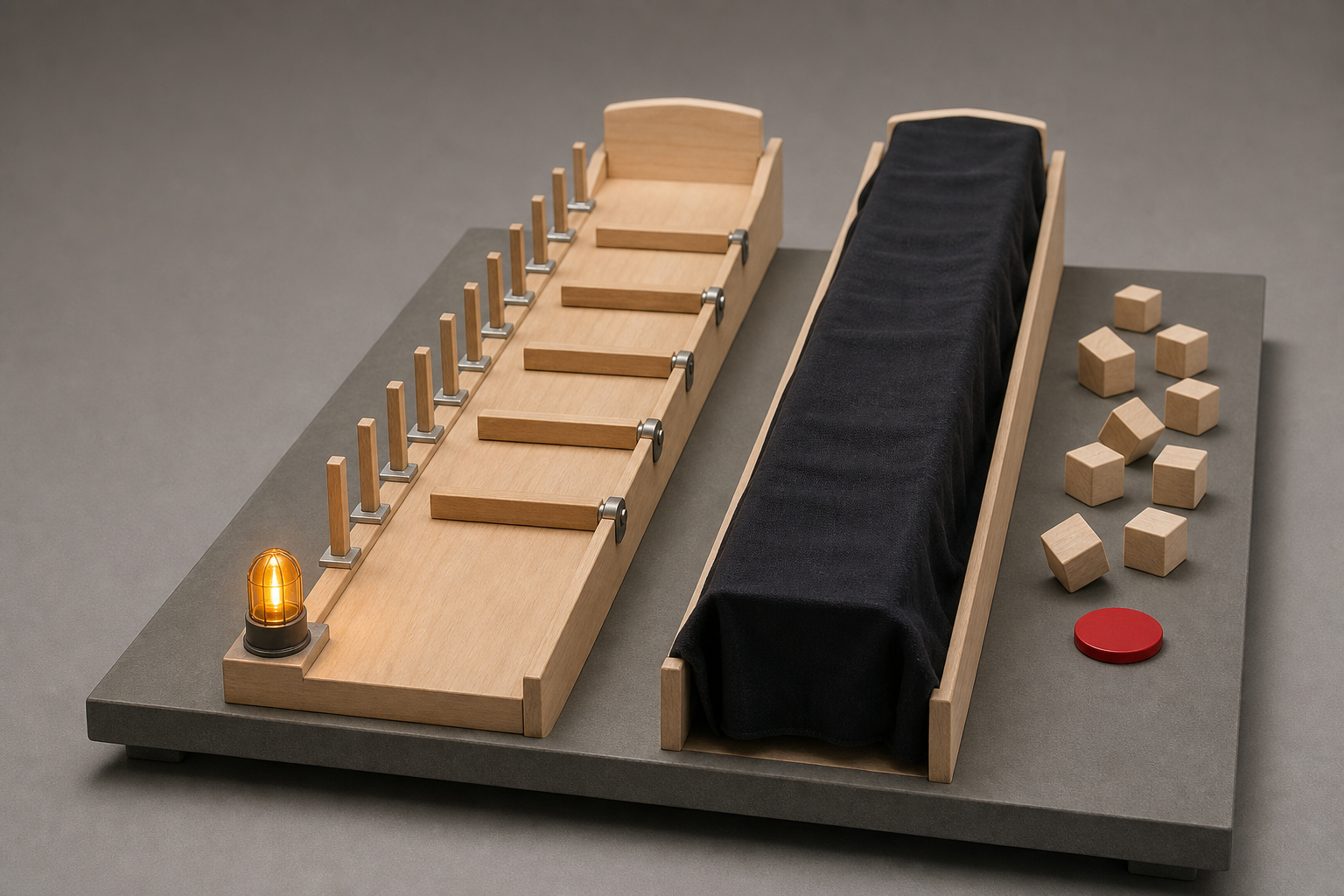
Telegraphing is information delivered before commitment. It can be a wind-up animation, a light changing color, a sound cue, a shadow showing where an object will land, a repeated motion cycle, or a safe first example of a rule. Good telegraphs do not reveal the correct answer automatically; they make the answer discoverable in time.
Consider a rotating beam. A fair version shows its axis, speed, direction, and collision volume before the player jumps. An advanced version may speed up or combine with a second beam, but each change remains visible. An unfair version starts behind the camera, uses decoration that does not match the collision shape, or changes speed at an unmarked random instant.
The test is not “did the player notice?” in isolation. Ask three more precise questions:
- Could the cue be perceived from the normal camera position?
- Did it arrive early enough for the intended input device and network conditions?
- Did the cue predict the actual danger rather than merely decorate it?
Telegraphing should scale with consequence. A low-cost surprise can be funny and teach a rule. A surprise that deletes a long run needs stronger advance evidence, because the player has more at stake. Hidden information can be legitimate in deduction, exploration, or bluffing games, but then discovering and reasoning about that information is the intended skill. Hiding a platform’s collision rule in a precision obby usually is not.
Consistency makes practice transferable
Players build an internal model through repetition: this surface has this friction, this warning lasts this long, this color means this hazard, and this button triggers this action. Consistency lets practice on one attempt improve the next. It does not require every encounter to be identical. It requires variation to have boundaries the player can learn.
Randomness is fair when it changes the problem while preserving agency. A sequence can select among several announced patterns, for example, if every pattern has a readable tell and a viable response. Randomness becomes punitive when it removes counterplay: an unavoidable strike chooses a target after the dodge window closes, a safe tile becomes lethal without a cue, or a spawn places one player directly in danger.
Controls are part of the same contract. Roblox’s current Input documentation says the platform supports mouse/keyboard, touch, gamepad, and VR, and documents an Input Action System for mapping actions to multiple hardware bindings. It also recommends responding to the player’s preferred input type and notes that Roblox provides familiar default bindings for basic movement and camera control. Those are platform facts. The design implication is ours: if a challenge depends on a precise action, test the actual action across the supported input types instead of assuming a desktop keypress represents every player.
A practical consistency audit checks:
- visible art against the real collision boundary;
- cue duration against the actual active window;
- camera behavior before and during commitment;
- action bindings and button reach on supported devices;
- latency-sensitive interactions under degraded network conditions; and
- whether identical-looking objects obey identical rules.
Recovery and checkpoints preserve the learning signal
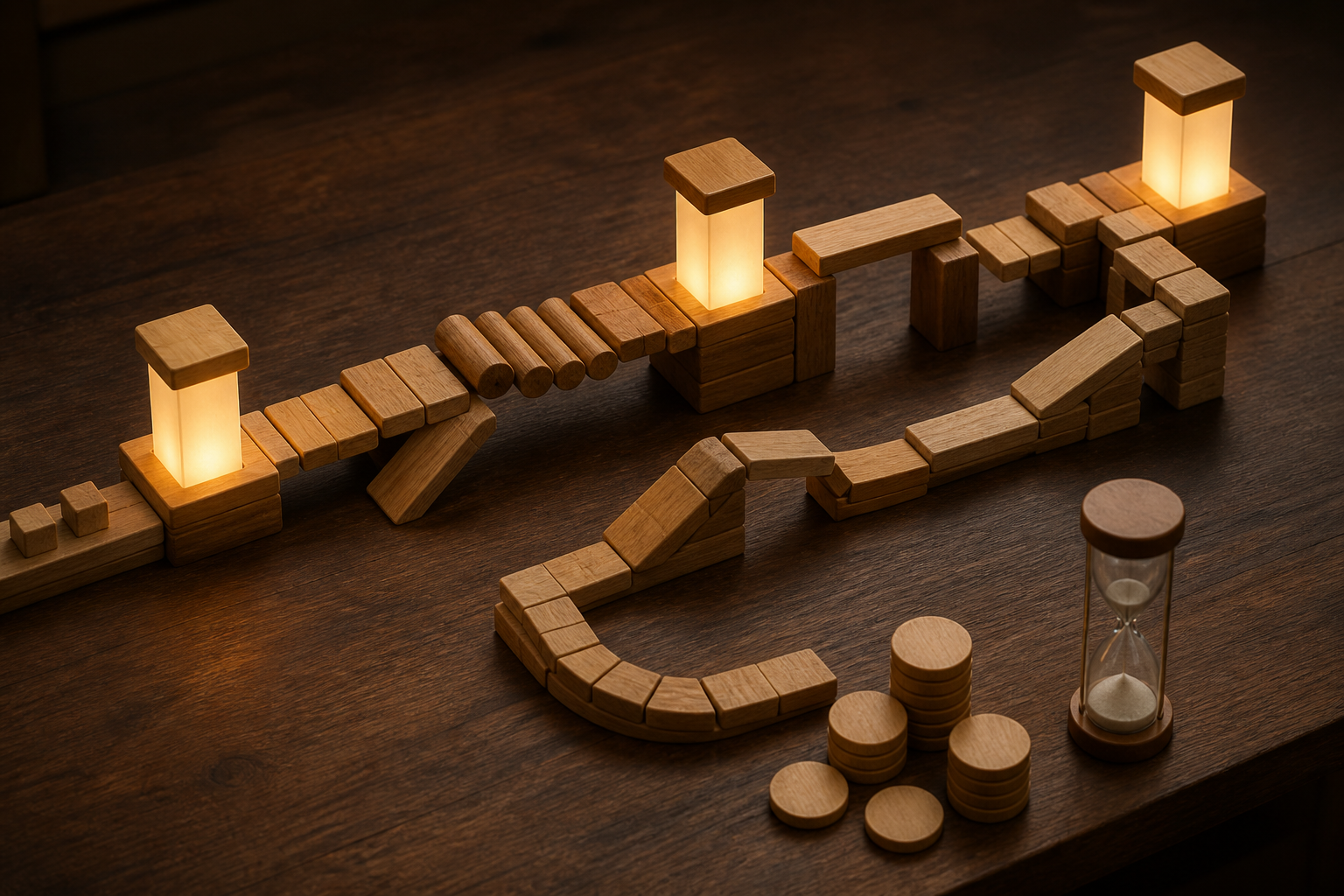
Recovery design determines how much useful practice a player gets per minute. The goal is not always to minimize loss. The goal is to make the loss proportional to the skill being tested.
Place a checkpoint after a concept is demonstrated reliably and before a substantially new concept begins. That keeps a retry focused. In a short sequence testing sustained consistency, a checkpoint in the middle may defeat the purpose. In a long course with six unrelated mechanics, withholding checkpoints can force players to replay mastered content just to reach the one action they still need to learn.
Roblox’s SpawnLocation reference states that spawn locations determine where players respawn and explicitly documents that they can be used as checkpoints in an obstacle course. That confirms an available platform mechanism; it does not prescribe the correct spacing. Designers still need to choose what progress a checkpoint represents, how it activates, whether it persists, and what happens if several spawn locations are eligible.
Useful recovery patterns include:
- Immediate reset: best for one short, repeatable execution test.
- Safe lower route: a failed jump costs time but lets the player remain in motion and rejoin.
- Section checkpoint: preserves completed concepts while requiring consistency within the current section.
- Practice gate: lets a player rehearse a pattern before the full consequence version.
- Limited rescue: preserves stakes while giving occasional protection from an outlier mistake.
Each pattern has a limitation. Frequent checkpoints can erase tension and let players brute-force a sequence one move at a time. A safe recovery lane can become the optimal route if it is faster than success. Persistent checkpoints can complicate multiplayer races or progression state. Test the behavior, not just the intention.
Feedback closes the learning loop
A learning loop is observe → attempt → outcome → diagnosis → adjusted attempt. Fair difficulty shortens the distance between outcome and diagnosis. A player should be able to answer “what should I change?” without opening a guide for every ordinary failure.
Feedback should identify the causal layer. If the player jumped too early, the animation, sound, camera, or landing marker should support that diagnosis. If the player used the wrong route, the scene should reveal the missed branch. If the input never registered, pretending the mistake was timing teaches the wrong lesson. More effects are not automatically clearer; a screen full of particles can hide the exact contact that mattered.
A useful failure review records:
- the last decision the player could control;
- the information available at that moment;
- the input the game received;
- the state transition that caused failure; and
- the time until another meaningful attempt.
Designers can then distinguish challenge from friction. Players failing at different moments after choosing different responses may be exploring a real problem. Many players failing at the same invisible edge, pressing the expected action with no response, or asking what happened are stronger signs of a communication or control problem.
A practical recipe for building a difficult but fair section
Start with the skill, not the obstacle count. Write one sentence: “This section tests the player’s ability to ___.” Possible answers include reading a rhythm, controlling momentum, coordinating roles, remembering a route, or staying consistent across five familiar actions.
Then build in six passes:
- Teach safely. Present the rule with low consequence and enough time to observe it.
- Confirm recognition. Ask for one clean response without combining unrelated pressure.
- Add execution demand. Tighten timing, spacing, or decision load while preserving the cue.
- Combine known rules. Create depth from interaction between already learned elements.
- Set recovery deliberately. Decide how much prior mastery the player must repeat and why.
- Validate the intended skill. Watch attempts and check whether success correlates with learning, not device advantage or accidental routing.
For example, a three-stage moving-platform section might first show one platform cycling beside a safe floor, then require a single jump, then combine two platforms with offset rhythms. The hardest stage can demand consistency across both. It should not simultaneously introduce an invisible speed change, a new camera lock, and a different jump binding. That would make failure hard to diagnose.
Playtesting converts fairness from opinion into evidence

A designer who knows every rule cannot experience the same uncertainty as a first-time player. Playtesting should therefore capture both behavior and interpretation. Ask the tester to describe what they expected before explaining the system. Their expectation reveals whether the telegraph and rule language worked.
Roblox Studio documentation currently describes solo client/server testing, multi-client simulation, device emulation, touch simulation, controller emulation, and network simulation for latency, packet loss, and jitter. These are platform-specific test capabilities. They support several fairness checks: whether a cue is visible on a small screen, whether a touch action is reachable, whether multiple clients see the same state, and whether a timing challenge remains intelligible under realistic network variation.
Use a small evidence table for each test build:
| Signal | What it can reveal | What it cannot prove alone | |---|---|---| | Failure location | A possible difficulty spike or unclear rule | Why the player failed | | Attempts to pass | Practice cost and variance | Whether the section felt fair | | Time to retry | Recovery friction | Whether the checkpoint is correctly placed | | Tester explanation | The player’s mental model | Population-wide behavior | | Device/input | Possible control disadvantage | Causation without comparable tests |
Roblox’s Funnel Events documentation says funnel events can track progression through key stages and show where users stop advancing. It also states that events are sent from the server in published experiences, not from the client or Studio. A designer can define meaningful progression steps and compare drop-off, but funnel data is not a fairness score. Instrumentation should be combined with replay observation, tester explanation, input/device context, and the current build version.
Common ways “hard” becomes unfair
Watch for these failure modes:
- Late or false telegraphs: the cue appears after commitment or does not match the active hitbox.
- Rule exceptions with no language: two identical surfaces behave differently for reasons the player cannot infer.
- Input-dependent precision: a window is comfortable on keyboard but unreliable on touch or gamepad.
- Camera-created blindness: the default view hides the landing, attacker, or route during a forced action.
- Random punishment: variation selects an unavoidable failure rather than a different solvable problem.
- Excessive reset distance: the retry repeats unrelated mastered content and buries the current lesson.
- Feedback noise: effects announce failure but conceal its cause.
- Version-blind analytics: results from different checkpoint rules or movement tuning are combined as if the task were unchanged.
Not every complaint means the design is unfair. Players can misread a clear cue, resist a new skill, or dislike a deliberate high-stakes format. The response is not to remove all difficulty. Reproduce the failure, inspect available information and controls, compare multiple players and devices, and decide whether the result measured the declared skill.
Where SEELE AI fits—and where it does not
SEELE AI can help a team explore a standalone browser prototype of an obstacle, feedback pattern, checkpoint flow, or pacing idea. That can make an early design hypothesis concrete enough to discuss and test.
The boundary matters: a standalone prototype is not Roblox-native implementation, export, or validation. It does not prove Roblox physics, replication, input behavior, device performance, network behavior, SpawnLocation configuration, or production analytics. Those claims require implementation and testing in Roblox Studio and, where documentation requires it, a published Roblox experience. Treat the prototype as a design artifact, then rebuild and verify the relevant behavior in the target platform.
A fair-difficulty review checklist
Before release, ask:
- Is the intended skill written in one sentence?
- Can the player perceive the threat before the last controllable decision?
- Does the cue match the real timing and collision behavior?
- Are random outcomes bounded, signaled, and answerable?
- Do retries preserve the lesson without deleting the intended stakes?
- Does each checkpoint separate meaningful units of mastery?
- Can players diagnose ordinary failures from in-game feedback?
- Have keyboard/mouse, touch, and gamepad paths been tested where supported?
- Have small screens, multiple clients, and adverse network conditions been considered where relevant?
- Are progression metrics segmented by build and interpreted alongside qualitative evidence?
The standard is not “nobody gets frustrated.” Difficult games create tension and failure on purpose. The stronger standard is: players can understand the rule, trust the system, learn from the result, and believe the next attempt is theirs to improve.
Frequently Asked Questions
What makes difficulty fair in a Roblox game?
A fair challenge exposes enough information before commitment, applies learnable rules consistently, gives causal feedback after failure, and returns players to a retry point that preserves the intended lesson.
Does fair difficulty mean an easy game?
No. A fair game can require precise timing, fast decisions, teamwork, or long-run consistency. Fairness concerns whether the challenge measures the intended skill rather than hidden rules, unreliable controls, or arbitrary punishment.
How should Roblox checkpoints be spaced?
Place checkpoints around meaningful units of mastery: preserve concepts the player has already demonstrated, but avoid splitting a sequence whose purpose is sustained consistency. Roblox documents SpawnLocation as a checkpoint mechanism; spacing remains a design decision.
Can randomness be fair in a difficult Roblox game?
Yes, when possible outcomes are bounded, signaled, and answerable. Randomness becomes punitive when it selects an unavoidable failure or changes a known rule after the player can no longer respond.
How should creators playtest fair difficulty?
Observe first-time expectations, failure locations, inputs, retry time, and player explanations. Test relevant device, client/server, multi-client, and network conditions, then interpret progression analytics alongside qualitative evidence rather than treating drop-off as a fairness score.
Can SEELE AI validate a Roblox game mechanic?
SEELE AI can help explore a standalone prototype, but that is not Roblox-native implementation, export, or validation. Roblox physics, replication, input, performance, checkpoints, and analytics must be implemented and verified in Roblox Studio and the target Roblox environment.