Give each card one economic job
To make a card-based business game with AI, define what each card changes before adding a large deck. Material cards should be spent, workshop cards should turn inputs into outputs, and a contract should convert one finished good into a reward. Then price the actions and set a deadline that gives the player enough turns to complete the chain.
This guide uses Copperline Works, an original fictional factory design. Its prices, card effects, and outcomes are teaching rules for a paper ledger, not estimates from a real business or results from a built or tested game. You will get a four-action recipe, a two-turn calculation, one copyable build prompt, and checks for duplicated inputs or payouts.
Make cards change visible stock
A business deck feels like a production system when a card changes what the player can make next. A Copper Wire card is inventory. A Wind Coil card is an operation that consumes two wires and creates a Coil. An Assemble Transformer card consumes that Coil and a Ceramic Core. The finished Transformer then satisfies a contract. Each step should have a visible input, action, and result.
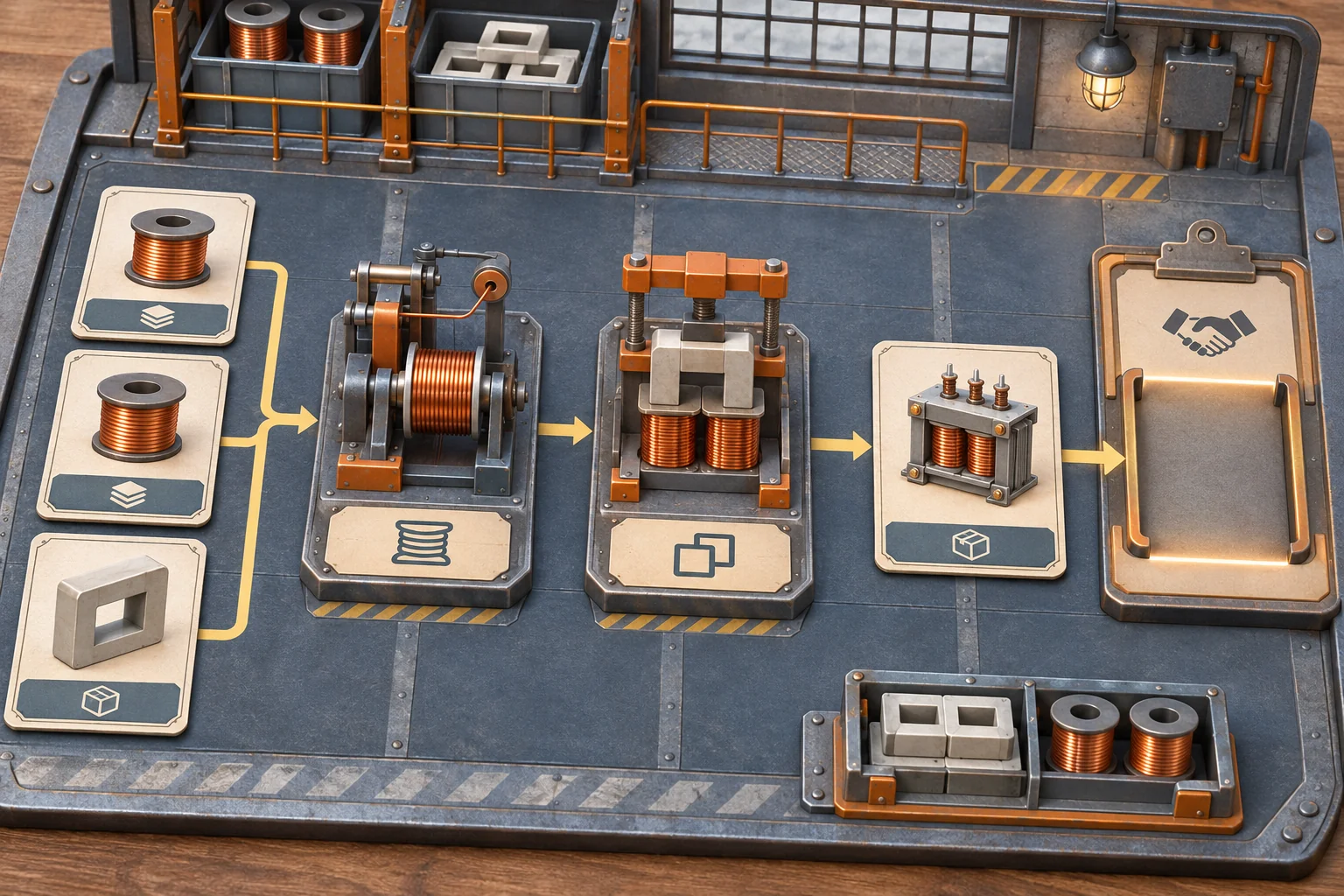
Keep the first chain short enough to trace by hand. If a player can play a card without spending its listed inputs, the production loop has a duplication bug. If the player cannot tell which item was produced, the output needs a clearer card or state change.
Write the recipe and contract as rules
Start Copperline Works with 7 coins, two action points each turn, no materials, one active order, and a two-turn deadline. The order requires one Transformer and pays 9 coins when delivered on time. Copper Wire costs 1 coin per card and Ceramic Core costs 2. That makes the planned input purchase cost 4 coins.
Every operation below costs one action point. Workshop actions check all of their requirements before removing anything. If an input is missing, the play is invalid and leaves inventory and cash unchanged. The same rule applies to a delivery after the order has expired: there is no active contract to consume, so neither the Transformer nor the cash changes.
| Card or action | Cost | Requirement | State change |
|---|---|---|---|
| Buy Inputs | 1 AP plus the selected price | Enough coins for the full selection | Add the selected Copper Wire or Ceramic Core cards. |
| Wind Coil | 1 AP | At least 2 Copper Wire cards | Consume 2 wires; create 1 Coil. |
| Assemble Transformer | 1 AP | At least 1 Coil and 1 Ceramic Core | Consume both; create 1 Transformer. |
| Deliver Order | 1 AP | 1 Transformer and an unexpired active contract | Consume the Transformer and order; add 9 coins once. |
Keep the cards and their effects distinct: buying changes cash and inventory, a workshop changes materials, and delivery changes both the contract and cash. That separation makes the ledger easy to inspect and gives an AI builder fewer hidden rules to infer.
Trace the order from 7 coins to 12
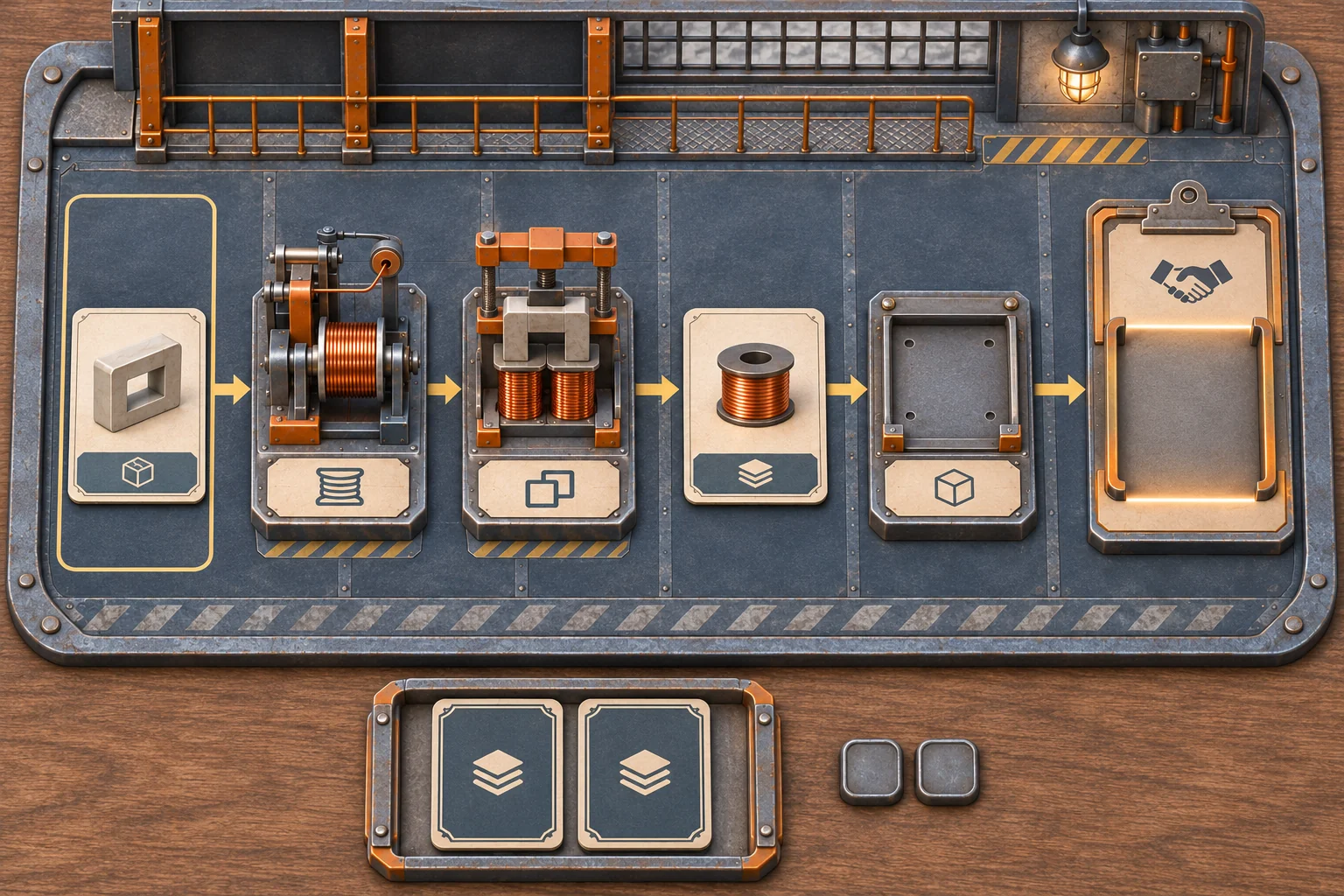
The chain takes four actions: buy, wind, assemble, and deliver. With two action points per turn and no carryover, it spans two turns. The middle state matters: after Turn 1, the wire is gone but the Coil and Core are still available for assembly.
| Point in the turn | Action | Wire | Coil | Core | Transformer | Order | Cash |
|---|---|---|---|---|---|---|---|
| Start | — | 0 | 0 | 0 | 0 | Active | 7 |
| Turn 1, action 1 | Buy 2 Wire and 1 Core | 2 | 0 | 1 | 0 | Active | 3 |
| Turn 1, action 2 | Wind Coil | 0 | 1 | 1 | 0 | Active | 3 |
| Turn 2, action 1 | Assemble Transformer | 0 | 0 | 0 | 1 | Active | 3 |
| Turn 2, action 2 | Deliver Order | 0 | 0 | 0 | 0 | Complete | 12 |
The purchase costs 2 × 1 coin for wire plus 1 × 2 coins for the Core, so cash falls from 7 to 3. Delivery adds 9, so the close is 12 coins. Net profit is 5 coins after the 4-coin input purchase. No other fee, income, or random draw is included in this first slice.
Change the deadline on paper first
The first draft gives the order a Turn 1 deadline. That deadline does not fit: the production chain needs four one-AP actions, but Turn 1 provides only two. It cannot pay out by the deadline. Change only the deadline to the end of Turn 2, then keep the rules and action order the same. Two actions per turn now fit the same four-step chain, and the ledger closes at 12 coins.
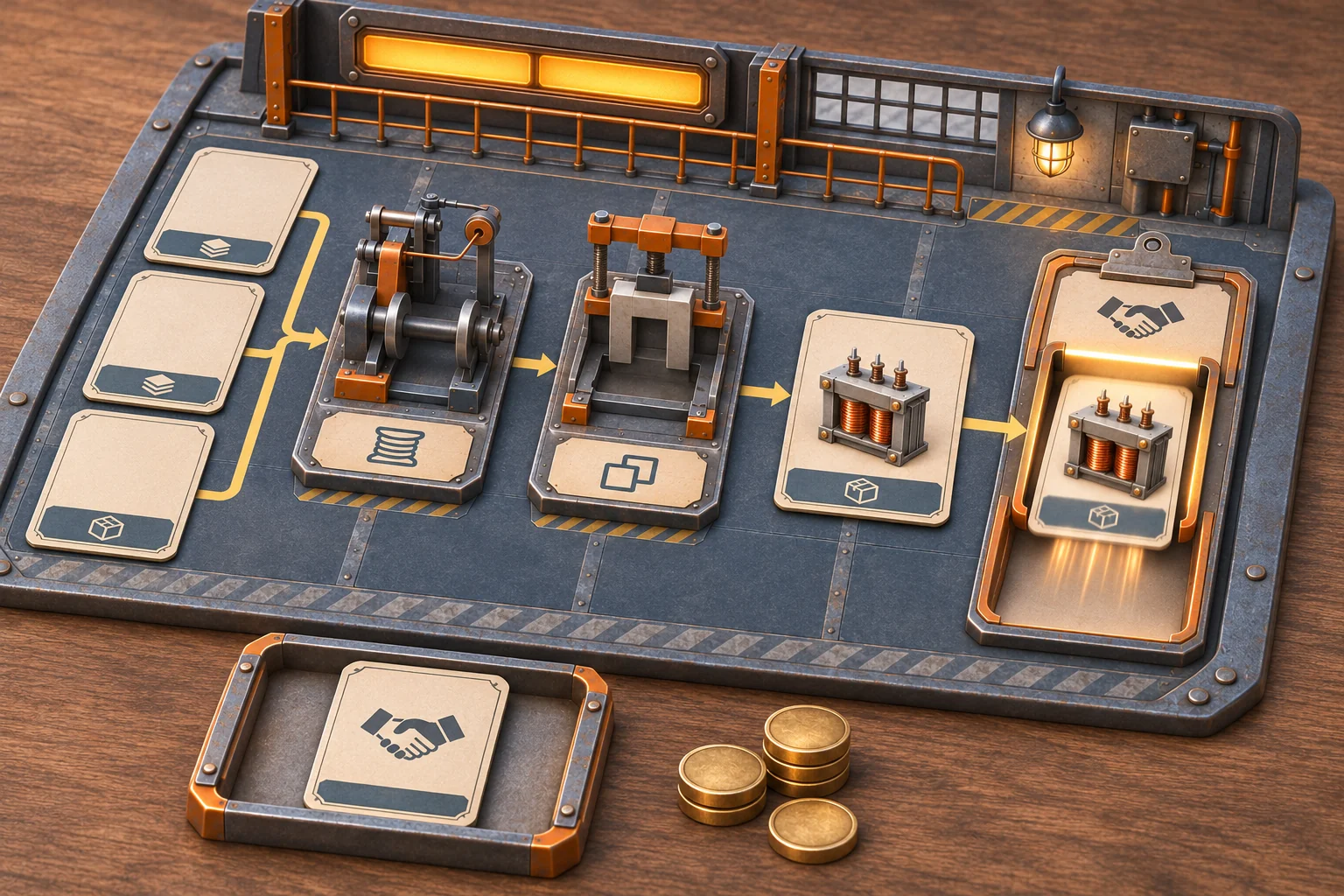
This is a bounded paper simulation, not an actual prompt run or gameplay test. When you build your own version, record the intended initial state, actions, expected result, and observed result separately. Only report a tested iteration after you have captured what really happened.
Ask for one playable slice
Give the builder the starting state, card rules, timing, and failure behavior together. Ask for the smallest version that can prove the production chain. Use this prompt as a request, then inspect the actual result rather than assuming the rules were implemented.
Create an original card-based business game called Copperline Works.
This is a design specification, not a report of an existing or tested game.

Goal: fulfill one transformer contract before its deadline.
Start with 7 coins, 2 action points per turn, no materials, one active
contract requiring 1 Transformer, and a deadline at the end of Turn 2.
There are no extra contracts, interest, staff, upkeep, random draws,
discard penalties, or action-point carryover.

Copper Wire costs 1 coin per card. Ceramic Core costs 2 coins per card.
Buy Inputs costs 1 action point and adds the selected cards only if the
player can afford the full purchase.
Wind Coil costs 1 action point, consumes exactly 2 Copper Wire, and creates
exactly 1 Coil.
Assemble Transformer costs 1 action point, consumes exactly 1 Coil and
1 Ceramic Core, and creates exactly 1 Transformer.
Deliver Order costs 1 action point, consumes exactly 1 Transformer and the
active unexpired contract, and adds 9 coins once.

Each action is atomic. Check all costs and required cards before changing
state. If any requirement is missing or the contract has expired, reject
the action and leave inventory, contract and cash unchanged. Every action
costs its own point. Refresh to 2 action points at the start of each turn;
unused points do not carry over. The contract expires at the end of its
deadline turn.

Build a compact playable slice with readable card inputs, workshop actions,
contract state, cash and per-turn action points. Add a restart that restores
the exact initial state. Do not add other systems or invent test results.
Include checks for: an unaffordable purchase; Wind Coil with fewer than
2 wires; one valid Wind Coil consuming both wires once; assembly with either
input missing; repeated use of consumed inputs; one successful delivery and
a blocked second payout; delivery after expiry as a no-op; and restart.
Show expected and observed results separately when testing the build.
The prompt defines the requested behavior and a way to inspect it. It does not demonstrate that a particular tool will implement card movement or atomic actions. If the first result changes resources twice, blocks a valid transition, or skips the deadline, revise that rule before adding art or more cards.
Check for free outputs and duplicate payouts
Test the first wrong state change instead of asking for a general polish pass. Record the starting inventory and cash, make one action, and compare every changed field with the expected result. Then replay the same action to check that a consumed input cannot be used again.
| Symptom | First rule to inspect | Expected check |
|---|---|---|
| Wind Coil succeeds with one wire | Input requirement and atomic validation | Reject it with a reason; no wire is removed, cash is unchanged, and no Coil is created. |
| Two Coils appear from one pair | Whether the same input cards can trigger twice | The valid action consumes both wires once; a repeated play is blocked. |
| Assembly works without a Core | Whether both recipe inputs are checked before consumption | No Coil or Core is removed and no Transformer is created. |
| An expired contract still pays | Deadline timing and active-order guard | Delivery is rejected as a no-op; no order or Transformer is consumed and no coins are added. |
| Restart keeps old stock or cash | Which state fields reset together | Restore 7 coins, zero materials and outputs, 2 action points, and one original active contract. |
These are proposed acceptance checks, not observed failures. Keeping the expected outcome beside the action makes a later fix easier to verify and helps distinguish a rule error from a display error.
Use a general creation workflow carefully
SEELE’s official Free AI Game Maker page describes a general path: write a game idea in plain English, test a playable 2D or 3D result in your browser, and refine it with follow-up prompts. Its FAQ says SEELE Workspace shows the selected AI model, available Koin balance, and displayed generation cost before submission. That makes it a possible place to explore a compact game idea; the page does not promise a card-economy template or this production chain.
Give the tool the rules you want to explore, then check whether the returned project actually consumes and creates the right cards. Verify the timer, failed actions, and restart yourself. Treat a generated scene as a starting point until its behavior has been inspected.
Frequently asked questions
How many card types should I start with?
Use only the types needed for one complete loop: materials, workshop actions, one finished good, and one contract. Add a new card type only when it creates a decision or state transition that the current chain cannot express. This makes it easier to spot missing costs and duplicated outputs.
Should workshop cards be reusable?
That depends on whether they represent reusable stations or one-use work orders. The Copperline example charges one action point per workshop activation and uses each action once for one contract, so it does not claim a universal reuse rule. If you add multiple orders, state whether stations remain available and test repeated activations.
When should a contract expire?
Choose a clear boundary, such as the end of a named turn, and say whether a delivery on that turn is still valid. In Copperline, the deadline is the end of Turn 2. A Turn 1 version expires before Turn 2, so a later delivery is rejected without changing inventory or cash.
What should happen when materials are missing?
Reject the operation before consuming anything. Show a short reason, keep the existing cards and cash, and do not create an output. Check both single-input failures and repeated plays; otherwise a correct recipe may still create free goods or lose resources on an invalid move.
Was Copperline Works tested?
No. It is an original fictional design and a paper calculation created to explain cards, actions, prices, and timing. The two-turn ledger follows the stated rules, but it is not a prompt run, gameplay observation, client case, or online game. Test your own build and report its actual results separately.
Build the chain before the deck
A small production chain gives you a useful first test: every action has a cost, every input is consumed once, and the contract resolves on a stated deadline. Start with that loop, inspect each state change, and add card variety only when it creates another meaningful choice.
Start with the Free AI game maker and describe your own short rules. Then check the resulting actions and resource changes against a ledger.