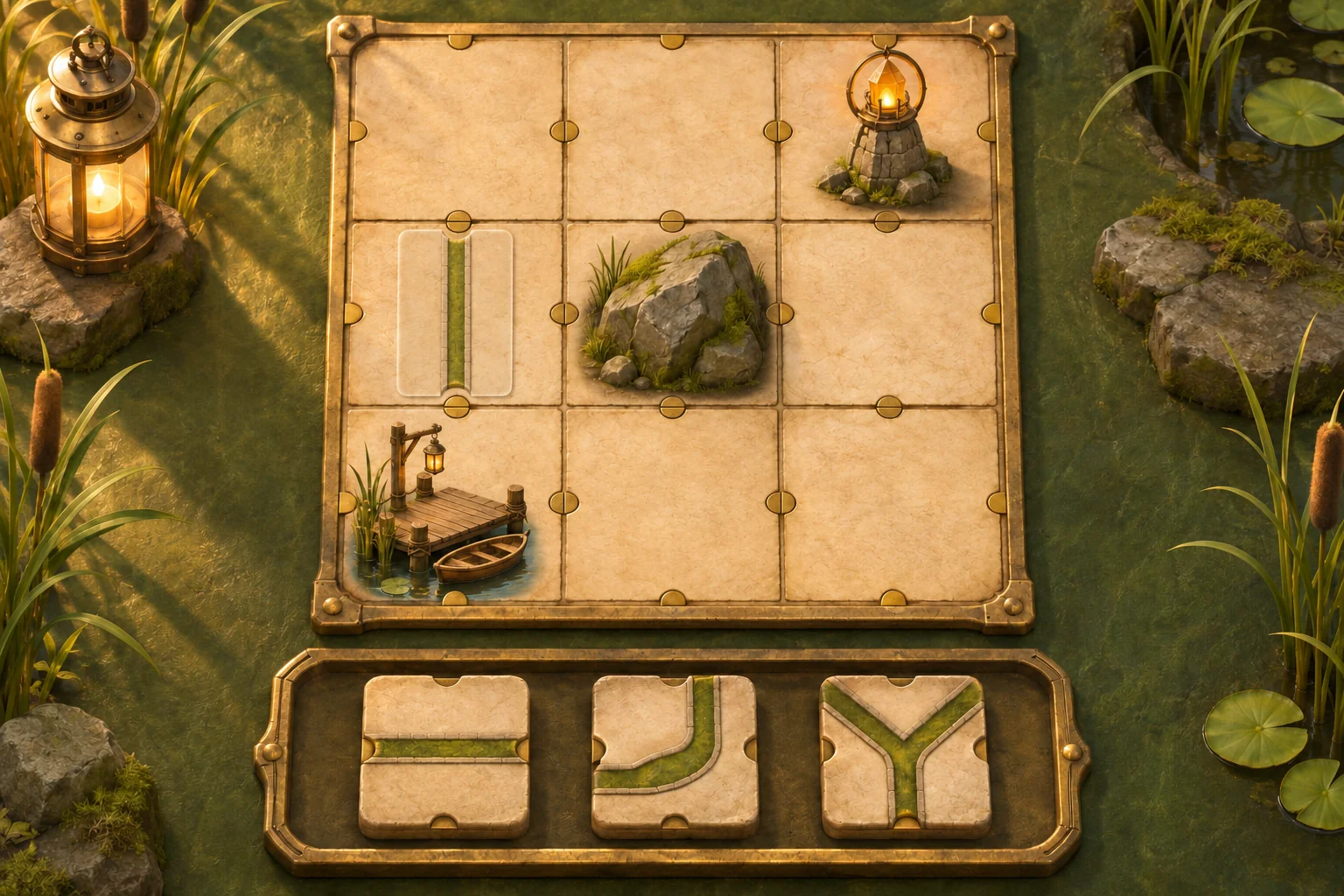
A dice-placement game becomes strategic when one roll creates more useful choices than the player can take. Start with three dice, three competing action bays, and a fixed order that turns resources into progress. In this fictional teaching example, the same 2, 4, 6 roll can light a lighthouse lens now or bank two modules for later. The arithmetic below is a manual design exercise, not a generated game or playtest.
Start with the allocation problem
Lantern Quay is a compact harbor strategy game about restoring three lighthouse lenses in three rounds. Each round, roll three six-sided dice and assign one die to each of three actions: Salvage, Forge, and Install. Lock all three assignments before resolving anything. Then resolve them in the printed order, even if the player placed the dice in another order.
That sequence creates the central decision: a high die can gather more brass, make more lens modules, or qualify to install one. It cannot do all three. The player is planning a small pipeline rather than collecting a score from a roll. Start with this loop: roll → assign once → resolve Salvage → resolve Forge → resolve Install → carry remaining stock forward.
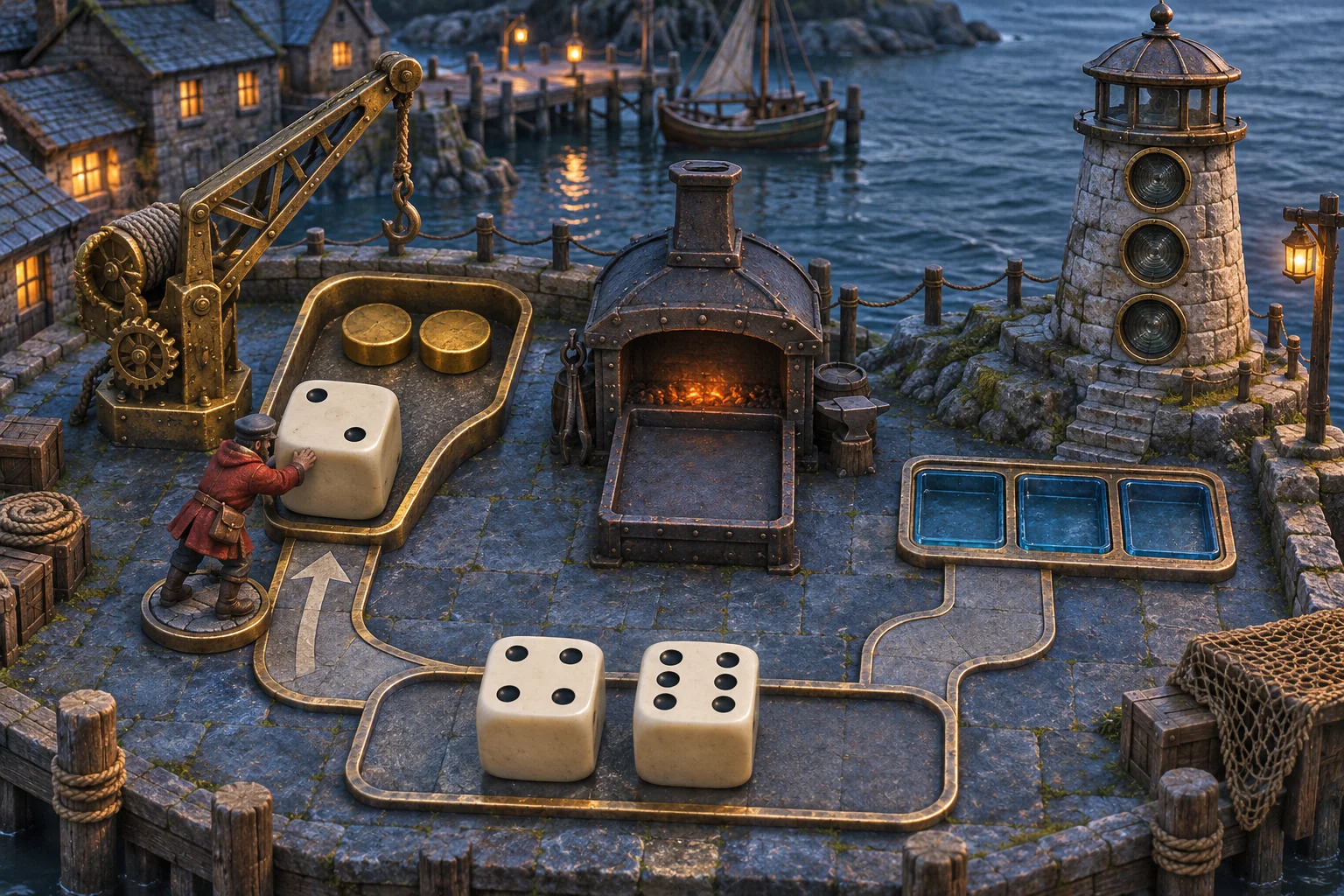
The image shows the first fictional turn in progress: the keeper pushes the two-pip die into the Salvage bay. The starting tray held one brass disc; the action adds one more. The three lens windows stay dark because neither Forge nor Install has resolved yet. Physical spaces and resources make the choice legible without a rules panel.
Define the game state and win condition
Write down only the state needed to decide what each action can do. Lantern Quay has two carried resources, brass and lens modules, plus a progress count. A round does not end when the dice are placed; it ends after the fixed three-action sequence resolves.
| State or rule | Lantern Quay contract | Why it matters |
|---|---|---|
| Starting state | Round 1 of 3; brass 1; modules 0; lenses lit 0/3 | Every worked example starts from the same ledger. |
| Dice | Roll exactly three d6; assign each die once to a different action bay | A high value has an opportunity cost. |
| Resolution | Salvage → Forge → Install, after all assignments lock | Earlier actions can fund later ones in the same turn. |
| Carryover | Unspent brass and modules remain for the next round | A weak install roll can still set up a later turn. |
| Finish | Light all three lenses by the end of round 3; otherwise restoration is incomplete | The player can judge progress against a fixed horizon. |
Restart returns the game to round 1 with brass 1, modules 0, and no lit lenses. There is no hidden score, bonus turn, reroll, or alternate victory condition in this example. Keeping that boundary narrow makes it possible to check a whole turn by hand before adding upgrades or extra action spaces.
Map dice values to the three action bays
Give each bay a result that can be read directly from its die and the current stock. Salvage follows a simple step pattern. Forge trades brass for modules in whole actions. Install is the only action that advances the lighthouse, and its threshold means low dice still have a purpose elsewhere.
| Action | Die result | State change | Failure or limit |
|---|---|---|---|
| Salvage | 1–2 / 3–4 / 5–6 | Add 1 / 2 / 3 brass, equal to ceil(die ÷ 2). | Always resolves; it does not spend another resource. |
| Forge | 1–2 | No module produced. | No brass is spent. |
| Forge | 3–4 | Spend 2 brass to gain 1 module. | If the full cost is unavailable, the whole action fails with no partial spend. |
| Forge | 5–6 | Spend 3 brass to gain 2 modules. | If the full cost is unavailable, the whole action fails with no partial spend. |
| Install | 1–4, or 5–6 with no module | No change. | There is no partial lens progress. |
| Install | 5–6 with at least 1 module | Spend exactly 1 module and light 1 lens. | At most 1 lens can be installed per round. |
Apply each row in order and update the ledger before moving to the next bay. A die belongs to one action only; the player cannot use a 6 to Forge and then reuse it to Install. The resource stock can carry between rounds, but the action’s die cannot. This separation keeps the choice meaningful and avoids counting the same roll twice.
Hand-resolve a complete round
Use the same fictional roll, [2, 4, 6], from the starting state. For an immediate lens, assign 2 to Salvage, 4 to Forge, and 6 to Install. The fixed order lets the Salvage gain pay for the Forge action before the Install check happens.
| Resolution step | Calculation | Brass | Modules | Lenses |
|---|---|---|---|---|
| Start | Round 1; roll 2, 4, 6; assignments locked | 1 | 0 | 0/3 |
| Salvage 2 | ceil(2 ÷ 2) = 1 brass added | 2 | 0 | 0/3 |
| Forge 4 | Spend 2 brass; gain 1 module | 0 | 1 | 0/3 |
| Install 6 | Spend 1 module; one lens qualifies | 0 | 0 | 1/3 |
Now compare a bank-for-later allocation with the same roll: put 4 in Salvage, 6 in Forge, and 2 in Install. Salvage adds 2, taking brass from 1 to 3. Forge spends all 3 and creates 2 modules. Install 2 misses the 5+ threshold. The round ends at brass 0, modules 2, and lenses 0/3. The player gives up immediate progress but carries a larger module stock into the next round.
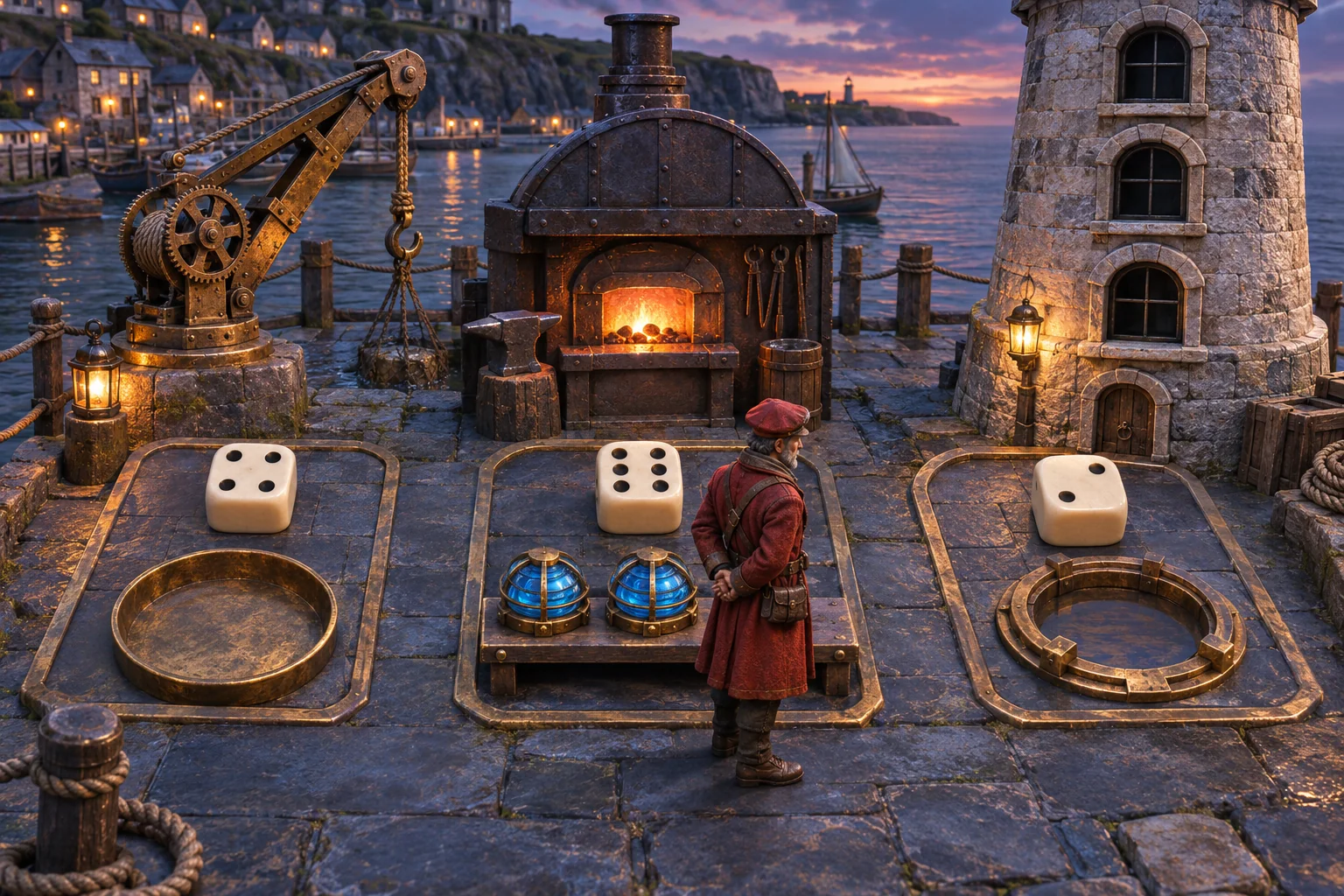
That is a real design choice in the rules even though Lantern Quay is fictional: immediate progress is not automatically better than preparation. A later round may make the two modules useful, but the example does not claim which line players prefer. The ledger shows exactly what each allocation buys and what it postpones.
Revise one ambiguous timing rule
An incomplete draft says actions resolve as soon as a die is dropped. That makes the result depend on placement order. From brass 1, if a player drops Forge 4 before Salvage 2, Forge asks for 2 brass and fails as a whole action. Salvage later raises brass to 2, and Install 6 finds no module. The turn ends at brass 2, modules 0, lenses 0/3.
Make one rules change: place all three dice face-up first, then always resolve Salvage → Forge → Install. Do not change the roll, assignments, resource costs, or win condition.
| Manual version | Rule | Same roll and assignment | End state |
|---|---|---|---|
| v0 draft | Resolve immediately when each die is placed | Forge 4 is dropped before Salvage 2, so Forge fails with only 1 brass | Brass 2; modules 0; lenses 0/3 |
| v1 proposal | Lock all placements, then resolve in printed order | Salvage 2 adds 1, Forge 4 spends 2 for 1 module, Install 6 uses it | Brass 0; modules 0; lenses 1/3 |
The revised contract removes dependence on the order of mouse or hand placement; it does not prove a player will find the rule clearer. The outcome frame shows the v1 hand-calculated turn ending with one amber lens lit. It is one successful turn, not a final victory: two lenses remain dark and two more rounds are available.
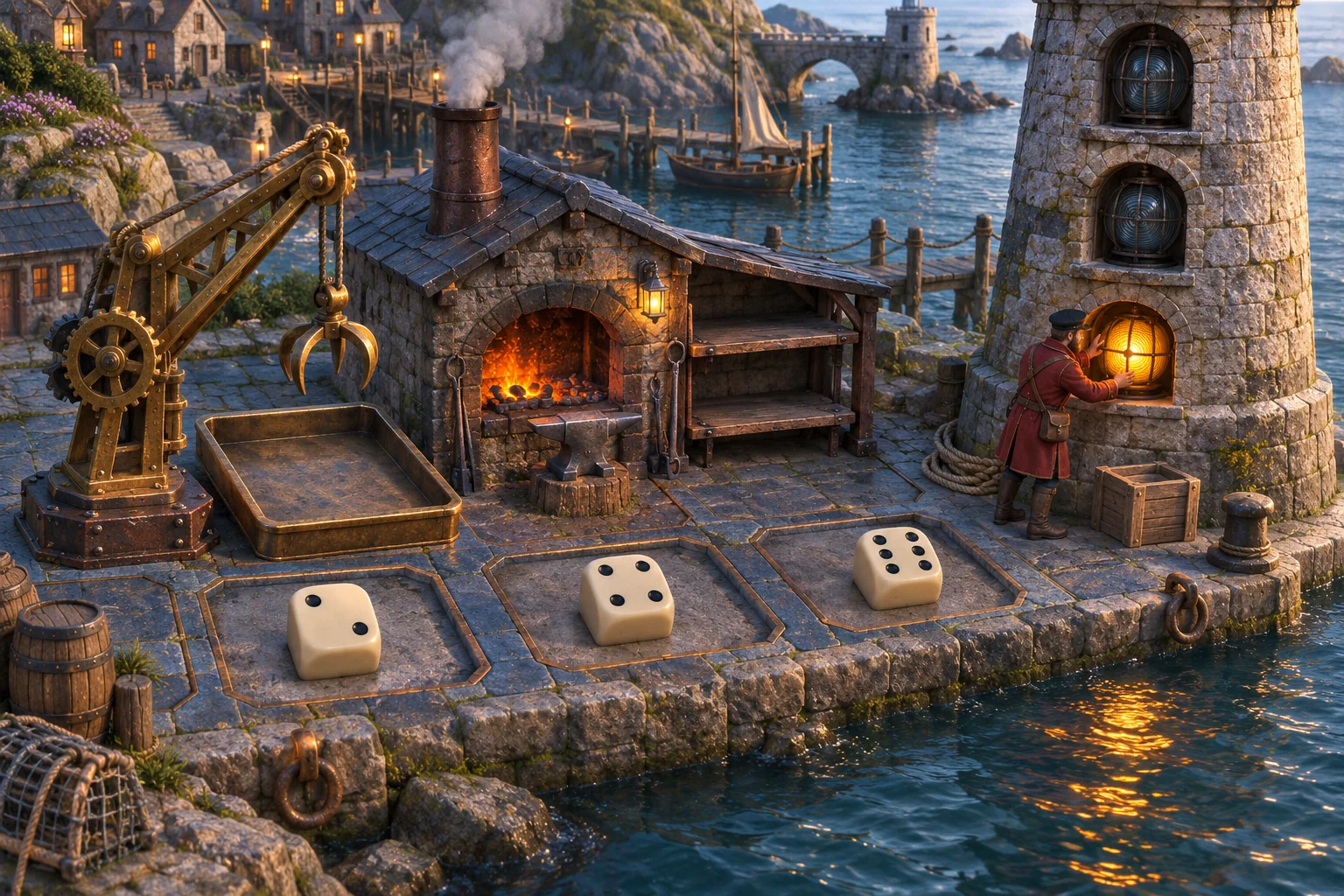
This is a fictional simulated design iteration, not an engine result or empirical improvement. It isolates one ambiguity and calculates the consequence of changing one rule. No prompt was run, no playable build was tested, and no player preference was measured.
Check edge cases before expanding
Before adding upgrades, run a small set of checks against the rules. These are proposed checks for a future playable build, not tests completed here.
- For Salvage, verify faces 1–2 add one brass, 3–4 add two, and 5–6 add three.
- For Forge, check the 2-brass and 3-brass thresholds, plus a short-stock case. An unaffordable action should spend nothing and create no modules.
- For Install, confirm 1–4 does nothing, 5–6 needs a module, and one turn can light no more than one lens.
- Place the same three dice in different physical orders and verify the locked assignments still resolve Salvage → Forge → Install.
- Check that unused brass and modules carry over, round 3 ends at exactly three lit lenses for a win, and fewer than three is incomplete restoration.
- Restart from a midgame state and confirm round 1, brass 1, modules 0, and lenses 0/3 are restored.
Capture a future observation as action | expected state | actual state | one change. Leave “actual state” blank until a real build is run. If an observation disagrees with the contract, reproduce the state, change one rule, and record the new expected result before making another change. That gives the next iteration a checkable question instead of a vague request to “make the strategy feel better.”
Take the rule sheet to a creation workspace
A compact rules sheet is a useful starting point for a general game-creation workflow. State the audience and format, describe the first player decision, list the three action spaces and their resource results, then specify the intended scene and the behavior that still needs checking. After a result is available, inspect whether dice are assigned once, whether actions resolve in the stated order, and whether the displayed stock matches the ledger.
SEELE’s official Free AI Game Maker page describes a broad workflow: describe a game idea in plain English, review a playable 2D or 3D result, and refine it with follow-up prompts in Workspace. Its prompt examples specify a game genre, scene, character, controls, and goal; the page also invites creators to test the playable result in a browser. It does not verify Lantern Quay, its dice economy, or this exact implementation. Before a larger request, review the selected model, available Koin balance, and displayed generation cost in Workspace, then test the actual result yourself.
Start with one short game brief
Keep the first version to one roll, three competing actions, a small resource ledger, and a visible goal. Open the Free AI game maker to describe your own game idea and review what it produces. Treat the output as a draft to inspect; the rules and outcomes in this article remain a fictional manual example, not a SEELE result.
Frequently asked questions
Does every die need a unique action space?
That is the rule in Lantern Quay: roll three dice and assign one to each of Salvage, Forge, and Install. Lock all three before resolving them. Another game could allow duplicate placements, but it would need a different resource and order contract so the player can predict how those choices interact.
Are low dice wasted?
No. A 1 or 2 still adds one brass in Salvage, while low Forge or Install dice may fail their thresholds. The trade-off is intentional: a player must decide whether to spend a high roll on more stock, more modules, or a qualified installation. These are proposed rules for the example, not tested balance results.
How do I stop placement order from changing the result?
Lock all assigned dice first, then resolve the action bays in one printed order. In the example that is Salvage, Forge, Install. A die’s physical placement sequence no longer decides whether a later action can spend a resource earned earlier in the turn.
What happens if Forge cannot afford its full cost?
The whole Forge action fails without partial spending. A 3–4 needs 2 brass for one module; a 5–6 needs 3 brass for two. The player keeps the existing brass and gains no module. This avoids an unclear partial result when the stock is short.
Was Lantern Quay generated or playtested?
No. Lantern Quay is an original fictional design exercise. The roll traces and v0-to-v1 change are hand-calculated from its stated rules. No game prompt was run, no playable build or player test was performed, and no measured improvement is claimed.