Key takeaways
- If you have a game idea but cannot code or create art, start by reducing it to one playable loop: one player action, one goal, and one failure state. Use AI-assisted or no-code workflows to build a tiny prototype, keep placeholder art readable, and test whether real players understand the objective and want to retry. A platform like SEELE AI can help you turn a brief into a playable first build, iterate in the workspace, and prepare a project handoff, but you still need human review for controls, scope, rights, and production readiness.
Direct answer: turn the idea into a tiny playable slice first
If you have a game idea but cannot code and cannot make art, the fastest path is not to design the whole dream project. The practical path is to turn the idea into a tiny playable slice: one goal, one control scheme, one failure state, one short loop, and one art direction simple enough to fake, replace, or iterate later.
That means you should stop asking “How do I build my full game?” and start asking “What is the smallest version that proves this idea is fun when someone else plays it?” For most beginners, that proof takes the form of a browser-playable prototype, a very short level, or a single repeatable mechanic.
A workable beginner sequence looks like this:
- define the player action and win condition in one sentence,
- reduce the scope to one loop you can test in under five minutes,
- use AI or template-driven tools for the first playable build,
- use placeholder or generated art that is clearly temporary,
- playtest with real people,
- only then decide whether the project deserves more systems, better art, or a production handoff.
If you want a short answer: use tools that get you to a playable prototype quickly, accept temporary art, and judge the idea by playtest evidence rather than by how impressive the design doc sounds. This is the practical meaning behind the adjacent validated search phrasing “make a game without coding”: prove the loop first, then invest more.
Start with a playable question, not a giant feature list
Beginners often describe a world, backstory, monetization idea, skill tree, crafting system, live events, and multiplayer plan before they have proved the first ten seconds are engaging. That order usually kills momentum.
A better starting brief is much smaller:
- Who is the player?
- What can they do in moment one?
- What are they trying to achieve?
- Why might they fail?
- What should make them want one more try?
For example, “a cozy monster-bakery RPG” is too broad to build first. But “drag ingredients into one oven before the timer expires, and each round adds one harder ingredient rule” is playable. Someone can test that. Someone can say whether it feels tense, clear, and worth expanding.
Use this one-sentence format:
The player uses _[core action]_ to achieve _[goal]_ while avoiding _[failure/risk]_.
If you cannot fill that sentence clearly, you do not have a build brief yet. You still have an idea cloud.
Choose the smallest prototype that proves the idea
The first version does not need every system. It needs to prove one of these questions:
Match each question to the smallest useful test:
- Is the core mechanic fun? Build one level or one endless loop.
- Is the concept understandable? Build one tutorialized scene with one objective.
- Does the theme hook players? Build a short vertical slice with matching text, art, and audio.
- Is the progression satisfying? Build three rounds with escalating difficulty.
- Is the multiplayer or social element essential? Build one local or asynchronous interaction test.
For a complete beginner, the safest default is a single-player browser-playable loop with one mechanic. That keeps testing, feedback, and sharing simple.
A good first scope usually has:
- one player verb or two at most,
- one win state,
- one lose state,
- one environment,
- one short round or short level,
- temporary audio and temporary art if necessary.
If your first version requires an economy, a world map, ten enemy types, class balance, cutscenes, and account systems, it is too large for the question you are trying to answer.
What to do if you cannot code
Not being able to code does not mean you cannot make something playable. It means you should choose workflows that hide code for the first proof, while keeping a path to revise later if the idea is worth it.
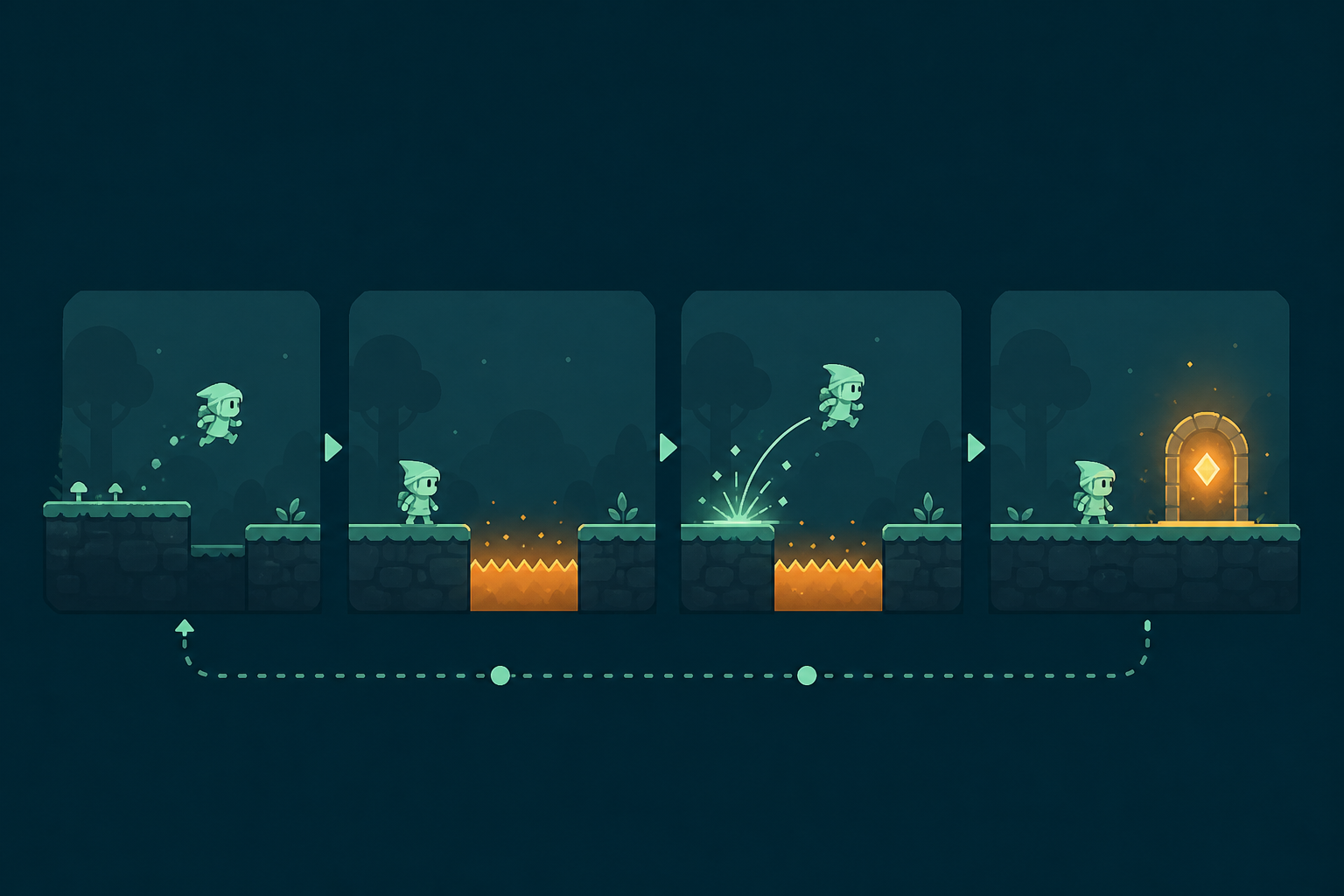
For beginners, there are three realistic routes:
1. AI-assisted playable generation
This route is best when you need to turn a written concept into a first playable build quickly. The job is to give a clean brief, inspect the result, and iterate on the loop, clarity, and difficulty.
A tool like SEELE AI's game creation workflow can help you turn a prompt into a playable first build, continue iterating in the workspace, and prepare a project handoff for continued production. That is useful when you want evidence about the idea before you invest in a full native build pipeline.
The boundary matters: a generated first build is not the same thing as a fully polished shipped game. You still need human review for controls, pacing, rights, technical fit, and commercial readiness.
2. No-code or template-first builders
This route is best when your mechanic fits a known pattern: platformer, quiz, match, card battler, top-down collector, simple runner, or menu-driven game loop. Templates remove blank-page fear, but they can also lock you into the template's assumptions.
Use them when the question is “Can this loop work at all?” not “Can this tool represent every future system I might want?”
3. Collaborate later, after proof
If your idea needs custom engineering or a strong art identity, the right time to involve a programmer or artist is after you have a tested prototype or at least a tight playable brief. Otherwise you are asking collaborators to build uncertainty, not a validated direction.
What to do if you cannot make art
Lack of art skill is a scope problem, not a permission problem. Your first version only needs visuals that make the rules readable.
You can usually start with:
- plain shapes,
- icon-based UI,
- generated placeholders,
- color coding,
- one consistent palette,
- simple sound cues.
Good placeholder art should answer three questions clearly:
- what can I interact with?
- what is dangerous or important?
- what just changed because of my action?
If the prototype is visually ugly but mechanically clear, that is acceptable. If it is beautiful but unreadable, it fails the prototype job.
This is also where many beginners waste months. They chase a final art style before proving the loop. Instead, keep art cheap until playtests tell you the idea deserves better production.
Turn the idea into a usable production brief
Once you have reduced the concept, write a short build brief. Keep it concrete enough that a builder, AI workflow, or collaborator can act on it without guessing.
Use this structure:
Core brief
- Game promise: what the player gets to do
- Target platform: browser, desktop, mobile, or prototype only
- Player input: tap, drag, keyboard, mouse, controller
- Win condition: how a round or level is completed
- Lose condition: what failure means
- Session length: how long one play session should last
Content brief
- Theme: cozy, chaotic, spooky, arcade, tactical, etc.
- Visual readability rules: colors, symbols, contrast needs
- Audio needs: optional BGM, must-have SFX, silence okay?
- Must-keep ideas: the one or two elements that define the concept
- Can-cut ideas: features that are not needed for v1
Evaluation brief
- What must testers understand without explanation?
- What emotion should the first minute create?
- What question are you trying to answer from this build?
A strong beginner brief is short. If it is ten pages, it probably contains fantasy production instead of executable scope.
Build the first version around one test loop
A playable prototype should usually follow this loop:
- Enter the game quickly. No long onboarding.
- Understand the objective immediately.
- Perform the core action within seconds.
- Receive clear feedback.
- Win or fail fast.
- Want to retry with a small improvement.
That loop is what people actually evaluate. Not your lore folder. Not your future roadmap.
For a total beginner, good first prototype categories include:
- one-screen puzzle,
- simple survival loop,
- score attack,
- short runner,
- drag-and-drop management loop,
- choice-driven mini narrative with branching consequence.
If the idea is story-heavy, still give the player a real interaction test. “Click through text” rarely proves whether the game part works.
Playtest before you upgrade the project
The first serious decision is not engine choice or publishing strategy. It is whether other people can understand and enjoy the playable slice.
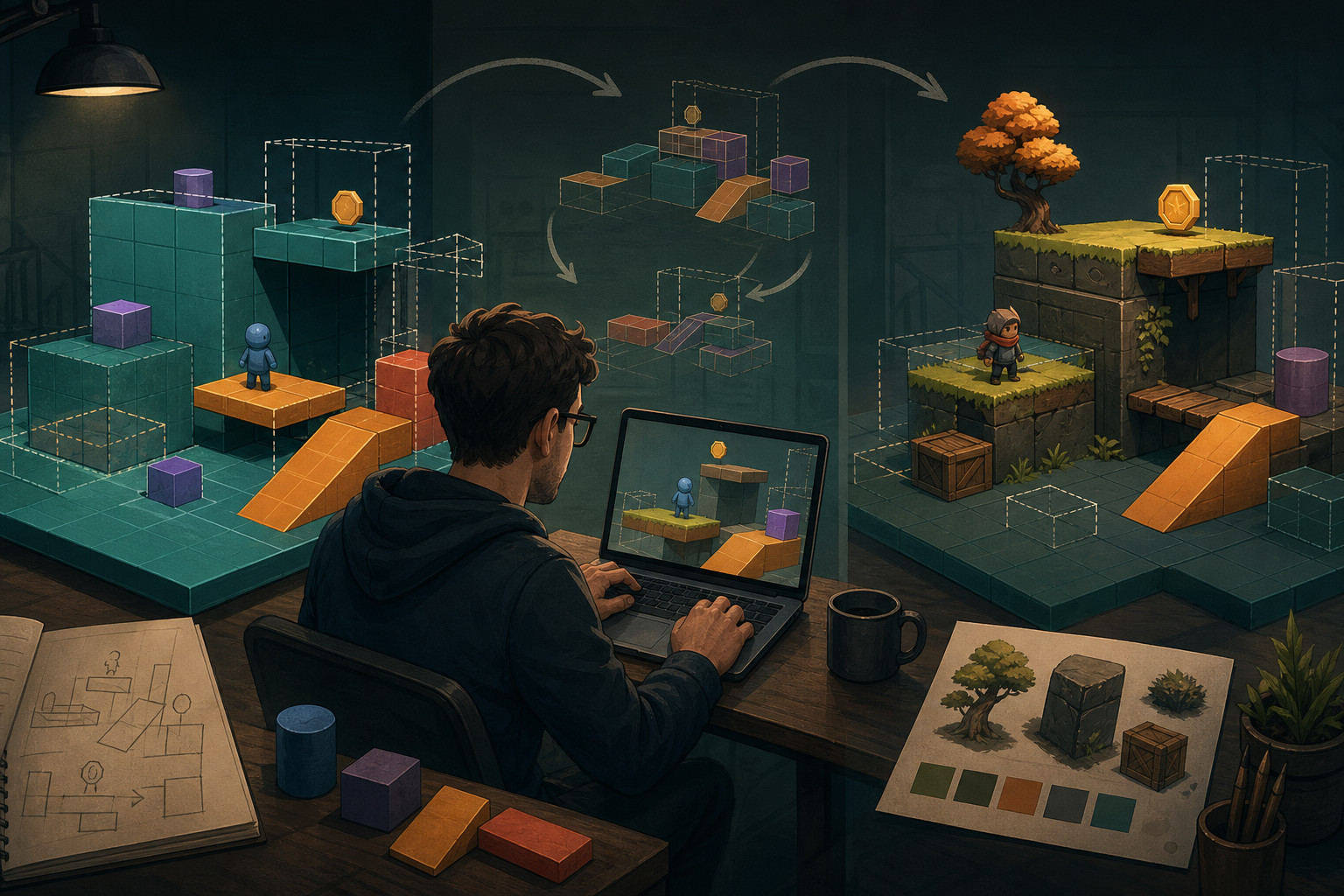
Ask 3–5 people to try the prototype with minimal explanation. Watch for:
- where they hesitate,
- whether they know the goal,
- whether they understand the controls,
- when they get bored,
- what they try that the game does not support,
- whether they ask to retry.
Use very direct questions:
- What did you think you were supposed to do?
- What felt good?
- What felt confusing?
- What would make you try one more round?
- Would you describe this as a game idea worth expanding?
The most important beginner rule is: do not defend the prototype while testing it. Confusion is data. Silence is data. Misread mechanics are data.
Decide what happens after the prototype
After playtesting, one of four things is usually true:
1. The loop is fun and clear
Keep going. Add one layer only: maybe progression, another level, a stronger art pass, or better retention feedback.
2. The loop is understandable but flat
Do not rebuild everything. Change the tension, reward timing, pacing, or difficulty curve first.
3. The idea sounds better than it plays
This is a success, not a failure. You learned early. Cut it, pivot it, or extract the best mechanic into a smaller concept.
4. The scope is wrong for your current skill level
Reduce it again. A smaller finished experiment teaches more than a giant abandoned dream.
If the prototype survives this stage, then you can decide whether to:
- keep iterating in a workspace,
- rebuild more cleanly in a deeper engine pipeline,
- hire or collaborate with artists/programmers,
- create a more polished pitch build.
When SEELE AI is a good fit — and when it is not
SEELE AI is a good fit when your immediate job is to turn a concept into a playable first build, inspect the result, and continue iterating on the playable direction. In the repo truth sources, the platform is positioned around generating a playable first build, continuing iteration in the workspace, and exporting an editable project handoff for continued production.
That makes it useful for questions like:
- Can this loop be understood quickly?
- Is the idea more fun as a browser-playable prototype or as a deeper project brief?
- Which parts of the concept deserve custom engineering later?
It is not a magic replacement for production judgment. You still need to review:
- whether the controls feel right,
- whether the art direction is legally and commercially usable,
- whether the output structure matches your long-term destination,
- whether a more custom implementation is needed after validation.
If your next step is “prove the idea to real players quickly,” this workflow can help. If your next step is “ship a giant polished commercial game with no further judgment,” that expectation is unsafe.
Common mistakes beginners should avoid
Building the dream version first
The bigger the first build, the less likely it becomes playable. Scope creates failure earlier than lack of talent does.
Waiting for perfect art
Perfect art is not needed to test whether a mechanic, rule set, or short loop works.
Treating prompts as a substitute for design
AI can accelerate output, but it cannot decide what success means for your game. The concept still needs a real playable question.
Ignoring export or handoff needs
If the idea works, you may need editable assets, project structure, or a clearer production path. Check that before you become dependent on a closed workflow.
Collecting opinions before collecting play evidence
People will compliment an idea in conversation and still lose interest when playing. Prototype reactions are more valuable than verbal enthusiasm.
A practical beginner plan for the next 48 hours
If you are stuck, use this exact plan:
Hour 1: write the one-sentence player loop and cut the scope to one mechanic.
Hour 2: write a build brief with win state, fail state, target platform, session length, and theme.
Hours 3–6: create the first playable version with an AI-assisted or no-code workflow.
Hours 6–8: fix only the blockers that prevent understanding the game.
Day 2: ask a few people to play, observe silently, and record what confuses them.
After testing: choose one of three paths:
- improve the validated loop,
- pivot the concept,
- stop and save the lesson.
That is how a non-coder and non-artist turns “I have an idea” into something people can actually play.
Frequently Asked Questions
Can I make a game if I cannot code or draw?
Yes. Start with a tiny playable slice, use placeholder or generated visuals, and choose a workflow that gets you to a testable build quickly. The first goal is proof of playability, not final production quality.
What kind of game should a complete beginner make first?
A short single-player loop is the safest default: one-screen puzzle, simple runner, score attack, drag-and-drop management loop, or another small mechanic that can be tested in minutes.
Should I use a no-code tool or an AI game generator?
Use the route that gives you the fastest clear prototype for your specific mechanic. AI-assisted generation is useful when you need a first playable build from a concept brief; template-first tools are useful when the game fits a known pattern.
Do I need final art before I test the idea?
No. You need readable visuals, not polished visuals. Placeholders are acceptable if players can understand what matters, what is dangerous, and what changed after their action.
When should I bring in a programmer or artist?
Usually after the first prototype proves the idea is understandable or fun. A tested playable slice gives collaborators a clearer target and reduces waste.
What does a successful first prototype prove?
It proves that someone else can understand the goal, perform the core action, get feedback, and want to continue or retry. That is stronger evidence than a long feature list or positive conversation alone.