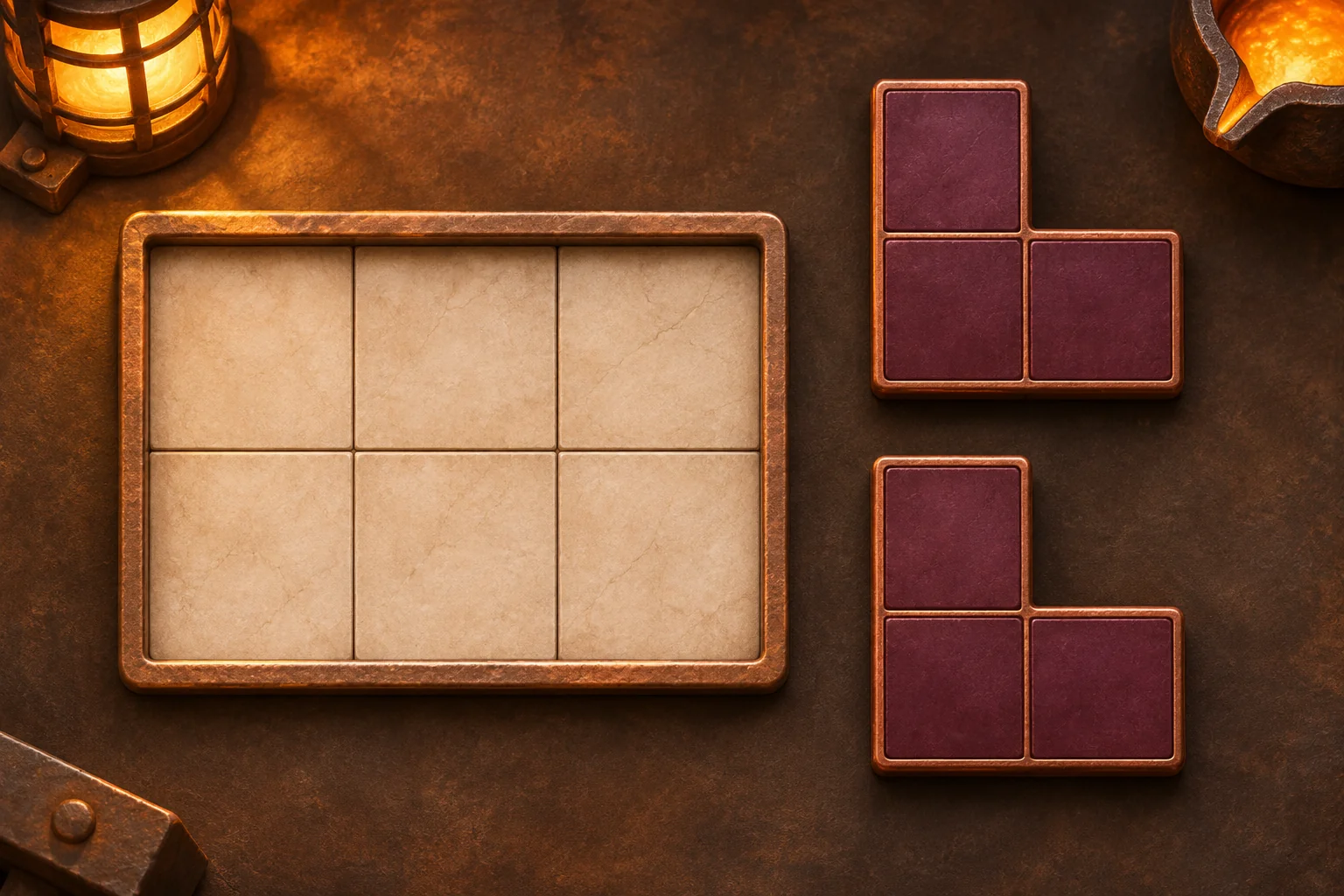
Start with a small realm and a clear political goal
To make a grand-strategy prototype with AI, connect a few systems across several turns: provincial production funds national orders, those orders change unrest or political support, and the result changes who controls the map. A focused three-province realm can show that scale without dozens of factions or a long campaign.
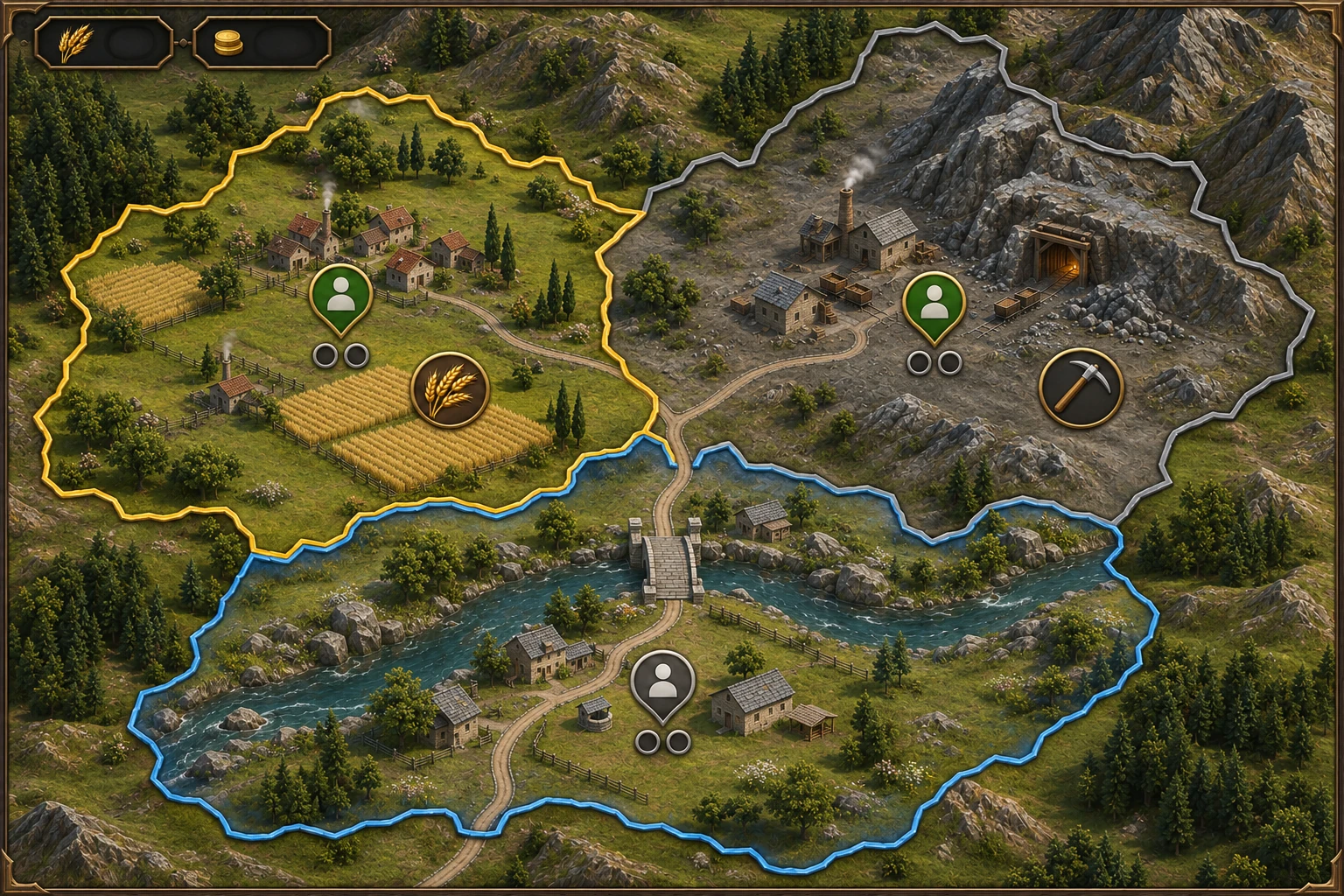
The Three Marches is an original teaching design. Wheatvale and Ironmarch begin under the player's control; Grey Crossing is neutral. The values, names, and rules below are invented, and the three-year ledger is hand-calculated. It is not a real game, a SEELE result, or a playtest.
| Province | Opening control | Annual output rule | Political state |
|---|---|---|---|
| Wheatvale | Player | 2 Grain while owned and unrest is below 2 | Unrest starts at 0/2 |
| Ironmarch | Player | 1 Coin while owned and unrest is below 2 | Unrest starts at 0/2 |
| Grey Crossing | Neutral | No output before capture; 1 Coin in later years after capture | Support starts at 0/2; capture at 2 |
Keep the objective equally narrow: capture Grey Crossing by the end of Year 3 while retaining both starting provinces. At the start of a year, each eligible province produces first. Then the player takes one national order. Support, ownership, and the end-of-year win check resolve afterward. This ordering makes every total auditable.
Make each order trade resources for a political effect
A meaningful grand-strategy choice should affect more than a button label. Tax adds immediate Coin but raises unrest; Relief spends Grain to restore a province; Petition spends both resources to win support. Define the cost, timing, cap, and visible result for each action before adding more factions or events.
| Order | Cost or gain | State change | When it helps |
|---|---|---|---|
| Tax one owned province | Gain 2 Coin | Raise that province's unrest by 1, capped at 2 | Build Coin now, while weighing the next production phase |
| Relieve one owned province | Spend 1 Grain | Lower unrest by 1, minimum 0 | Restore future output after the province reaches the strained threshold |
| Petition Grey Crossing | Spend 2 Coin and 2 Grain | Add 1 support, capped at 2; at 2, the province joins | Turn a funded political action into territorial control |
Unrest 1 still allows normal output. Unrest 2 makes a province strained: it produces zero in the next production phase until Relief lowers unrest to 1. A province captured this year does not produce during the same year; its listed output begins in a later year. Those boundaries prevent a player from counting revenue before it exists.
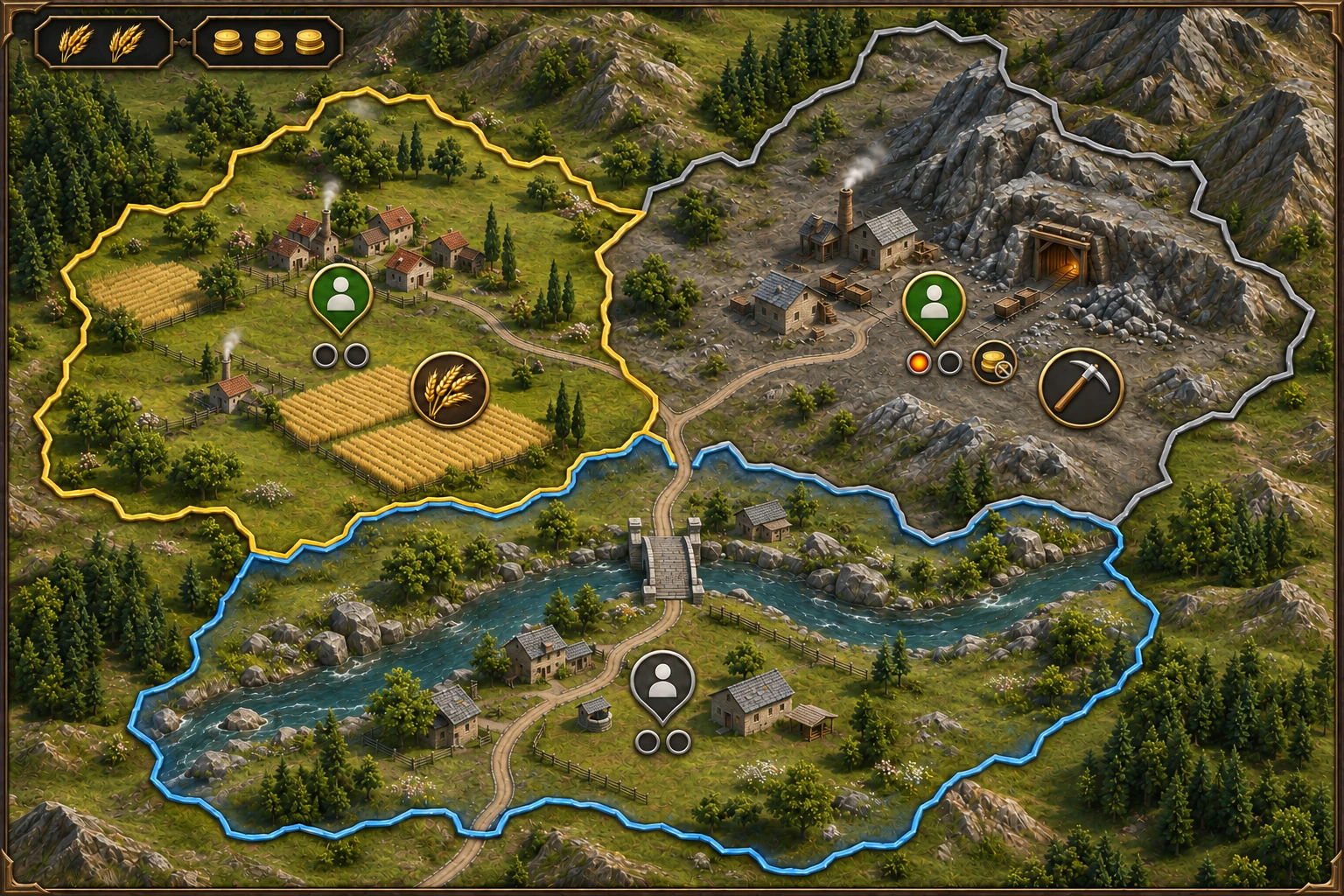
The interface should keep current state separate from a forecast. Show the current unrest pip and current output plainly, then explain that a second Tax would cross the threshold and suppress next year's Coin. Do not shade out today's production at unrest 1; that would contradict the rules.
Hand-resolve three years before adding campaign content
Start at Year 1 with Grain 0, Coin 0, support 0/2, and unrest 0 in both owned provinces. Apply production before the annual order. The trace below uses only the stated rules; no random event, battle, or hidden income is needed.
| Year | Production and order | End state: Grain / Coin / support / Ironmarch unrest |
|---|---|---|
| Opening | No order yet; all three opening values are zero | 0 / 0 / 0 / 0 |
| 1 | Wheatvale adds 2 Grain and Ironmarch adds 1 Coin. Tax Ironmarch for 2 more Coin; unrest becomes 1. | 2 / 3 / 0 / 1 |
| 2 | Both owned provinces produce. Ironmarch at unrest 1 still earns 1 Coin. Petition Grey Crossing for 2 Grain and 2 Coin; support becomes 1. | 2 / 2 / 1 / 1 |
| 3 | Both owned provinces produce again. Grey Crossing is still neutral during production. Petition for 2 Grain and 2 Coin; support reaches 2 and Grey Crossing joins after production. | 2 / 1 / 2 / 1 |
The totals close. Across Years 2 and 3, Wheatvale produces 4 Grain; the two petitions spend all 4, leaving 2 only because Year 3 production adds 2 after the first petition. Ironmarch produces 3 Coin across the three years, and the Year 1 Tax adds 2, for 5 total; the petitions spend 4 and leave 1. The capture-year rule means Grey Crossing adds no Coin in Year 3.
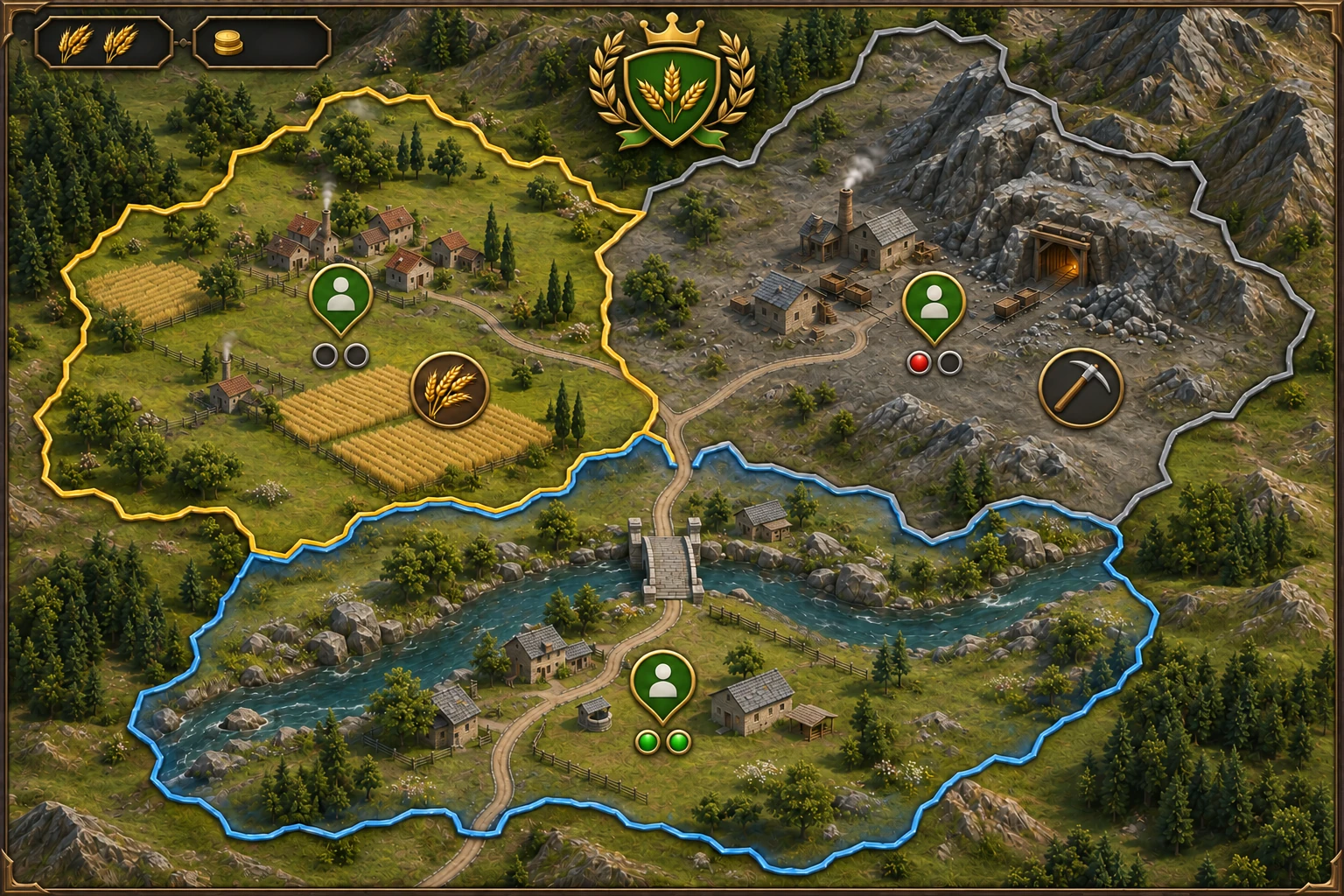
This route reaches the goal without taxing twice or triggering the strained state. It also exposes a tradeoff worth keeping: a second Tax could create Coin, but would push Ironmarch to unrest 2 and remove its next eligible Coin until Relief. That is a design consequence to test in a future build, not an observed result.
Show the unrest consequence before the player commits
A province card can turn a hidden rule into a decision. Put ownership, current unrest, current yield, and next-year forecast together. When the player previews Tax at unrest 1, show the resulting unrest 2 and a warning that the province will produce no Coin next year unless relieved. Keep current yield visible until the order resolves.
Simulated interface refinement: The initial card in this paper design shows ownership but omits the link between unrest and yield. The revised concept adds the forecast above the Tax confirmation. This is a proposed design hypothesis, not a usability test, software iteration, or observation from a built game.
For a prototype review, record the input state, selected order, displayed forecast, resolved state, and next production. If the forecast says “strained” but next-year production still pays out, or if the card hides current yield at unrest 1, the interface and rule contract disagree. Fix the earliest mismatch before adding more provinces.
Check thresholds, timing, and restart as separate cases
The winning ledger is one path, not a full validation plan. Use small edge cases to confirm that the same order resolves consistently when resources or unrest differ. Each check below describes expected behavior from the fictional contract; none is a report of actual software behavior.
| Case | Input state | Expected rule result | What to inspect later |
|---|---|---|---|
| Unaffordable petition | Less than 2 Coin or less than 2 Grain | No support gained; no partial payment | Resources and support stay unchanged; reason is visible |
| Second Tax | Owned province at unrest 1 | Gain 2 Coin; unrest becomes 2 | Current phase output remains; next phase output is suppressed |
| Relief recovery | Strained owned province at unrest 2 | Spend 1 Grain; unrest becomes 1 | Production resumes at the next year's start, not immediately |
| Capture timing | Grey reaches support 2 after production | Grey joins; no same-year Coin | First 1-Coin output appears only in a later year |
| Restart | Win or miss the Year 3 condition | New run restores Year 1, both home provinces, 0 resources, and 0 support | No prior ownership, stock, or unrest leaks into the next run |
A useful review log names the first step where actual and expected values split. Record the starting state and one action at a time; otherwise, a wrong annual order, an early capture payout, and a missing threshold can look like the same balance problem. Add random events only after these deterministic checks are legible.
Give a creation workspace rules it can be checked against
Turn the contract into a compact brief with state, action order, thresholds, and acceptance checks. Keep the scope to three provinces and three years, then ask for visible feedback at the moment a decision changes future output.
Design a small turn-based grand-strategy prototype called The Three Marches with three provinces: player-owned Wheatvale produces 2 Grain per year, player-owned Ironmarch produces 1 Coin, and neutral Grey Crossing begins at support 0/2. At each year start, eligible owned provinces produce first. Then allow one order: Tax one owned province for +2 Coin and +1 unrest (maximum 2); Relief spends 1 Grain to lower unrest by 1; Petition Grey Crossing spends 2 Grain and 2 Coin for +1 support. At unrest 2, a province produces nothing next year until Relief lowers it to 1. At support 2, Grey Crossing joins after production and produces no Coin in the capture year. Win at the end of Year 3 if Grey is owned and both home provinces remain owned. Show current resources, unrest, next-year yield, support, and the consequence of a pending order. Include restart to the exact opening state. Do not add combat, random events, or extra income. Present these as explicit rules, then check each acceptance case before treating the build as correct.This is a proposed handoff prompt, not a prompt run or a claim that a generated game will follow every rule. SEELE's current Free AI Game Maker page says users can describe a game in plain English, review a playable 2D or 3D result, and iterate in Workspace. Before submitting, the page advises reviewing the selected AI model, available Koin balance, and displayed generation cost. It also recommends testing a finished build on target devices before sharing. Those broad statements do not establish that this exact strategy loop or its rules will be generated.
After a playable version exists, compare it with the ledger and edge cases above. Keep the first task small, inspect the result, and request focused changes only where an observed mismatch appears.
Build the loop before expanding the map
A first grand-strategy prototype needs connected consequences more than a large atlas. Start with two production sources, one costly political target, an unrest threshold, and a short win condition. Hand-resolve the route, make each forecast visible, then use a real build to find where rules and feedback diverge. To begin shaping your own small strategy concept, open the Free AI game maker and describe the first decision you want a player to understand.
Grand-strategy prototype FAQ
What should a grand-strategy prototype include first?
Begin with a small map, a short horizon, and two or three systems that affect one another. In this example, production funds orders, Tax changes unrest, and petitions change control. Add a new province or faction only when it creates a decision the player can see and explain. A large map without connected consequences usually adds bookkeeping before it adds strategy.
How do I connect economy and political control?
Make a resource pay for an action that changes a visible political state. The Three Marches example spends Grain and Coin on petitions; support then changes a neutral province's control. Keep production timing and capture timing explicit so players know when income arrives. This hand-resolved route illustrates the design logic, but a real prototype still needs to be checked against it.
When should an unrest threshold reduce production?
Choose a clear threshold and state whether it affects current or future production. Here, unrest 1 still produces normally; unrest 2 suppresses the next year's output until Relief returns it to 1. Showing current unrest beside next-year yield helps players distinguish a warning from an immediate penalty. The exact threshold is an invented teaching value, not a genre-wide rule.
How can a neutral province be gained without combat?
Give the player a defined political action with a visible cost and bounded progress. In this example, each affordable petition spends 2 Coin and 2 Grain for one support; at 2/2, Grey Crossing joins after production. The rule creates a territorial objective without battle or random rolls. Other designs can use negotiation, votes, or logistics, but should define cost, timing, cap, and result.
Was the Three Marches example tested?
No. The province names, values, rules, interface refinement, and three-year outcome are original fictional teaching material, and the ledger was calculated by hand. No game was built or playtested for this example, so it is not evidence of actual behavior. Use the trace as an expected-state contract, then compare a real implementation with each stated rule before describing results.