A naval tactics game becomes interesting when a ship’s position changes which weapon can fire and who gets caught by the next attack. Start with two allied ships, one enemy, and one warning lane. Let the player move each ship before firing, then resolve the enemy’s marked attack only if it survives. That small loop makes fleet position, weapon range, and timing matter without needing a campaign or a large roster.
Tidemark Strait is an original fictional teaching scenario worked through by hand. Its coordinates, ship values, and attack pattern are invented game rules, not real-world naval data. No game-building prompt was run, no playable build or player session exists, and the two-turn result is a hand calculation, not a test.
Introduce the first firing lane
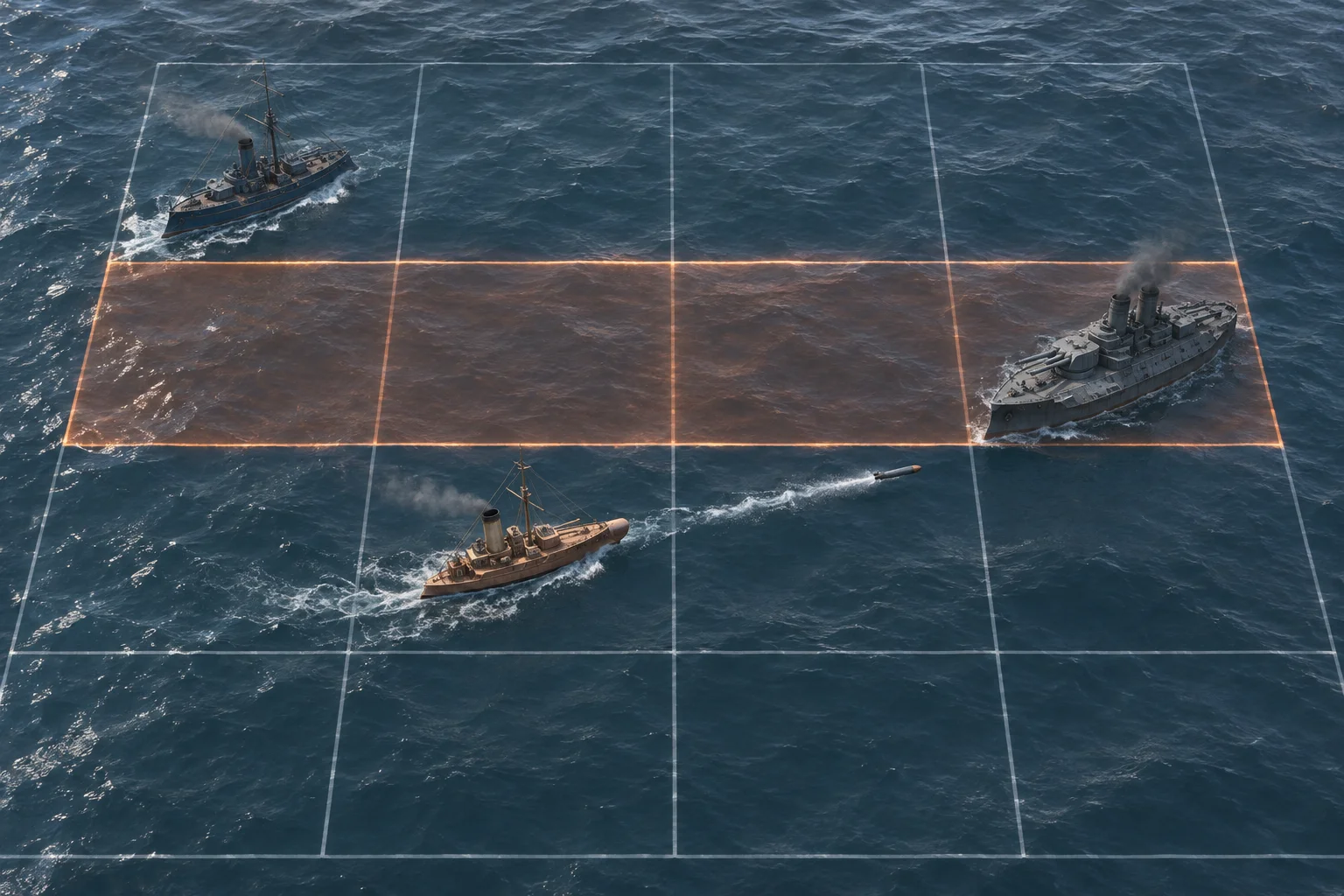
Use a 6-by-6 square grid with open water and no blocking terrain. Each cell has integer coordinates from 1 to 6. Put the player’s frigate, Lark, at (1,2), the torpedo cutter, Needle, at (1,4), and the enemy dreadnought, Breakwater, at (4,2). Breakwater marks row y=2 at the start of every round. The warning should appear before the player commits to ship movement.
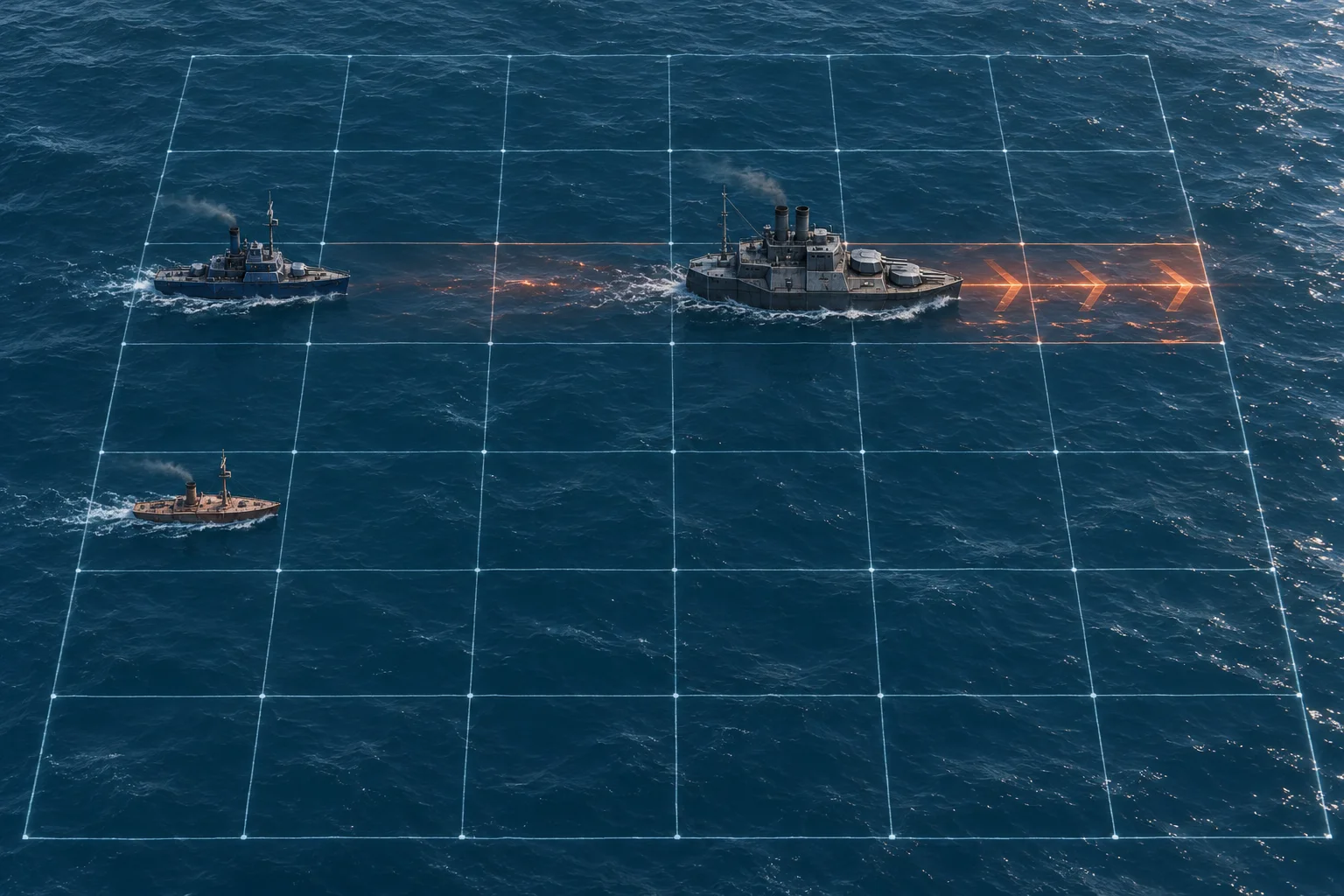
Keep the first encounter to these three ships. Lark rewards a clean firing line; Needle needs to close distance for a torpedo. Breakwater’s repeated lane attack makes a ship’s final row just as important as its weapon range.
Give each ship a distinct firing window
Write weapon rules as tests the game can answer yes or no. Lark’s cannon can fire only along its row or column. Needle’s torpedo can travel in any direction across this open board, but its range is shorter. Movement is cardinal and costs one step per cell; a diagonal move takes two steps.
| Ship | Start | HP | Weapon and legal hit |
|---|---|---|---|
| Lark, frigate | (1,2) | 3 | Broadside cannon: 2 damage at range 1–3 when target shares its row or column. |
| Needle, cutter | (1,4) | 3 | Torpedo: 1 damage at Manhattan distance 1–3, in any direction over open water. |
| Breakwater, dreadnought | (4,2) | 4 | Marks row y=2, then deals 2 damage to each allied ship still there after its response. |
Manhattan distance is |x₁−x₂| + |y₁−y₂|. From Needle’s starting cell (1,4) to Breakwater at (4,2), the distance is 3+2=5, so the torpedo is out of range. Moving Needle to (2,3) changes the calculation to 2+1=3, which is legal. Lark at (1,2) can already hit Breakwater at range 3 because both occupy row 2.
Resolve the warning after fleet movement
Give both friendly ships one command per round: move up to two orthogonal cells, then fire once if the weapon is in range and its firing condition is met. Resolve Lark first, then Needle. After both commands, Breakwater fires along row 2 if it still has HP. Every allied ship in that row takes 2 damage. A ship that reaches 0 HP is sunk and removed; if Breakwater is sunk before its attack, the attack is canceled.
| Phase | Rule | What the player should see |
|---|---|---|
| Warning | Mark row 2 before the player commands either ship. | A clear lane indicator appears on the water grid. |
| Movement | Each allied ship may take up to two cardinal steps. | Show each ship’s new cell and wake; no free diagonal movement. |
| Friendly fire | Lark fires its aligned broadside first; Needle fires its torpedo second. | Show legal range, hit response, and updated enemy HP. |
| Enemy response | If Breakwater remains afloat, hit every allied ship ending on row 2 for 2 damage. | Apply damage after both friendly attacks, then show any sunk ship leaving play. |
| End state | Win when Breakwater is sunk and at least one friendly ship remains afloat. Lose if both allied ships sink first. | Stop the round as soon as the enemy is sunk; do not resolve a canceled attack. |
This order makes the warning useful. The player can move away from row 2, but a ship that leaves its firing line may have to hold its shot. A slower, safer attack can be better than firing from the marked row.
Hand-check a two-turn victory
Compare two choices against the same opening. In the recommended line, Lark moves out of danger while Needle closes to range. Every state change follows the written order.
| Round | Allied commands | Breakwater | Allied result |
|---|---|---|---|
| 1 | Lark: (1,2)→(1,1), then hold fire because the target is neither in its row nor column. Needle: (1,4)→(2,4)→(2,3), then torpedo at distance 3 for 1 damage. | HP 4→3. The row-2 response misses because no allied ship remains on row 2. | Lark 3 HP; Needle 3 HP. |
| 2 | Lark: (1,1)→(1,2), then broadside at range 3 for 2. Needle stays at (2,3), torpedo at distance 3 for 1. | HP 3→1→0. Breakwater is sunk before it can fire. | Both allied ships survive at 3 HP. Victory after two rounds. |
The arithmetic is 1 damage in round 1, then 2+1=3 in round 2; total damage 4 equals Breakwater’s starting HP. Lark’s move removes both ships from the first warning lane. On round 2 it returns to the row only when the combined fire can sink Breakwater before the response.
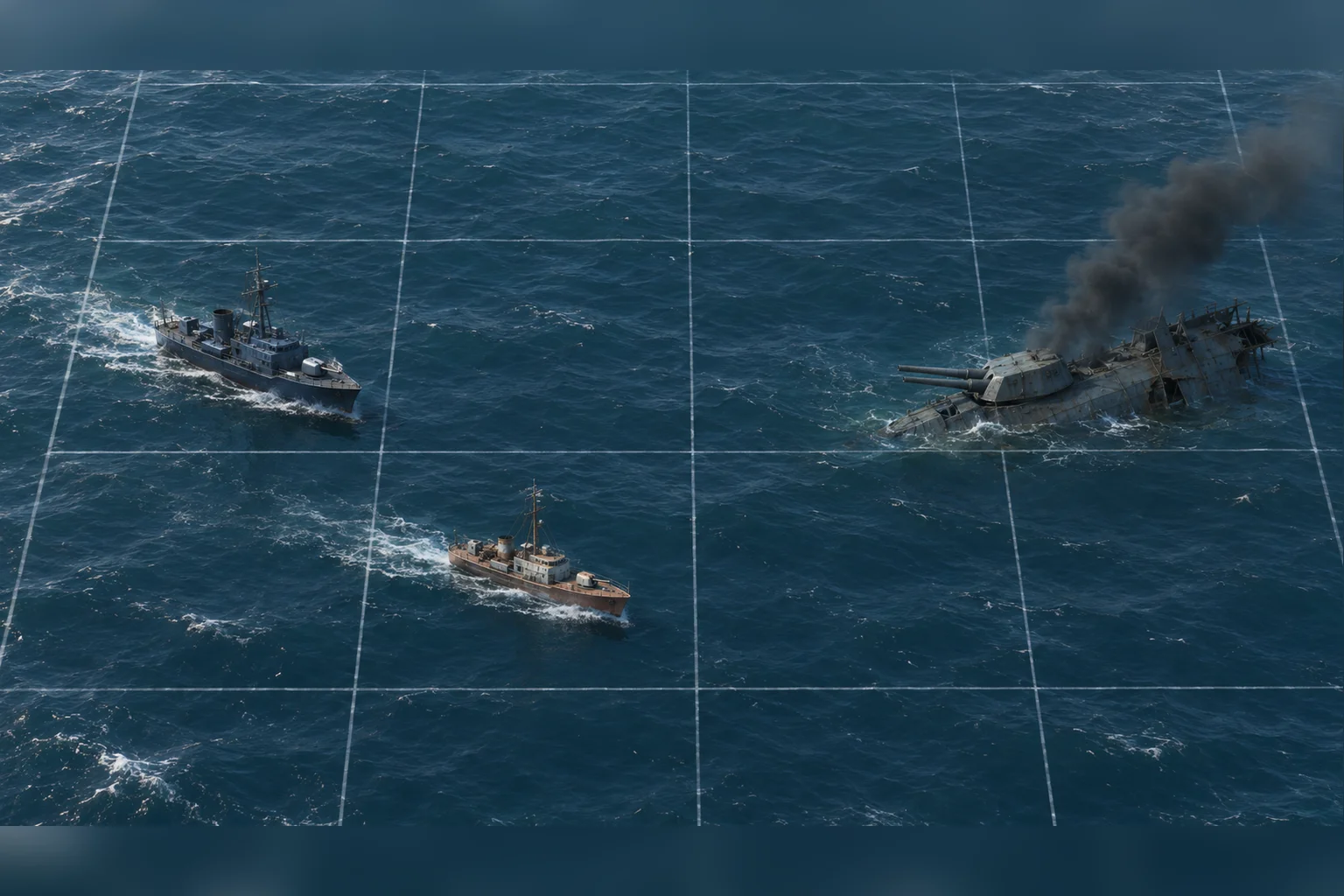
For comparison, a greedy first round leaves Lark at (1,2) to fire immediately. Lark deals 2 and Needle deals 1, leaving Breakwater at 1 HP; the marked row attack then reduces Lark from 3 HP to 1. In round 2, Lark moves to (1,1) and holds fire while Needle deals the final point. The fleet still wins, but Lark ends at 1 HP instead of 3. These are two paper strategies, not observed game results.
Turn the rules into a build checklist
Before adding islands, extra ship classes, or a campaign, ask a first prototype to expose the exact choices in this encounter. A useful acceptance table names the starting state, action, and expected result. It should check the rule itself before it judges whether the battle feels fun.
| Check | Expected result | Failure to catch |
|---|---|---|
| Broadside from (1,2) to (4,2) | Legal at range 3; deal 2. | Range works but row alignment is ignored. |
| Broadside from (1,1) to (4,2) | Illegal; neither row nor column matches. | Diagonal targets are accepted by the cannon. |
| Torpedo from (1,4) to (4,2) | Illegal at Manhattan distance 5. | Starting shot fires outside range 3. |
| Torpedo from (2,3) to (4,2) | Legal at distance 3; deal 1. | Range and distance use different metrics. |
| Round-one warning response | With Lark at (1,1) and Needle at (2,3), row 2 attack misses both. | Enemy attacks before movement or hits the old position. |
| Round-two finish | Apply 2 then 1 damage; Breakwater reaches 0 HP and does not fire. | Enemy response still resolves after the ship is sunk. |
These expected results are a manual contract for later testing. If an actual build differs, record the observed position or damage, then change one rule and recalculate the expected state. Do not call the paper ledger a completed prototype test.
Scope the next prototype pass
SEELE’s current 3D AI game page describes turning a text prompt into a playable 3D game, directing the scene, camera, and controls, testing a first build in a browser, and making changes in chat. It recommends starting with one scene and one goal. That page supports a broad prototype workflow, not a naval-specific output or the Tidemark rules. A future result still needs the range, order, and win checks above.
Carry over the two ship roles, one marked attack lane, the two-round example, and the expected end state. Then inspect movement, weapon alignment, torpedo range, attack order, and ship removal before expanding the scope. To explore a focused 3D prototype workflow for your own tactics idea, start with the 3D AI game.
Start with one readable battle
Keep the first naval tactics slice small enough that each move and shot has a visible reason. A repeated warning lane, one aligned cannon, and one shorter torpedo are enough to create a fleet-positioning decision. Tidemark Strait is a fictional design resolved by hand, not a tested game, but its rules give a future build a concrete acceptance path.
Frequently asked questions
What makes a naval tactics game strategic?
A useful first decision changes where a ship can fire or whether it remains inside a warned lane. In Tidemark Strait, Lark can leave row 2 to avoid damage but temporarily loses its broadside. Needle moves closer to reach torpedo range. These roles create a choice before any campaign or extra ship class is added.
How do you calculate a broadside shot?
Check two conditions: the target shares the frigate’s row or column, and its distance along that line is between 1 and 3 cells. Lark at (1,2) can hit Breakwater at (4,2) at range 3. Lark at (1,1) cannot, because neither coordinate aligns with the target.
When does the telegraphed lane attack resolve?
Show the warning at the start of the round, let both friendly ships move and fire, then apply the enemy attack if it is still afloat. The attack hits allied ships that end on row 2. If the enemy reaches 0 HP first, it is sunk and its pending response is canceled.
What should a first naval prototype test?
Use the same fixed positions and check movement, weapon legality, range, damage, telegraph order, and the win condition. The sample expects Needle’s move to (2,3) to put it at distance 3, then expects the enemy to sink after the round-two 2+1 damage. A real build must be inspected and played separately.
Is Tidemark Strait a tested game?
No. Tidemark Strait is an original fictional example with invented ship stats, positions, and attack rules. The two-round sequence is calculated from those rules by hand. No game-building prompt execution, playable build, player session, observed behavior, or empirical test is included. The concept images do not demonstrate a working game.