Solve from the marked view
A perspective puzzle needs a rule the player can test, not an optical trick that only works in the designer’s head. Start from one marked viewing station, compare the live projection with a target, then move one near object along a short rail. In this fictional room, a 3×3 grid makes the projected shape explicit: three depth-separated fragments form a stepped gate glyph, and only one of the near tile’s three legal stops completes it.
The useful design move is to keep the viewpoint, target, and two fixed fragments constant while changing one position. The table and mask arithmetic below are a paper-checked example, not a measured result or a built game. It gives you a compact prompt, a unique solution, and a checklist for a later playable version.
Define the projection grid
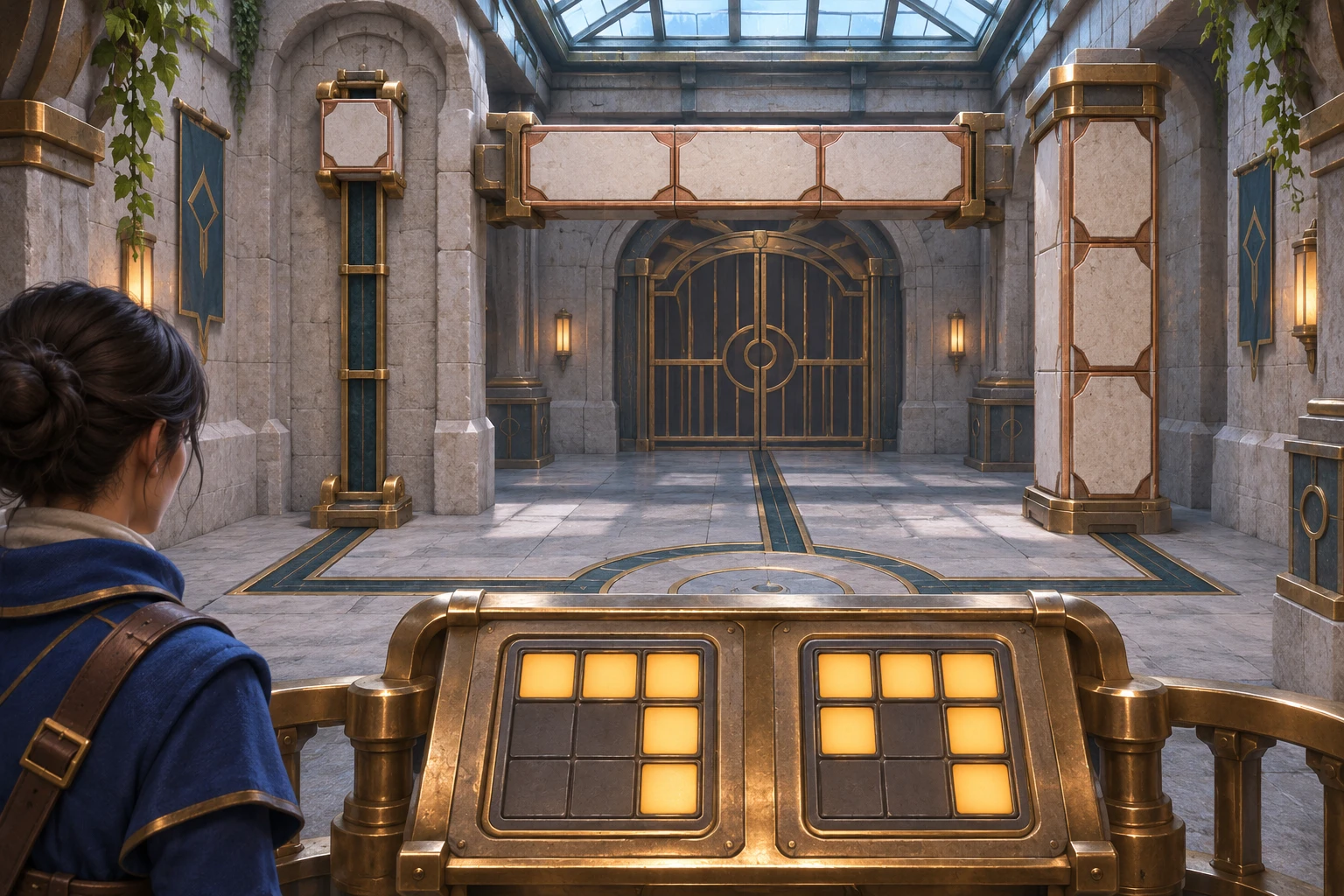
Call the 3×3 cells by row and column, starting at the upper left. A 1 means a cell is filled; a 0 means it is empty. From the marked brass station, the target is 111 / 101 / 001: all three top cells, the left and right cells in the middle row, and the bottom-right cell. This authored grid is the puzzle’s rule. It is not a general formula for real-world perspective or computer vision.
Two fragments never move in this room. The middle-depth crossbar projects to 111 / 000 / 000, and the far-right post projects to 001 / 001 / 001. Their combined footprint is 111 / 001 / 001. The near tile is one cell wide and can occupy only the leftmost cell of row 1, row 2, or row 3. Its mask changes with the rail stop:
| Piece or stop | Projected mask | What stays fixed |
|---|---|---|
| Target | 111 / 101 / 001 | Reference silhouette |
| Middle crossbar | 111 / 000 / 000 | Middle depth |
| Far post | 001 / 001 / 001 | Far depth |
| Near tile at row 1 | 100 / 000 / 000 | Top rail stop |
| Near tile at row 2 | 000 / 100 / 000 | Middle rail stop |
| Near tile at row 3 | 000 / 000 / 100 | Bottom rail stop |
When fragments overlap, a cell remains filled. The puzzle clips anything outside its nine-cell window, then compares the union against the target. At the starting stop, the near tile overlaps a cell the crossbar already fills, so the live union remains 111 / 001 / 001. The target is still missing its middle-left cell. This baseline gives the player a visible reason to touch the rail.
Keep those masks in the prompt and in the review notes. If the game invents a fourth stop, shifts the station, changes a fixed fragment, or lights a cell outside the authored union, the result is no longer the same puzzle. A small explicit grid is easier to check than a vague request to “make the objects look aligned.”
Prompt one viewpoint room
Ask for one room and one testable interaction. Name what the player sees from the station, which objects move, how their projections combine, and what exact event opens the route. The prompt below is ready to adapt: its invented rules define a design target, while the final questions ask for visible checks instead of assuming an implementation.
Create one original third-person 3D puzzle room called The False Archive. The player stands at a marked brass viewing station and sees a 3x3 live-projection grid beside a 3x3 target grid. The target is 111 / 101 / 001. Use three physically separate fragments at different depths: a fixed middle-depth crossbar projecting 111 / 000 / 000; a fixed far-right post projecting 001 / 001 / 001; and a one-cell near brass tile on a vertical rail. The near tile has exactly three legal stops, at row 1, row 2, or row 3 of the left column, with masks 100 / 000 / 000, 000 / 100 / 000, and 000 / 000 / 100. A projected cell is filled if any fragment covers it; clip outside the 3x3 window. Do not move the station or either fixed fragment.

At the start, place the near tile at row 1. Recompute the live grid after each rail move. Keep missing target cells outlined and extra live cells lit so the player can tell what is wrong. Exact nine-cell equality shows an alignment cue. On the very next game frame, start lifting the gate automatically without another button press or hidden condition. The gate is not passable until its opening animation finishes. Reset returns the tile to row 1 and closes the gate. Use a short rail, readable silhouette, walkable space, and a clear view of the station, fragments, and gate. Do not add another movable piece, alternate viewpoint, mirror, shadow rule, extra stop, or second solution.

Return the room, controls, target and live-grid feedback, reset behavior, and a short validation checklist. Explicitly show the live union for all three tile stops and flag any mask that differs from the stated rules. Keep the object projections authored to these masks; do not silently change the puzzle to force the answer.
That request gives the generator a bounded scene and asks it to expose the part most likely to drift: the relationship between each fragment mask and the live grid. A good review starts by checking the fixed pieces, station, and rail stops, then verifies the nine-cell union. Art can vary; the mask arithmetic cannot if the puzzle is to preserve its stated solution.
Move the near tile and check
One downward snap moves the near tile from row 1 to row 2. The crossbar and far post remain untouched. The union now becomes 111 / 101 / 001, exactly equal to the target. The player does not need to infer whether the shape is “close enough”: every target cell is filled and no other cell is lit.
Make the feedback local. Before a match, leave an unfilled target cell visibly outlined and show any extra live cell as a separate lit mark. After the row-2 move, show the completed middle-left cell and a distinct alignment cue. This lets a player connect one input to one changed cell. If the grid changes elsewhere, the player needs a clear rule explaining why.
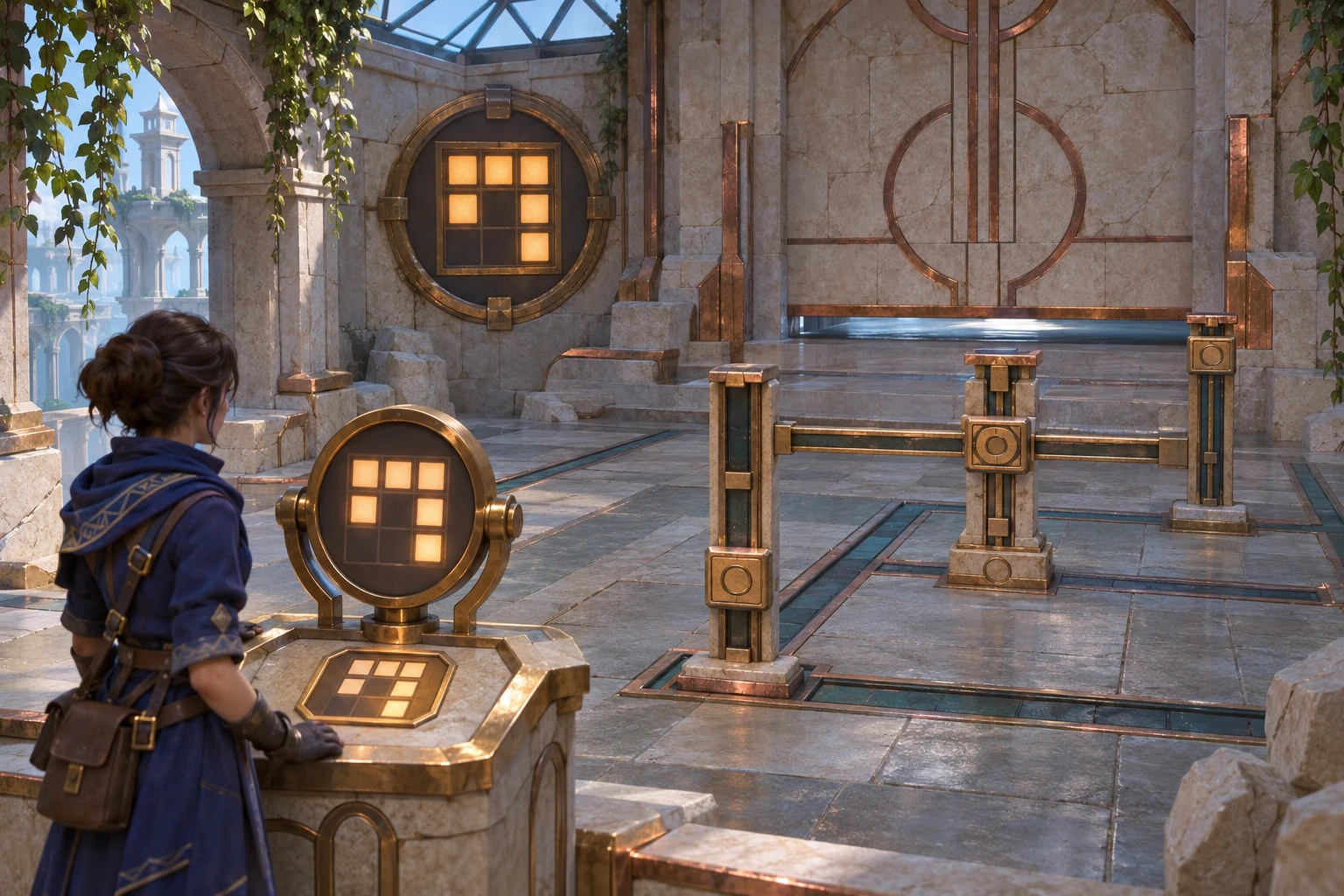
Specify the gate timing as part of the interaction, not as an afterthought. In this design, exact mask equality triggers the alignment cue. On the next game frame the gate begins lifting automatically. There is no confirmation button, second tile move, timer, or hidden switch. The player can pass only after the opening animation completes. That order separates the match event from the later passable state and makes both easy to inspect.
Also state what happens when the player resets. The near tile returns to row 1, the live union returns to 111 / 001 / 001, the middle-left target cell is open again, and the gate closes. A reset should restore every part of the puzzle state, not just move the tile while leaving a previous alignment cue on screen.
Paper-check the only matching snap
Before implementation, combine the fixed masks with each legal near-tile mask. This is a deterministic paper calculation from the invented rules above; no game-generation prompt has been run and no player has tested the room. Codex built-in ImageGen produced the concept illustrations only; those image prompts did not generate this game. The comparison tells you whether the intended answer follows from the stated positions rather than from an unstated visual exception.
- Row 1 start: fixed union
111 / 001 / 001OR near tile100 / 000 / 000stays111 / 001 / 001. It misses target cell r2c1. - Row 2: fixed union
111 / 001 / 001OR near tile000 / 100 / 000becomes111 / 101 / 001. It matches all nine target cells with no extra. - Row 3: fixed union
111 / 001 / 001OR near tile000 / 000 / 100becomes111 / 001 / 101. It still misses r2c1 and adds an unwanted r3c1 cell.
Only row 2 is an exact match. The comparison changes one variable—the near tile’s rail stop—while keeping the station, fixed fragments, clipping rule, and target constant. That makes the example useful as a small design exercise: it provides a baseline, one successful correction, and a competing position that fails for two visible reasons.
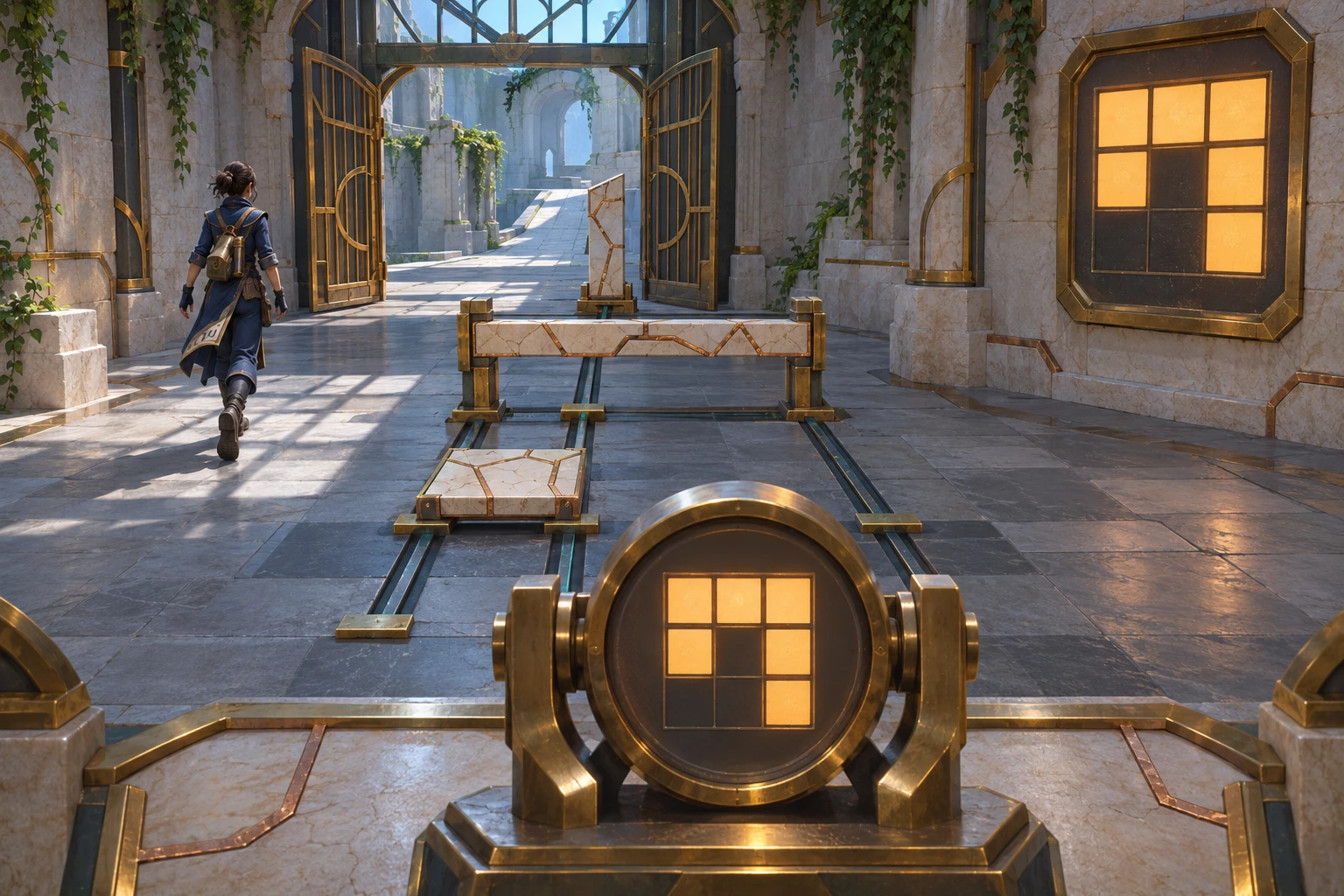
The result image is a concept of the intended end state, not a capture from a generated or playable build. The sequence is still precise: row 2 creates equality, the next frame starts the lift, and the completed animation makes the doorway passable. Keeping those states distinct prevents a still image of an open door from implying that the door opens on the same frame as the match.
Review the build and choose the next step
For a later real build, inspect the puzzle from the marked station. Confirm that the target has nine cells; the two fixed fragments produce their stated masks; the near tile can stop only at rows 1, 2, and 3; and the live union follows the OR rule after each move. Check the row-1 baseline, row-2 match, row-3 failure, missing/extra cues, next-frame gate lift, completed passable opening, and reset. Record observations only after a playable build exists.
No game-generation prompt output, implementation, playtest, or usability result exists for this design. Codex ImageGen was used only for concept illustrations. The False Archive, grid masks, snapping behavior, feedback, gate, and arithmetic are fictional choices in a paper-checked example. They do not demonstrate that SEELE generates perspective-alignment mechanics or that the proposed room works in play.
SEELE’s Free AI Game Maker page describes writing a game idea in plain English, reviewing a playable 2D or 3D result, and iterating in Workspace. That general workflow can support drafting a focused room brief and then inspecting what a real build contains. It does not establish these projection rules or guarantee the unique match. Before submitting, check the selected AI model, available Koin balance, and displayed generation cost in Workspace; then inspect the actual result before relying on it.
To start, keep the first prompt narrow: one viewpoint, one 3×3 target, two fixed fragments, one three-stop rail, one feedback rule, and one gate condition. Free AI game maker is the approved next step for shaping that idea into a first draft.
Frequently asked questions
How is a viewpoint puzzle different from a shadow puzzle?
A viewpoint puzzle changes how depth-separated objects overlap from one marked position; this example ignores lighting and shadow entirely. A shadow puzzle usually asks the player to shape or interpret a cast silhouette. Here, the authored 3×3 masks define the rule, and moving one near tile changes exactly one grid cell while the station and fixed fragments stay put.
Why is the row-2 tile position the only solution?
The fixed fragments combine to 111 / 001 / 001. Row 1 overlaps an already-filled top cell and still misses r2c1. Row 2 adds that missing cell without adding an extra. Row 3 still misses r2c1 and adds r3c1, so only row 2 exactly matches 111 / 101 / 001.
How many moves does the intended correction take?
From the authored row-1 start, the tile moves down one rail notch to row 2. The row-2 union matches the target, so the match cue appears. On the next game frame the gate begins lifting automatically, then becomes passable when the opening animation finishes. No second press or hidden switch is part of this design.
What should an AI prompt include for a viewpoint puzzle?
State the marked station, target grid, each fragment’s depth and mask, every legal movable position, overlap and clipping rules, feedback for missing and extra cells, reset behavior, and the exact gate trigger. Ask for the live union at each legal stop. Then review those states against the written rules rather than assuming a generated scene followed them.
What should I verify in a real build?
Check that the view station is fixed, the two fixed fragments do not move, and the near tile has exactly three rail stops. Compare the live 3×3 mask after each move, inspect the alignment cue, verify that the gate starts on the next frame and is passable only after animation, and confirm reset restores the row-1 state. Those are future checks, not results reported here.