Make the Firing Window the First Combat Question
To make a space dogfighting game with AI, start with one readable duel and one combat question: does the target stay inside the firing arc long enough for a burst to finish? That choice links movement, aim, weapon timing, and hit feedback into a loop a creator can explain and later inspect.
Farline Pass is a fictional design exercise. Its ships, speeds, angles, and outcomes are hand-calculated paper values. No prompt was run, no game was built or playtested, and no result from SEELE is being shown. The calculation can help make a brief internally consistent; it cannot prove that a build implements the rules or that the encounter feels good.
Keep the first loop focused: read the rival’s drift → turn toward its lead → enter the firing arc → hold a short burst → confirm the hit cue → reposition for another pass. Start with two ships and a single weapon. Add missiles, upgrades, or a fleet only after this tracking decision is clear.
Define the Duel Before Adding More Systems
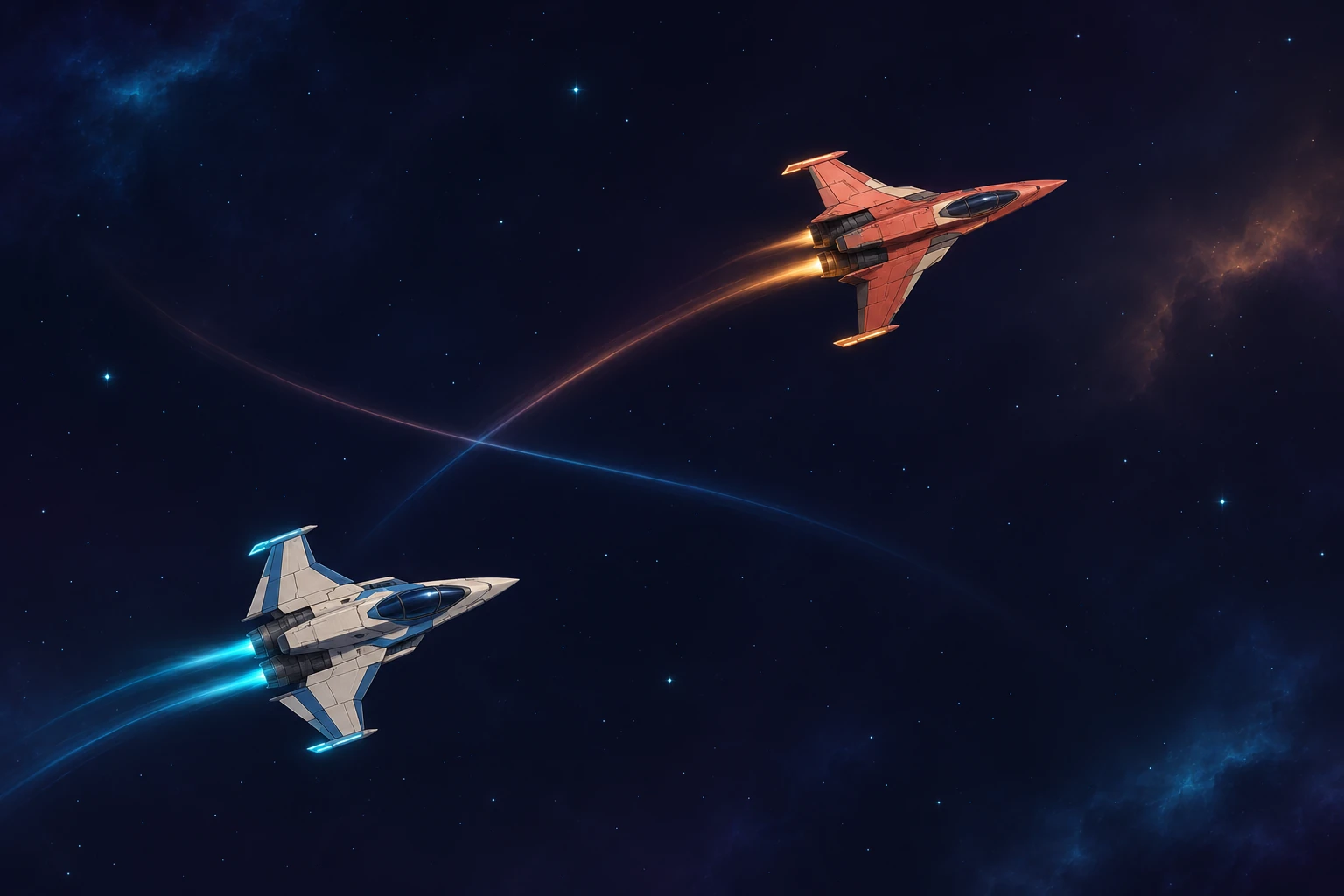
Call the player’s ivory-blue craft the pursuer and the coral craft the target. For this first pass, freeze range at 6 world units while the target moves sideways at 0.8 units per second. The pursuer turns at 90 degrees per second. A weapon can begin or continue a burst only while the target’s bearing is within a cone of 10 degrees on either side of the nose.
| Variable | Paper value | Why it matters |
|---|---|---|
| Range | 6 units, held constant during the aim phase | Keeps the angular calculation separate from closing distance. |
| Target tangential speed | 0.8 units/second | Creates a steady change in bearing around the pursuer. |
| Pursuer turn rate | 90 degrees/second toward the target | Sets how quickly the nose can catch up. |
| Weapon cone | ±10 degrees | Defines the interval in which the shot may count. |
| Burst hold | 0.26 seconds at baseline | The target must remain in the cone continuously for the whole hold. |
| Starting target bearing | +26 degrees | Provides a repeatable initial aim error for the paper trace. |
Convert the target’s sideways motion into angular drift with a small-angle model: angular rate = tangential speed ÷ range. Here, 0.8 ÷ 6 = 0.1333 radians per second, or about 7.64 degrees per second. The pursuer closes the relative angle at roughly 90 − 7.64 = 82.36 degrees per second. This model assumes the range stays fixed; it is a simple aiming exercise rather than a full orbital or Newtonian flight simulation.
The target starts 26 degrees to the right while the valid cone spans from −10 to +10 degrees. As the pursuer turns, the target crosses the full 20-degree cone in about 20 ÷ 82.36 = 0.243 seconds. That crossing interval is the firing window in this model. A burst that needs longer than the window cannot complete under the authored rule.
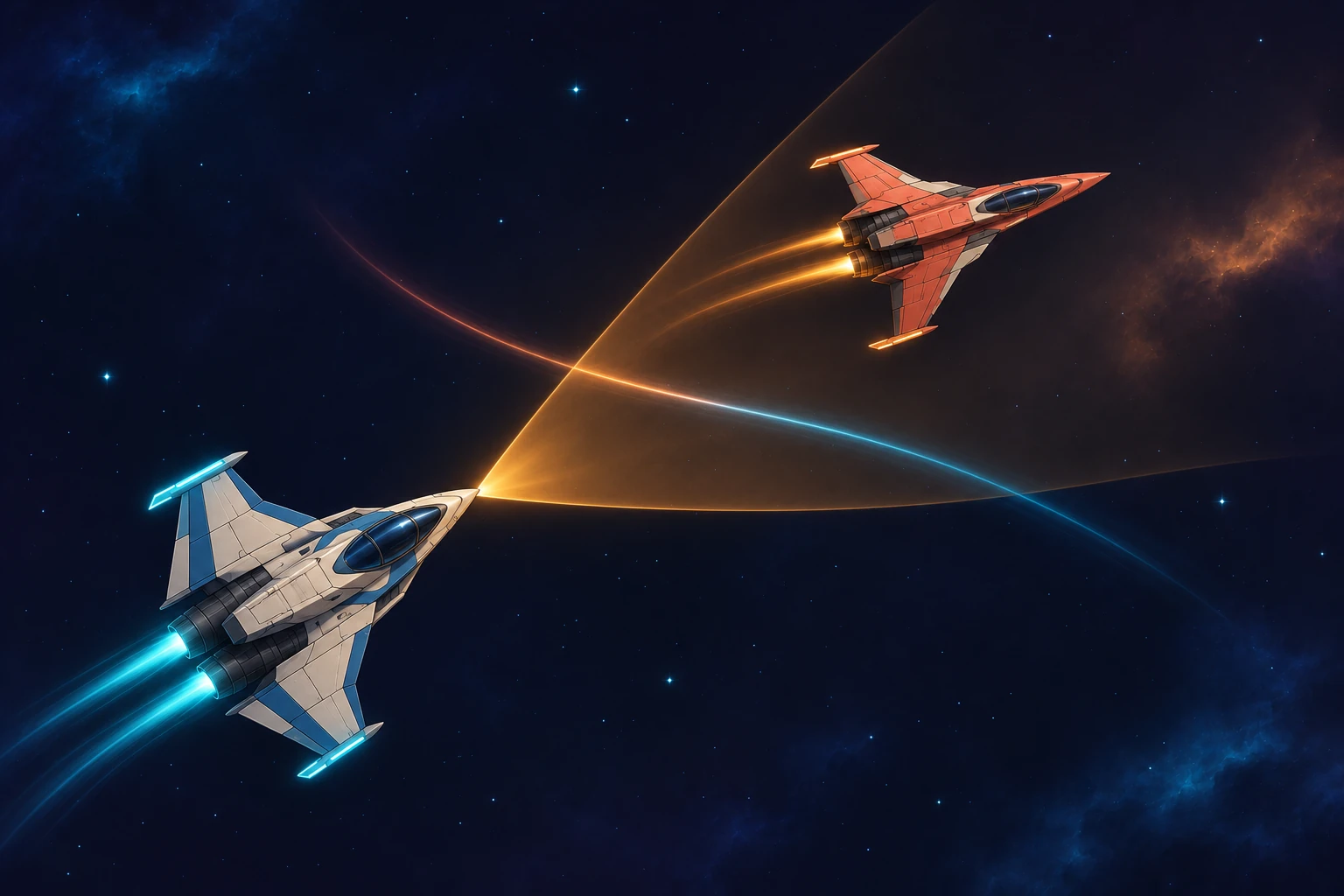
Make each state visible if you later build the room: target bearing, nose direction, cone entry, burst start, burst completion or cancellation, and hit confirmation. If any one of these is hidden, a player may see a flash without understanding whether the aim, weapon, or collision rule caused it.
Prompt a Small First Pass with Observable Rules
A useful first-room request specifies what the player sees, what changes over time, what a successful shot requires, and how to repeat the scenario. It also names exclusions so the first version stays focused. The prompt below is a design artifact; it has not been run and does not claim to produce Farline Pass.
Create a compact top-down space dogfighting training room with one ivory-blue player craft and one coral rival. Keep their range at 6 world units during the aiming pass. Start with the player heading at 0 degrees and the rival bearing at +26 degrees. Give the rival a steady sideways drift equivalent to 0.8 world units per second at that range. Turn the player craft toward the rival at 90 degrees per second.

Add one forward weapon with a clearly visible ±10-degree firing cone. The baseline burst must hold for 0.26 seconds continuously inside the cone before it confirms a hit; cancel the burst if the rival leaves the cone before the hold completes. Show the current target bearing, nose direction, cone entry, burst state, and a distinct hit or cancel response using readable marks rather than dense text. Include a reset that restores the same start state.

First return a small playable encounter with these requested states and observable feedback. Check whether the target stays in the cone for the full baseline hold. Then change only the burst hold to 0.18 seconds and inspect the same pass again. Report any behavior that differs from these requested rules; do not claim the paper calculation is an observed result. Do not add missiles, upgrades, extra enemies, damage types, or campaign progression.
Before any future test, check the inputs one by one: range assumptions, angular sign, turn direction, cone width, continuous hold rule, burst cancellation, hit confirmation, and reset. If the behavior differs, record the build version and the actual state before changing one value. The acceptance list is a request for inspection, not evidence that a tool has already passed it.
Calculate Why the Baseline Burst Misses
In the authored baseline, a full pass through the ±10-degree cone lasts about 0.243 seconds. The weapon requires a continuous 0.26-second hold. Because 0.26 is longer than 0.243, the target exits the cone before the hold finishes, so the paper model cancels the burst instead of counting a hit.
Use this as a design check, not a difficulty claim. A live game might include acceleration, range change, aim assistance, latency, or different hit logic; those systems are deliberately absent here. The calculation answers only this narrow question: given the listed values and the continuous-hold rule, is the baseline burst duration shorter than the available alignment window?
| Paper step | Calculation | Result |
|---|---|---|
| Target angular drift | 0.8 ÷ 6 | 0.1333 rad/s ≈ 7.64°/s |
| Relative sweep rate | 90 − 7.64 | ≈ 82.36°/s |
| Full cone width | +10 − (−10) | 20° |
| Available window | 20 ÷ 82.36 | ≈ 0.243 s |
| Baseline comparison | 0.26 s hold vs 0.243 s window | Hold is too long in this paper model. |
Change Only the Burst Hold
For one paper revision, reduce the required hold from 0.26 seconds to 0.18 seconds. Keep range, drift, turn speed, initial bearing, cone width, and the hit rule fixed. This is the only edited variable.
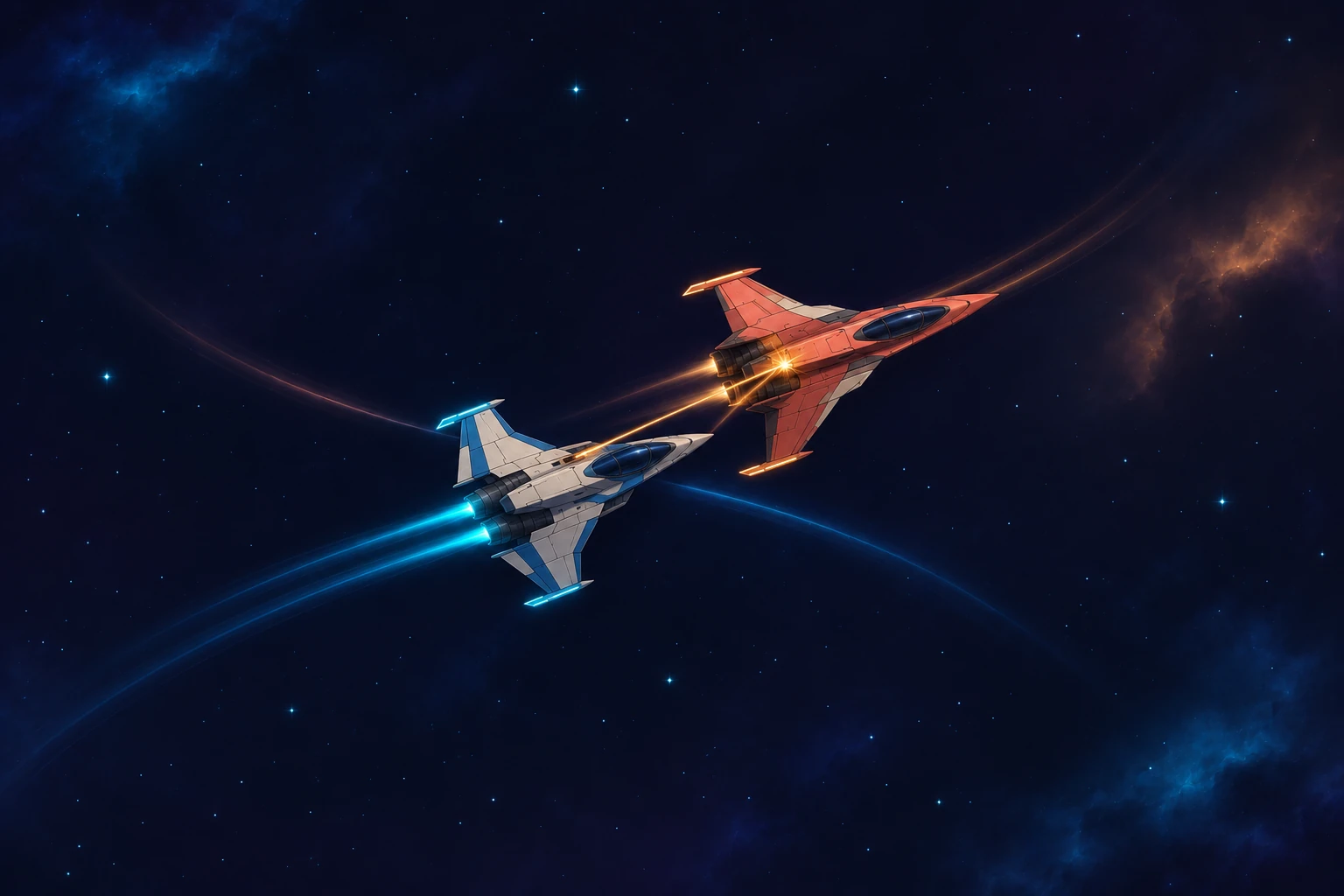
The target first reaches the near edge of the cone after the relative angle closes from +26 to +10 degrees: 16 ÷ 82.36 ≈ 0.194 seconds. A 0.18-second burst then ends about 0.374 seconds after the turn begins. By that point, the target bearing in this model is about 26 − (82.36 × 0.374) = −4.8 degrees. That remains inside the ±10-degree cone, so the authored short burst completes before the target leaves the valid range.
This is a hand-calculated paper rehearsal, not a tested balance change. It says that a shorter hold fits the defined interval. It says nothing about whether a player can read the cue, whether the encounter feels fair, or whether a generated build will implement the timing. Use a playtest only after there is a real build and record what actually happened.
| Setting | What stays fixed | Paper result |
|---|---|---|
| Baseline: 0.26 s | 6-unit range, 0.8 units/s drift, 90°/s turn, ±10° cone, +26° start | The 0.243-second window closes before the hold can finish. |
| Revision: 0.18 s | The same range, drift, turn, cone, and start bearing | The hold ends near −4.8°, within the cone in this model. |
Diagnose Tracking and Hit Feedback Separately
When this idea becomes a playable prototype, do not adjust every weapon and movement variable at once. First identify which state failed, then change one rule and repeat the same pass. The table is a design checklist, not a report of observed bugs.
| Symptom to inspect | Possible cause | One check or revision |
|---|---|---|
| The target seems aligned but the burst cancels. | The displayed bearing may not match the weapon’s actual cone, or the hold may exceed the interval. | Compare the cone edge and burst timer to the requested ±10° and 0.26-second rule. |
| The player turns the wrong way after the target crosses the nose. | Angle wrapping or sign convention may be inconsistent. | Log the signed bearing through the crossing and test only the direction rule. |
| A hit appears without a clear reason. | Hit feedback may not distinguish aim, burst completion, and target contact. | Show separate burst-complete and hit-confirmed states; inspect each transition. |
| The pass is difficult to repeat. | Reset may retain velocity, heading, or target drift from the prior run. | Restore the same range, heading, bearing, and speed, then repeat without adding weapons. |
If a future test disproves the paper assumption, update the model from the recorded behavior. Do not keep the original numbers just because the arithmetic is tidy. A useful iteration records the input, the change, the output, and what still needs to be checked.
Use an AI Game Maker as a First-Build Loop
SEELE’s Free AI game maker page describes a broad workflow: describe an idea in plain English, generate a playable 2D or 3D first version, test it in a browser, and refine it with follow-up prompts. It says Workspace shows the selected AI model, available Koin balance, and displayed generation cost before submission. Those product-page facts support a general create-review-iterate path; they do not promise a specific firing cone, stable turn rate, continuous burst rule, or hit-registration result.
For this design, the creator supplies the encounter goal, target motion, turn speed, cone, burst condition, feedback, and reset. If a playable result is available, compare each item with its observed behavior and record divergences. Keep requested values separate from observations. A concept illustration can help explain the target state, but it is not a screenshot, generated build, or test result.
Once the first pass is readable, choose the next question from what the actual build reveals. That may be cone visibility, a faster target, changing distance, or a second weapon. Add one system only when the current turn-and-burst loop already makes sense.
Build One Clear Pass Before Expanding the Fleet
Start with a single rival, a visible firing arc, one continuous burst rule, and a repeatable reset. Calculate the window using the target’s angular drift and compare it with the hold requirement. Then inspect the same states in a real build before making any claim about hit rate or balance. Farline Pass supplies a compact paper model and a prompt to help structure that next step; its numbers and outcome are illustrative only.
When you are ready to frame a first room, use the Free AI game maker, check the selected AI model, available Koin balance, and displayed generation cost before submitting, and compare any playable output with your own acceptance checks.
Frequently Asked Questions
What is a firing window in a space dogfight?
It is the time the target remains inside the weapon’s valid firing arc. In this paper model, the target crosses a 20-degree cone at about 82.36 degrees per second, leaving roughly 0.243 seconds for a continuous burst. It depends on relative sweep speed and cone width, so change one input at a time when tuning a build.
How do I estimate a target’s angular drift?
For a small, fixed-range paper model, divide sideways target speed by range to estimate radians per second, then convert to degrees if the rest of the rules use degrees. A real build may change range, acceleration, or motion, so verify those assumptions in its actual behavior. Record the actual range and velocities first, because they determine whether this estimate applies.
Does shortening the burst to 0.18 seconds prove the game works?
No. The 0.18-second setting fits the fictional calculation. It is not a measured gameplay result, player test, or confirmation that any generator implemented the rule. A playable build and recorded observation are needed for that. Treat it as a design hypothesis and verify the sequence before making a balance claim.
Do I need a full Newtonian flight model to prototype this loop?
No. A first design pass can isolate bearing, turn rate, cone width, and burst duration. Add changing range or acceleration only when the simpler encounter is understandable and you have a specific reason to test the extra motion. Start with the repeatable encounter, then add motion to answer a specific design question.
Can an AI game maker guarantee this firing behavior?
No such guarantee is established here. The official product page describes a general natural-language creation, playable-result review, and iteration workflow. Inspect the actual output against the firing-cone, hold, hit, and reset rules before treating it as implemented. Ask for those details in the brief, then check the actual controls and feedback yourself.