Asymmetric strategy games give each side a different problem to solve. A useful first prototype keeps one shared map and turn clock, then gives each faction a distinct objective, action budget, and way to disrupt the opponent. This guide turns that design into a compact scenario you can inspect one move at a time. The Breakwater Relay example below is a hand-resolved paper design, not a tested game or balance result. Its Couriers choose between protecting a case and moving it quickly; the Wardens can intercept the carrier or prepare to hold the harbor. Use the shared-rules checklist, copy the build prompt, and record any behavior you have not actually tested as unknown.
Start with two decisions
Asymmetry means that the factions ask different strategic questions, not just that they use different colors or unit names. In Breakwater Relay, the Couriers ask, “Can we move the signal case to either harbor exit before the Wardens stop us?” The Wardens ask, “Can we deny delivery, then hold two of three relay towers when the sixth round ends?” Each side has a plan the other can interfere with.
That connection matters. If both factions only advance their own score, their turns may feel like separate puzzles. If every Courier move is answered by an interception threat or a shift in tower control, the two plans meet on the same board. Start with that shared conflict, then add faction-specific actions only when they create a choice the opponent can read and answer.
Build the shared spine
Fix the rules both factions rely on before tuning their special actions. A shared spine makes it easier to see whether a side feels different because of its objective or because one basic rule is unclear.
| Keep common | Make faction-specific |
|---|---|
| Map spaces, connected routes, and what it means to move one edge | Which routes each faction values, and whether its actions trade speed for protection |
| Round order, the action refresh point, and when unused actions expire | Each faction’s action budget and any special action cost |
| How a contested or empty objective is counted | Each faction’s way to win and the conditions that can stop it |
| When the game checks victory and what happens if no one meets a win condition | What each side must watch during the opponent’s phase |
A published example can help you separate these layers without copying another game’s design. Leder Games describes Root’s base factions as spanning low, moderate, and high asymmetric complexity. In the October 2025 Law of Root, the publisher separates general rules from faction rules and says faction rules take precedence when the two conflict. That is one documented approach, not a universal formula. For your prototype, write down the common rules first and let each faction override only the rule it needs.
Give each faction a loop
For each side, write one line for its goal, one for the scarce action or resource, and one for how the opponent can interfere. A faction is not distinct if it has a special move that never changes a decision.
- Couriers: deliver the case to either exit. They refresh to 3 action points (AP), so they can pick up, move, escort, or combine movement across connected spaces. The hard choice is whether to spend two AP protecting the carrier or use those AP to move farther.
- Wardens: intercept an exposed carrier or position figures to control the relays. They refresh to 2 AP. An intercept costs the whole phase’s budget, so using it gives up other movement that round.
- Shared interaction: both sides use the same routes, occupy the same spaces, and can stand together on a relay. A relay is controlled only when one side has a figure there and the opponent has none. That makes a contested tower different from a Warden-held tower.
The worked design uses open information and alternating phases on one shared map. It can be explored as two-player pass-and-play or as a player against a scripted opponent that follows the same action rules. It does not define hidden hands or online match coordination. If secrecy matters to your idea, decide what is hidden, when it is revealed, and how the opponent can respond before adding it. Otherwise, keep the first version visible so each decision can be checked.
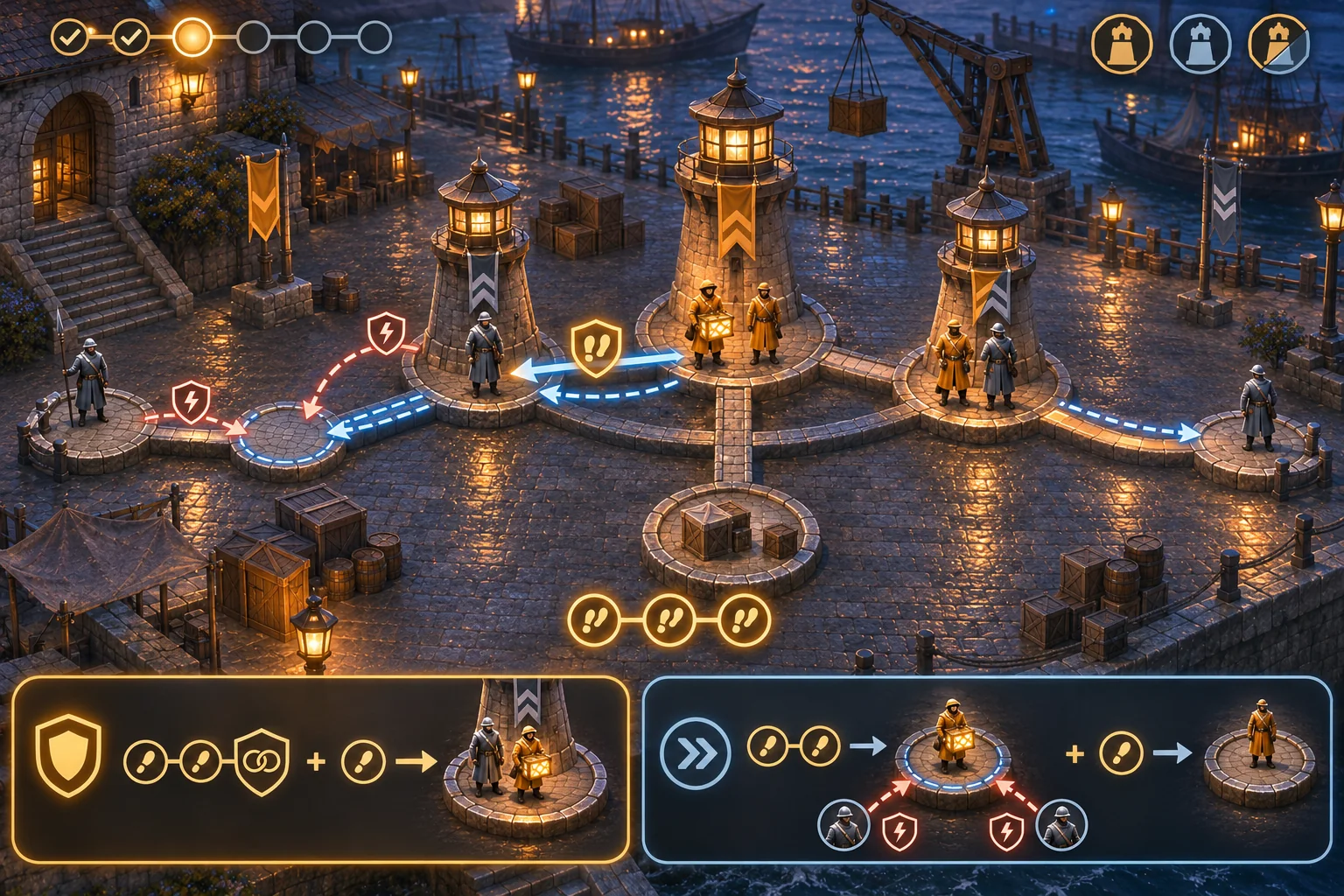
Work a small example
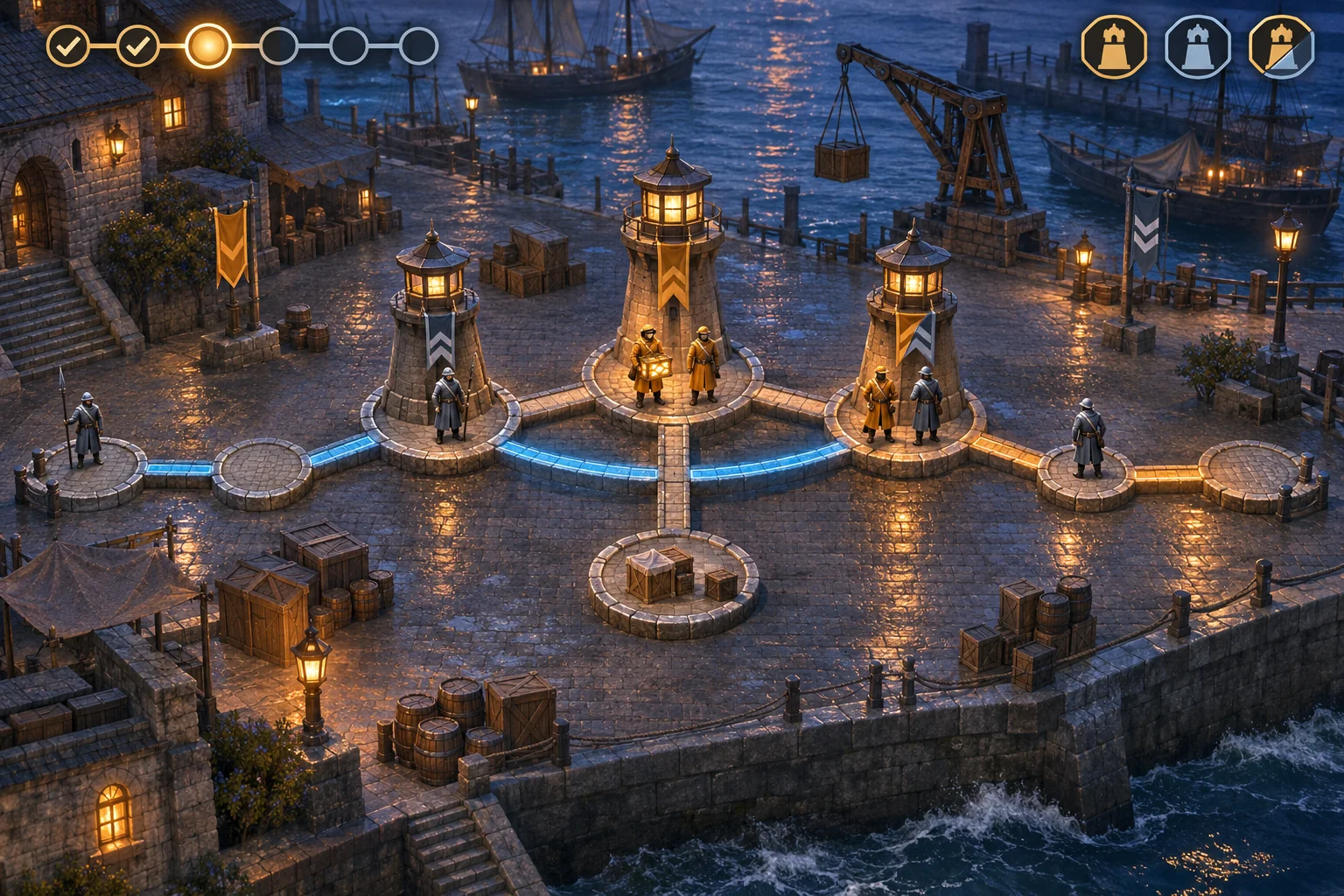
Breakwater Relay uses eight spaces: Depot D, Central Relay J, West Relay W, East Relay E, West Approach P, East Approach Q, West Exit Xw, and East Exit Xe. Routes connect D–J; J–W and J–E; W–P and W–E; P–Xw; E–Q; and Q–Xe. The only relay towers are at J, W, and E. Each figure moves along one connected edge for 1 AP. Opponents do not block movement, and figures may share a space.
The signal case starts at D. Three Couriers begin with C1 and C2 at D and C3 at J. Four Wardens begin with W1 at W, W2 at E, W3 at Xw, and W4 at Q. Each round, the Couriers take their phase first and refresh to 3 AP; then the Wardens refresh to 2 AP. Unspent AP expire at the end of the phase.
A Courier at D or at the dropped case’s space can pick up the case for 1 AP. Escort costs 2 AP and requires a second Courier in the carrier’s space. The supporting Courier stays behind; an escort marker follows the carrier and prevents an Intercept through that round’s Warden phase. A Warden can spend 2 AP, once per phase, to Intercept an unescorted carrier on the same or an adjacent space; the case drops where the carrier stands. A Courier wins immediately by entering Xw or Xe with the case.
Wardens do not win merely by occupying towers early. At the end of each Warden phase, each relay is held by a side only if that side has at least one figure there and the other side has none. If both sides are present, it is contested; if no one is present, it is uncontrolled. If the case has not been delivered, Wardens win at the end of Round 6 when they hold at least two relays. Otherwise, a game with no delivery and fewer than two Warden-held relays is a draw.
Here is one legal route to the Round 3 decision. In Round 1, C1 spends 1 AP to pick up the case at D, 1 AP to move D–J, and C2 spends 1 AP to follow D–J. The Wardens pass. In Round 2, C3 spends 1 AP to move J–E; C2 then spends 2 AP to escort C1 at J. The Wardens pass, and the escort protection expires after their phase. At the start of Round 3, C1 and C2 are at J, C3 and W2 share E, W1 is at W, W3 is at Xw, and W4 is at Q. The Couriers have 3 AP.
Protected line: spend 2 AP on Escort, then 1 AP to move C1 from J to W. C2 stays at J while the escort marker follows C1. W1 may share W with the carrier, but cannot Intercept during this Warden phase. The case advances one edge toward P.
Exposed line: skip Escort, spend 2 AP to move C1 J–W–P, then 1 AP to move C3 E–Q. The carrier reaches P, but has no escort. W1 at W and W3 at Xw are each one edge away, so the Wardens can spend their 2 AP to Intercept and drop the case at P. The Couriers gain distance and reposition C3, while the Wardens get a clear counterplay window.
These are two hand-resolved design lines, not observations from a playable build. The decision is useful because each AP has a visible cost: safety delays the carrier, while speed exposes it to a legal response. You can change the numbers later, but first make sure the game applies the stated costs and timing consistently.
Write the AI brief
A compact prompt should name the map, starting state, action costs, end conditions, and what the builder should show for review. This one asks for observable state transitions and tells the tool to surface any gap rather than silently invent a rule.
Build a small turn-based strategy prototype called Breakwater Relay from this fictional rules brief. Use two sides, open information, one shared map, and no dice or random events. Do not add online networking or hidden information.

Map spaces: Depot D, Central Relay J, West Relay W, East Relay E, West Approach P, East Approach Q, West Exit Xw, East Exit Xe. Connections: D-J; J-W; J-E; W-P; W-E; P-Xw; E-Q; Q-Xe. Put relay towers only at J, W, and E. Opposing figures may share a space and never block movement.

Start the signal case at D. Couriers: C1 and C2 at D, C3 at J. Wardens: W1 at W, W2 at E, W3 at Xw, W4 at Q. Each round, Couriers act first with 3 action points, then Wardens with 2. Refresh each budget at the start of its side's phase; unused points expire. Moving one figure along one connected edge costs 1 point.

Courier actions: Pick Up costs 1 point and works at D or the case's current space. Escort costs 2 points and requires another Courier at the carrier's space; the helper stays, while an escort marker follows the carrier and blocks Intercept through that round's Warden phase. A carrier enters either exit for an immediate Courier win.

Warden action: Intercept costs 2 points, can be used once per Warden phase, and works only when an unescorted carrier is on the same or an adjacent space. Drop the case on the carrier's current space. Recalculate relay control at the end of each Warden phase: one side controls a relay only if it has at least one figure there and the opponent has none; both present is contested and neither present is uncontrolled. If the case has not been delivered, Wardens win at the end of Round 6 with at least two controlled relays. Otherwise, no delivery and fewer than two Warden-held relays at that check is a draw.

Add a reset to the exact starting state. Show current round, whose phase is active, remaining AP, case carrier or location, relay control, and the reason an action is legal or rejected. Include these review checks: (1) the Round 1–2 sequence in the article reaches C1/C2 at J, C3/W2 at E, W1 at W, W3 at Xw, and W4 at Q; (2) the protected Round 3 line spends 2 AP on Escort and 1 AP on J-W, preventing Intercept for that Warden phase; (3) the exposed line spends 2 AP on J-W-P and 1 AP on E-Q, then allows a 2-AP Intercept at P; (4) delivery wins immediately; (5) Round 6 Warden control of W and E with J empty wins if no delivery; (6) fewer than two Warden-held relays with no delivery is a draw. State which checks are not implemented or cannot be verified. Do not claim the prototype is balanced or tested.
The prompt is a specification to try, not evidence that a tool has produced or tested this design. When you inspect a candidate build, check action refresh, legal routes, Escort timing, Intercept range, relay control, both win paths, the draw, and reset. Save the actual input and build version if you run it so a later revision can be compared with the same setup.
Inspect both sides before revising
Test one rule at a time and begin with the earliest action where the displayed state differs from the brief. These checks help separate an implementation mismatch from a design choice.
| Observed symptom | Rule to inspect | One bounded check |
|---|---|---|
| An escorted carrier is intercepted during the same round | Whether Escort protection follows the carrier through the Warden phase | Run the protected Round 3 line; confirm the 2-AP escort and 1-AP move leave the marker active until the phase ends. |
| The carrier moves two edges for 1 AP or a move crosses a missing route | Movement cost and map adjacency | Trace J–W–P as two separate edges; confirm it costs 2 AP and no unlisted connection is usable. |
| A contested relay counts for one side, or Wardens win before Round 6 | Control requires a figure and no opposing figure, and the Warden check happens only at the end of Round 6 | Compare one occupied, one contested, and one empty tower at the exact end check. |
| The game declares delivery after an unescorted carrier is intercepted | Whether the case drops before victory is checked | Use the exposed line, intercept at P, and confirm the case is no longer carried. |
One proposed balance change is to reduce Escort from 2 AP to 1 AP. Treat that as a hypothesis, not a proven improvement. In a real playtest, record how often players choose Escort, how far the case moves, whether Intercept is used, and the final result for each side. Compare those observations with the same baseline rules. Do not change AP costs and map routes together if you want to understand which change affected play.
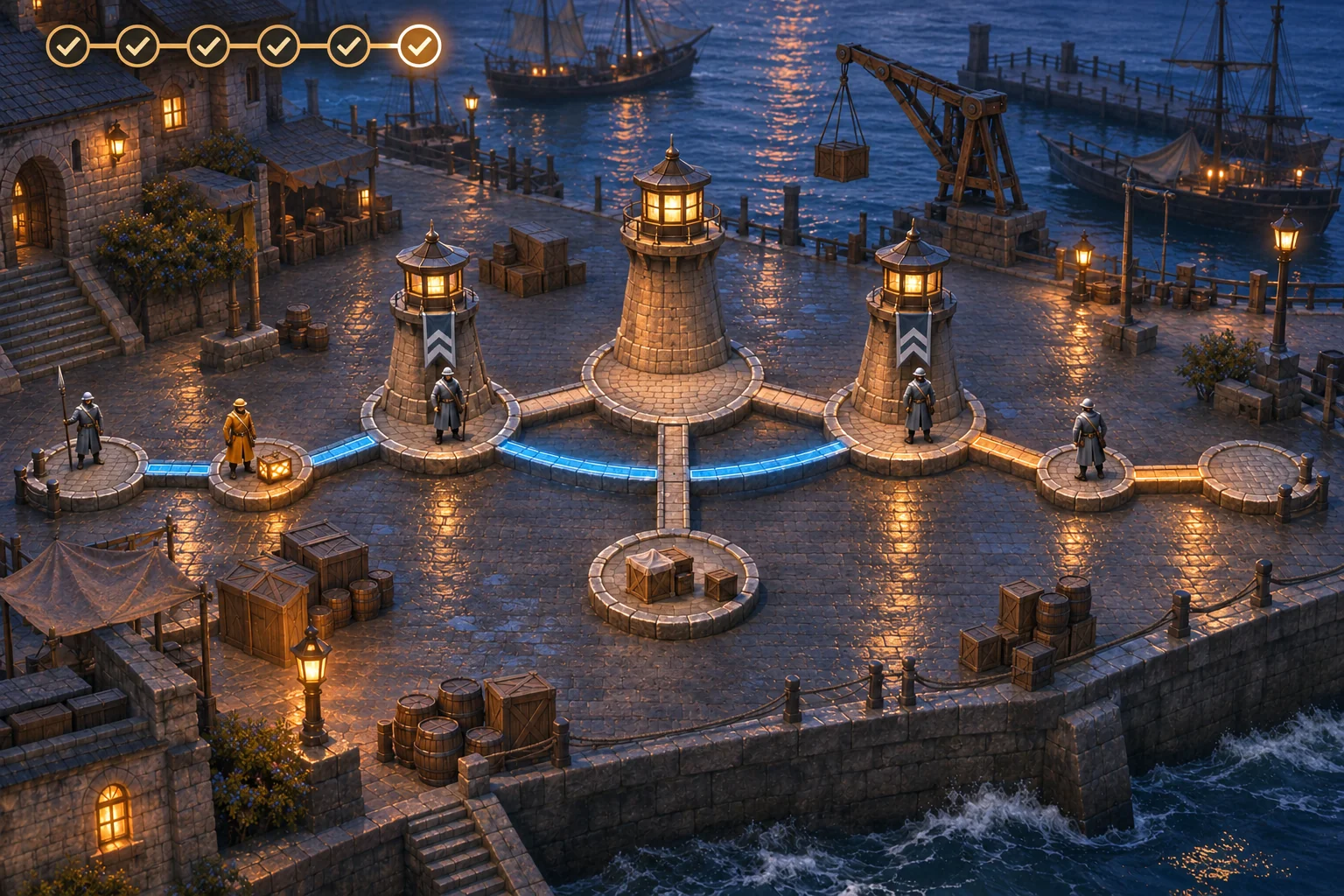
This outcome is also a paper illustration, not a playtest capture. It gives you a concrete end-state to reproduce: six rounds have elapsed, J is empty, Wardens hold W and E, and the undelivered case lies at P. If a build reaches a different result from those exact conditions, check its control and victory timing before changing the design.
Use AI with clear checks
SEELE’s Free AI Game Maker page describes a general workflow: explain a game idea in plain English, review a playable 2D or 3D result, and iterate in Workspace. That general description does not verify support for Breakwater Relay’s asymmetric rules, networked play, or balance. Bring the map, faction loops, and acceptance checks as your input, then inspect what the available result actually implements.
Start with one shared board and one measurable question: does the protection-versus-speed choice produce a legal Warden response? If the result is not available or does not match the brief, record that gap instead of reporting a successful test. When you are ready to describe a focused strategy-game idea and review a playable starting point, visit the Free AI game maker.
Frequently asked questions
What makes a strategy game asymmetric?
Asymmetry comes from different strategic loops: distinct goals, action budgets, and meaningful counterplay, not cosmetic differences alone. Keep a shared movement and round structure so players can understand how the two plans interact. The example uses different win conditions and action budgets while retaining a common map.
How many factions should a first prototype use?
Start with two. Two sides are enough to test whether objectives and actions produce different decisions and whether each side can disrupt the other. Add more factions only after you can explain the first pair’s shared rules, turn sequence, and win conditions without exceptions becoming hard to track.
Should an asymmetric game use hidden information?
Only if secrecy is part of the main experience. The worked example keeps the board state public so players can reason about routes, action costs, and relay control. If you add hidden information, define who can see it, when it is revealed, and what counterplay remains before building other secret systems.
Can an AI game maker balance the factions?
A prompt can describe goals, actions, costs, and checks, but that does not prove the resulting game is balanced. Inspect whether both sides can use their legal actions and reach their win conditions, then play repeated tests and record the setup and outcomes. Treat any cost change as a hypothesis until you have evidence.
What should I record in a first playtest?
Record the rules version, starting state, side played, action choices, missed opportunities, round reached, and final condition. For this design, track Escort use, case distance, Intercepts, relay control, and whether delivery occurs by Round 6. Those observations let you compare a later revision with the same scenario.