Start with a route and a market
An exploration-trading game becomes easier to plan when the player can connect three decisions: which route to reveal, what to bring back, and whether the market will still pay enough after each sale. Start with one short voyage. Chart a route, spend fuel to reach a discovery site, survey a fixed cargo cache, sail to market, and trade before the action limit. The route, hold, fuel, and demand should all matter to that same loop.
Moonwake Reach is an original fictional teaching design. Its places, goods, prices, and rules are invented. No game-generation prompt has been run; Codex ImageGen prompts were used only to create the concept illustrations. No playable build, game test, or measured iteration exists. The route traces below are hand calculations from the stated contract, not observed results.
- Start with a route and a market
- Write the voyage state
- Compare two discovery routes
- Trace the trade action
- Simulate one rule revision
- Build an acceptance checklist
Write the state before adding islands
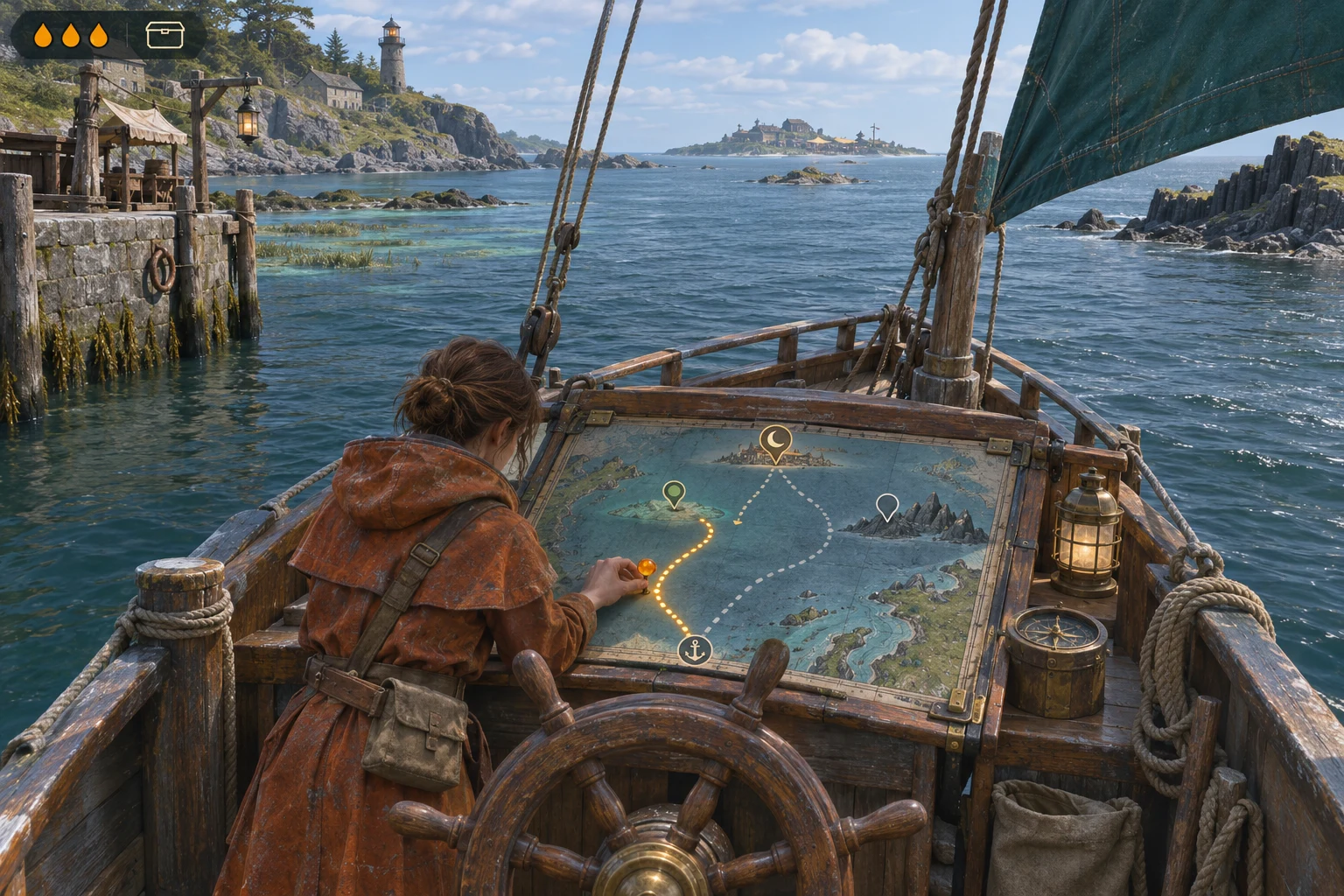
A map with many destinations can look exploratory while leaving the player unsure what a trip changes. Begin with a finite state that can fit in a small ledger. In this example, a voyage starts at Anchor Harbor with zero credits, three fuel, an empty two-slot cargo hold, demand index two, and five actions available. The Moon Market destination is known, but the chart begins without the two discovery routes.
The player spends one action on Chart. That action reveals both route plans, each leg's fuel price, and the visible demand signal at Moon Market. The player then commits the voyage to one plan. Each Sail action traverses one revealed leg, costs one action, and consumes the fuel printed for that leg. If the leg costs more fuel than remains, it is unavailable and changes no state. The route does not roll randomly in this example, so the player can compare both options before leaving.
Survey also costs one action. It yields the site's fixed cache once, only if the whole cache fits the hold. Route A's two Tideleaf crates use both slots. Route B's single Stormglass crate uses one. No mid-voyage refill, storage transfer, or demand carryover is part of this first slice. Removing those systems keeps the route, cargo, and market decision connected and auditable.
| State at start | Rule | Why it matters |
|---|---|---|
| Location: Anchor Harbor; credits 0 | Chart first, then choose one revealed route | The destination and route cost are visible before commitment |
| Fuel 3; hold 0/2; demand 2 | Each route leg has a fixed fuel cost; Survey adds its entire cache once | The player can compare range and cargo fit |
| Five voyage actions | Chart, sail, survey, sail, trade | Each route has the same finite action budget |
| Market sells a batch | Price each unit from current demand, then reduce demand by one | Order matters even inside one Trade action |
For the trade rule, define price as the good's base value plus the current demand index. Every sold unit reduces demand by one, to a floor of zero, before the next unit is priced. Each new practice voyage resets demand to two. These are deliberate design settings, not facts about a real market.
Choose a route by fuel and cargo yield
Route A travels from Anchor Harbor to Eelgrass Shoal for one fuel, then from the shoal to Moon Market for one more. Surveying Eelgrass gives two Tideleaf crates with a base value of one credit each. It fills the hold but leaves one fuel after delivery. Route B costs two fuel to reach Basalt Shelf and one fuel to reach the market. Its fixed Stormglass cache contains one crate with a base value of four. It uses the whole hold less fully, but leaves no fuel reserve.
| Plan | Fuel to discovery + market | Survey cache | Base value | Fuel at market |
|---|---|---|---|---|
| A: Eelgrass Shoal | 1 + 1 = 2 | 2 Tideleaf | 1 each | 1 |
| B: Basalt Shelf | 2 + 1 = 3 | 1 Stormglass | 4 | 0 |
Both trips fit the five-action schedule because Chart, the first Sail, Survey, the second Sail, and Trade each use one action. A route choice is not simply “take the highest base value.” Route A uses two fuel and exposes the player to a multi-item repricing decision. Route B spends the full reserve to carry one higher-base-value crate. The hand calculation can show those trade-offs, but it cannot tell us which route players would prefer or whether either option is balanced.
Mark the route and cache as visible before asking for any art or code. A practical route diagram should show Harbor, both discovery sites, the Market, leg costs, and which cache belongs to each site. If a player cannot see the cost of the second leg before leaving, the risk is hidden rather than chosen.
Survey, carry, and trade through demand changes
Route A is the clearest example because its two identical crates make the per-unit rule easy to see. Chart uses action one. Sailing to Eelgrass uses action two and reduces fuel from three to two. Survey uses action three and fills the hold with two Tideleaf. Sailing to Moon Market uses action four and leaves one fuel. The Trade action is action five, but it contains two price calculations in a fixed order.
| Trade unit | Base value | Demand before this unit | Price paid | Demand after payment |
|---|---|---|---|---|
| First Tideleaf | 1 | 2 | 1 + 2 = 3 | 1 |
| Second Tideleaf | 1 | 1 | 1 + 1 = 2 | 0 |
The final Route A state is five credits, one fuel, an empty two-slot hold, zero demand, and Moon Market as the location. It meets the example objective: deliver all cargo and finish with at least five credits by the end of action five.
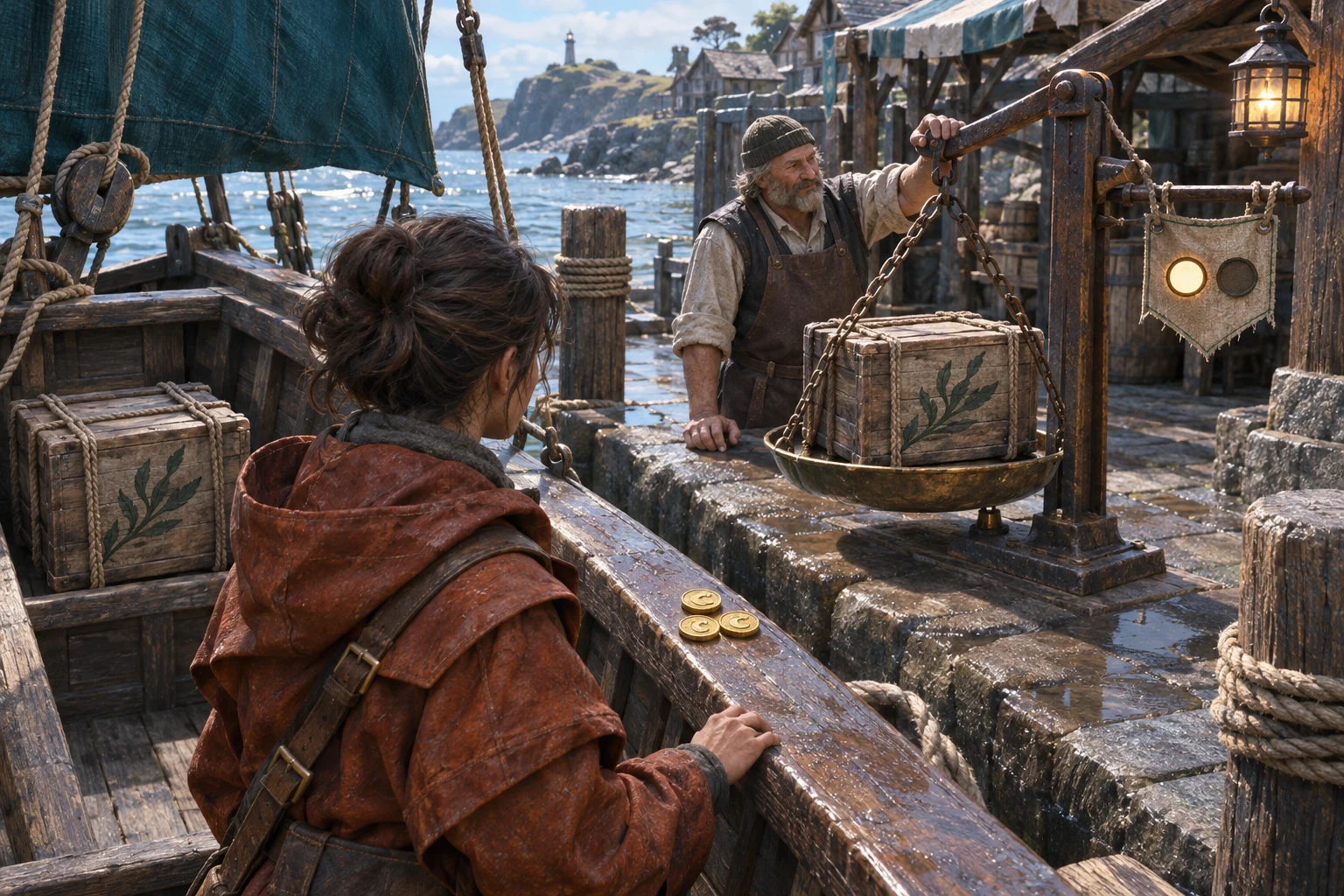
Route B gives a useful contrast. After Chart, the two-fuel Sail to Basalt leaves one fuel. Survey adds one Stormglass, and the final one-fuel leg reaches Moon Market with no reserve. The single crate sells for base value four plus demand two, or six credits; demand then falls to one. The five-credit objective is met, but the trip ends with zero fuel. That is a different resource profile, not proof that Route B is superior.
This moment matters because both crates sell during one action while their prices still differ. The market first pays for one unit, then updates demand, then prices the next. If the interface shows only the final total, the reader may not know which rule produced it. Show the remaining crate, the changed demand marker, and the first payment at the same time.
Fix the stale batch quote
A small iteration can isolate one timing ambiguity. In the deliberately incomplete v0, a Trade action snapshots the opening demand and uses that same value for every unit in the batch. Route A's two Tideleaf crates would each receive one plus two, for six credits in total. Demand still falls from two to zero after the batch, but the second crate is priced from stale demand.
In v1, keep the route, cargo, action count, base values, starting demand, and final demand unchanged. Change only the order inside Trade: calculate a unit's price from current demand, pay it, reduce demand, then calculate the next unit. The same two crates now pay three and two credits, for five total. The difference is one credit; both versions finish at demand zero.
| Rule version | Unit one | Unit two | Credits | Demand after batch |
|---|---|---|---|---|
| v0: quote from opening demand | 1 + 2 = 3 | 1 + 2 = 3 | 6 | 0 |
| v1: update before next quote | 1 + 2 = 3; demand becomes 1 | 1 + 1 = 2; demand becomes 0 | 5 | 0 |
This is a fictional hand simulation, not an actual test or measured improvement. The acceptance question for a future build is narrow: after the first Tideleaf sale, does the next unit use demand one? If no build or observation exists, the correct status is “not run,” not “passed.”
Check the route and market contract
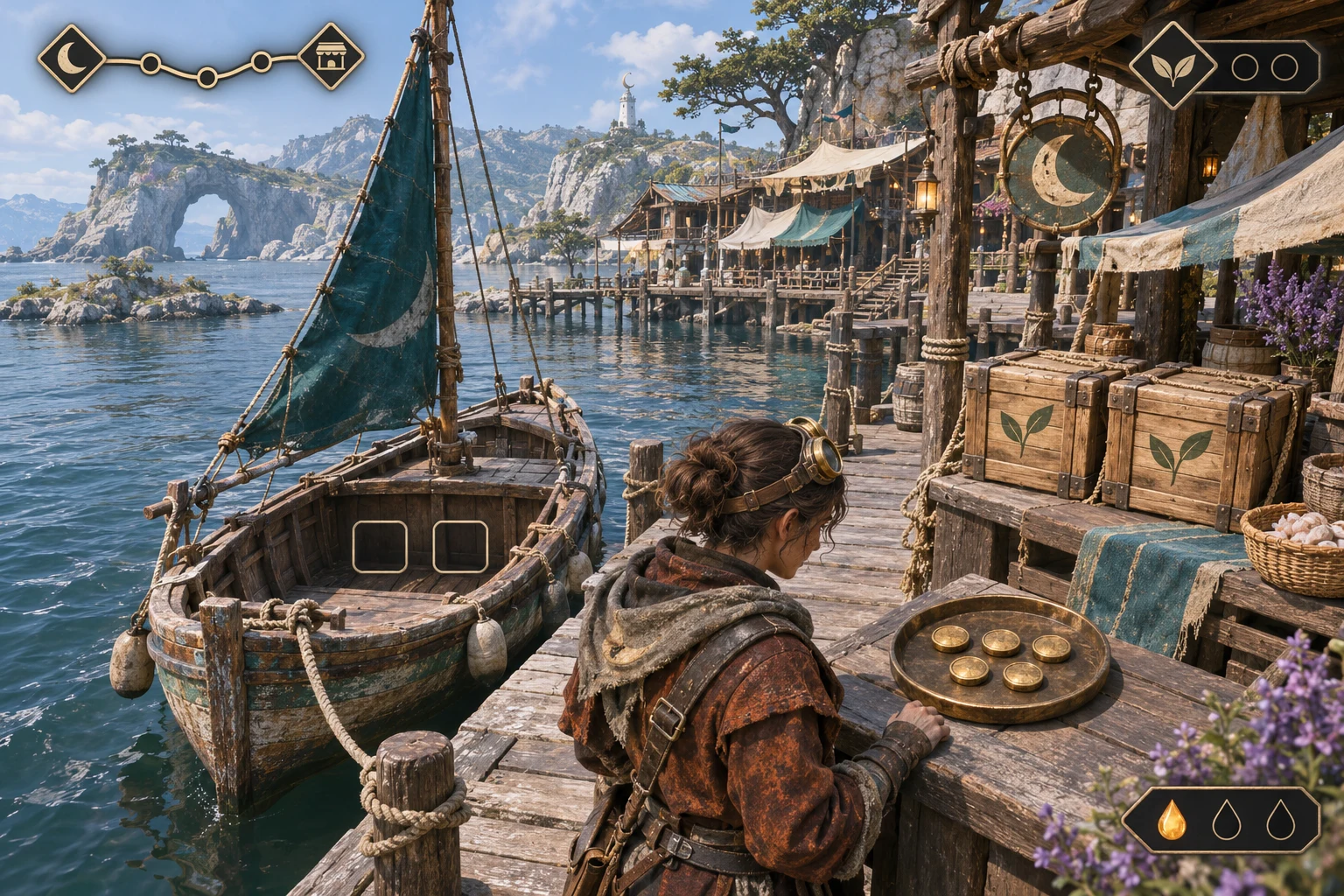
Turn the example into observable checks before adding islands, storms, upgrades, or random cargo. A compact checklist helps a future creator distinguish a rule error from a presentation problem:
- Chart reveals both route branches, each printed leg cost, and the Moon Market demand signal before the player commits.
- Route A spends one fuel on each leg and ends with one; Route B spends two then one and ends with zero. An unaffordable leg changes neither location nor fuel.
- Survey can happen once at the chosen site. Eelgrass gives exactly two Tideleaf if both slots are open; Basalt gives one Stormglass. A cache that does not fit is unavailable without partial cargo.
- A fresh practice run starts at demand two. Route A's first Tideleaf pays three, demand becomes one, the second pays two, and demand becomes zero. Route B's Stormglass pays six, leaving demand one.
- Trade is one action even when it sells two crates. Both routes reach Moon Market and complete the stated objective on action five.
- The result screen shows credits, fuel, empty cargo, demand, location, and completion together. The screen reports the designed state without claiming the route has been tested.
These are proposed acceptance checks only. The article has no build logs, screenshots from a running prototype, or player observations. When a prototype eventually exists, record the input and starting state, compare expected and observed values, and mark missing cases unverified. Do not infer that an unobserved mechanic works because its paper trace is consistent.
Take the route brief into a creation workflow
A first creation request should state the audience, format, first action, route graph, resources, cargo, market timing, and what counts as success. Ask for a small playable slice and a visible state display; leave storms, persistent economies, and more destinations out of the first pass. Then inspect the returned result and compare each state transition with the written contract.
The current official Free AI Game Maker page describes plain-English game requests, playable 2D or 3D results, browser testing, follow-up prompt refinement, and review of generation costs. These are general creation and review steps; they do not promise that Moonwake Reach or its demand rule has been generated. Before submitting, inspect the selected AI model, available Koin balance, and displayed generation cost in Workspace.
Start your own exploration-trading game
Begin with one route choice that changes what the player can carry, then make the market react in a rule the player can calculate. Keep the map, action count, resources, and success condition visible. Use the paper trace as a design target for a future prototype, and report only results you actually observe. When your own route brief is ready, open the Free AI game maker to explore a first direction, then inspect the playable output and current cost.
Frequently asked questions
What makes an exploration-trading loop different from a map tour?
A map tour reveals places, but a trading loop makes discovery change a resource decision. In this example, the chosen site determines cargo, cargo fits a limited hold, the route spends fuel, and each sold unit changes the next price. If a destination does not affect a later choice, it may be decorative rather than part of the loop.
How do I decide whether a longer route is worth its fuel?
Write the cost of every leg and the fixed cache at the destination before choosing. Compare fuel remaining at market, cargo capacity, base value, demand, and action count. Moonwake Reach makes Basalt pay six credits but consume all three fuel; Eelgrass pays five and leaves one. Those fictional values make a trade-off visible, but a future build or playtest is needed to learn what players prefer.
Should demand change after a batch or after each item?
Choose one order and make it explicit. If each sale changes the price of the next unit, price one item from current demand, pay, update demand, and continue. The example v0 instead snapshots opening demand for the whole batch. Its v1 correction changes only that timing rule, so the one-credit difference can be traced without changing route, cargo, or base price.
What happens when the hold is full or a route costs too much fuel?
Decide whether an action is legal before applying its effects. This sample rejects an unaffordable Sail without movement or fuel loss. It also makes Survey unavailable if the entire cache will not fit, rather than silently dropping or selling part of it. A different game can allow partial cargo, but then the player needs a clear rule and a test for it.
Was Moonwake Reach built or tested?
No. Moonwake Reach is a fictional design, and its action traces are hand-calculated from the rules in this article. No game-generation prompt has been run; Codex ImageGen prompts were used only for the concept illustrations. The proposed game prompts and checklist remain unexecuted for a game; no playable build or measured result is presented. Treat each acceptance check as pending until someone observes it in a real build and records the evidence.