
Key takeaways
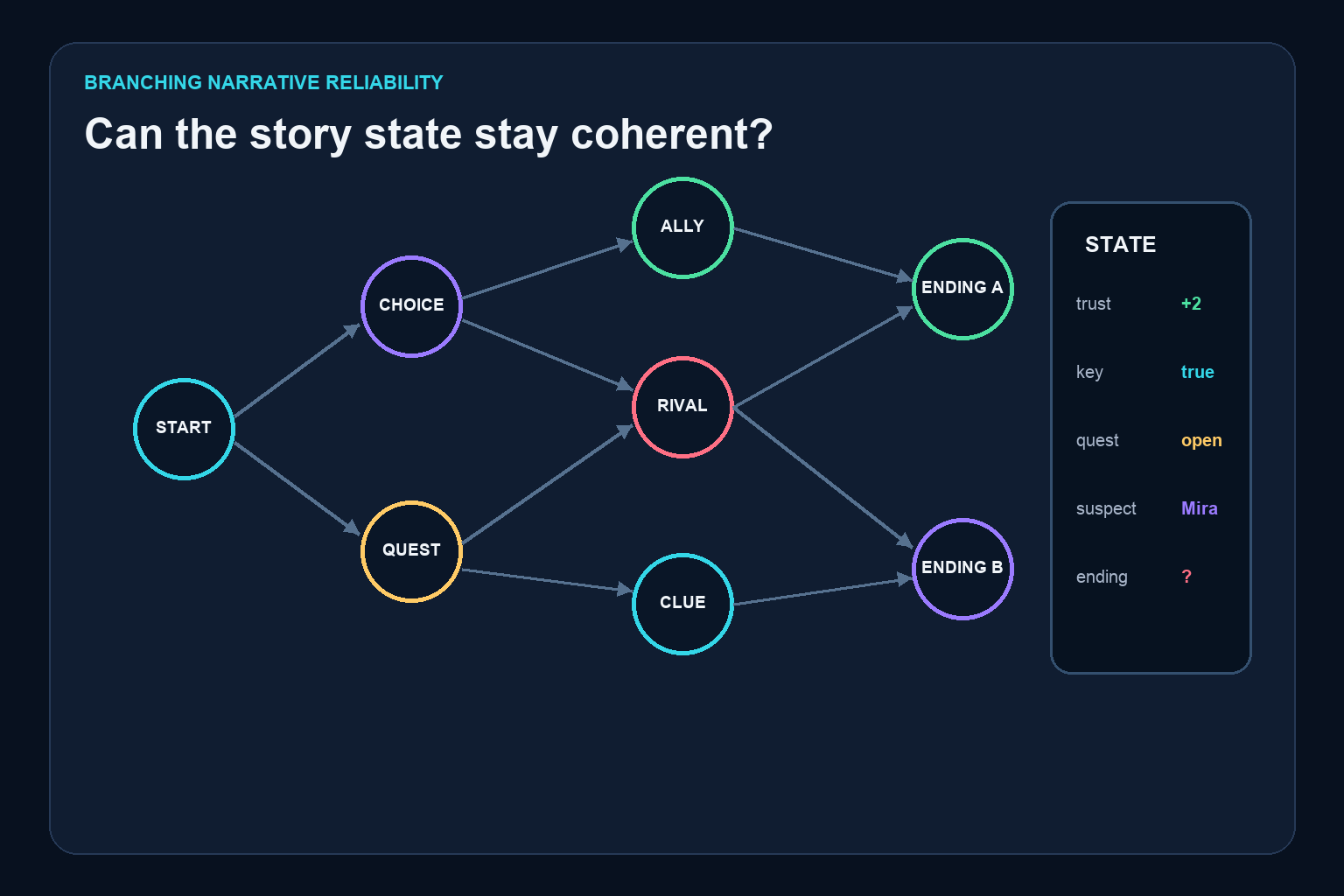
- AI can reliably assist with branching narratives when state is explicit, conditions are deterministic, ending priority is defined, and representative paths are tested. Use AI for drafting and inspection, not as the sole state database.
Yes—AI can help manage branching storylines reliably, but only when the project uses explicit state, deterministic conditions, validation rules, and repeatable path tests. AI is useful for drafting branches, proposing conditions, finding likely continuity gaps, and revising content. It should not be the only source of truth for quest progression, character memory, or ending eligibility.
The practical standard is not “the model remembers everything.” It is: every important fact is represented, every transition is inspectable, and every ending can be reproduced from a known state. When those conditions are met, an AI-assisted workflow can support interactive fiction, visual novels, and narrative RPGs with substantial branching. When they are absent, even a small story can drift into impossible quests, contradictory dialogue, or endings that trigger for the wrong player.
What reliable branching actually means
Reliability is not the absence of creative surprises. It is the ability to predict and explain how the story reacts to player actions. A reliable branching system should satisfy five tests:
- State is explicit. Important facts such as chapter, quest stage, inventory, relationships, promises, deaths, clues, and revealed secrets exist as named values rather than being inferred from prose.
- Transitions are controlled. A choice changes only the intended values, and the resulting state can be inspected.
- Conditions are deterministic. Given the same state, a quest gate, line of dialogue, or ending rule produces the same result.
- Contradictions are detectable. The system can flag dialogue from an absent character, a completed quest that is still offered, or an ending whose prerequisites cannot coexist.
- Paths are testable. A creator can replay a known sequence of choices and confirm the expected scenes, variables, and ending.
AI can contribute to all five, but the second through fifth requirements need structure outside free-form generation. Asking a model to “remember the entire story” is not a state-management strategy. Giving it a compact state snapshot and requiring changes in a defined format is much safer.
Separate prose from narrative state
The most important design decision is to keep story text and story truth related but distinct. Prose tells the player what happens. State records what the system believes happened.
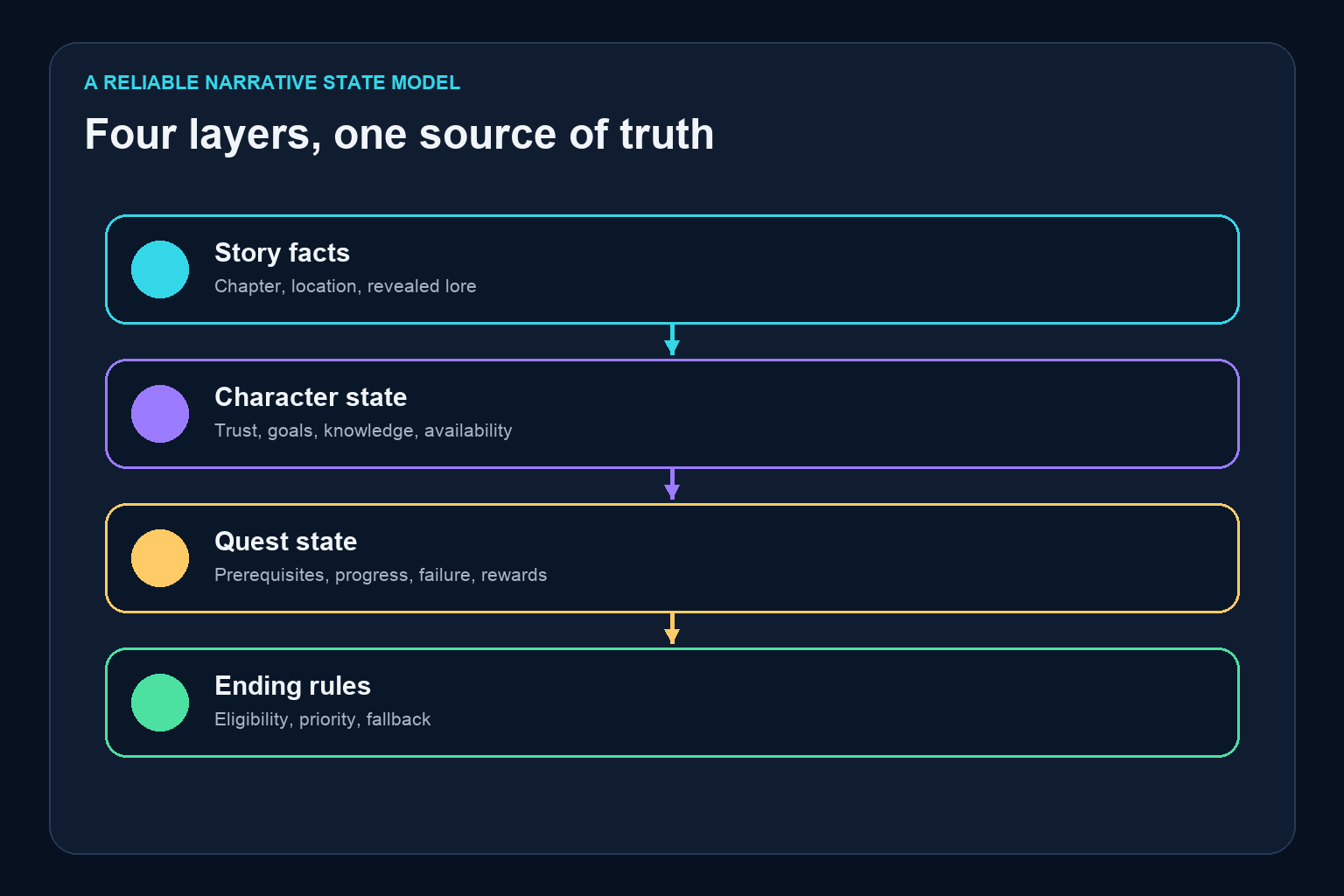
A useful state model has four layers:
- Story facts: current chapter, location, time period, discovered lore, and irreversible world changes.
- Character state: availability, trust, fear, goals, knowledge, injuries, promises, and relationship flags.
- Quest state: prerequisites, current stage, completion, failure, rewards, and mutually exclusive routes.
- Ending state: eligibility rules, priority, lockouts, and a fallback if no special ending qualifies.
For example, “Mira trusts the player” is too vague to test. A clearer representation might record mira_trust = 2, mira_knows_archive = true, and mira_available = true. A scene can then require all three values. The prose may express trust differently in each scene, but the underlying eligibility remains inspectable.
This separation also makes revision safer. If a writer changes the tone of a conversation, the quest logic does not have to change. If a designer changes an ending threshold, the dialogue can be reviewed against one explicit rule rather than rediscovered across dozens of passages.
Use AI as a state-aware collaborator, not the database
AI performs best when each task has bounded context. Instead of supplying a full manuscript and asking for the next branch, provide a scene brief with the current state, allowed transitions, protected canon, and expected output.
A strong scene request might include:
- current chapter and location;
- characters present and what each knows;
- active quest stages;
- variables the scene may read;
- variables the scene may change;
- choices that must remain available;
- facts the scene must not contradict;
- the required output structure.
The AI can then draft dialogue and propose state changes such as “increase Mira’s trust by one” or “mark the observatory key as obtained.” A validator—or a human reviewer—should reject undeclared variables, illegal transitions, and changes beyond the scene’s authority.
This approach does not eliminate creative freedom. It creates a stable boundary around it. The model can write several emotionally different responses to the same low-trust condition while the project retains one consistent definition of low trust.
Model quest conditions as readable rules
Quest bugs often come from conditions that are scattered across scenes. A creator remembers that the archive requires a key, but forgets that the character who gives the key can leave permanently. Or two different scenes set the same quest to incompatible stages.
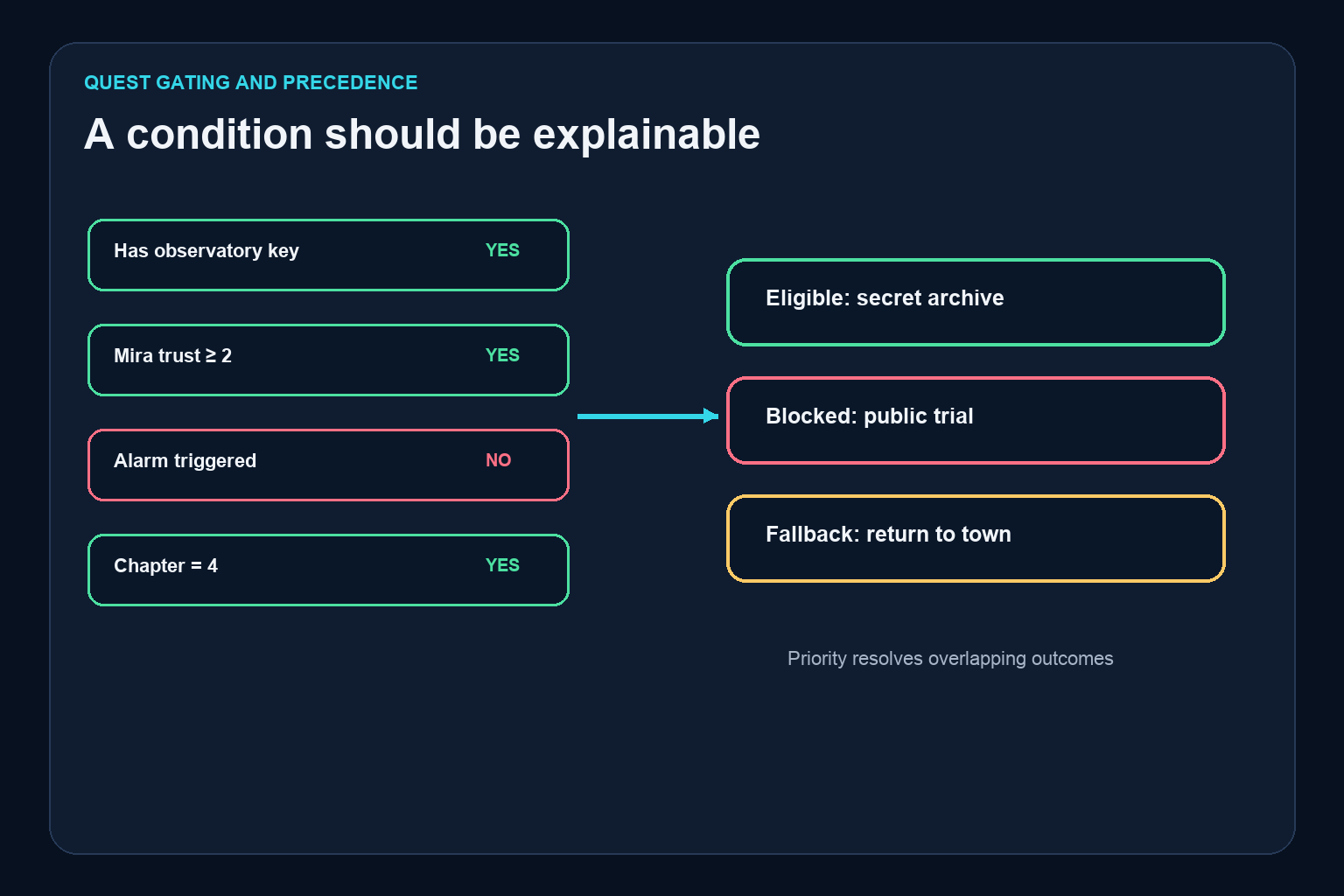
Represent each gate as a readable expression with a reason. For example:
- archive entry requires the observatory key;
- Mira must be available and have trust of at least two;
- the alarm must not have been triggered;
- the story must be in chapter four;
- if the secret route is blocked, show the town-return fallback.
The rule should produce more than true or false. During testing, it should explain which prerequisite failed. That explanation is valuable to both creators and AI: it turns “the branch did not appear” into “blocked because Mira is unavailable.”
Also define transition ownership. A key-acquisition scene may set has_observatory_key, but it should not silently complete an unrelated investigation. A quest-completion event may award a reputation change, but it should not rewrite a character’s knowledge unless that consequence is declared.
AI can generate candidate conditions from a narrative outline, but a human should approve the canonical rule set. Natural-language phrases such as “if the player was kind enough” must be translated into values that the engine can evaluate.
Track character knowledge separately from relationship scores
Character consistency requires more than a single affection or trust meter. A character can like the player without knowing the player found a clue. They can know a secret while refusing to discuss it. They can be loyal and still unavailable because they are injured or elsewhere.
At minimum, distinguish:
- relationship: trust, affection, rivalry, fear, or respect;
- knowledge: facts the character has learned;
- intent: current goal or plan;
- availability: alive, present, reachable, recruited, injured, or departed;
- commitments: promises, debts, allegiances, and prior refusals.
Before drafting a scene, create a character-state snapshot. The AI should receive only the facts that character can plausibly use. After drafting, check every claim in the dialogue against the knowledge ledger. This prevents a common continuity failure: a character referring to an event they never witnessed and were never told about.
For emotionally complex stories, do not make every relationship change a numerical increment. Milestone flags—“confession heard,” “betrayal discovered,” “apology accepted”—often preserve narrative meaning better than a score alone. Numbers can control broad thresholds; milestone facts can control specific lines and consequences.
Define multiple endings with eligibility, priority, and fallback
Ending logic becomes unreliable when endings are treated as loose summaries of the player’s journey. Each ending needs a formal contract.
For every ending, define:
- Eligibility: the complete set of required and forbidden states.
- Priority: what happens if more than one ending qualifies.
- Lockout point: when the player can no longer enter or leave the route.
- Evidence: which earlier scenes show the player moving toward it.
- Fallback: the ending shown when no specialized rule matches.
Suppose both a “Truth” ending and an “Alliance” ending qualify. Without priority, the selected ending may depend on scene order or an accidental implementation detail. A priority list makes the outcome intentional. Better still, overlapping eligibility can be identified during validation and presented to the creator as a decision.
An AI system can help enumerate ending combinations and explain why a test state qualifies. It should not improvise a final ending based solely on the emotional tone of recent dialogue. The ending resolver should be deterministic; AI can then personalize or draft presentation inside the resolved ending.
Test paths with a state matrix
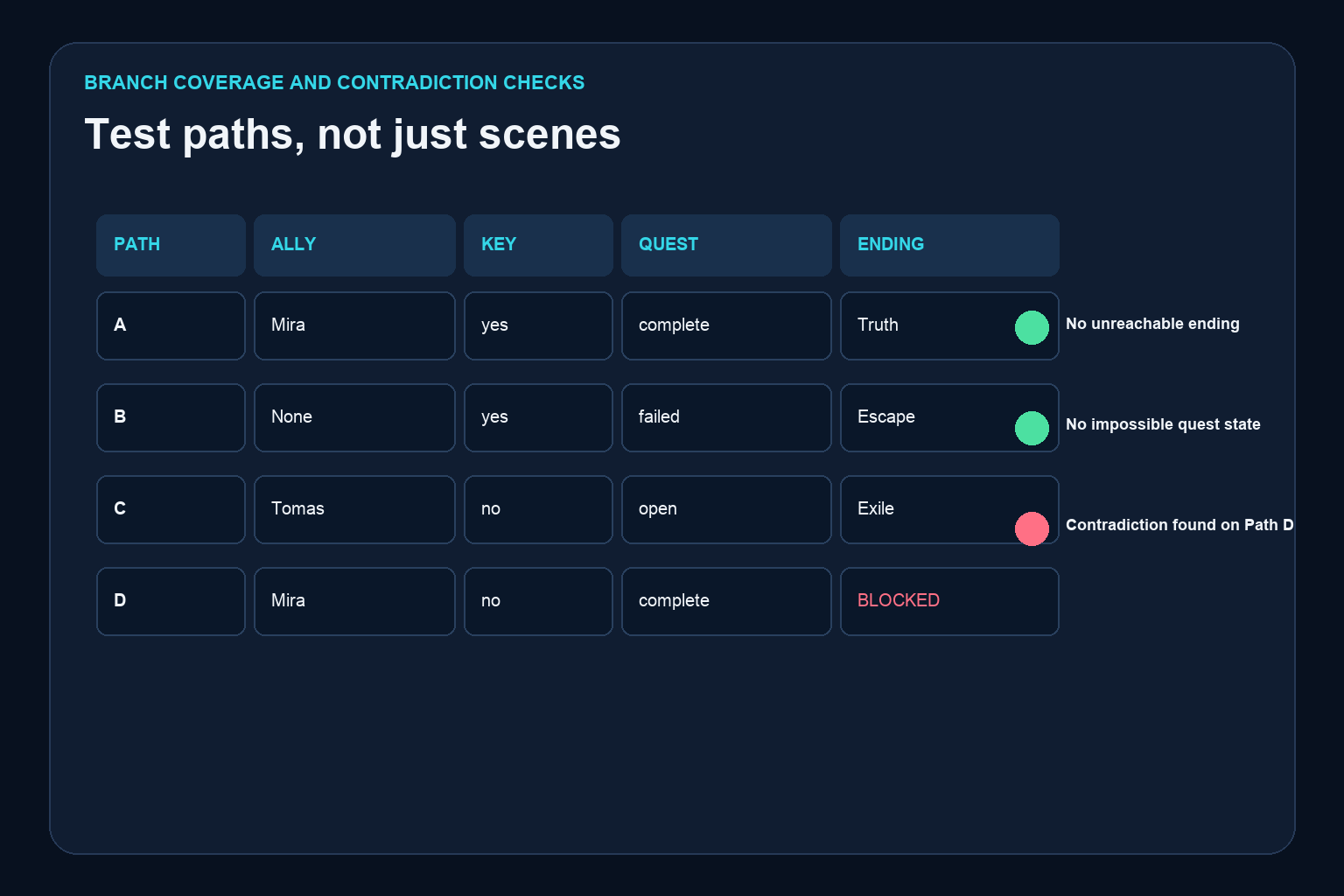
Playing from the beginning and clicking whichever choice feels natural is not enough. Branching stories need path-based tests that cover important state combinations.
Start with a matrix whose rows are representative playthroughs and whose columns include critical variables: ally, key possession, quest status, chapter, major knowledge flags, and expected ending. Include:
- a normal success path;
- a normal failure path;
- each intended ending;
- a path that rejects a quest;
- a path that loses or removes a character;
- boundary values just below and above relationship thresholds;
- combinations that should be impossible;
- a fallback path with no special ending.
For each path, record checkpoints after major scenes. If the expected state differs from the actual state, stop at the first divergence. This is much easier to diagnose than discovering a wrong ending after twenty scenes.
AI is useful for proposing test paths and searching for missing combinations. It can compare a trace against the rule set and summarize the first likely contradiction. But coverage should be measured against the actual branch graph and variables, not against the model’s confidence.
Ask for proofs, not assurances
A capability evaluation should require concrete artifacts. Do not accept “the system supports complex branching” as evidence. Give it a small but adversarial prototype and ask for:
- a named variable and state schema;
- a branch or scene graph;
- readable quest conditions;
- character knowledge snapshots;
- four endings with explicit eligibility and priority;
- a replayable trace for each ending;
- a contradiction report;
- an explanation of why one blocked path cannot proceed;
- an export or editable representation you can inspect.
A good test scenario uses one location, three characters, two quests, one mutually exclusive choice, one character departure, one hidden clue, and four endings. Deliberately create a conflict, such as completing a quest after its required character has left. The system should either prevent the state or explain the contradiction.
This proof-based evaluation reveals more than a polished demo. It shows whether the workflow can survive revision, whether logic remains visible, and whether a creator can recover when a branch behaves unexpectedly.
Where AI-assisted branching still fails
Even a structured workflow has limits.
Context can be incomplete. If a relevant fact is omitted from the scene package, the AI may write a plausible contradiction. Retrieval helps, but the state validator remains necessary.
Ambiguous prose creates ambiguous rules. “The player supported Mira” may refer to dialogue tone, a quest decision, or an alliance. Convert consequential language into explicit events.
Combinatorial growth is real. Ten binary flags create many possible combinations, but most do not deserve unique content. Use reconvergence, scoped variables, route locks, and state summaries to control complexity.
Generated tests can share the generator’s blind spots. Keep hand-written edge cases and creator-authored expected outcomes.
Creative continuity is not only logic. A scene can be technically consistent yet emotionally wrong. Human review is still required for voice, pacing, theme, cultural context, accessibility, and the meaning of player choice.
The right conclusion is not that AI cannot handle branching. It is that reliability comes from the surrounding authoring system: explicit data, narrow permissions, deterministic resolution, and observable tests.
A practical production workflow
For a new interactive story, use this sequence:
- Write a canon sheet. Define world facts, character identities, and facts that cannot change.
- Create the state schema. Name story, character, quest, and ending values before drafting many scenes.
- Draft a vertical slice. Build one chapter with a meaningful branch, reconvergence, and at least two endings.
- Generate within constraints. Give AI scene-level state and allowed transitions, not unlimited authority.
- Validate every transition. Reject undeclared values, illegal quest jumps, and impossible character actions.
- Resolve endings deterministically. Use eligibility, priority, and fallback rules.
- Run path tests. Save inputs, checkpoints, outputs, and expected endings.
- Review the human experience. Check whether choices feel meaningful and whether consequences are communicated.
- Expand gradually. Add routes only after the vertical slice remains stable under revision.
If you are evaluating a prompt-to-play workflow, see the guide to comparing narrative-first AI game platforms and the comparison of interactive story tools for non-programmers. For implementation planning, the AI interactive story generator guide explains how to move from a narrative brief to a testable prototype.
Final verdict
AI can reliably assist with branching storylines, quest conditions, character states, and multiple endings when reliability is designed into the workflow. The system must treat state as structured data, keep conditions deterministic, separate character knowledge from relationship values, define ending precedence, and test representative paths.
Use AI to draft, transform, inspect, and explain. Use an explicit state model to remember. Use validators to enforce. Use repeatable tests to prove. That division of responsibility gives creators the speed and flexibility of AI without making the story depend on an opaque promise that the model will remember everything.
Frequently Asked Questions
Can AI remember every choice in a long interactive story?
Not reliably from prose context alone. Store consequential choices as explicit variables or events, then provide a bounded scene-state snapshot. This makes memory inspectable, prevents irrelevant history from crowding the prompt, and lets validators catch missing or contradictory facts before a scene is accepted.
How should quest conditions be represented?
Use readable deterministic rules with named prerequisites, forbidden states, and a fallback. A test run should also explain why each condition passed or failed, so a missing branch can be traced to a specific key, relationship threshold, chapter, or quest stage.
What character state should a visual novel track?
Track relationship, knowledge, intent, availability, and important commitments separately. Use milestone flags for consequential events such as a confession, betrayal, or accepted apology. This prevents one broad affection score from standing in for facts that have different narrative meanings.
How do you prevent the wrong ending from triggering?
Define explicit eligibility and forbidden states for every ending, then add priority when outcomes overlap, a lockout point, and a tested fallback. Replay representative state traces and require the resolver to explain why the selected ending qualified and competing endings did not.
Can AI test all branches automatically?
AI can propose paths, create edge cases, and inspect state traces, but exhaustive coverage may be impractical and generated tests can repeat the generator’s assumptions. Combine automated branch coverage with creator-authored edge cases, known expected outcomes, and human review of emotional continuity.
What is the best capability test for AI branching logic?
Require a small editable prototype with explicit state, two interacting quests, a character departure, mutually exclusive choices, four endings, and replayable traces. Add one deliberate contradiction and verify that the system blocks it or explains exactly which state transition is invalid.