Key takeaways
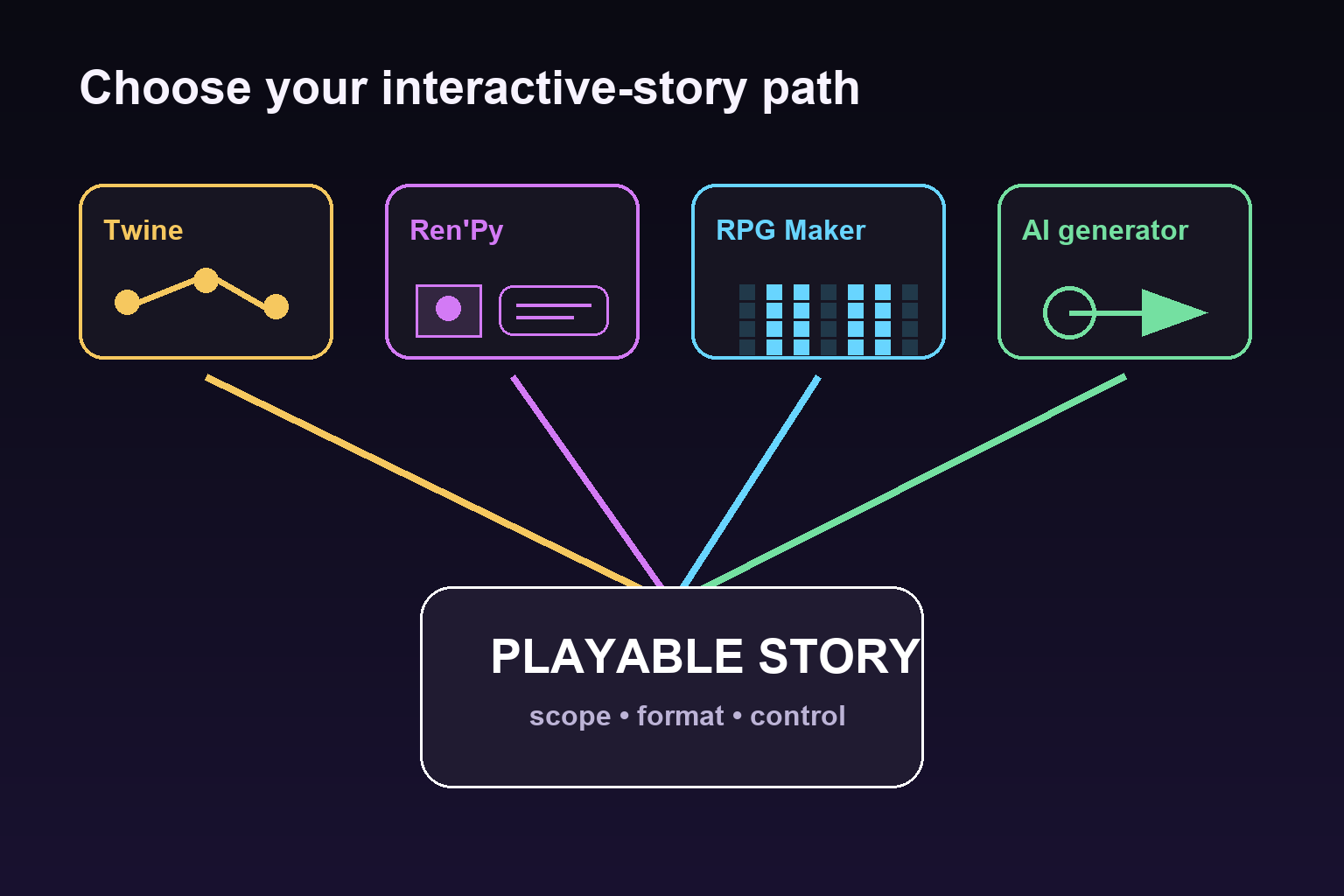
- Choose Twine for browser-based branching fiction, Ren'Py for visual novels, RPG Maker for map-based RPG stories, and an AI game generator for prompt-to-prototype iteration. Match the tool to the first playable artifact you need.
A non-programmer should choose Twine for a browser-based branching story, Ren'Py for a character-led visual novel, RPG Maker for a map-based role-playing game, and an AI game generator when the priority is getting to an editable prototype from a plain-language brief. The best choice is not the tool with the longest feature list. It is the tool whose default output already resembles the story you want to release.
This comparison focuses on format, authoring model, creative control, testing burden, and the kind of first playable artifact each option encourages. It deliberately avoids pricing and speed claims because plans, versions, hardware, and project scope can change the answer.
The short answer
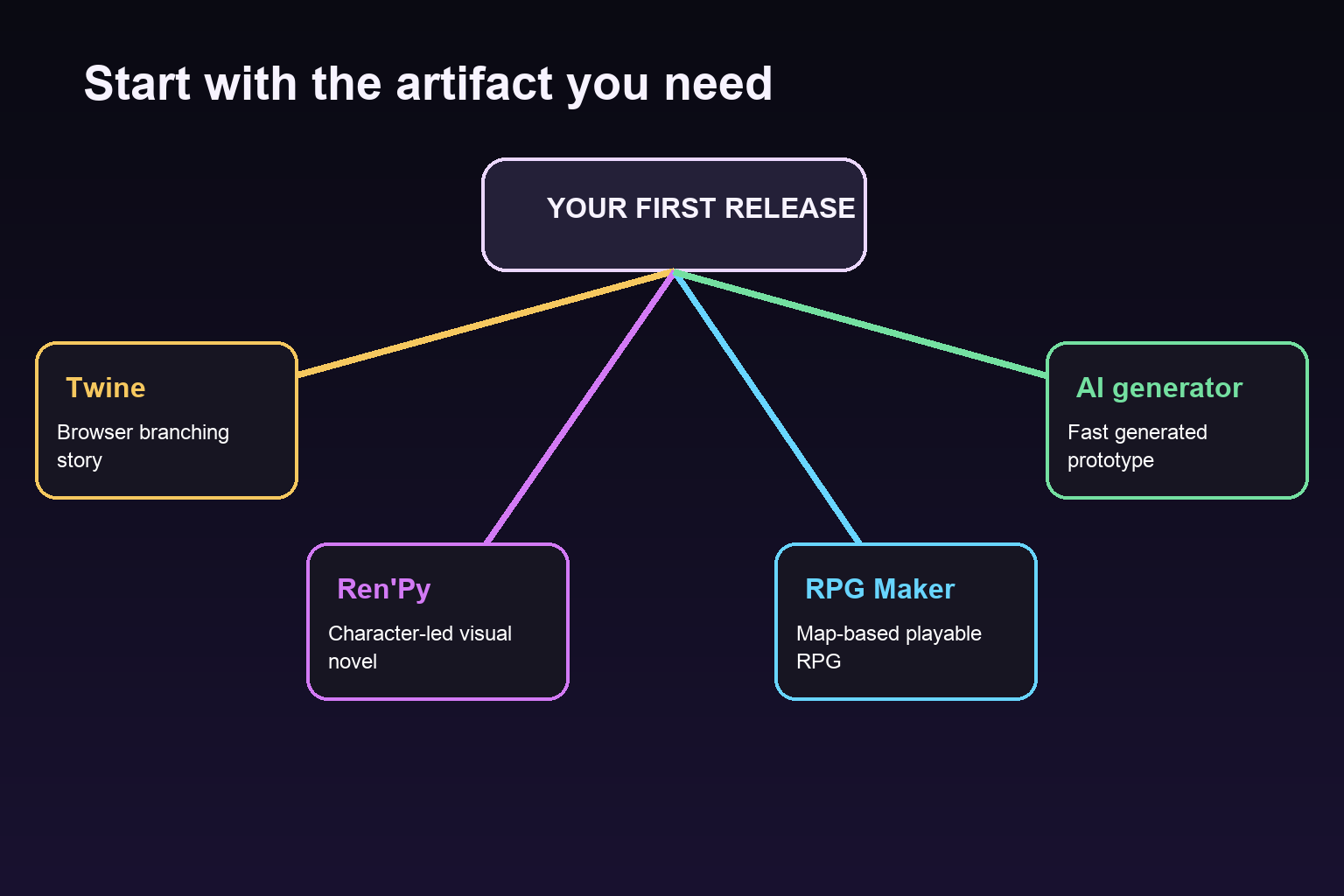
Start by naming the smallest artifact that would prove your idea works.
- Choose Twine when the proof is a set of readable passages connected by meaningful choices.
- Choose Ren'Py when the proof is a visual-novel scene with dialogue, characters, backgrounds, and branching.
- Choose RPG Maker when the proof needs maps, movement, events, inventory, or other recognizable RPG structure.
- Choose an AI game generator when the proof is an editable, playable draft produced from a narrative brief, especially when you want to explore the story and interaction model together.
If you are undecided, prototype one scene before committing to a full production workflow. A ten-minute playable conversation reveals more about tool fit than a long feature checklist.
Decide by output format, not by fear of code
“Non-programmer” covers several very different comfort levels. You may dislike syntax but enjoy arranging logic visually. You may be willing to edit a few variables but not build a user interface. Or you may want to describe the experience in ordinary language and revise the generated result.
Ask these four questions:
- Will the player mainly read and choose, watch and choose, or move through a world?
- Does the story need presentation assets such as character sprites and backgrounds from the first prototype?
- Do you want to control every branch manually, or generate a starting structure and edit it?
- Which system is hardest for your idea: narrative logic, visual presentation, or game mechanics?
The answers point toward an authoring model. They also prevent a common mistake: choosing an RPG tool for a story that is really a branching novella, or choosing a passage tool for an idea whose emotional impact depends on staging and character performance.
Choose Twine for passage-first branching fiction
Twine is the clearest fit when your story can be modeled as passages and links. Its story map makes branching structure visible, so a writer can inspect where choices split, reconnect, or end. A basic prototype can stay close to prose: write a passage, add choices, connect the next passages, and test the result in a browser.
Twine is especially useful for choice-driven short fiction, dialogue experiments, interactive essays, and narrative prototypes where the core question is “Does this branch feel meaningful?” You can add variables and presentation logic as the project grows, but the passage remains the central unit.
The limitation is equally important: if your concept depends on explorable maps, animation-heavy presentation, inventory, or combat, you will be assembling more of that surrounding game layer yourself. Twine is a strong narrative-structure choice, not an automatic shortcut to every kind of game.
Choose Ren'Py for a visual novel
Ren'Py is purpose-shaped for visual novels. Its natural building blocks are dialogue, speakers, scenes, images, menus, and labels. That means your first prototype can resemble the final reading experience earlier: a character appears, a line is delivered, the player chooses a response, and the script follows a branch.
A non-programmer still needs to become comfortable with a script file and precise formatting. The useful distinction is that the script expresses story actions rather than asking you to construct a general engine from scratch. If your project is a romance story, mystery, kinetic novel, or character-focused branching drama, that alignment can make the learning worthwhile.
Ren'Py is less natural when movement through a tile map or systemic RPG interaction is the main attraction. It can support custom behavior, but the farther your design moves from visual-novel conventions, the more technical decisions you introduce.
Choose RPG Maker for maps, events, and RPG structure
RPG Maker is the most direct of these choices when the player needs to walk around, speak to characters in locations, collect items, trigger events, and progress through an RPG-shaped world. Its editor organizes work around maps, database entries, and event commands. For many creators, that is easier to reason about than writing a movement system before the story can be tested.
Choose it when place matters to the narrative: a town changes after each chapter, clues are found by exploring rooms, or conversations are tied to characters and map states. The event system can express substantial logic without requiring every interaction to begin as handwritten code.
Its constraint is format gravity. A story placed in an RPG editor tends to inherit maps, movement, event pages, and content-production needs. If the player mostly reads choices, that extra structure may not help. Use RPG Maker because spatial play is part of the story, not because “RPG” sounds broader or more complete.
Choose an AI game generator for prompt-to-prototype iteration
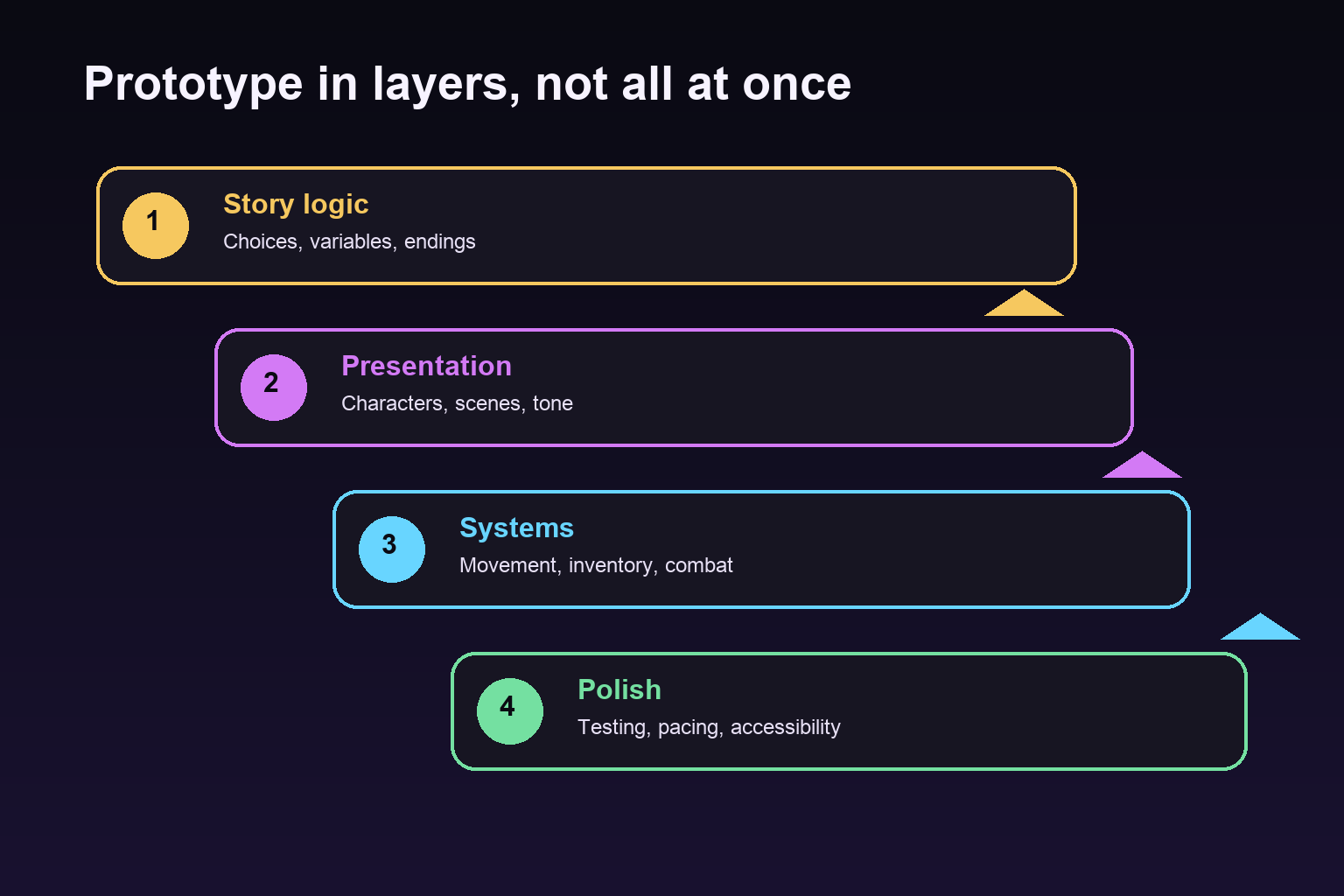
An AI game generator changes the starting point. Instead of first translating the idea into passages, script commands, or event pages, you describe the scene, player goal, choice structure, visual direction, and desired interactions. The generator produces a draft that you can inspect and refine.
This approach is useful when you need to discover the format as well as the story. You might begin with: “Create a five-minute mystery scene in a locked observatory. The player interviews two characters, examines three clues, and chooses which suspect to accuse. Keep the ending editable.” The resulting prototype lets you judge pacing, interaction density, and presentation together.
The tradeoff is review. Generated logic, continuity, assets, and interactions need human testing. A prompt is not a substitute for a narrative specification, and a first generation is not a final release. The strongest workflow uses AI to create and revise a concrete draft while the creator retains responsibility for canon, tone, accessibility, and playtesting.
For a closer look at this workflow, see how AI interactive story generation is built and the AI interactive story generator guide.
A practical comparison by creative task
Fastest path to testing branch quality: Twine. The passage map keeps attention on choices, consequences, and endings.
Closest default fit for visual-novel presentation: Ren'Py. Dialogue, speakers, scenes, images, and menus are first-class story concepts.
Closest default fit for an explorable RPG story: RPG Maker. Maps, events, and game-state structure are built into the authoring model.
Best fit for exploring a playable concept from natural language: an AI game generator. It can turn a multidisciplinary brief into a draft, but that draft must be edited and tested.
Most direct manual control over every branch: Twine or Ren'Py, depending on presentation format. The author explicitly defines the narrative path.
Most important question before choosing: What must be playable in your first proof? If the answer is unclear, reduce the scope to one scene with one meaningful choice and one visible consequence.
Use a two-stage workflow if one tool is not enough
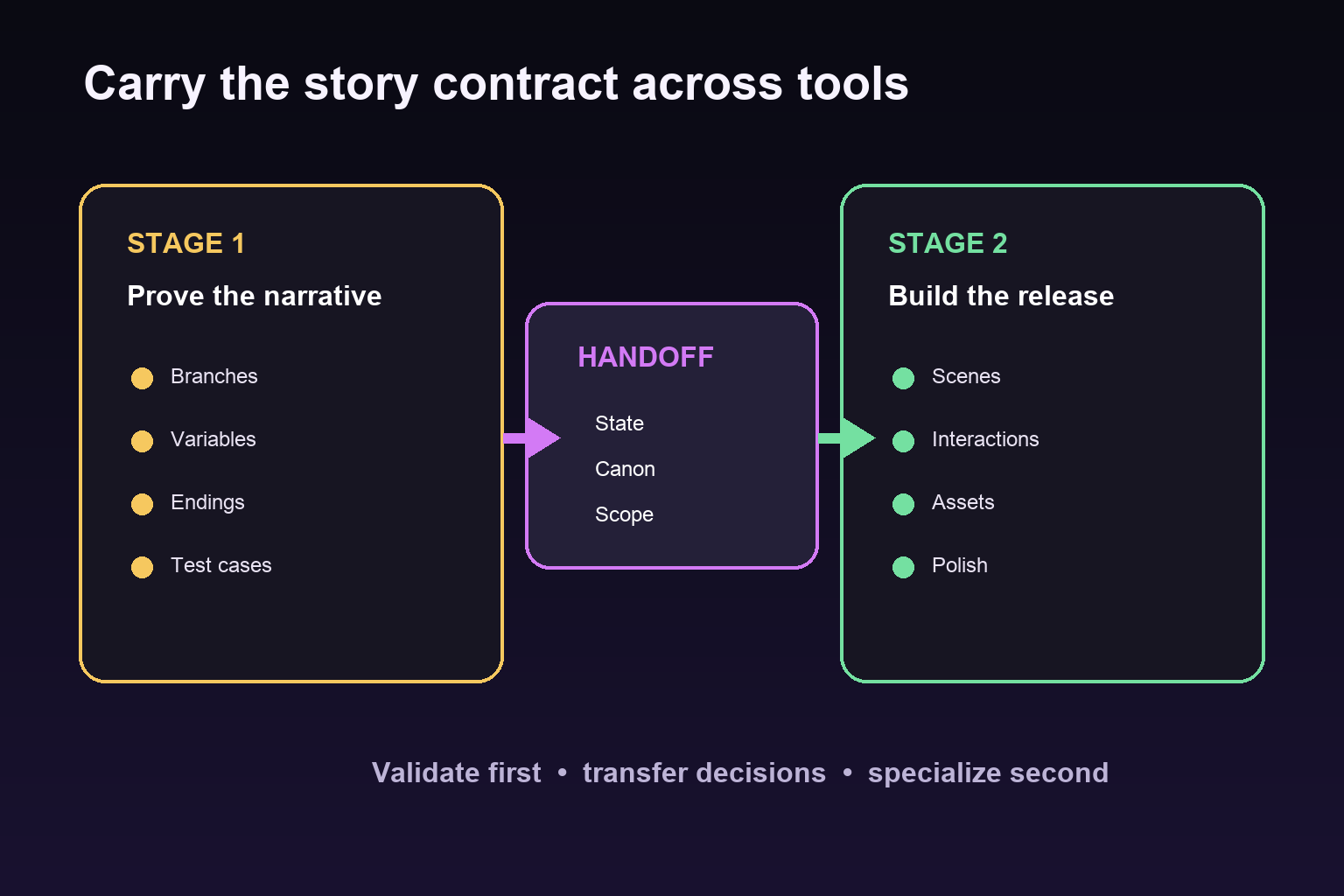
You do not have to make one permanent choice on day one. A writer can validate branching logic in Twine, then rebuild the approved structure in Ren'Py for visual presentation. An RPG creator can outline conversations separately before implementing map events. An AI-generated prototype can clarify scope before the team selects a more specialized production environment.
The handoff works only if you preserve the right information. Keep a branch list, variable definitions, character goals, scene states, endings, and a test checklist. Do not rely on the first tool's visual graph as the only source of truth if the next tool cannot import it directly.
A good prototype handoff answers: What did the player know before this scene? Which choice changes state? What visible consequence proves the change? Which content remains placeholder? What must a human review before release?
A low-risk way to make the decision
Build the same micro-scene in your two leading options. Limit it to one setting, two characters, three choices, one variable, and two endings. Then review the result using these criteria:
- Authoring clarity: Could you find and change a branch without getting lost?
- Output fit: Did the prototype feel like the experience you intend to ship?
- Revision cost: Could you change a character goal or ending without rebuilding unrelated work?
- Testing visibility: Could you identify unreachable branches and inconsistent state?
- Asset burden: Did the tool require art, maps, interface work, or data before the story became testable?
- Ownership: Can you understand, edit, and maintain the result after the first draft?
Score the experience in words, not invented numbers. “I can revise a branch confidently” is more useful than a synthetic benchmark. The winner is the tool that lets you keep making the next important change.
Final recommendation
For most non-programmer writers, Twine is the safest first choice for pure branching fiction because its core model is easy to see. Choose Ren'Py when visual-novel presentation is central, even if you need to learn a small amount of script structure. Choose RPG Maker when exploration and RPG systems carry the narrative. Choose an AI game generator when you want to move from a plain-language concept to an editable playable draft and are prepared to review the generated result carefully.
Do not choose based on which tool appears most powerful in the abstract. Choose the one that makes your next story decision visible, testable, and easy to revise.
Frequently Asked Questions
Can I make an interactive story without coding?
Yes. Twine, Ren'Py, RPG Maker, and AI game generators all provide no-code or low-code starting points, though advanced customization can introduce scripting.
Is Twine or Ren'Py better for a visual novel?
Ren'Py is generally the more direct fit for character-led visual-novel presentation, while Twine is often simpler for browser-based branching text.
Can RPG Maker create a story without combat?
Yes. Its maps and events can support exploration, conversations, puzzles, and state changes without combat being the focus.
When should I start with an AI game generator?
Use one when you have a clear scene brief and want an editable playable draft before committing to a specialized authoring workflow.
Can I move a story from one tool to another?
You can move the narrative design, but automatic project conversion is not guaranteed. Preserve branches, variables, states, endings, and test cases.
What should my first interactive-story prototype include?
Use one setting, two characters, three meaningful choices, one tracked variable, and two endings to test the core experience.