AI game reverse engineering means using AI tools to help analyze a game’s compiled code or behavior, rebuild parts of its implementation, or adapt it to another platform. It does not mean that an AI can recover the original project files with one click. Recent projects show a more specific shift: coding agents can take on a large amount of reconstruction work, while engineers still have to define what “correct” means and prove that a build behaves as intended.
That distinction is easy to lose in headlines about games being “decompiled by AI.” The tool may produce code, but a traditional recompiler may do the machine-code translation, and a developer may provide the tests, reference build, compatibility layer, and original platform files.
Why is AI game reverse engineering getting attention?
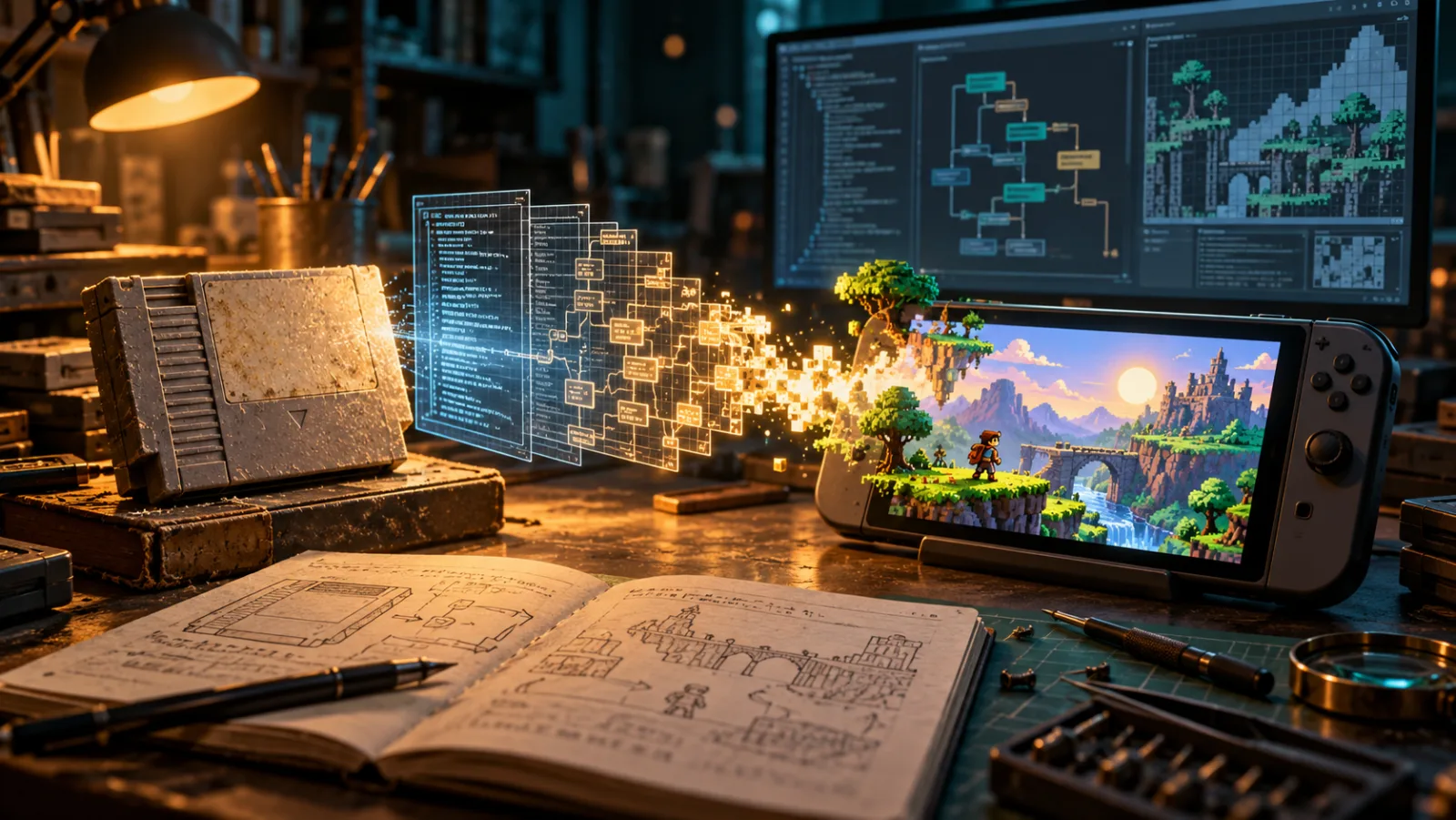
On October 13, 2026, Xbox Wire announced XBOX LABS and said the company had seen games rapidly decompiled and rebuilt for hardware they were not designed to run on. The post mentioned PC builds translated to Apple Silicon, browser ports using WebAssembly and WebGPU, and game remixes. It did not identify the projects or say that every example used AI. The announcement describes Xbox’s interest in exploring the area; it is not a technical report on a particular port. Read the XBOX LABS announcement on Xbox Wire.
A project with more inspectable technical detail is ssbu-recomp, a public static recompilation project for Super Smash Bros. Ultimate version 13.0.4. Its author says Claude coding agents wrote almost all of the repository’s code. But that does not mean an AI model performed every translation step: the project’s lifter mechanically translates AArch64 machine code into C, while the runtime reimplements console services and graphics interfaces for Windows. Separate tools turn selected game scripts into readable C++.
The repository calls the build playable in parts, not finished. Its October 2026 status reports a tested 1-vs-1 match through the results screen, while several other modes and physical-controller behavior remain untested. It also describes deterministic logs and differential checks for selected code. This is a technical project with stated measurements, not evidence that any game can now be reproduced automatically.
A second useful author account, Maurice Heumann’s write-up on using agents to decompile an unnamed shooter, says early output looked readable and ran, but contained semantic errors. The author reports that a later verification harness compared rebuilt functions against the original binary; the final report says 99% of functions were present and 83% matched byte for byte. The code is private, the game is not named in that post, and the figures are the author’s own report rather than an independently reproducible result. The most useful lesson is the verification failure and correction, not a viral token count.
What can AI actually do in reverse engineering?
AI fits into a larger toolchain. A common workflow starts with a legally available executable or a reference build, then combines disassemblers, decompilers, build tools, and tests. An AI coding agent can help at several points:
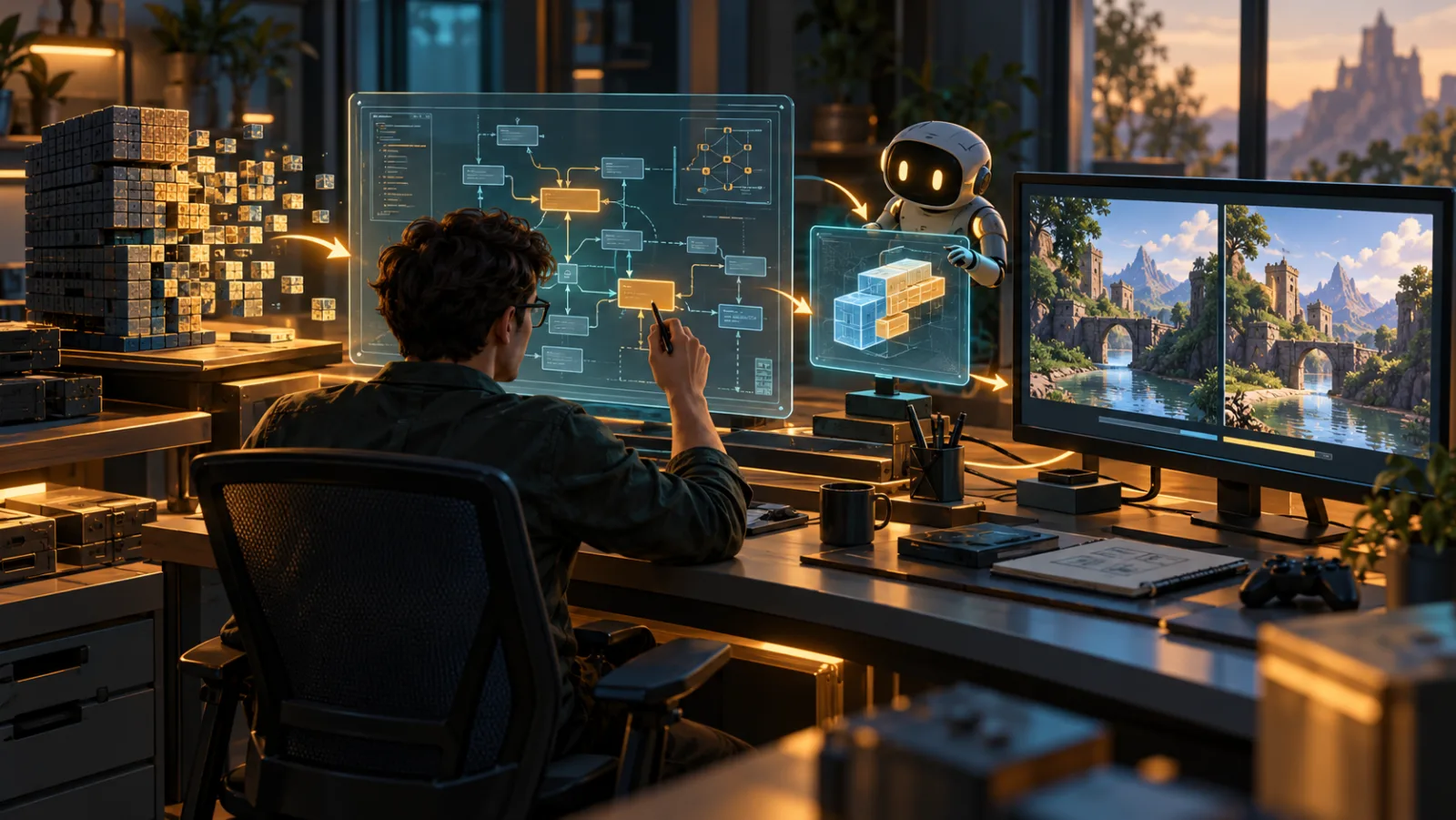
- Explain difficult output. It can summarize disassembly or decompiler output, suggest what a function may do, and identify likely inputs, outputs, or calls to other functions. These are hypotheses to check against evidence.
- Organize the reconstruction. It can help name functions, group related routines, infer data structures, map dependencies, and produce notes that make a large codebase easier to navigate.
- Write or adapt implementation code. It can draft a compatibility layer, translate a known function into a clearer form, or help port a component to another compiler or operating system.
- Build checks and debug differences. It can write test harnesses, compare logs or outputs, explain a failing build, and propose a fix for a mismatch.
The role of AI depends on the project. In ssbu-recomp, the author explicitly describes AI-written project code, while the central static translation is mechanical. That is AI-assisted engineering around a recompiler, not proof that AI alone decompiled an entire game.
Three boundaries matter:
- Decompilation does not recover the original source tree. Compiled binaries usually omit original comments, names, project organization, and much of the information used to build them. Reconstructed source can be readable and behaviorally accurate without being the developer’s original source.
- Code that compiles may still be wrong. In Heumann’s account, early functions looked plausible and the game launched, yet types, signatures, data layouts, and logic were incorrect. A successful build proves only that the compiler accepted the code.
- Static recompilation is a technique, not an AI feature. A recompiler can translate machine code into a target platform’s instructions with deterministic tools. AI may help write the surrounding software or correct exceptions, but a project must say where it was used before the method can be called AI-assisted.
Game assets, platform APIs, shaders, timing, audio, input, save behavior, and hardware quirks add further work. A native executable is not a complete port if scenes render incorrectly, controllers fail, saves corrupt, or a mode cannot be finished.
Could AI help bring old games back?
Potentially. When original documentation or source code is missing, AI can help a small team form and test hypotheses about unfamiliar code. Agents can also handle repetitive edits across many functions, produce scaffolding for a compatibility layer, and help compare a new build with an available reference.
That can make it more practical to explore a preservation build, an authorized port, or a maintenance project that once looked too large for a small team. It does not make the work automatic: the team still needs reliable reference behavior, platform knowledge, test coverage, and time to repair edge cases.
Technical feasibility and permission to distribute are separate questions. A project may run locally while its code, artwork, music, voices, or game data remain protected. A recompiler’s tools may be shared without sharing a game dump, but that design does not settle every legal issue around making or distributing a port.
Does this make indie games easier to clone?
It may lower the effort needed to inspect and reproduce some implementation details. That creates a risk of unauthorized copying, especially when agents can quickly draft code from detailed observations or when a project uses a binary as a reference. It does not follow that every similar game came from reverse engineering.
Keep three activities distinct:
- Reverse engineering code analyzes an existing program to understand its internal behavior or implementation.
- Reimplementing a mechanic builds a new implementation from observed behavior or a design description. Similar movement, scoring, or combat rules alone do not establish that source code was copied.
- Copying assets or other protected expression reuses things such as art, music, text, characters, or code. This raises different questions from implementing a broadly similar mechanic.
AI can accelerate some of these tasks, but it does not erase their differences. To assess a claim, look for evidence: project notes, source-control history, disclosed tools, asset provenance, or a technical comparison. Do not infer reverse engineering or infringement from genre, camera angle, or a familiar mechanic alone.
What changes for game studios and publishers?
For studios, the opportunity is easier maintenance of legacy code, authorized ports, cross-platform adaptation, compatibility testing, and internal technical analysis. The risk is a faster path to unauthorized copying and a greater chance that teams accept plausible-looking output without proving it is correct.
A responsible AI-assisted workflow needs review gates that match the task:
- Record which original binaries, documentation, reference builds, and third-party code were used.
- Track code and asset provenance, licenses, and any permissions required for the target release.
- Set acceptance tests before asking agents to implement a function or port a feature.
- Keep the verifier independent from the code being verified, and review suspicious changes to tests or build scripts.
- Test complete player journeys on the target hardware, including input, rendering, saves, audio, and failures.
- Have a person review generated changes and the distribution plan before release.
The projects above show why a reviewer or a compiling build is not enough. Where byte-for-byte comparison is possible, it can provide strong evidence for a function. Where it is not, teams need behavioral tests and clear records of what remains unverified.
What becomes more valuable when implementation gets easier?
A reasonable industry inference—not a measured rule—is that implementation speed alone will matter less when more teams can produce code quickly. The differentiating work moves toward choosing a good problem and shaping a complete experience: tuning controls and difficulty, building a distinct art direction and world, finishing the content, and responding to players over time.
Those advantages are not contained in reconstructed code. A binary can reveal many implementation details; it cannot hand a new team the original designers’ judgment, a trusted player community, an ongoing service, or the history of updates that made a game meaningful to its audience. Teams still have to earn those things through creative decisions and sustained work.

What should AI game creators take away?
Use tools on projects and assets you own or are authorized to work with. Keep a record of where code and media came from, define a small original gameplay loop, and make the expected behavior testable before asking an agent to build it. Run the game, check more than the happy path, then revise and test again.
For creators who want to explore their own game idea, SEELE Workspace is for making and iterating on original playable projects. It is not a reverse-engineering or commercial-game cloning tool.
Frequently asked questions
Can AI recover a game’s original source code?
Usually not in the literal sense. A binary does not contain all the original comments, names, build scripts, or source organization. AI can help reconstruct readable code or explain behavior, and some projects can compare reconstructed output against the original. That still does not recreate the exact source tree written by the original developers.
Is AI decompilation the same as game porting?
No. Decompilation attempts to turn compiled code into a higher-level representation. Static recompilation translates machine code for another target, while porting also requires adapting platform services and validating the complete game on the new hardware. One project may combine all three.
Can AI reverse engineer an entire game?
Agents can contribute to large projects, but “entire game” needs a precise definition. A project may reconstruct most functions while leaving some unverified modes, platform services, assets, or runtime behavior. Read the project’s own status and test records; completion claims should identify what was measured and what remains unknown.
Is AI game reverse engineering legal?
There is no universal yes-or-no answer. Rules vary by country and depend on how access was obtained, the purpose of the analysis, the code and assets used, license terms, anti-circumvention law, and what is later shared or sold. For example, U.S. law contains a limited reverse-engineering provision tied to lawful use and interoperability of independently created software; EU software law also sets narrow conditions for decompilation to achieve interoperability. Neither is a blanket permission to copy or distribute a commercial game. See 17 U.S.C. § 1201(f) and Article 6 of the EU Software Directive, and get advice for the relevant jurisdiction before acting.