Give every projectile one clear job
A bullet-hell shooter becomes easier to prompt when each object has a readable role and a single state change. Separate damaging shots from safe collectibles, define what a charged clear can affect, and specify how the player finishes the encounter. Then trace a short sequence before asking for more patterns.
Glass Current is an original underwater paper-design exercise for that workflow. Its values and outcomes below are calculated from the stated rules; no prompt was run, no playable game was supplied, and no playtest or balance measurement is claimed. Use the example to make your own rules inspectable, not as an observed game result.
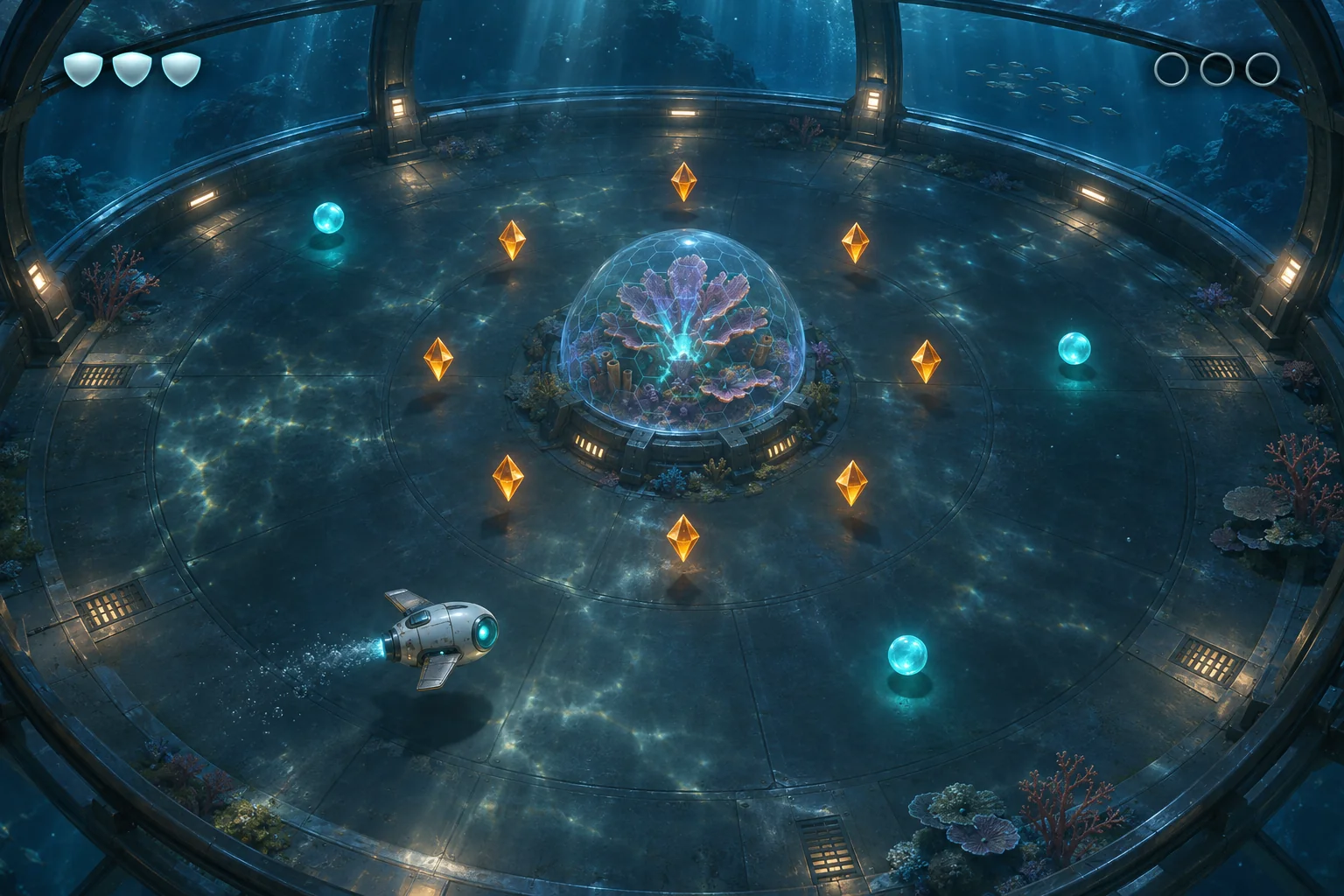
Start with two object classes: amber diamond shards are hazards; cyan spherical motes are collectibles. The difference should remain clear through silhouette, contrast, spacing, and behavior as well as hue. A player should be able to read what is safe to collect while the hostile pattern continues around the target.
Write the projectile and pulse contract
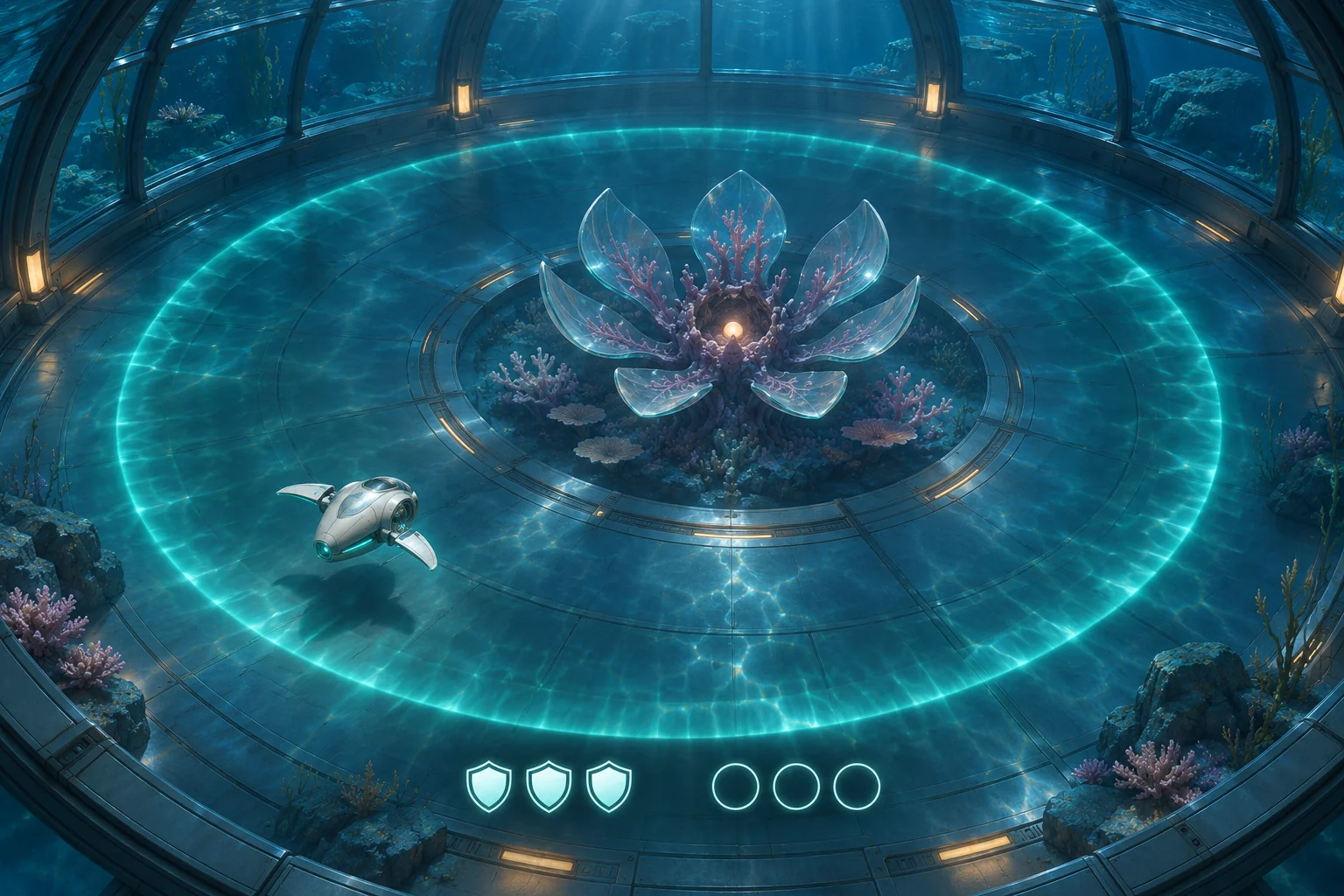
Give each action a trigger, a precise effect, and a rule for what disappears. Glass Current uses one compact overhead chamber, one survey pod, one stationary Reef Core, eight slowly orbiting amber shards, and three cyan motes. The pod begins with hull 3 and resonance charge 0/3. The shielded Core has 1 integrity.
| Object or action | Trigger | State change |
|---|---|---|
| Cyan mote | Pod contacts an available mote for the first time. | Remove that mote and add 1 charge, capped at 3. Do not damage hull; a removed mote cannot charge again. |
| Amber shard | Pod contacts an active shard. | Remove that shard and subtract 1 hull once. A removed shard cannot cause another damage event. |
| Pulse below threshold | Press Pulse at 0/3, 1/3, or 2/3. | No state changes: keep the current charge, shards, shield, and hull. |
| Pulse at threshold | Press Pulse at 3/3. | Remove every currently active amber shard, reset charge to 0/3, and expose the Core. Hull does not change. |
| Fire | Hit the Core with Fire. | While shielded, no effect. While exposed, one confirmed hit removes its final integrity and wins the encounter. |
Two limits close the loop. Hull 0 ends the attempt in a loss. The pulse only clears the shards active at the moment it resolves; the paper example has no additional wave, ammo cost, reload, weapon choice, or movement timer. These exclusions keep the first question focused: does collecting three motes create a useful opening without harming the pod?
Show a player the state that explains a decision: hull, charge pips, available motes, active shards, and whether the Reef Core is shielded. Use object shape and location to carry meaning; a color-only cue can disappear against a changing background or for a player who cannot distinguish it.
Trace the threshold and its outcome
Resolve events in order from one reset. The early Pulse is important because it proves the threshold rule: at 2/3, the button cannot clear shards or expose the Core, and it does not consume partial charge.
| Hypothetical event | Hull | Charge | Amber shards | Reef Core |
|---|---|---|---|---|
| Start | 3 | 0/3 | 8 active | Shielded, 1 integrity |
| Collect two distinct cyan motes | 3 | 2/3 | 8 active | Shielded, 1 integrity |
| Press Pulse early | 3 | 2/3 | 8 active | Shielded, 1 integrity; no state change |
| Collect the last cyan mote | 3 | 3/3 | 8 active | Shielded, 1 integrity |
| Pulse at 3/3 | 3 | 0/3 | 0 active | Exposed, 1 integrity |
| Fire once at the exposed Core | 3 | 0/3 | 0 active | Disabled; encounter won |
The sequence says exactly what creates the opening. The Pulse removes the eight active shards and lowers the shield; it does not deal the final damage. That still requires a confirmed Fire hit. Keeping those transitions separate makes it possible to spot a build that incorrectly wins on Pulse or damages a still-shielded target.
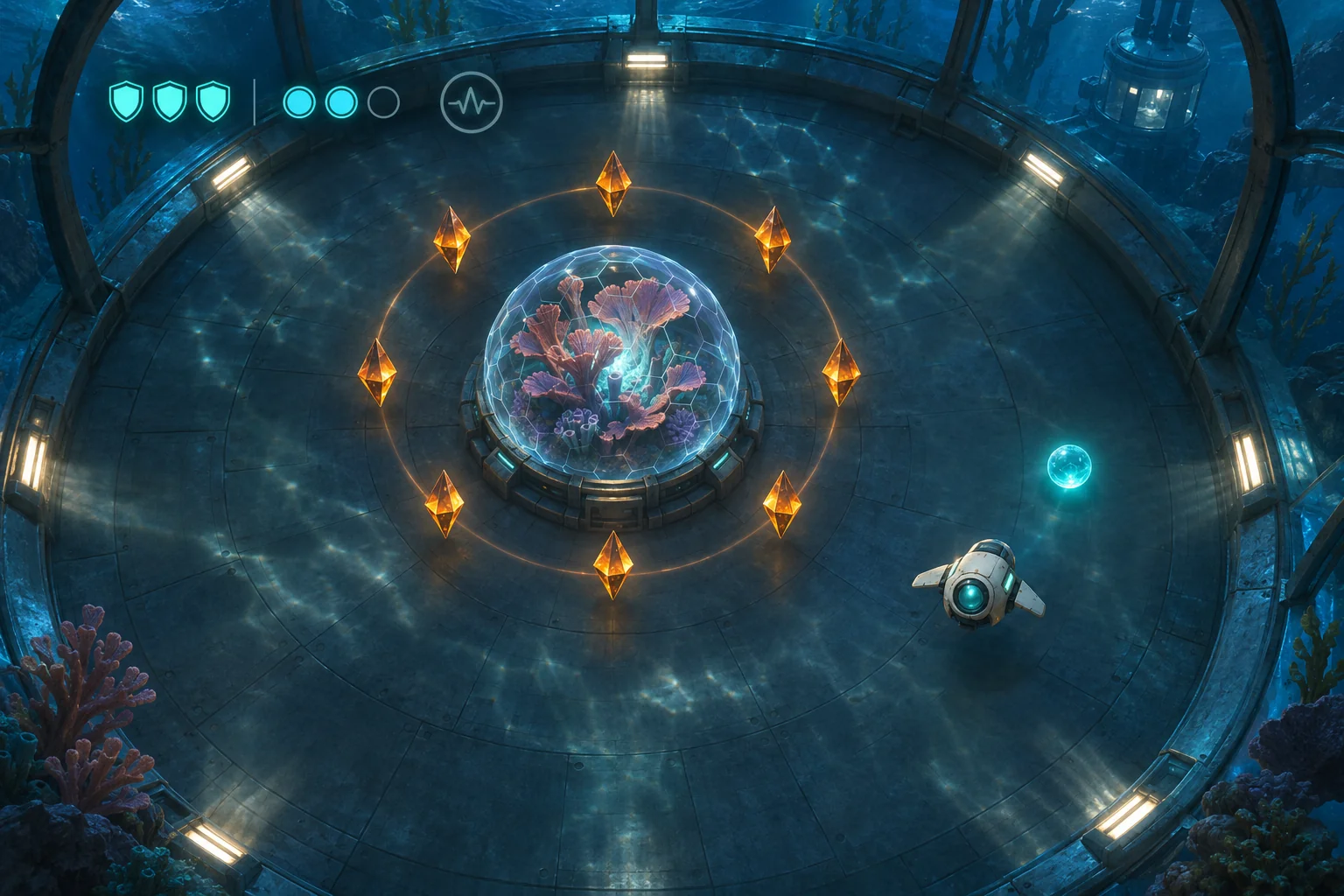
Check collision behavior on a separate fresh reset. With hull 3, one amber contact should remove that shard and reduce hull to 2. Contacting the same removed shard again cannot reduce hull further. This one-contact check is separate from the safe collection route, so it isolates damage and removal.
Give each prompt a different job
Keep rule design, scene creation, and validation in separate requests. This makes it easier to tell whether a mismatch came from an unclear rule, a scene that hides the state, or an output that changes a transition. The following templates describe Glass Current as a paper design; none has been run.
Prompt 1: return the rule model
Turn this brief into a compact rule model for one overhead bullet-hell encounter called Glass Current. Use one survey pod, one stationary Reef Core, eight slowly orbiting amber diamond shards, and three cyan spherical motes.

Reset state: hull 3; resonance charge 0/3; Core shielded with 1 integrity; eight shards active; three motes available. First contact with an available mote removes it and adds 1 charge, capped at 3; it does not damage hull. Contact with an active shard removes it and subtracts 1 hull once. A removed object cannot trigger again.

Pulse at 0/3, 1/3, or 2/3 changes nothing. Pulse at 3/3 removes all active amber shards, resets charge to 0/3, exposes the Core, and leaves hull unchanged. Fire at a shielded Core has no effect. One confirmed Fire hit against the exposed Core removes its last integrity and ends the encounter in Victory. Hull 0 is Defeat.

Return a state table for reset, two unique mote contacts, early Pulse, the third mote, charged Pulse, and the final Fire. Add one separate one-shard collision check from a fresh reset. Do not invent movement timers, ammo, extra enemies, waves, or additional attacks. Identify any contradictory rule rather than silently changing it.
Prompt 2: request the first chamber
Create a focused overhead 3D bullet-hell encounter from the approved Glass Current rule table. Use a circular underwater research chamber, one compact survey pod, one stationary shielded Reef Core, three cyan spherical motes, and one slowly orbiting pattern of eight amber diamond shards. Keep the pod's route to the motes readable and leave room to move around the Core.

Show hull as three icons and resonance charge as three pips. Make the Core visibly shielded until a 3/3 Pulse clears every active amber shard, resets charge to 0/3, and exposes its final integrity. Pulse below 3/3 must leave the state unchanged. A confirmed Fire hit is the only action that finishes the exposed Core. A removed mote or shard cannot trigger again.

Use distinct silhouette and color for cyan collectibles and amber hazards. Keep visible feedback for hull, charge, remaining motes, active shards, shield state, and Victory/Defeat. Do not add a second enemy, wave, weapon, ammo, warning timer, lane grid, or online feature. Preserve the rule table exactly. Return the controls and an initial-state checklist with the scene; flag any rule the scene cannot show.
Prompt 3: validate the transitions
Validate this Glass Current encounter from a fresh reset for each case. Do not change the rules while checking. For every action, record expected and resulting hull, charge, active shard count, remaining mote count, Reef Core shield/integrity, and terminal state.

Case A: collect two different motes, press Pulse at 2/3, and confirm no state changes; collect the third mote; Pulse at 3/3; then Fire once at the exposed Core.
Case B: from reset, contact one active amber shard once and check hull 2 with that shard removed; revisit its former location and confirm no second damage event.
Case C: from reset, fire at the shielded Core and confirm no change; then set charge to 3/3 using three unique motes, Pulse, and Fire once.
Case D: set hull to 1 and contact an active shard; report Defeat at hull 0 and confirm no later input can report Victory.

Return one row per action and identify the first mismatch if any. Do not claim success from a visual effect alone; inspect state values and the terminal condition. Do not add enemies, projectiles, resource rules, or balancing changes.
The prompts intentionally request checkable outputs: a state table, a scene that makes those states visible, and repeatable action sequences. If a result changes the rule order or hides the charge and target state, revise that specific request before adding a second pattern.
| Prompt job | Input to preserve | What to inspect |
|---|---|---|
| Rule model | Reset, one-time object contacts, threshold, shield, Fire, and terminal conditions. | Every event has a unique, calculable state transition. |
| First chamber | One pod, one Core, one eight-shard orbit, and three motes. | Shapes, pips, shield, and movement space make the decision readable. |
| Validation | Fresh resets and fixed action sequences. | Expected values match after each action and no removed object triggers twice. |
Find the first mismatched rule
When a result differs from the table, start at the first event where its state changes. Record the reset, action, expected values, and observed values. Change one cause, then repeat the same sequence so the correction remains visible.
| Symptom | Check first | Focused correction |
|---|---|---|
| Pulse clears shards at 2/3 | Is the threshold checked before the clear effect? | Require charge exactly 3 before resolving Pulse; leave all state untouched below threshold. |
| One mote charges twice | Does first contact remove or mark that mote? | Track each mote as available or collected; only an available mote can add charge. |
| One shard damages the pod twice | Is the shard still active after contact? | Remove the shard on its first hit and make collision resolution ignore removed objects. |
| Core opens before the charged Pulse | Are charge and shield state separate? | Change the Core shield only when Pulse resolves at 3/3. |
| Fire damages a shielded Core | Does the Fire action check exposure first? | Make shielded Fire a no-op; allow one integrity loss only after exposure. |
That process checks wiring, not difficulty. If the transitions match but the screen feels too crowded or collection too easy, treat that as a separate design question. Change one trajectory or spacing rule only after the state model works, then keep the same threshold and target sequence for comparison.
Move a focused brief into a creation workflow
The official SEELE Free AI Game Maker page describes plain-English game briefs, review of playable 2D or 3D results, iteration in Workspace, and checking displayed generation costs before a larger run. Those capabilities support a general path for bringing a small idea into a creation workflow. They do not establish that Glass Current, this charge pulse, or its state transitions have been generated or tested.
Bring a bounded brief: one enemy, one projectile pattern, two object roles, one charged effect, and a short check sequence. Inspect whether any actual result preserves the state table before you describe behavior as working. The current AI Space Shooter page separately emphasizes a readable first pattern and room to dodge; this article’s underwater conversion loop is not a result demonstrated by that page.
When you are ready to outline a game idea, use the Free AI game maker to enter a focused brief, review the result, and decide what needs another pass. Check the current cost shown in Workspace before generating. This article provides no actual Glass Current build or test outcome.
Add another pattern only after this loop holds
Once you can reproduce the charge, clear, exposure, and final hit from a reset, choose one next experiment. A second shard shape, another mote effect, or a new enemy pattern each changes a different decision; introduce one at a time and update the state table before asking for it. The useful next step is the smallest change that answers a design question, not a larger field by default.
Glass Current remains a fictional paper design and its images are concept illustrations. There is no verified prompt run, generated game, play session, balance test, or player observation behind the example.
Frequently asked questions
What makes a projectile a collectible rather than a hazard?
Give it a different shape, movement, and collision result, then keep those signals consistent. In this example, cyan spheres add charge and disappear; amber diamonds remove hull and disappear. Color supports the distinction, while silhouette and behavior give the player additional cues if hue is hard to read against the scene.
Should Pulse consume partial charge?
Choose the rule that creates the decision you want and state it before the scene prompt. Glass Current makes Pulse a no-op below 3/3, preserving 1/3 or 2/3 charge. If you want partial charge to be consumed, specify exactly how many shards clear, whether the Core changes, and what feedback confirms that alternative rule.
How can I make the bullet field readable without relying only on color?
Pair hue with shape, scale, movement, contrast, and consistent collision behavior. Here, the safe motes are round and the hostile shards are diamond-shaped. Keep both visible against the chamber floor, leave a clear route to the motes, and check that status pips and projectiles remain distinct at the actual play size.
Was Glass Current generated or tested?
No. Glass Current is an original hypothetical paper design. The table is calculated from the written rules, and the pictures are concept illustrations. No prompt execution, generated build, play session, user observation, or balance measurement was supplied. Check your own result before reporting its behavior as working or tested.
When should I add another attack pattern?
Add one after you can reproduce the first pattern’s collection, damage, Pulse threshold, shield exposure, and win/loss transitions. If those states are still unclear, another attack adds more variables to diagnose. Once the first loop is consistent, write what choice the new pattern should create and include its state change in the acceptance table.