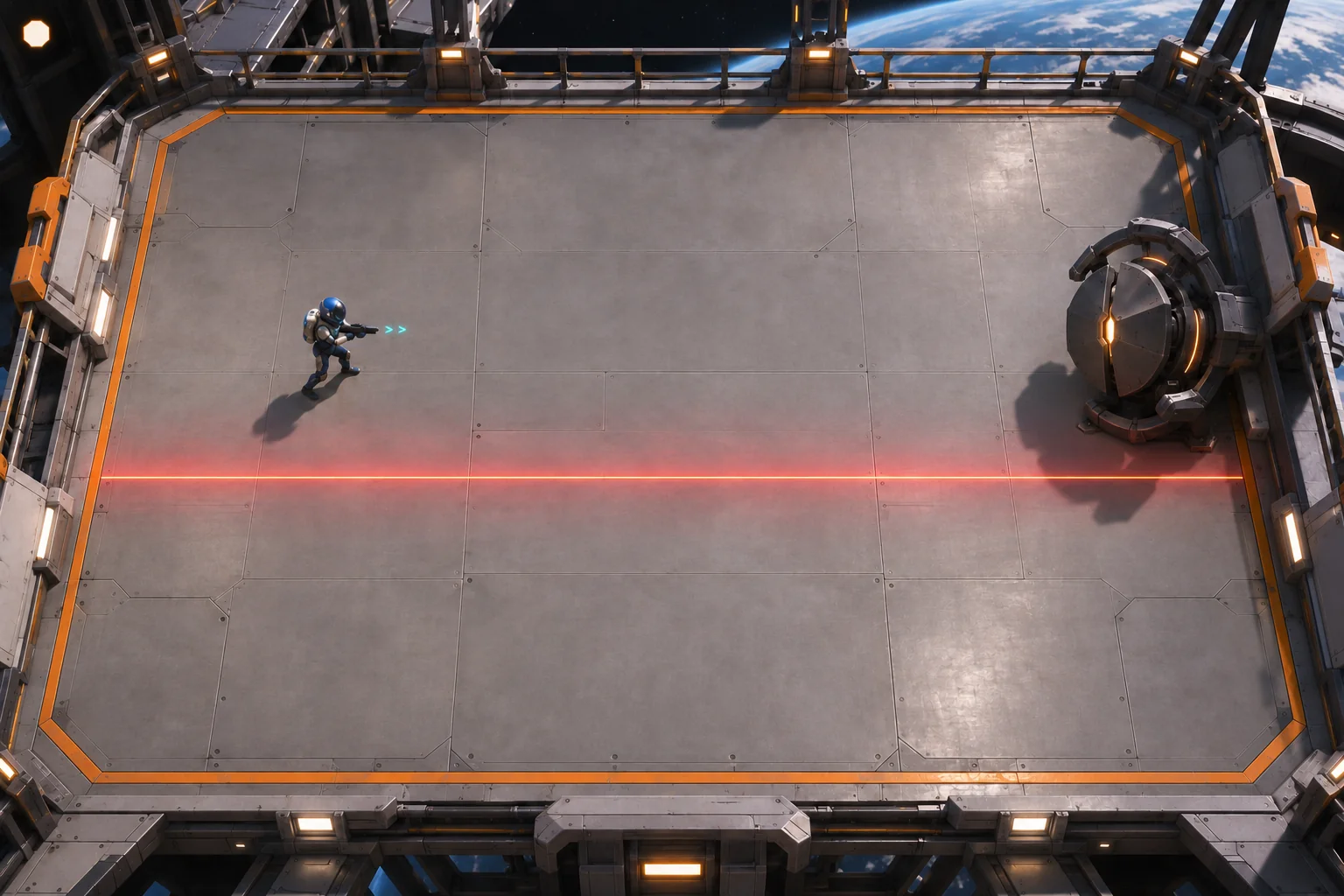
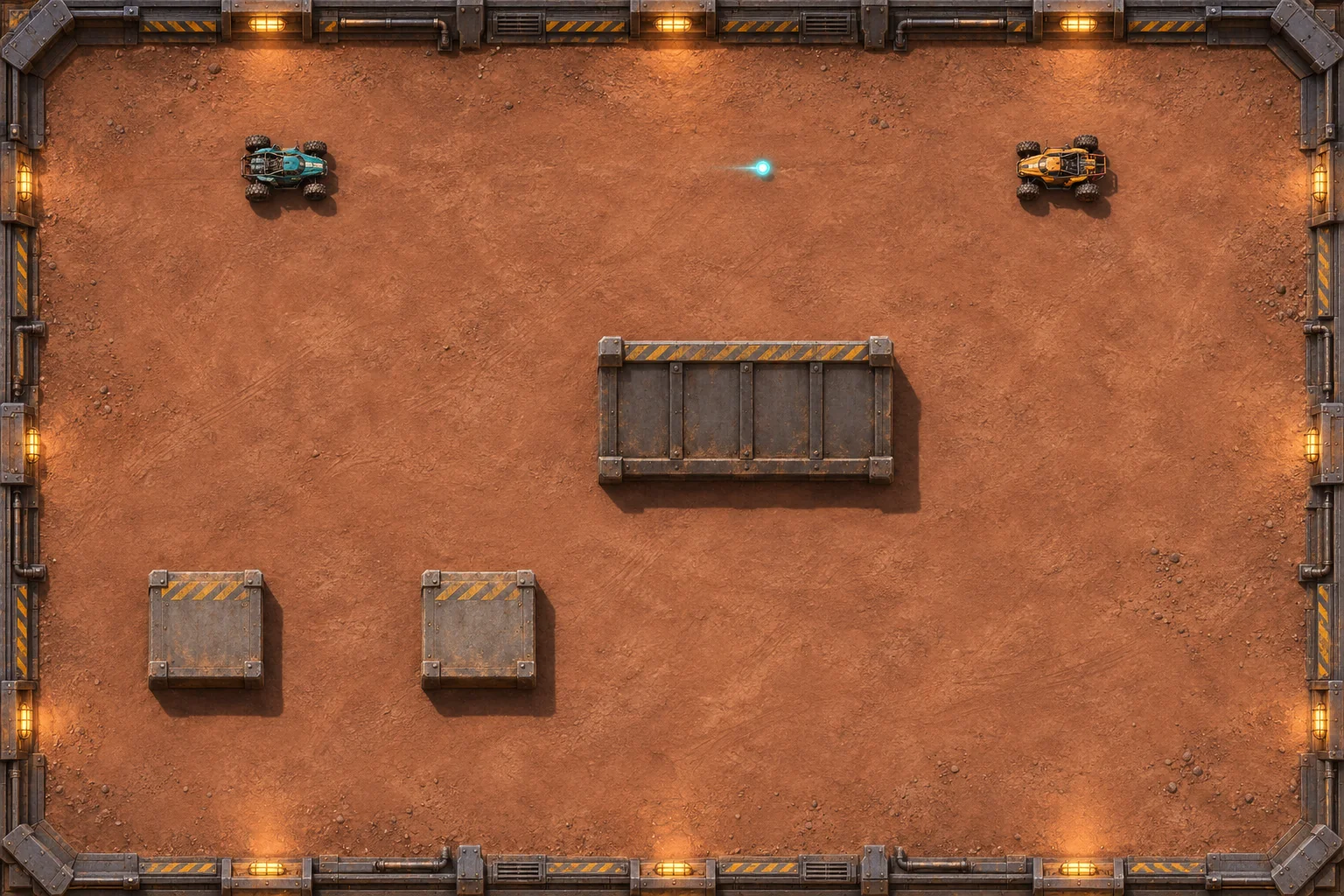
A co-op platformer needs a clear shared condition: what each player does, when their actions count together, and what happens if one misses. Define that small loop before asking for a long level. Twinspan Relay below is an original paper-design example, not an existing build or playtest. Its 1.5-second pairing window and 4-second bridge are chosen to make the rules easy to inspect; they are not measured balance values.

Define the co-op contract
Write the action loop as a sequence of states, not a mood such as “make the players cooperate.” Twinspan Relay gives both couriers the same run and jump moves. At each relay, Player A must touch the blue pad and Player B the amber pad. The first correct landing starts a shared timer. If the second player reaches the matching pad in time, a short bridge appears; both players must cross before it retracts. The checkpoint moves forward only when both arrive.
This contract also says what failure looks like. A wrong pad, fall, or expired timer returns both players to their last shared checkpoint and clears the bridge. Neither player is left waiting alone or loses a life in this teaching design. If one reaches the checkpoint while the other is still crossing, it stays inactive until both are present. That keeps progress attached to the team state.
| Player action | Shared state change | What happens next |
|---|---|---|
| First player lands on their assigned pad | Start a 1.5-second pairing window; remember which pad is occupied | The other player can still complete the pair |
| Second player lands on their matching pad before the timer ends | Mark the pair complete and open one walkable bridge for 4 seconds | Both players move toward the same checkpoint |
| Both players reach the checkpoint before the bridge closes | Advance the shared checkpoint and clear the relay timer | Present the next pad pair |
| Wrong pad, fall, late landing, or bridge timeout | Clear the active pair and return both players to the previous checkpoint | Let the team attempt the same relay again |
The table makes timing and recovery visible to both players. Before adding scenery or extra mechanics, confirm that each row names a trigger, a state change, and a next state. If “the bridge opens” is the only described result, the prompt still needs to say when it closes and how the team recovers.
Prompt 1: write the shared rules
Use a short contract prompt to settle the player count, screen scope, joint goal, and recovery rule. Ask for any unresolved assumptions instead of allowing a builder to fill gaps silently.
Plan a two-player local co-op platformer for one shared screen. Both players have the same run and jump moves; neither has a special ability. The shared goal is to cross three paired landing relays and reach an exit together.

For each relay, Player A must land on the blue pad and Player B on the amber pad. The first correct landing starts a 1.5-second pairing window. If the second player lands on their assigned pad before it expires, form one continuous walkable bridge for 4 seconds. Both players must reach the next shared checkpoint before the bridge closes. A wrong pad, fall, missed pairing window, or bridge timeout returns both players to the last shared checkpoint and clears the active timer and bridge. The checkpoint advances only when both players are there. The exit opens only after both players reach their matching final pads. Restart returns both to the starting checkpoint and clears every timer.

Return a state table for both player positions, assigned pads, pairing timer, bridge timer, shared checkpoint, and exit state. List any remaining assumptions. Keep the plan local and same-screen; do not add online networking, asymmetric powers, lives, or random events.
This prompt is a design template, not a record of a run. It asks the builder to expose the state you need to inspect. If the resulting control scheme assigns different buttons to the two controllers, check that both still have the same actions and that instructions identify each player's input before the first gap.
Write the one-gap prompt
Turn the contract into one small encounter with a start, an interaction, and a recognizable checkpoint. Keep one pair of pads and one gap so a confusing result has fewer possible causes. Specify what players can see before the jump, how the first landing starts the clock, and how the bridge communicates its remaining time.
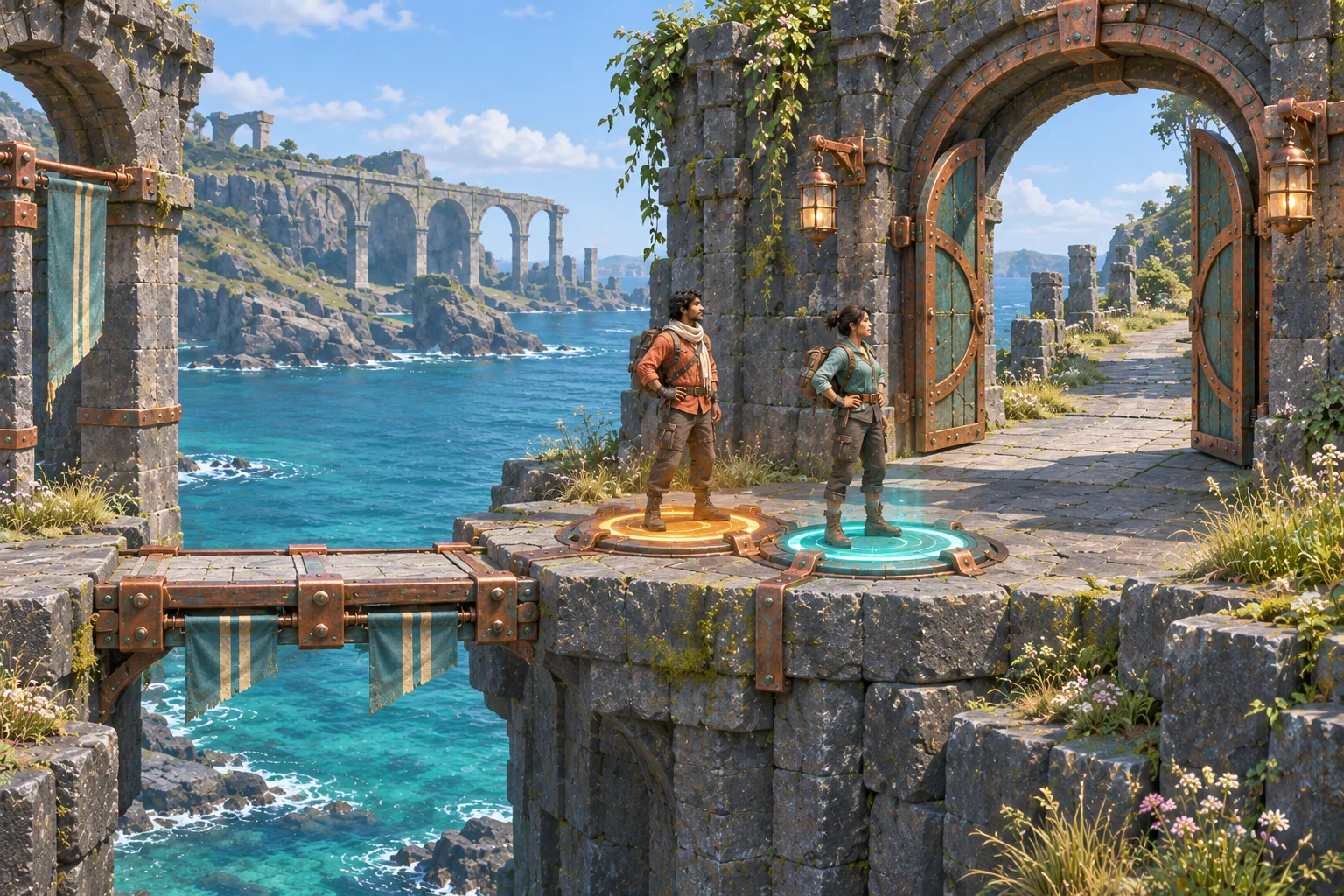
In the Twinspan example, the two pads glow in different colors and sit on opposite ledges. The first matching landing starts the 1.5-second window; the second matching landing forms the bridge. The temporary path should be wide enough to read as a route, while the checkpoint beyond it remains inactive until both couriers arrive.

Prompt 2: request one relay
Keep the first build request narrow. Ask for a reset and a visible status cue alongside the movement, because both are part of the co-op loop.
Create a small local two-player platformer prototype from this rule contract. Use one shared screen, two controllers, and the same run and jump abilities for both players. Build one reachable gap with a safe start ledge, one blue landing pad for Player A, one amber landing pad for Player B, and a shared checkpoint on the far side.

Show both players, their assigned pad colors, the 1.5-second pairing window after the first correct landing, and a clear indication of the 4-second bridge timer after both matching pads are occupied. The bridge must be a continuous walkable surface. Advance the checkpoint only after both players touch it before the bridge closes. If a player falls, lands on the wrong pad, arrives after the pairing window, or misses the bridge timer, return both players to the previous checkpoint and clear the active state. Add a restart that returns both players to the start.

Keep the camera wide enough to show both players and the full gap. Include a compact controls screen. Do not add other gaps, collectibles, enemy attacks, special powers, random events, or online play. State which of these rules are implemented and which remain unverified; do not assume a successful build from this request.
A good specification does not guarantee an implementation. If you use it with a build tool, inspect whether the status cue changes at each trigger and whether the second player can still act while the first waits. Save the actual prompt and build version before comparing later changes.
Extend the route only after the first relay
Once a real one-gap build has passed the same-player and opposite-player checks, extend the route without changing the core rule. Reuse the pad colors, timer, bridge duration, reset, and checkpoint behavior. Vary one geometric feature at a time, such as gap width or landing height, so a later failure is easier to locate.
| Stage | Keep fixed | Change only when |
|---|---|---|
| One-gap encounter | Two players, one assigned pad pair, shared reset and checkpoint | Both orders of arrival and one failure case match the contract |
| Three relay route | Same movement, pad assignment, timers, and recovery rule | The next relay begins only after the joint checkpoint advances |
| Final exit | Each player's visible target and shared finish condition | The gate opens only when both players reach their final pads |
| Scenery pass | Collision, cues, camera framing, and relay logic | One visual or spatial change can be compared against the same sequence |
The extension prompt should preserve these invariants and ask for a route summary that shows the active relay and checkpoint. Do not add a new ability just because a later gap is harder; first decide whether the challenge is meant to test timing, communication, or movement distance.
Prompt 3: add two more relays
Only after the one-gap version has been inspected against its acceptance checks, extend the same local co-op route with two more paired landing relays and a final exit. Preserve the same movement abilities, blue/amber pad assignment, 1.5-second pairing window, 4-second bridge, joint checkpoint rule, miss/fall reset, and restart behavior. Change only the gap spacing, landing height, and scenery between relays.

Keep both players visible when a pairing cue appears. Show the current shared checkpoint, which relay is active, and whether each player is before the gap, on their assigned pad, crossing the bridge, or at the checkpoint. The final gate opens only when both players reach their matching exit pads. Return a compact route map and a list of state transitions. Do not add networking, new powers, enemies, or random rules. If no one-gap version has been inspected, return this as a planned extension and do not label it as verified.
Verify both player states
Write repeatable action sequences before deciding whether a co-op beat is clear. Record both players' starting positions, who lands first, the elapsed time between landings, whether the bridge opens, and whether the shared checkpoint advances. The values below are a paper calculation for Twinspan Relay, not observations from a playable build.
For the first relay, Player A lands on the blue pad at t=0; Player B lands on amber at t=1.0. One second is inside the 1.5-second pairing window, so the bridge opens at t=1.0 and expires at t=5.0. Both players reach the checkpoint at t=3.2, before it closes, so the example state advances. On relay two, Player B arrives at t=1.9, after the pairing window ends at t=1.5. No bridge forms, and both return to the previous shared checkpoint.
| Action sequence | Expected shared state | What it checks |
|---|---|---|
| A lands at 0.0s; B lands at 1.0s; both reach the checkpoint at 3.2s | Pair succeeds, bridge runs 1.0–5.0s, shared checkpoint advances | Matching pads, timer start, bridge duration, and joint arrival |
| A lands at 0.0s; B lands at 1.9s | Pair timer expires at 1.5s; no bridge forms; both reset | Late arrival does not open the bridge or leave one player ahead |
| Either player lands on the wrong color | Relay fails and both return to the last shared checkpoint | Pad assignment is readable and consistently enforced |
| Both pads match but one player falls before the checkpoint | Bridge clears; neither player keeps solo progress | Failure recovery stays shared |
| Only one player reaches the checkpoint before the bridge closes | Checkpoint remains inactive; both reset when time expires | One player cannot advance the team alone |
| Both reach the final paired pads | Exit opens and the shared route is complete | Finish condition requires both players |
| Restart is used from any active relay | Both return to the start; timers and bridges clear | Reset removes stale shared state |
These expected states are acceptance cases to run on a real build later. They are not test evidence. A useful observation log records the rule version, both controllers, actions, timing, player positions, relay state, checkpoint, and result. If the result differs, keep the sequence unchanged while you diagnose it.
Revise the miss without changing the whole loop
When a pair fails, locate the first state that differs from the intended sequence. If a player did not see the pad assignment, improve the cue or camera framing before changing the timer. If the correct landing registers but the bridge does not open, inspect pad matching and timer start. If one player advances alone, fix checkpoint gating before adding more level content.
For a real revision, change one cause at a time and repeat the same action sequence. A camera adjustment should not also change the pairing window; a brighter pad should not also alter the reset rule. Keep separate notes for what you observed, what you think caused it, and what you changed. Without a build or player observation, present a proposed fix as a design idea, not a demonstrated improvement.
Prompt 4: ask for a focused revision
Using the actual action sequence and state log I provide, identify the earliest point where the co-op relay differs from the written contract. Separate an implementation mismatch from a visibility, camera, or control problem. Propose one small change, state what should remain unchanged, and write the same action sequence as a repeat check.

Do not invent player feedback, test results, or a successful revision. If no observation log is supplied, return a checklist of likely causes without claiming that any cause occurred. Preserve the shared checkpoint, pad assignment, timers, and reset rules unless the evidence specifically shows which one should change.
Use a small multiplayer scenario as the handoff
SEELE’s Multiplayer Game Maker page describes how to plan player count, roles, shared objectives, interaction rules, and one short scenario. It also says online play still needs project-specific implementation, networking, synchronization, hosting, and testing. That guidance can help frame a co-op concept, but it does not verify Twinspan Relay’s local controls or make the exact timing rules work. Inspect any actual result against both players' state changes before expanding the mode.
Start by writing the shared objective and one acceptance sequence. When you are ready to frame that short multiplayer concept, use the Multiplayer game maker. Treat the page as a planning handoff; confirm the behavior you need in the project you actually build.
Frequently asked questions
How many players should a first co-op platformer use?
Start with two players on one shared screen. That is enough to check whether both have a useful action and whether one player's movement changes a shared outcome. Add more players only after the pad assignment, timer, checkpoint, and finish rules remain readable when repeated with the first pair.
Do co-op players need different abilities?
No. Two players can coordinate through timing, positioning, or shared objectives while using the same movement set. Distinct powers add another system to explain, so introduce them only if the core loop already works and the new ability creates a choice neither player can solve alone.
What happens if only one player reaches a checkpoint?
In the Twinspan design, the checkpoint does not advance until both players reach it. If the bridge expires first, both return to the previous shared checkpoint. This rule prevents a solo arrival from leaving the other player stranded or creating a state the team cannot recover from.
Can an AI game maker guarantee online co-op?
No prompt alone can prove that networking, synchronization, hosting, or multi-device behavior works. A planning page can help define player count and interaction rules, but a real project still needs implementation and tests on its intended devices and network conditions. Keep local same-screen play separate from online claims.
Are the pairing and bridge times tested values?
No. The 1.5-second pairing window and 4-second bridge duration are illustrative values chosen for the paper example. They show how to make timing explicit in a prompt. Use observed player actions from an actual build to decide whether to change them, and record each revision separately.