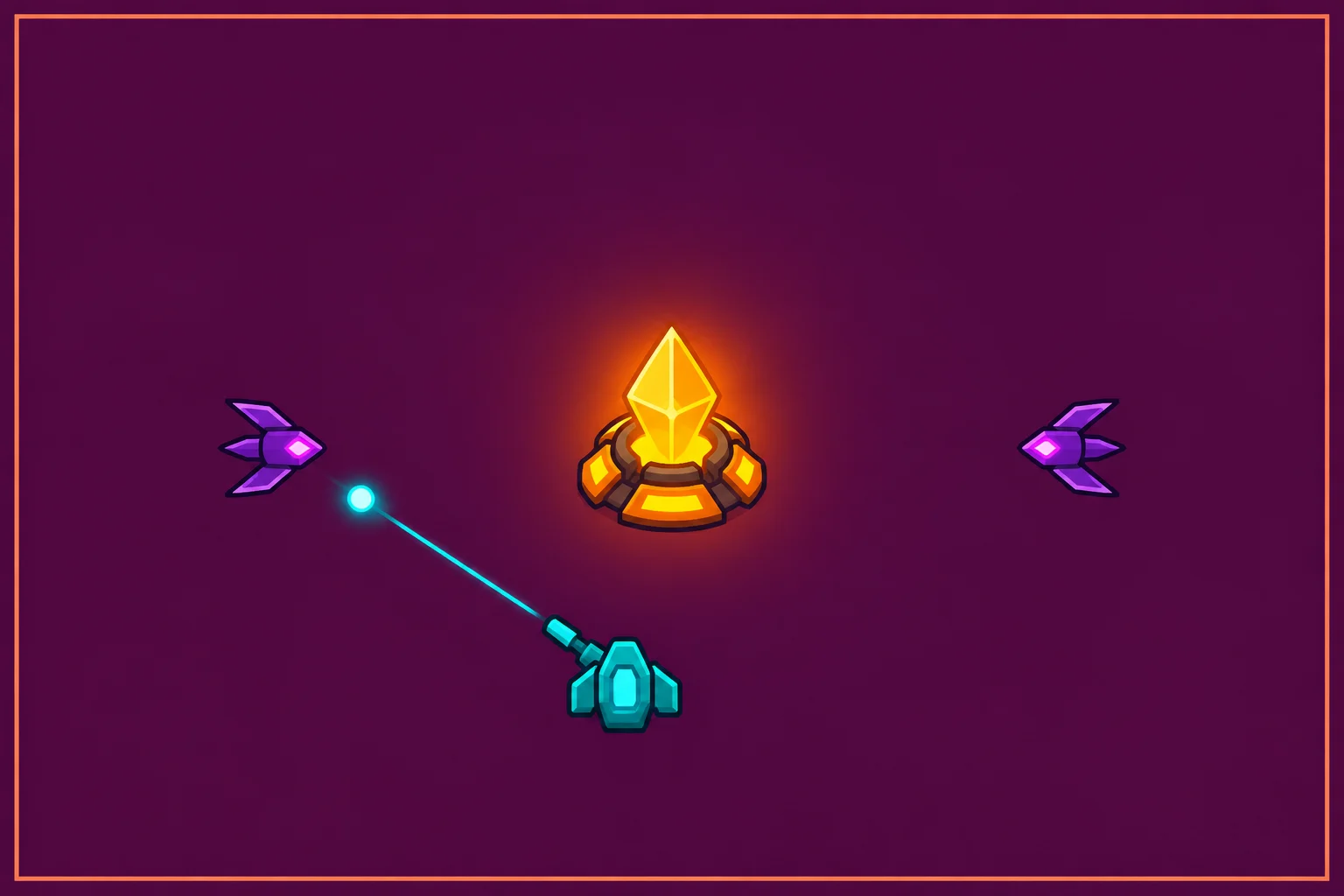
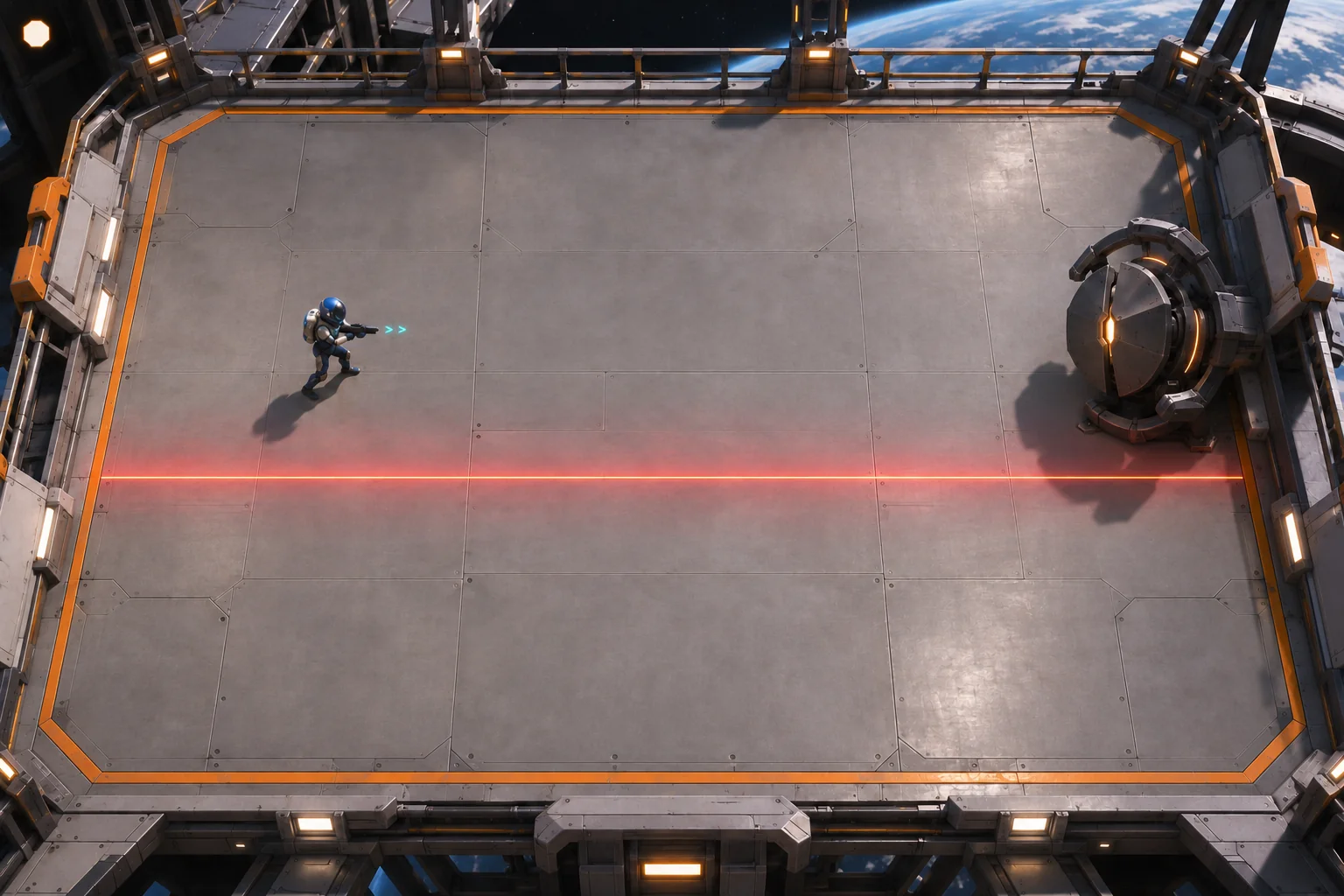
A mech-action prompt is easier to scope when it names one decision loop: read a firing telegraph, move through a small arena, attack while the target is in range, and understand the result. Start with one 6-by-5 room, three equipment slots under one power cap, and a short duel with a visible end state. Then write separate prompts for the loop, module rules, combat feedback, and acceptance checks. That sequence gives a future build a clear contract instead of a long list of disconnected features.
Cinderline Test Bay, the example below, is an original fictional design resolved by hand from its written rules. The four prompt templates are unrun; no game build or player session is shown, and no empirical test is claimed. Treat the numbers as a teaching simulation to adapt, not as observed behavior or a SEELE result.
Lock the duel before you write prompts
Make the first slice small enough that every action can be checked. Cinderline Test Bay uses a 6-column by 5-row grid. Rook-6 begins at (1,2) with 10 HP; a stationary Sentry begins at (4,2) with 8 HP. The Sentry telegraphs row 2, then row 1, then row 2 across three beats. Rook-6 gets one movement phase and one system action per beat. The player wins by disabling the Sentry before its attack resolves on the final beat.
| Rule | Cinderline contract | What the first build should make visible |
|---|---|---|
| Movement | Move on cardinal grid cells only. Vector Jets allow up to two steps; Heavy Treads allow one. | Show the legal destination cells and reject diagonal movement. |
| System action | Choose one Pulse Carbine shot or one Vent action after moving. | Show the action window and the result of the selected action. |
| Pulse Carbine | At Manhattan range 3 or less, deal 3 damage and add 1 heat. | Show a hit or miss, target response, and updated heat. |
| Heat | Heat is capped at 4. A shot is legal below 4; Vent costs the beat and removes 2 heat. | At 4 heat, disable firing until the player vents or chooses another action. |
| Sentry telegraph | Mark the target row before the player acts. If Rook-6 ends the beat in that row at x=1–4, the Sentry deals 3 raw damage. | Keep the marked row visible through the player’s move and resolve the shot afterward. |
| Bulwark Plate | Reduce a Sentry hit by 1, to a minimum of 0 damage. | Show the incoming hit and the reduced HP loss as one readable response. |
| Resolution | After the player’s move and action, the Sentry fires only if it still has HP. | If the carbine disables it, there is no extra enemy shot. |
| End states | Win when the Sentry reaches 0 HP; lose if Rook-6 reaches 0 HP first. | Show the winning disable or player defeat, then let the reader restart from the stated starting values. |
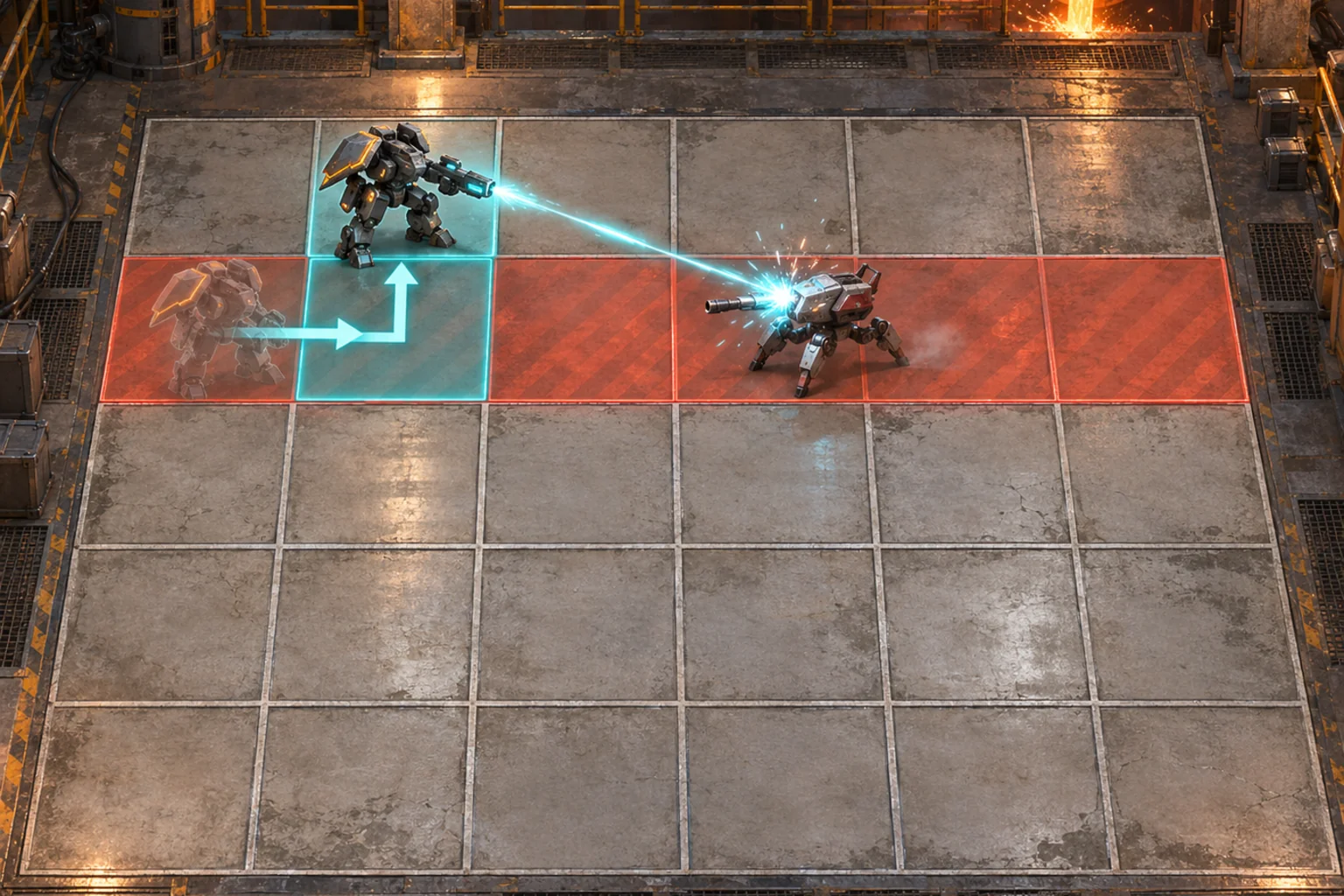
This timing rule is the hinge of the encounter. The hazard is announced first; movement happens before the shot; and a successful final attack can interrupt the enemy. State that order in the brief and ask for the screen feedback that proves it. “Make combat feel responsive” is not precise enough to tell you whether the telegraph, movement window, or damage order is wrong.
Fit modules within one power budget
Give each chassis a weapon slot, a drive slot, and an armor slot. Every selected module costs power from the same cap of 6. The example loadout fills all three slots without needing an exception: Pulse Carbine (2), Vector Jets (2), and Bulwark Plate (2), for 6 total. A drive swap changes mobility while leaving the weapon and armor rules intact.
| Slot | Module | Power | Rule and visible feedback |
|---|---|---|---|
| Weapon | Pulse Carbine | 2 | One shot per beat at range 3 or less; deals 3 damage and adds 1 heat. |
| Drive | Vector Jets | 2 | Move up to two cardinal steps; show the route as connected legal cells. |
| Drive alternative | Heavy Treads | 2 | Move one cardinal step; fewer escape options can mean more incoming damage. |
| Armor | Bulwark Plate | 2 | Reduce a Sentry hit by one; make the HP bar lose two segments instead of three. |
The three selected slots total 6 power exactly. If a player swaps to a module that costs 3, the game should either reject the 7-power loadout or require a clear removal; it should not quietly exceed the cap. Keep slot, cost, effect, and feedback together so a later swap does not change a statistic without telling the player.
Prompt the telegraphed fight
Each prompt should pass a specific decision to the next stage. Keep the input, constraints, requested output, and check in the prompt itself. The examples are reusable starting text for an appropriate workflow; they do not imply that SEELE accepts a special syntax or that any prompt has been run.
Prompt A: define the core loop
Design a small original 3D mech-action game around one arena duel. Use a 6-column by 5-row cardinal grid. The player controls Rook-6 at (1,2), 10 HP, against a stationary Sentry at (4,2), 8 HP. Each beat: the Sentry marks a row, the player may move using the equipped drive and take one system action, then the Sentry fires only if still alive. Include a clear win state, loss state, restart, and readable cause-and-effect feedback. Return a short rules summary and the smallest playable scene; do not add a campaign or unrelated systems. Check: every possible action has a visible result and a reset path.Start with the room, the controlled unit, the opponent, the repeatable action, and the stopping rule. A prompt that asks for movement, three weapon classes, upgrades, a hub, and several bosses at once makes it harder to tell which rule failed.
Prompt B: define the module contract
Add exactly three chassis slots: weapon, drive, and armor. The shared power cap is 6. Use Pulse Carbine (2 power: one shot per beat, range 3, damage 3, +1 heat), Vector Jets (2: up to two cardinal movement steps), Heavy Treads (2: one step), and Bulwark Plate (2: reduce incoming Sentry damage by 1, minimum 0). A legal loadout has at most one module per slot and total cost no higher than 6. Return the selected module, cost, effect, and feedback after each swap. Check: Carbine + Jets + Plate totals 6; replacing a 2-power module with a 3-power module must trigger a visible over-cap response.Give modules a stable slot and a single effect. The acceptance line catches a common prompt gap: a power limit is only useful if the game explains what happens when a loadout exceeds it.
Prompt C: specify combat timing and feedback
Use cardinal-grid Manhattan distance. At the start of each beat, telegraph rows y=2, y=1, then y=2. The player moves first, then takes one action: fire the carbine if within range 3 and heat is below 4, or Vent to remove 2 heat and spend the action. A shot deals 3 damage and adds 1 heat. If the Sentry survives the player's action and Rook-6 ends at x=1–4 in the marked row, deal 3 damage reduced by the Bulwark Plate to 2. At 4 heat, firing is illegal. Check: display the marked row, legal destinations, hit or miss, HP change, heat change, and whether the Sentry was disabled before its shot.This version states what is allowed, when it resolves, and what the player should see. It also prevents an ambiguous “simultaneous” turn from applying an attack after its source has already been disabled.
Hand-check the win state
Now resolve the example before asking for a build. Manhattan range is the sum of the horizontal and vertical cell differences. Rook-6 starts with 10 HP and zero heat; the Sentry starts with 8 HP. Every carbine hit removes 3 Sentry HP and adds 1 heat. Every Sentry hit removes 2 player HP after armor. The target’s row and the player’s final cell determine whether its shot connects.
| Beat | Vector Jets action | Sentry response | End state |
|---|---|---|---|
| 1 — row 2 | Move (1,2)→(2,1) via (2,2), then fire at range 3. Sentry HP: 8→5; heat: 0→1. | Rook-6 ends outside row 2, so the shot misses. | Rook-6: 10 HP; Sentry: 5 HP; heat: 1/4. |
| 2 — row 1 | Stay at (2,1), fire at range 3. Sentry HP: 5→2; heat: 1→2. | Rook-6 ends in the marked row, so armor reduces 3 damage to 2. | Rook-6: 8 HP; Sentry: 2 HP; heat: 2/4. |
| 3 — row 2 | Move to (2,2), fire at range 2. Sentry HP: 2→0; heat: 2→3. | The Sentry is disabled by the player’s action and does not fire. | Win after beat 3: Rook-6 at 8 HP, heat 3/4. |
Every range and damage step follows from the written contract: after beat 1 the distance is |4−2|+|2−1|=3; after beat 2 it is still 3; after beat 3 it is 2. The first move takes two cardinal steps, not a diagonal shortcut. The player receives one hit, reduced from 3 to 2, and the Sentry is removed before its last response.
The alternate Heavy Treads loadout still wins, but with less health. It moves one tile per beat: to (2,2), then (2,1), then (2,2). It fires on all three beats, so the Sentry goes 8→5→2→0 and heat goes 0→1→2→3. The first two destinations match rows 2 and 1, so Rook-6 takes two armored hits: 10→8→6 HP. The comparison exposes a real design choice—Jets avoid the first telegraph, while Treads spend more health for the same three-beat win.
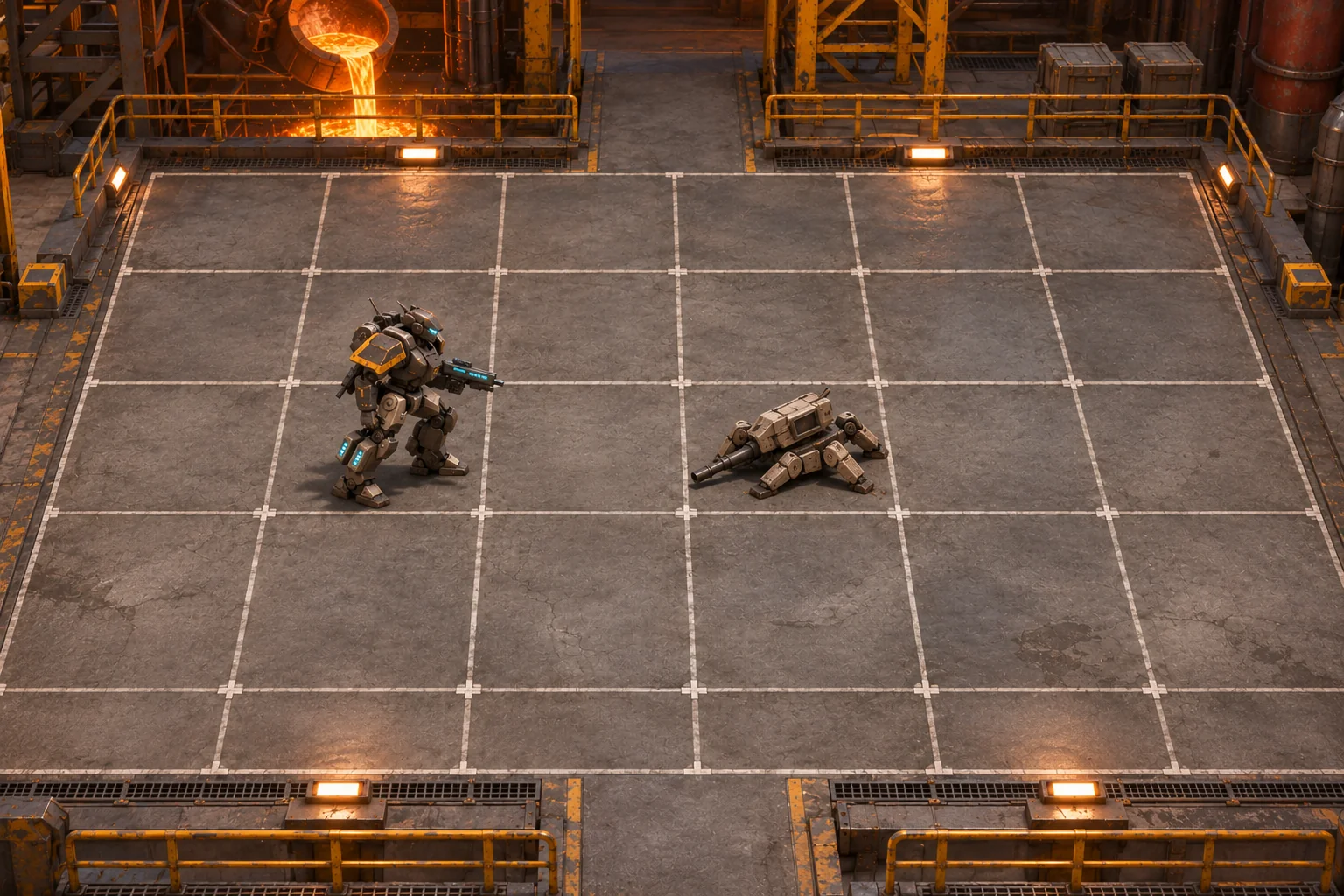
This is not a measured balance result. It is one deterministic paper example that helps you ask better questions: does the enemy’s warning arrive early enough, can each drive legally reach its shown cell, does the armor reduction happen once, and is the final shot ordered before the enemy attack?
Turn the checks into a first-build plan
Write the acceptance request separately so it does not hide inside a broad creative prompt.
Prompt D: ask for a reviewable test
Using the approved Cinderline rules, return a small test room with a visible restart. Include a short state log for the Vector Jets sequence and show player position, Sentry HP, player HP, and heat after each beat. Also check one over-cap loadout, one out-of-range shot, heat reaching 4, and a Sentry disabled before its response. If a requested behavior is missing or different, report the mismatch instead of silently changing the rules. This prompt is a plan to use later; it does not document an executed build.When you later have a real build, record the prompt version and starting state, then compare what happened with the acceptance table. Check the firing row before and after movement, the path through legal cells, the range calculation, module totals, armor damage, heat, enemy disable timing, and restart. Change one rule at a time and update the expected state before any later test. If no build or play session exists, leave the test result blank rather than filling it with the hand calculation.
The current 3D AI game page describes turning a text prompt into a playable 3D game, directing the scene, camera, and controls, then testing the first build in a browser and making changes in chat. It recommends starting with one scene and one goal. The Free AI Game Maker page describes a playable first version from a plain-English idea, browser testing, follow-up prompts, 2D or 3D games, and cost review before each generation. These are general workflows, not evidence that this fictional mech or its exact rules were generated.
Carry the four prompt stages, the six-power loadout, and the three-beat ledger into your own design process. To start shaping a small game idea and review a general creation workflow, use the Free AI game maker. Keep the Cinderline numbers as a reference contract; replace them with your own rules and verify an actual result before describing it as playable or tested.
Frequently asked questions
What should a mech-action prompt include?
A useful first prompt names the player goal, arena size, starting state, repeatable action, enemy response, win and loss states, and restart. Then specify the action order and the visible feedback that proves each rule. Keep the first scene narrow enough to check before adding a campaign, extra weapons, or progression.
How do you balance swappable mech modules?
Give each module one slot, a power cost, one primary effect, and visible feedback. In Cinderline, the Pulse Carbine, Vector Jets, and Bulwark Plate each cost two power, so their total exactly meets the six-power cap. A replacement that exceeds the cap should trigger an explicit rejection or removal choice.
How should an enemy telegraph work?
Show the threatened area before the player chooses movement, keep it visible during the action window, and resolve the attack only after the player's move and system action. State what counts as a hit and what armor changes. Then check that the final player cell, not the starting cell, determines whether the warning connects.
Is the Cinderline duel a tested game?
No. Cinderline Test Bay, its module values, the combat rules, and the three-beat result are an original fictional design resolved by hand. The prompt templates are unrun. No generated build, play session, observed behavior, or empirical test is included, and the concept images do not prove that the rules work in software.
Does SEELE guarantee a mech game from these prompts?
No. SEELE's official pages describe a general game-creation workflow and broad 3D prototyping guidance. They do not establish that this exact mech, module system, combat timing, or result has been generated. Review and test any future output against the rules you provide, and record what actually happens.