Start with one objective in a measurable space
To make a gridless tactics game with AI, define how far a unit can move, how distance is measured, what each action costs, and how the objective is checked. Removing tiles does not remove the need for rules. A small continuous arena can still be easy to read when every move uses the same coordinate scale.
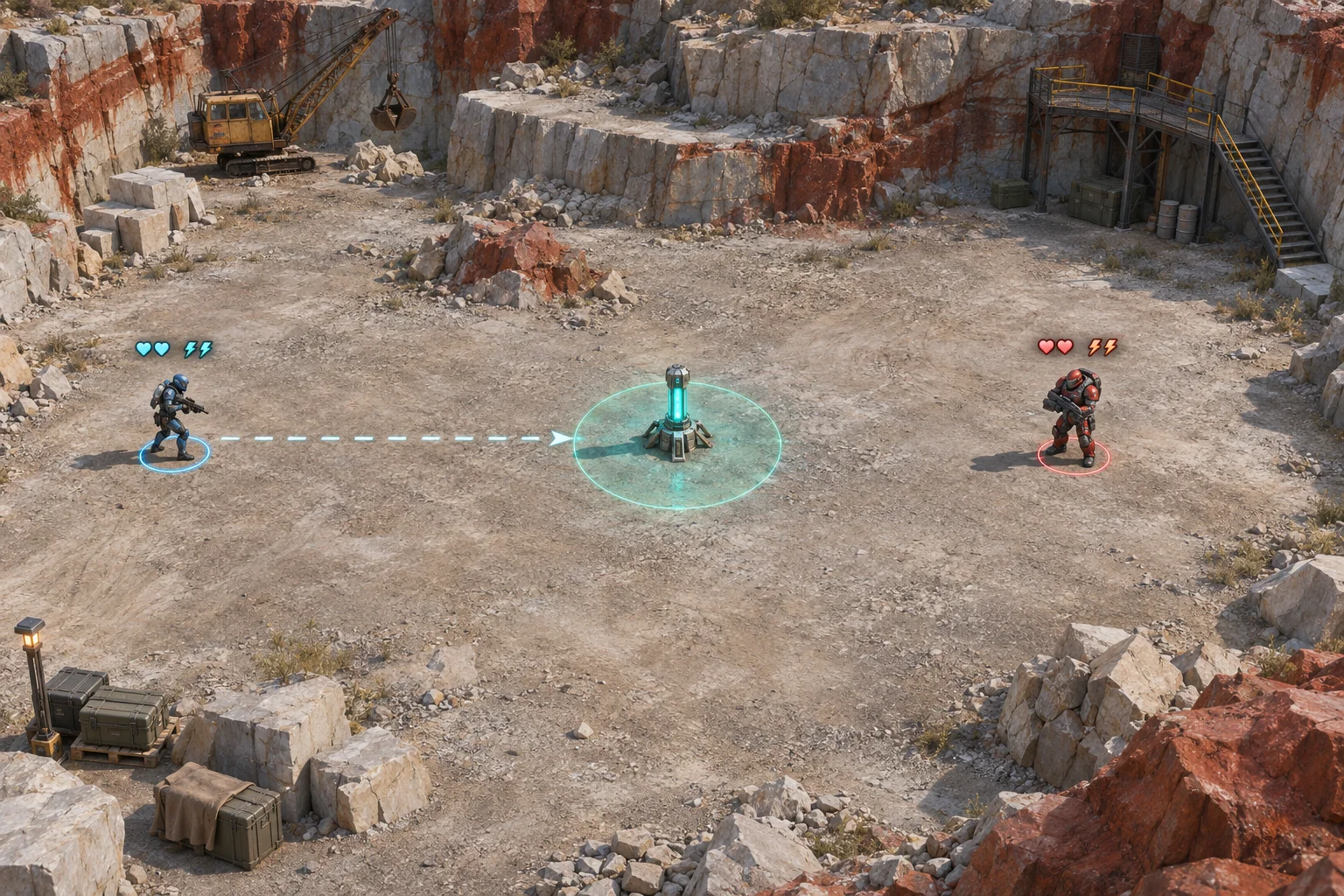
Quarry Beacon uses a 20m by 12m quarry, one capture point, and two units. Blue controls a Scout; Red controls a Guard. The Beacon sits at (10,6) with a 2m radius. Units occupy exact coordinates such as (2,6), not cells. Movement is free to choose a direction, but each action still has a maximum distance and a visible cost.
The example is hand-resolved from its written rules. It is not a generated game, playable build, or test result. That distinction matters: an authored rules trace can show what a future prototype should do, but it cannot prove that a system already behaves that way.
Set movement, range, and action costs first
Pick one spatial unit and use it for both movement and attacks. Here, one meter means one meter in the fictional arena. Measure the straight-line Euclidean distance between a unit's starting and ending coordinates. A unit may stop early; its position is never rounded to a square or snapped to a point.
| Rule | Quarry Beacon contract | What the player can read |
|---|---|---|
| Activation | Each side receives 2 AP on its activation. | Two available action markers before acting. |
| Move | One AP moves a unit up to 4m in any direction. | A route preview with a clear endpoint and remaining AP. |
| Shot | One AP deals 1 damage at Euclidean distance ≤6m; line of sight is open in this first slice. | Target, range eligibility, and damage after resolution. |
| Capture | A unit is inside when Euclidean distance from (10,6) is ≤2m, including the boundary. | Contested when both sides have a unit inside; control when only one side does. |
| Removal | At 0 HP, remove the unit immediately. A unit eliminated before its activation cannot act. | Health reaches zero, then the unit leaves the battlefield. |
The distinction between a move limit and a capture radius prevents a common source of ambiguity. The Scout can move 4m per action, while the Beacon is controlled within 2m of its center. Using the same distance measurement for both lets a reader calculate whether a path or attack is legal without guessing how the game rounds positions.
For a first prototype, keep the arena open and omit collision blockers. That keeps the question focused on movement and objective control. Once those rules are readable, add terrain only when it creates a meaningful choice such as a blocked line of sight or a longer approach.
Give the opponent a deterministic objective rule
A short enemy rule can make a tactics example repeatable. Quarry Beacon gives Red two AP. For each AP, if the Guard is outside the Beacon radius, it moves toward the nearest point on the radius by up to 4m. Once inside, it holds position. After a move, if a Blue unit is within 6m, the Guard spends a remaining AP to shoot the nearest Blue unit. With one Blue unit and open line of sight, the target is unambiguous.
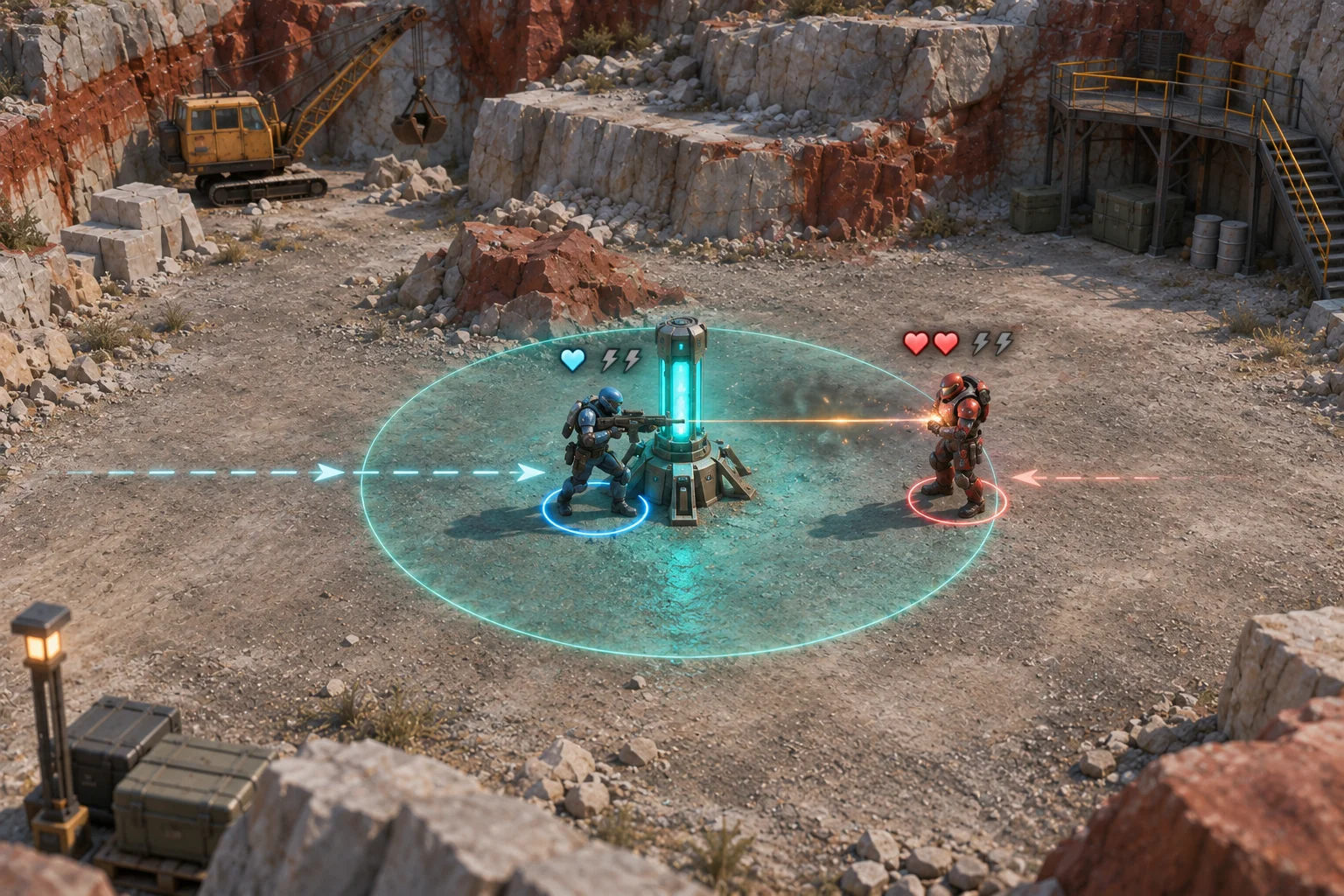
The opening position puts the Guard at (14,6), 4m from the Beacon center. The Scout starts at (2,6). Blue spends one AP moving from (2,6) to (6,6), then a second AP moving from (6,6) to (10,6). Red moves from (14,6) to (12,6), the nearest point on the 2m radius, and uses its remaining AP to shoot the Scout from 2m away. The Scout falls from 2 HP to 1 HP.
After Turn 1, Scout has 0 AP and 1 HP; Guard has 0 AP and 2 HP. Scout is at the Beacon center (0m from it), while Guard is exactly 2m away. Both qualify under the inclusive radius rule, so the Beacon is contested and the score remains 0–0. These positions and values are a hand-resolved expectation, not evidence from a running prototype.
Hand-resolve the two-turn encounter
A hand trace catches rule conflicts before the feature list grows. Reset AP at each activation, apply the player's actions before Red's, and stop the round if no enemy remains to activate.
| Point | Blue action | Red action | Result |
|---|---|---|---|
| Start | Scout at (2,6), 2 HP | Guard at (14,6), 2 HP | Beacon center (10,6), radius 2m, score 0–0 |
| Turn 1, Blue | Move (2,6)→(6,6) for 4m and 1 AP; then (6,6)→(10,6) for 4m and 1 AP. | Not active yet. | Scout is at the Beacon center with 2 HP and 0 AP. |
| Turn 1, Red | Scout waits at (10,6). | Move (14,6)→(12,6) for 2m and 1 AP; shoot from 2m for 1 damage and 1 AP. | Scout 1 HP, Guard 2 HP. Both are within ≤2m, so the point is contested; score 0–0. |
| Turn 2 | Scout's 2 AP refresh. Two shots at 2m deal 1 damage each: Guard 2→1→0 HP. | Guard is removed before Red activation. | Only Scout remains inside the Beacon radius; Blue earns one point and wins 1–0. |
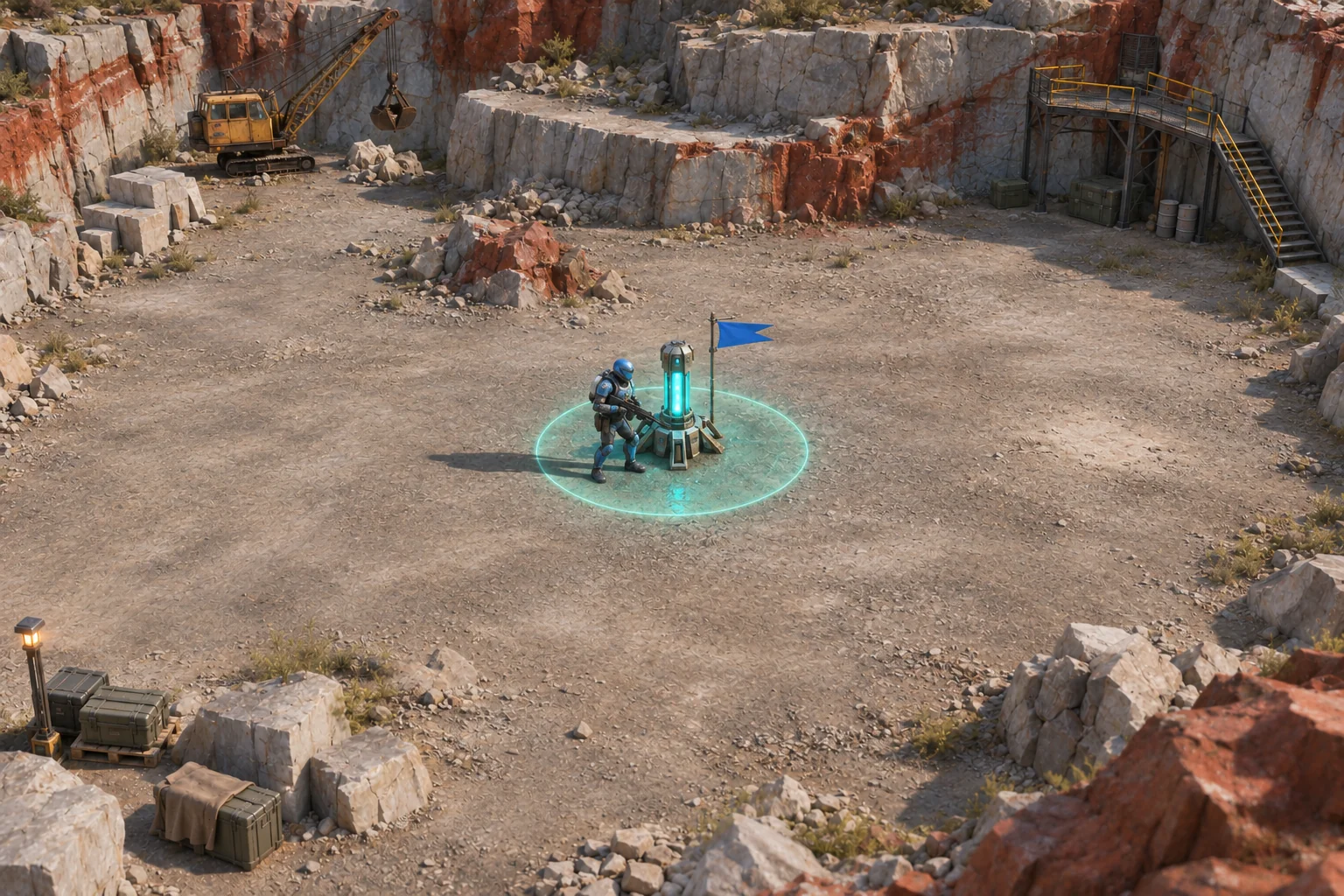
The arithmetic closes: each move uses exactly 4m, the Guard's shorter approach ends on the 2m boundary, its shot is within range, and two later shots remove the Guard before it can act again. The Beacon changes from contested to Blue control only after the opponent is gone. If the game instead checks capture before removal, it could reach a different result; that phase order belongs in the rule contract.
Replace vague “spaces” with a precise prompt
A prompt such as “move the Scout four spaces” smuggles in a grid. A clearer instruction names the unit, the measurement, the cap, and the expected behavior when a move ends short of its maximum.
| Vague direction | Precise rule request | Check later |
|---|---|---|
| “Move four spaces toward the point.” | “Spend 1 AP to move up to 4m in any direction, measured as straight-line Euclidean distance from start to end. Do not snap to cells.” | A 3m move remains 3m; a 4.1m endpoint is rejected. |
| “Capture the Beacon when close.” | “A unit is inside at Euclidean distance ≤2m from (10,6); the boundary counts.” | 2m qualifies; 2.01m does not. |
| “The enemy moves toward you.” | “If outside the radius, move toward the nearest point on its edge; if a Blue unit is then within 6m, spend a remaining AP to shoot the nearest target.” | At (14,6), the Guard ends at (12,6), then fires at the Scout. |
Simulated specification refinement: The three rows above show how an author can replace ambiguous wording with measurable rules. They are a written design clarification, not a prompt run or observed model response. When a future result is available, compare it with the distance and phase checks instead of describing this example as a test.
Write acceptance checks for boundaries and removal
Before expanding the arena, turn each boundary into a small expected-state check. The cases below follow the invented rules and describe what a later prototype should show.
| Case | Input | Expected result |
|---|---|---|
| Movement cap | Move endpoint is exactly 4m away, then 4.01m away. | 4m is legal; 4.01m exceeds one move. |
| No snapping | Move 3.25m into open space. | The endpoint remains at the chosen coordinate. |
| Capture boundary | Unit is 2m from (10,6), then 2.01m away. | 2m is inside; 2.01m is outside. |
| Attack boundary | Target is 6m away, then 6.01m away. | The first shot is in range; the second is not. |
| Zero HP | Guard reaches 0 HP before its activation. | Remove Guard and skip its action. |
| Contested point | Both sides have a unit within the radius after both activations. | No point is awarded. |
| Empty objective | Neither side has a unit within the radius. | No point is awarded. |
| Restart | After Blue wins 1–0. | Restore Scout and Guard to their starts and 2 HP, reset AP, and clear score. |
Ask for one expected result per case. If an observed prototype differs, include its starting coordinates and action sequence in the next instruction, then request the smallest rule correction. Keep random rolls, cover, supply systems, and extra units out until these checks agree with the intended contract.
Hand off a small rules brief and inspect the result
Once the arena, AP budget, and capture rule are written down, condense them into a creation brief. SEELE's current Free AI Game Maker page describes plain-English game descriptions, playable 2D or 3D review, and iteration in Workspace. Before submitting, the page advises reviewing the selected AI model, available Koin balance, and displayed generation cost. It also recommends testing a finished build on target devices before sharing. Those broad product details do not establish that Quarry Beacon's rules will be generated correctly.
Create a small gridless tactics prototype called Quarry Beacon. Use an open 20m × 12m arena, Blue Scout at (2,6) with 2 HP, Red Guard at (14,6) with 2 HP, and a Beacon centered at (10,6) with a 2m radius. No cells or snapping. One AP moves up to 4m by straight-line Euclidean distance. One AP fires a 1-damage shot at Euclidean distance ≤6m. Each activation has 2 AP. Blue acts before Red. Red moves toward the nearest point on the Beacon boundary until inside, then uses a remaining AP to shoot the nearest Blue unit if it is within 6m. After both activations, a side scores only if it has a unit within ≤2m and the opponent has none; the boundary counts. Remove a unit at 0 HP before it can activate. Stop when one Beacon point is scored. Make positions, AP, HP, range, and contested/control state visible. Do not add grids, cover, supply, or random rolls. Check the stated acceptance cases before expanding the prototype.The prompt is an authored starting point for a future project, not one submitted to SEELE or a claim that this battle has been built. If a generated result is available, inspect movement endpoints, attack range, zero-HP removal, and capture boundaries directly. Do not infer those mechanics from the product's general game-creation capability.
Build the distance contract before adding units
A readable gridless tactics slice needs only a measured arena, a few actions, one opponent rule, and one objective. Keep movement and range on one Euclidean scale, settle whether the boundary counts, and use a hand trace to define expected states. Then describe your own encounter in the Free AI game maker, inspect what it returns, and test the actual result before sharing it or building further.
Gridless tactics game FAQ
How do you measure movement in a gridless tactics game?
Choose coordinates and one distance rule. In Quarry Beacon, movement is straight-line Euclidean distance in meters, capped at 4m per AP. Positions do not snap to cells, and a unit may stop early. A path preview should expose the endpoint so a player can tell whether a move is legal. For example, a 3m move still uses one AP and ends at 3m.
Why use action points if movement is free-form?
Free positioning changes where a unit can move, while AP limits how much it can do in one activation. Quarry Beacon gives each unit two AP, with a move or shot costing one. That makes a move-then-shoot sequence readable without forcing units to follow a grid. It also lets you compare two legal sequences within the same turn.
What happens when a unit reaches zero health?
Remove it immediately and skip its later action. In the hand-resolved second turn, the Guard is removed by Blue's second shot before Red activates, so it cannot return fire. Define that timing before asking for a more complex enemy turn.
Does a unit exactly 2m away control the Beacon?
Yes, under this example's inclusive rule: distance ≤2m counts as inside. Scout is at the center and Guard stands on the 2m boundary after Turn 1, so the point is contested. At 2.01m, a unit would be outside. A closed-radius check makes the exact edge predictable.
Was Quarry Beacon generated or tested?
No. The names, coordinates, rules, battle trace, and visual scenes are original instructional material calculated by hand. No playable build or test result was supplied, so the trace is an expected-state design, not evidence of implemented behavior. Use it as a checklist, then verify a real implementation separately.