A marble auto-battler feels strategic when a lineup choice changes who survives an automatic collision. Start with two lanes, one marble matchup in each, a visible impact rule, and a hero ability that fires once on a chosen lane. Then cap the match at two collision pulses and score each lane from surviving health. A small ruleset makes it possible to explain what happened without relying on vague physics or an unverified build.
The example below, Rimline Rally, is an original fictional design worked through by hand. Its impact values and Bank Mark ability are proposed game rules, not measured physics. No prompt run, generated game, player session, or empirical test is included; the UI revision later in this article is a simulated design hypothesis.
Set the lanes and launch roster
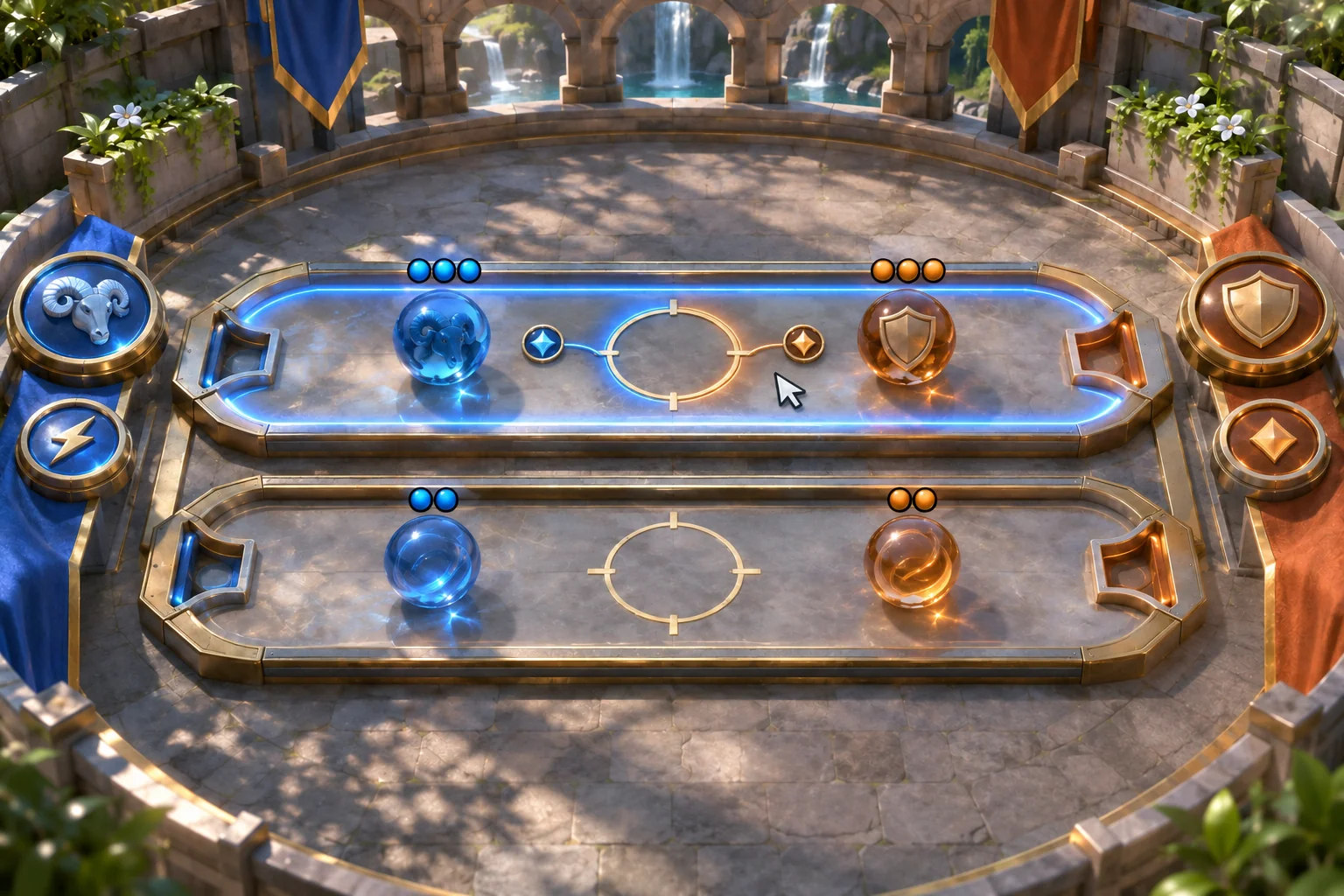
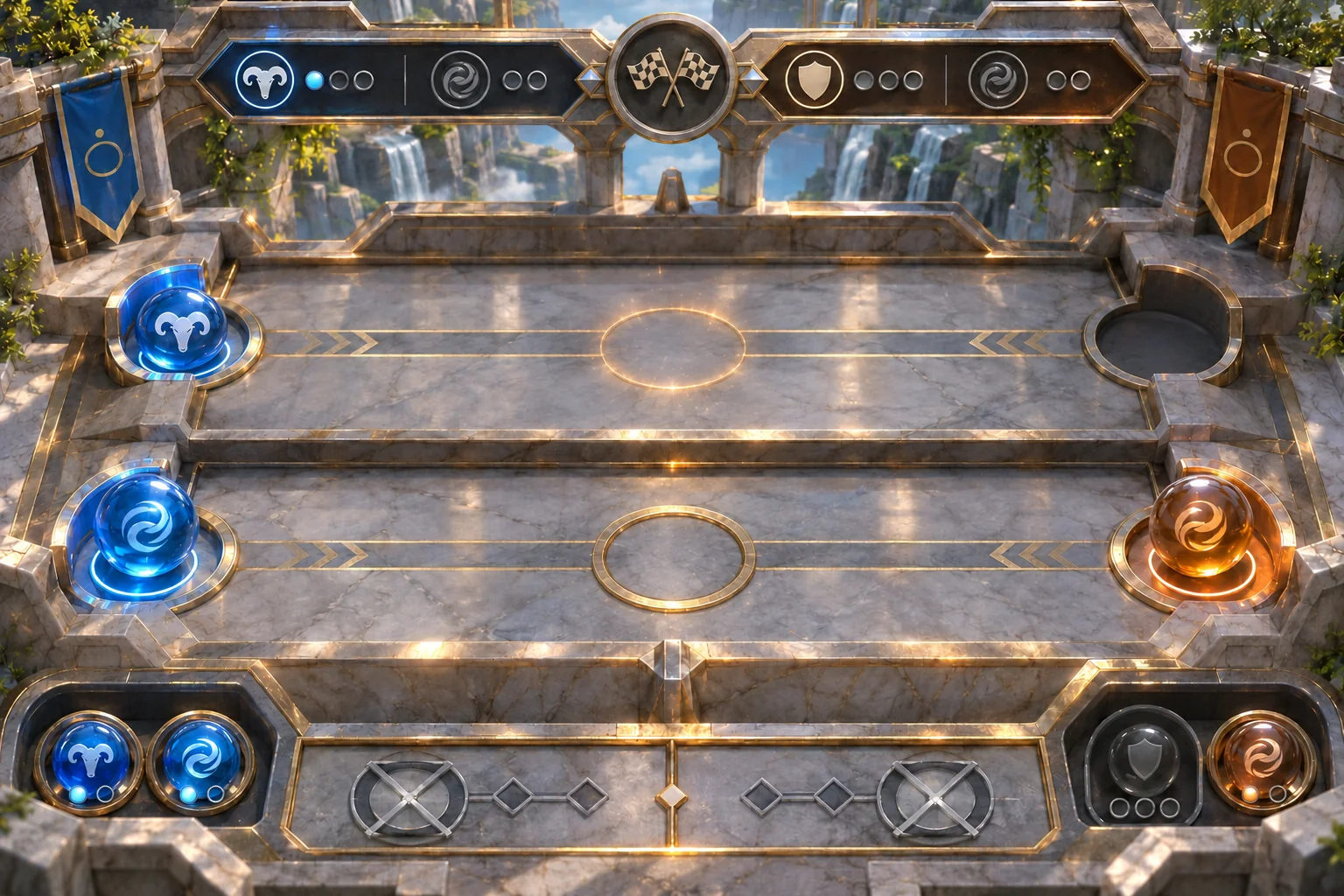
Give the player a decision before the automatic battle begins. Rimline Rally uses two parallel tracks, North and South. Each track has one launch notch for each side and a center contact ring. The rival formation and both hero marks are visible before the player commits, so lane assignment can respond to a matchup rather than a hidden roll.
Use one marble per side in each lane for the first slice. Health controls how long a marble can stay in the battle; Impact sets the damage it deals when it collides. Those numbers are game stats, not a realistic momentum formula.
| Lane | Player marble | Rival marble | Health at launch | Impact |
|---|---|---|---|---|
| North | Blue Rammer | Bronze Guard | 3 vs. 3 | 2 vs. 1 |
| South | Blue Orb | Bronze Orb | 2 vs. 2 | 1 vs. 1 |
Each team chooses a lane for its one-use Bank Mark hero ability. For the worked match, both teams mark North. That choice matters because a marked collision gets an extra point of damage from each side's first attack in that lane. Keep the selection visible, then lock the lineup and marks together.
Define collision and hero-trigger rules
“Marbles bounce and heroes use abilities” leaves several gaps. State when contact happens, whether both sides deal damage, how the mark modifies impact, and what a surviving marble does before the next pulse. In this first version, all opposing pairs in both lanes resolve together. The ability changes a fixed damage value rather than adding an unpredictable physics calculation.
| Phase | Rimline Rally rule | Visible feedback |
|---|---|---|
| Launch | After both sides lock, all active marbles roll to their lane’s center ring at the same time. | Each lane shows one opposed pair approaching contact. |
| Impact | Each marble deals damage equal to the opposing marble’s Impact. On a team’s first collision in its marked lane, add 1 damage and consume that Bank Mark. | Show one contact flash and both damage values resolving together. |
| Health update | Apply each pair’s damage simultaneously. Remove any marble at 0 health after both attacks are applied. | A defeated marble moves to the knockout pocket; its roster pips empty. |
| Rebound | Every survivor returns to its own launch notch after the pulse, even if its opponent was removed. It waits there if no opposing marble remains. | Keep the survivor at its original side and lane. |
| Stop and score | Run at most two pulses. Then total remaining health by lane; the higher total earns one lane point, while a tie earns none. | Show lane totals, spent marks, eliminated marbles, and the final lane-point score. |
The rebound rule keeps the example deterministic: a surviving unit never slides into an unmentioned scoring zone or changes lanes. The two-pulse cap also gives the match a clear endpoint, including a simultaneous knockout.
Hand-resolve the two-pulse match
Use the same starting lineup and let each pair resolve at once. Both teams mark North, so both first-hit bonuses apply there. South receives no bonus. This is a manual calculation from the written rules; it is not evidence that the collision system has been implemented or tested.
| Pulse and lane | Damage dealt | Health after simultaneous damage |
|---|---|---|
| Pulse 1 — North | Blue Rammer deals 2 + 1 Bank Mark = 3; Bronze Guard deals 1 + 1 Bank Mark = 2. | Rammer: 3 − 2 = 1 HP. Guard: 3 − 3 = 0 HP, removed. |
| Pulse 1 — South | Each Orb deals 1. | Blue Orb: 2 − 1 = 1 HP. Bronze Orb: 2 − 1 = 1 HP. Both rebound. |
| Pulse 2 — North | No opposing pair remains. | Blue Rammer stays at 1 HP; no second hit occurs. |
| Pulse 2 — South | Both Orbs deal 1 to each other at the same time. | Both go from 1 HP to 0 HP and are removed together. |
At the stop, North is player 1 HP versus rival 0, so the player earns one point. South is 0–0, so neither side earns a point. The final score is player 1, rival 0. The Rammer’s survival comes from the marked collision ending the North pair early; the South pair cancels out because both Orbs have the same health and Impact.
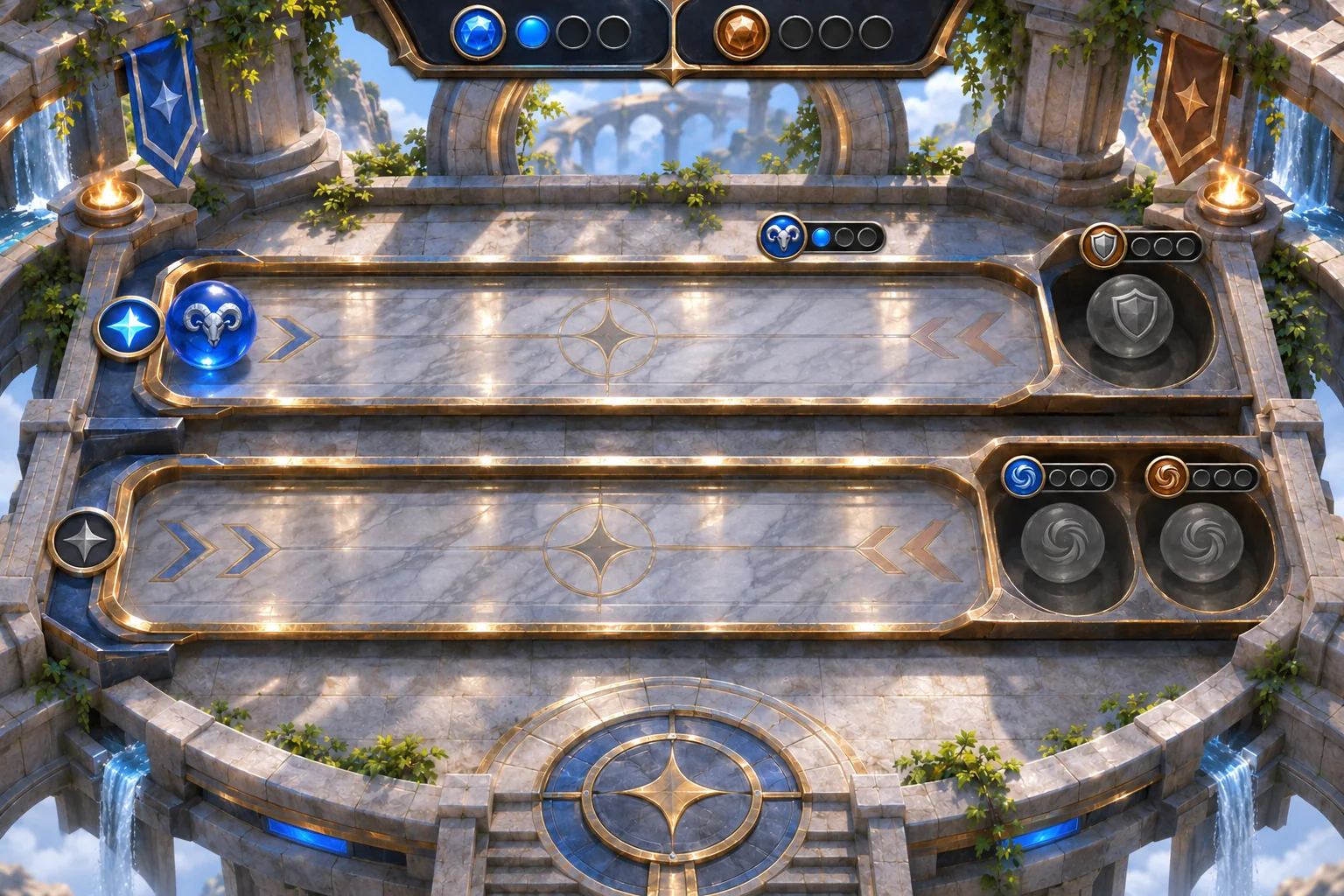
In another lineup, moving the Bank Mark to South could change which marble survives. The useful test is not whether an ability looks dramatic; it is whether the player can predict the lane and health consequence before launch.
Improve the result feedback on paper
A first hypothetical result screen might show only a generic winner badge. That says who won but hides the reason. A proposed revision would show each lane’s remaining-health total, which Bank Mark was consumed, which marbles were removed, and the final lane-point score. For this hand-resolved example, the feedback would show North 1–0, South 0–0, and a final 1–0 result.
This is an author-created interface hypothesis based on the rules table, not an iteration tested in a playable game or with players. The user request permits a clearly labeled simulation when empirical evidence is missing, but the example must not be presented as a measured result. If a real build is later available, record the starting state, exact prompt/version, actual behavior, and revised rule separately.
Check the auto-battle edge cases
Before adding more marbles, ask whether each boundary has a visible expected result. These checks make the first implementation easier to inspect and prevent it from inventing movement or turn order halfway through a match.
| Case | Expected result | What to inspect |
|---|---|---|
| Empty lane at launch | No cross-lane target is selected; the lane is scored from its final surviving health totals. | Unit stays in its lane and receives no collision damage. |
| Both marbles reach 0 in one pulse | Apply damage together, remove both, then award no lane point if both sides total 0. | No defeated marble gets an extra attack after removal. |
| Bank Mark in the chosen lane | Each team's mark adds 1 damage to its own first attack there, then is spent. | No bonus appears on pulse two or in another lane. |
| Two-pulse cap | End and score after pulse two even if both sides still have survivors. | No hidden third pulse or tie-break movement occurs. |
| Next match | Restore launch health, positions, and both marks before the next lineup choice. | No prior damage or spent ability leaks into the reset. |
These are proposed acceptance cases for a future build. If a future result disagrees, change one rule at a time and recalculate the expected state before asking for another pass.
Take the short rules brief to the game maker
The current Free AI Game Maker page describes turning a plain-English idea into a playable first version, testing it in a browser, and refining it with follow-up prompts. It supports 2D or 3D games, offers free starter Koins, and says to review the cost before each generation. These are general product claims; they do not establish that a marble collision system or Bank Mark behavior has been generated.
Carry over the two-lane setup, impact rules, hero trigger, pulse cap, and one expected match result. Inspect whether a future output keeps attacks simultaneous, removes a zero-health marble, rebounds survivors, and scores the lanes as specified. If it does something else, name that mismatch before adding more features. To shape your own small collision-driven game and review a general creation workflow, start with the Free AI game maker.
Start with one collision decision
A strong first marble battle needs only two lanes, a visible opponent, a meaningful stat difference, one limited hero trigger, and an endpoint that can be checked by hand. Define the contact and rebound rules before adding more abilities; then compare any actual future build with the same two-pulse ledger. Rimline Rally is a fictional teaching design, not a tested result, but its state table gives you a precise contract to adapt.
Frequently asked questions
What makes a marble auto-battler strategic?
A visible setup choice should change a result the player can predict. In this example, each team assigns a limited hero mark to a lane before launch, and the lane’s health totals show whether that choice helped. If swapping two marbles or moving a mark never changes the expected outcome, the first slice may need a clearer matchup.
How should collisions damage marbles?
Pick a clear rule and display it before battle. Rimline Rally uses each marble’s Impact as damage dealt to its opponent, applies both attacks simultaneously, then removes any marble at zero health. Impact is a made-up game stat here, not a real-world physics formula; a future game can model momentum differently if it states the rule.
When does the hero ability trigger?
The Bank Mark triggers on that team’s first collision in its selected lane, adds one damage to its own attack, and is then spent. If both teams mark the same lane, both bonuses apply during that pair’s simultaneous exchange. The mark cannot trigger again on pulse two or in a different lane.
How long should an auto-battle run?
Choose a stop condition before balancing the roster. This small example runs for at most two collision pulses and then scores surviving health in each lane. That cap prevents a tie from continuing indefinitely; if you add a tie-breaker later, make its trigger and effect a separate rule.
Does this article include a tested playable game?
No. Rimline Rally, its rules, and the two-pulse match are fictional teaching material resolved by hand. The interface change is a simulated design hypothesis. No prompt run, generated build, player session, observed behavior, or empirical test is included, and the concept images do not prove the rules work in software.