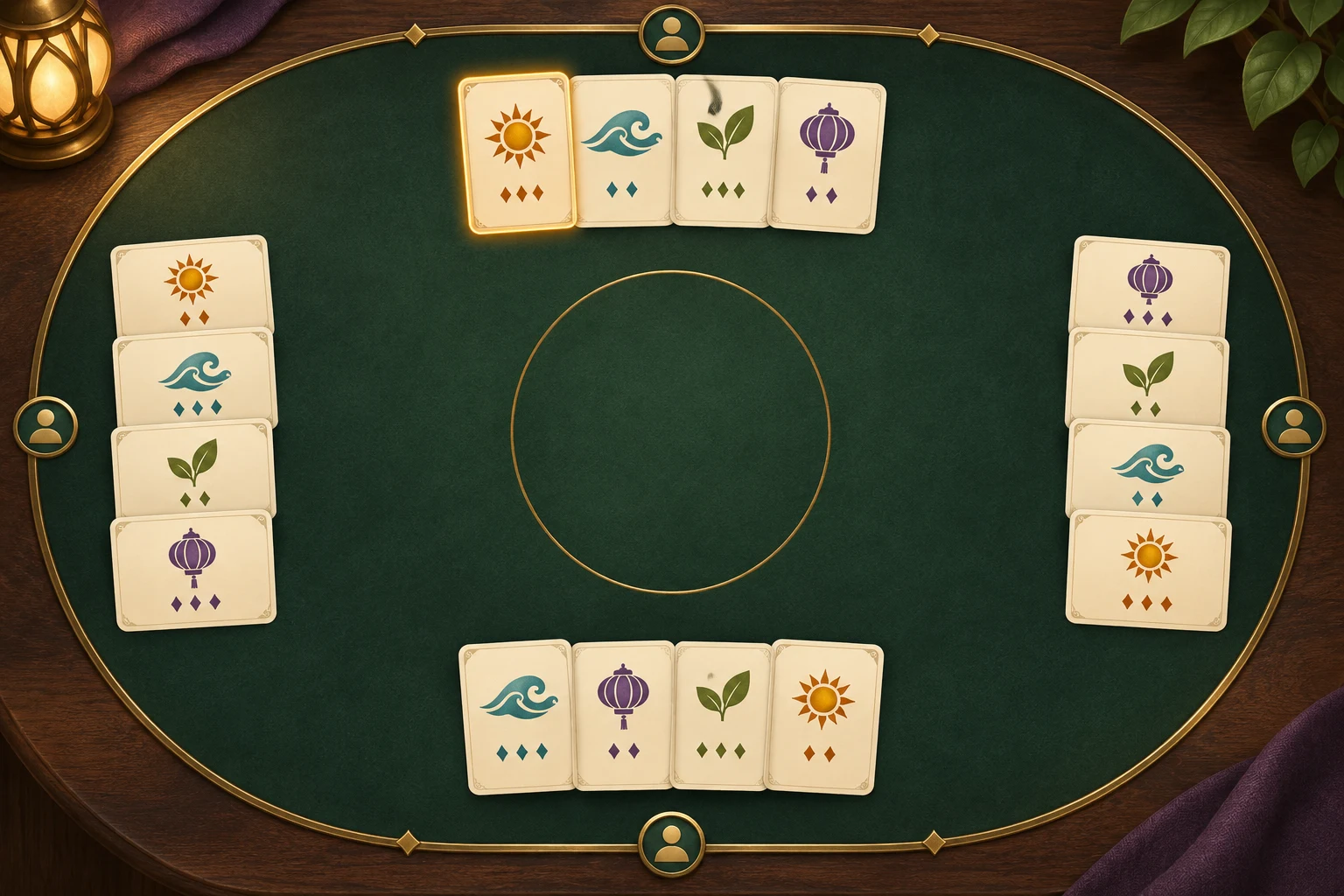
A solo card puzzle can feel strategic without a large deck or hidden rules. Give the player one card, one lane choice, and a visible target; then make success depend on using every card in a small fixed deal. The example here is Three-Lane Deal, an original fictional design whose rules and arithmetic are resolved on paper. It is not a generated game, a playtest, or a measured result.
The useful design question is simple: can a reader understand why one placement is legal, what feedback it causes, and whether the final deal wins? Start with the deal and its constraints. Add theme or production detail only after the loop can be checked from the table.
Choose a deal with a visible question
Three-Lane Deal uses six cards, numbered 1 through 6, and three lanes, A, B, and C. Each lane has a target. The player must place all six cards exactly once, with exactly two cards in every lane, and make each pair sum to its target. The opening hand is 1, 2, and 3; the visible draw order is 4, 5, and 6. There are no suits, shuffled draws, wild cards, or hidden bonuses. Because the deal is fixed, the example can be replayed and checked without guessing what might be drawn next.
Version one uses targets A=7, B=8, and C=6. The ranks sum to 21, and the three targets also sum to 21. That balance is a necessary arithmetic check, but it does not by itself prove that a route exists. The player still has to pair the cards without filling a lane incorrectly.
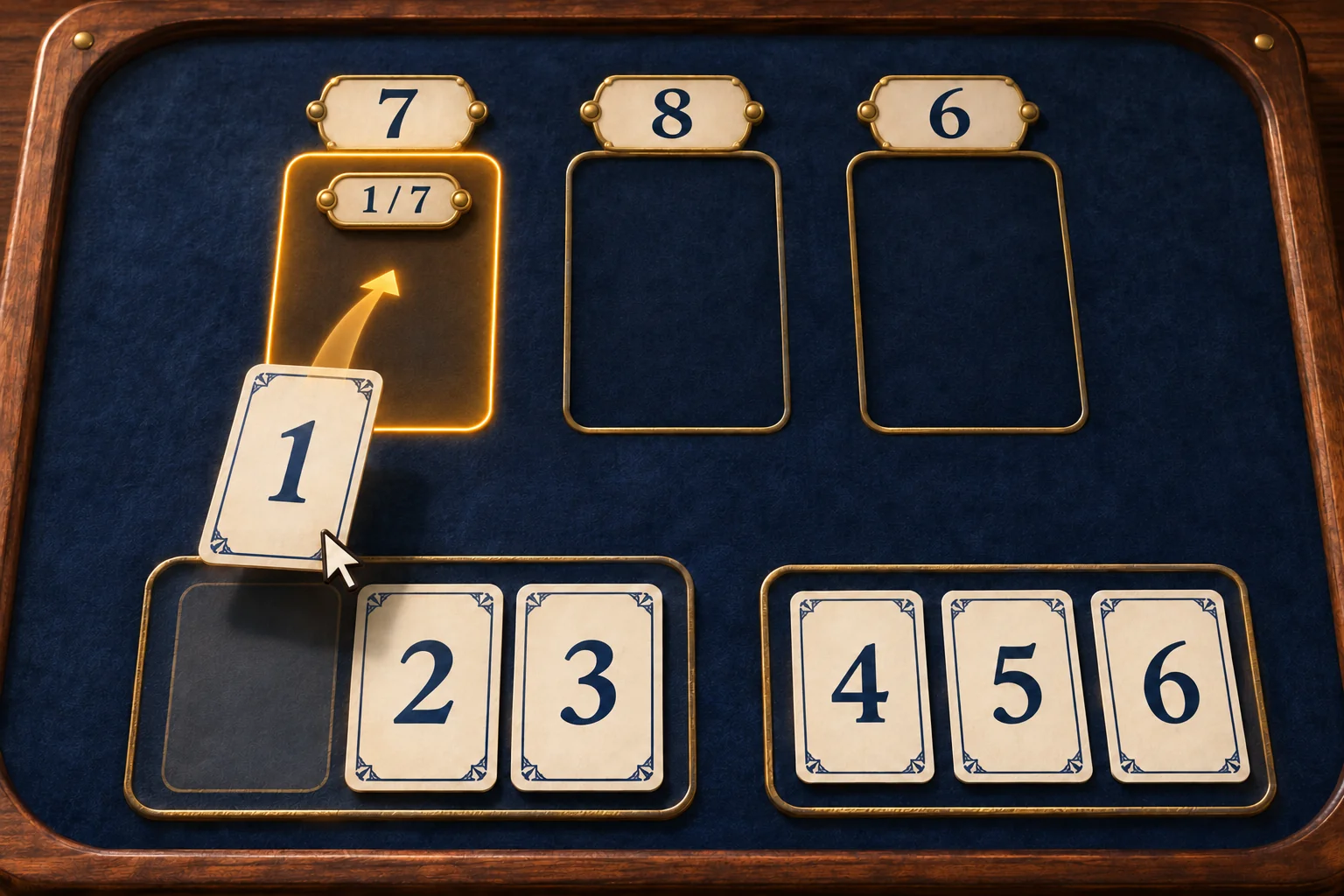
The main design benefit of a known deal is focus. A reader can ask whether the placement rule produces an interesting choice before introducing randomness, a shop, a run economy, or additional modes. Keeping those systems out also makes a later prototype easier to inspect: if the shown totals differ from the hand calculation, the cause is in the placement or feedback logic rather than an unrelated subsystem.
Write placement and failure rules before adding content
State the turn order precisely. On a turn, the player selects one card in hand and one lane with fewer than two cards. The card is placed and cannot be reused; its rank is added to that lane, and the interface shows the current total beside the target. A total above target fails immediately. When a second card fills a lane, its sum must equal the target or the deal fails. An exact pair locks the lane. If play continues, draw the next visible card to bring the hand back to three, stopping when the draw row is empty.
| Moment | Rule | Visible response |
|---|---|---|
| Before placement | Choose one held card and a lane with space. | Show legal lanes; do not imply that a hover is already a move. |
| After placement | Use the card once and add its rank. | Show the new total against the lane target. |
| At or above a limit | Overshoot fails; a full two-card lane must match exactly. | Explain the failed constraint and offer a deterministic restart. |
| Exact pair | Lock a lane at its target. | Use a restrained locked state without hiding the sum. |
| End of deal | With hand and draw row empty, win only if all three lanes are locked. | Show a clear solved or failed state; restart restores the same deal. |
This order resolves two common edge cases. First, a lane with one card is not complete even if its total happens to equal the target; it still needs a second card. Second, a player cannot leave an unfilled lane and claim victory just because the other sums happen to match. The terminal check uses the whole board: all six cards placed once, two cards in each lane, and three exact locked sums. A restart restores the same targets, hand, and draw order.
For a future prototype, treat this as an unrun design prompt rather than a report of something already built:
Make a small solo card-layout puzzle using this fixed design brief. Use six rank-only cards numbered 1–6, three lanes A/B/C with targets 7/8/6, an opening hand 1/2/3, and visible draw order 4/5/6. The player places one held card per turn into a lane with fewer than two cards. Show current/target totals after each move. Overshoot or a wrong two-card total fails; exact pairs lock. Refill the hand to three from the visible draw row. Win only when all cards are used once and all three lanes are locked at exact totals. Restart restores the same deal. Do not add suits, shuffle, wild cards, shop, upgrades, timer, or hidden scoring. Provide a clear failure explanation and show the final sums. Then inspect whether the implementation follows every stated rule.This prompt has not been submitted to a generator. It is a compact handoff format for a possible implementation, not evidence that a playable result exists. The same distinction applies to the images in this package: they are concept illustrations of manually specified states.
Follow the first three card placements
Now follow one legal opening sequence in version one. Play 1 into A; A reads 1/7, and the visible draw refills the hand with 4. Play 2 into C; C reads 2/6 and card 5 joins the hand. Play 3 into B; B reads 3/8 and card 6 completes the hand. None of the lanes is locked yet. The board has used 1, 2, and 3; the remaining cards are 4, 5, and 6.
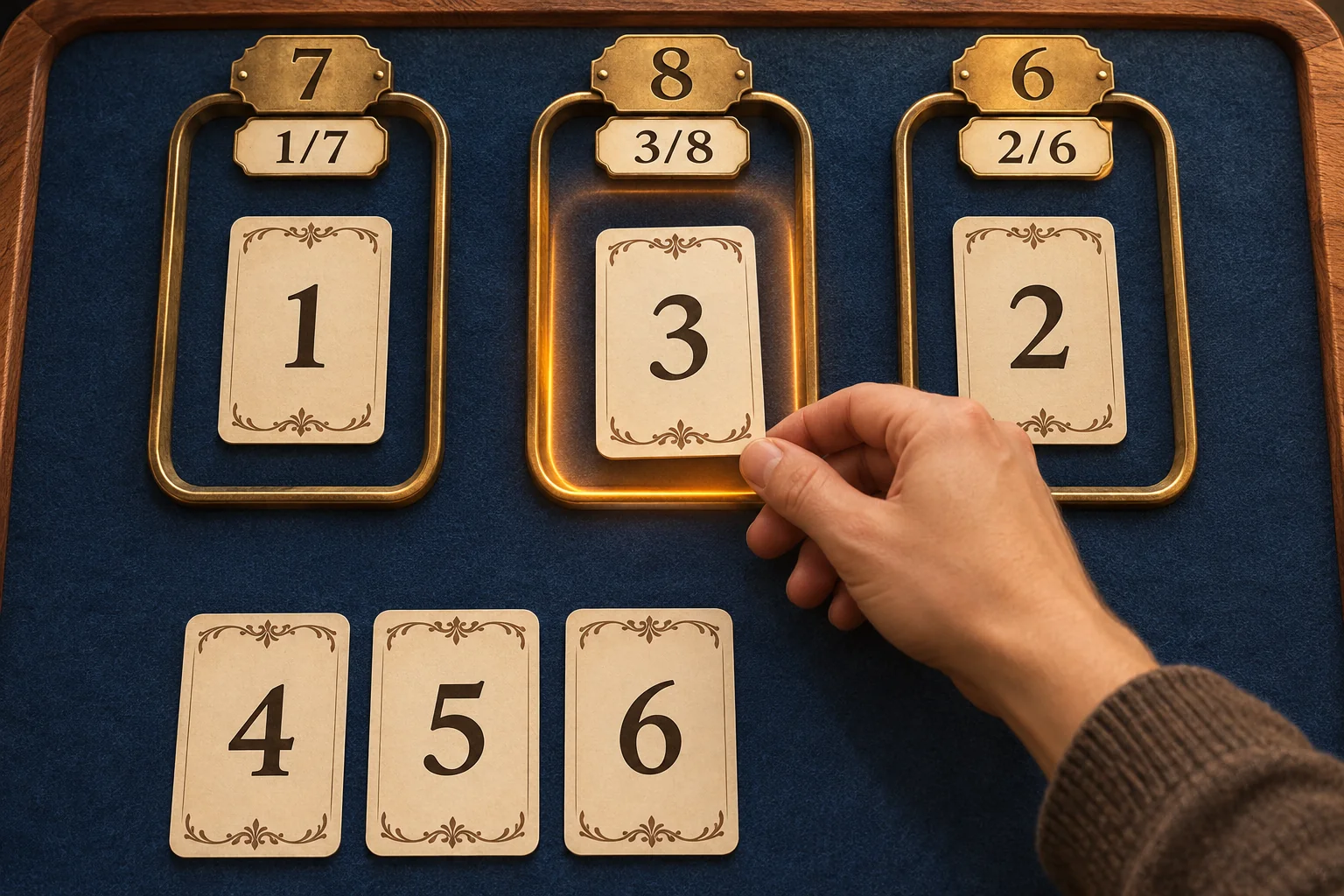
This opening puts a small planning question on the table. The first card does not determine the final pair by itself, but each lane can hold only two cards, so the player must preserve compatible partners. Here the remaining 6 can finish A, 5 can finish B, and 4 can finish C. A useful interface should show the current number and target after each accepted move, rather than making the player remember a hidden sum.
The state is deliberately static and reproducible. A human can recalculate each total from the visible cards. There is no claim that people have tried the example or that it has a particular difficulty. The only result established so far is that the written sequence obeys the authored placement rules.
Finish the deal and check every sum
Use the remaining cards in the order 6 to A, 5 to B, and 4 to C. A becomes 1+6=7 and locks. B becomes 3+5=8 and locks. C becomes 2+4=6 and locks. The hand and draw row are empty, every card has been used once, and each lane contains exactly two cards. Those visible conditions satisfy the win rule.
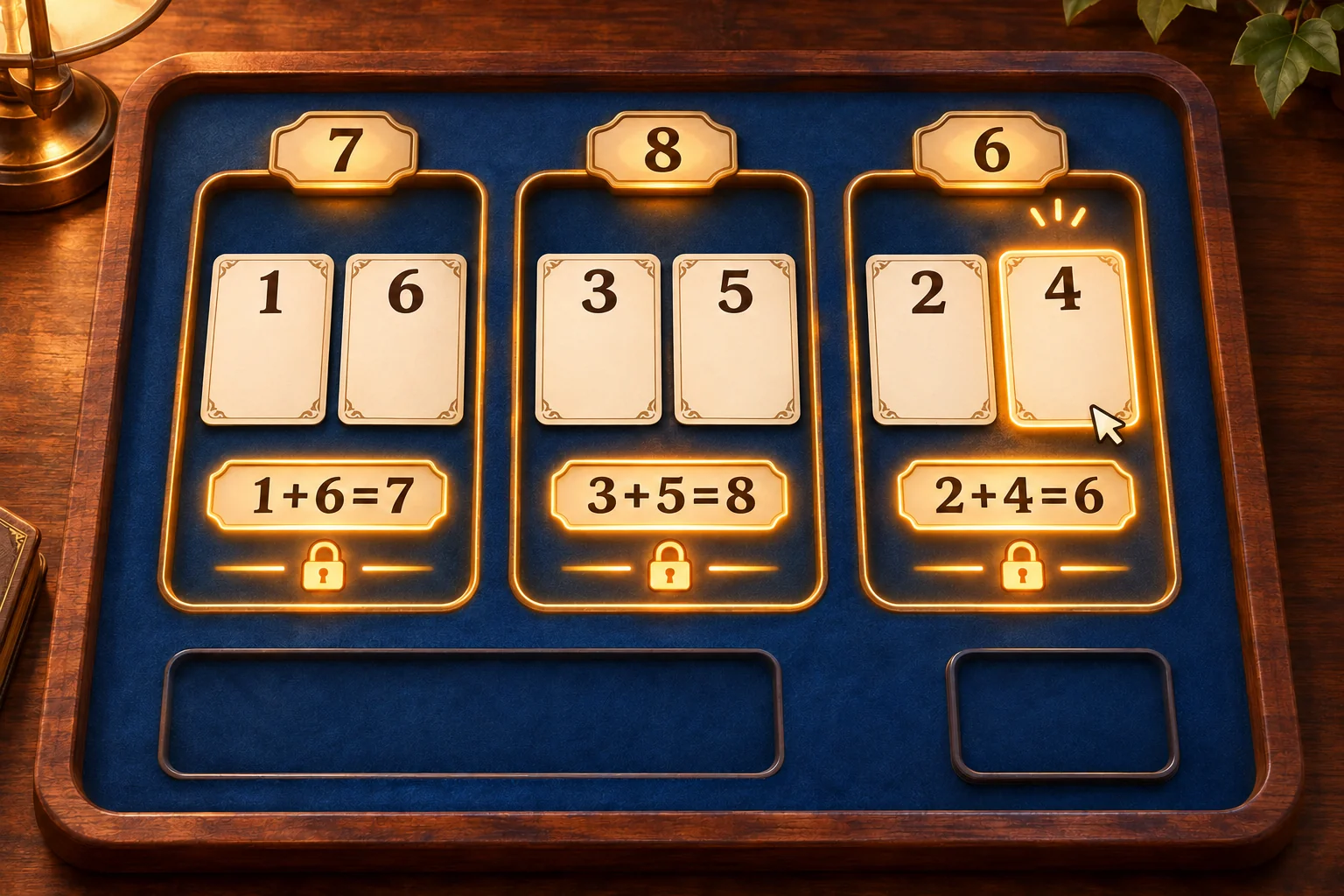
Do not substitute a celebratory animation for the proof of success. Keep the three target values and their completed pairs visible, then show the locked state and empty deal area. If any lane is wrong, explain which constraint failed and let the player restart the exact same sequence. Deterministic recovery makes a short puzzle easier to diagnose and makes acceptance checks repeatable.
Compare one target-profile iteration on paper
A paper iteration can test whether a rules change preserves solvability while making lane choice more specific. Version zero uses A=7, B=7, C=7; version one changes only the profile to A=7, B=8, C=6. Both target profiles total 21, matching the six ranks. The following comparison is arithmetic and exhaustive hand enumeration, not observed play or a measured difficulty result.
| Profile | Valid unordered pairs | Labeled lane assignments | What the comparison shows |
|---|---|---|---|
| v0: 7 / 7 / 7 | {1,6}, {2,5}, {3,4} | 6 ways to assign those distinct pairs to A/B/C | The same three pairs can occupy any of the three labeled lanes. |
| v1: 7 / 8 / 6 | Two complete pairings satisfy the targets. | 2 ways: A{1,6}, B{3,5}, C{2,4}; or A{3,4}, B{2,6}, C{1,5} | Unequal targets narrow which pair belongs in each lane. |
For v0, each pair sums to 7, so the three distinct pairs can be assigned to three labeled lanes in 3! = 6 ways. For v1, enumerate pairs against each target. A=7 can take {1,6} or {3,4}; B=8 can take {2,6} or {3,5}; C=6 can take {1,5} or {2,4}. The only disjoint combinations that use all six ranks are the two listed in the table. This count concerns pair-to-lane assignments only; it does not count permutations of the turn order.
The design hypothesis is modest: a non-uniform target profile may make the lane choice more specific while leaving two valid layouts. That is a reason to consider the change, not proof that it is more fun, fair, or difficult. A later playable build would need rule-by-rule inspection and actual player testing before making those claims.
Turn the paper model into a build brief
If you choose to hand the design to a creation workflow, state the fixed deal, action order, lane capacity, failure checks, feedback, and terminal test in plain language. Ask for a playable result, then check its actual behavior against the listed acceptance cases: no card can be reused; a lane rejects a third card; an overshoot fails; an incorrect full pair fails; an exact pair locks; the hand refills in visible order; the final state requires all three lanes; and restart returns to the same deal. Do not treat a written response or generated concept image as proof that those cases work.
The current AI puzzle game maker page advises stating the puzzle rule, visible clue, and solving action, then letting players observe pieces, test a move, and understand why a solution works. It also recommends learnable rules, fair difficulty steps, informative invalid moves, and checking solvability. The page says to review generation cost before starting. This general guidance does not verify Three-Lane Deal, its exact card mechanic, or a generated build.
The candidate article route for this local package is provisional. Its URL and any derived tracking parameter must be confirmed against the accepted Blog route before publication. This preview is local-only and does not claim that the candidate page is live.
Start small and check the next step
For a first pass, keep the deal fixed, make each lane’s capacity visible, and show a current/target total after every placement. Hand-resolve the solution before expanding the concept; then list the acceptance cases a future build should pass. If a later version adds randomness, scoring, or a run structure, change one rule at a time and recalculate the affected states. The small example gives a concrete base for that next design conversation without pretending the work has already been implemented.
Solo card puzzle FAQ
What is the core loop in Three-Lane Deal?
Choose one card in hand, place it in a lane with space, and check the new total against that lane’s target. Refill from the fixed visible draw row, then continue until the cards are gone. A wrong full pair or overshoot fails; exact pairs lock. The fictional example wins only when all three lanes are exact.
Why use a fixed draw order?
A fixed order makes the paper example repeatable. It lets a reader check the same opening hand, refill timing, and final cards without a random draw changing the puzzle. That does not prove the design is fun or balanced. It only makes the stated route and arithmetic easier to inspect before a later implementation adds any randomness.
How does version one differ from version zero?
Version zero assigns target 7 to all three lanes. Version one changes the targets to 7, 8, and 6 while keeping the same six-card deal. Both target sums equal the rank total of 21. Hand enumeration gives six labeled pair assignments for v0 and two for v1; these are design calculations, not measured difficulty scores.
Has this puzzle been built or playtested?
No. Three-Lane Deal is an original fictional teaching example. The traces and pair counts are manually resolved from the written rules. The prompt is an unrun template, and the images are concept illustrations. No game build, generated playable result, playtest, player preference, or measured outcome is claimed.
What can the product link verify?
The official page recommends stating the rule, visible clue, and solving action, using learnable steps, and checking fairness, invalid moves, and solvability. It does not verify this example or promise this mechanic will be generated. Any future result should be checked against the explicit acceptance cases.