A tableau-building card game becomes easier to understand when cards stay visible and their effects trigger at a clear moment. Start with a short row, a fixed hand, and one harvest rule before you build a large deck. Greenhouse Row is a fictional paper design: a player places Bean, Bee, and Lily cards into three garden plots, then checks how neighboring effects change the score. The example below shows the v0 layout at 7 points and a one-value revision that reaches a 9-point target. These are manual calculations, not a generated game or playtest. You will also get a starter build prompt and a checklist for checking a future result.
Choose a small tableau and a clear harvest goal
A first prototype does not need a full deck or a draw system. Greenhouse Row uses three adjacent plots—left, center, and right—and a starting hand of four unique cards: Bean, Bee, Lily, and Fern. The player takes exactly three turns, placing one unused card into one empty plot on each turn. Cards remain on the table until harvest, so their positions matter. One card is left unused.
The goal is to score at least 9 points when the third card is placed and the tableau is harvested. A short hand and a fixed target let you focus on the engine: which card stays where, which neighbors it affects, and when those effects count. There is no draw, shuffle, market, discard effect, reroll, or hidden objective. If a later build adds any of those systems, it will be harder to tell whether a scoring change came from card adjacency or from a new source of randomness.
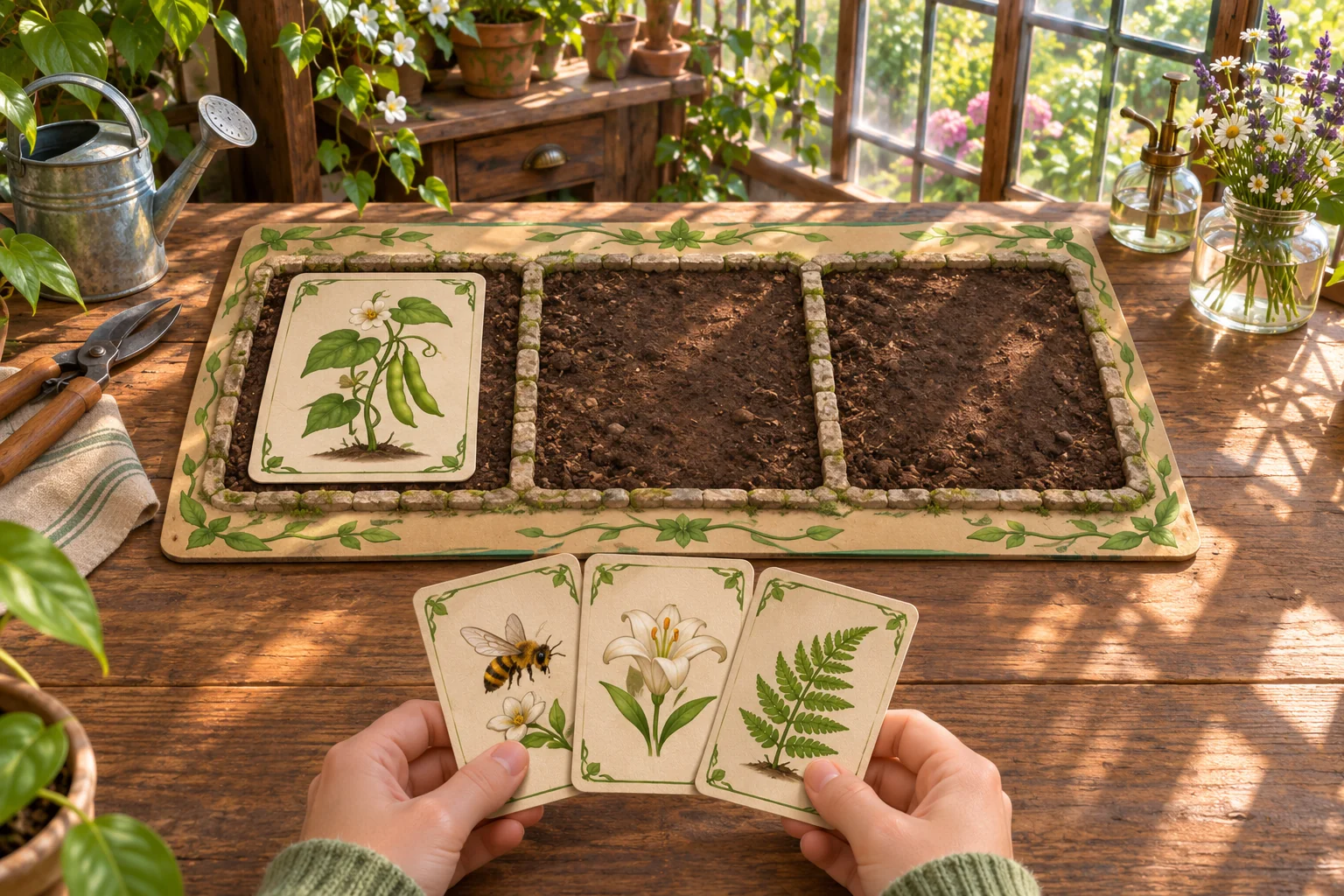
Use a clear state display in a future prototype: the cards in hand, the three plots, whose turn it is, and whether harvest has resolved. The first decision is simply where to place Bean. The value of that choice becomes clearer after the neighboring cards are defined.
Write card effects and timing before building a deck
Give every card a base value and describe its effect with a direct relationship. In this example, “adjacent” means the immediately neighboring occupied plot in the three-card row. It never means a card two spaces away. Effects wait until the third placement, so a partially filled tableau does not score early.
| Card | Base value | Harvest effect |
|---|---|---|
| Bean | 3 | No additional effect. |
| Bee | 1 | In v0, add 1 to each adjacent non-Bee card. In v1, change this value to 2. |
| Lily | 1 | Add 2 to each immediately adjacent Bean. |
| Fern | 2 | No additional effect. |
Resolve harvest in a simple pass. First count each card’s base value. Then inspect every occupied neighbor pair and apply its listed effect once. The Bee affects each neighboring non-Bee card; Lily affects a neighboring Bean only. Effects do not chain, and a card never increases its own value. This means all bonuses are read from the finished layout rather than triggered again as a bonus changes another card.
State the target and failure result too: a total of 9 or more wins; a lower total misses the target. The rule can be checked from one row without guessing whether a card persists, whether an effect repeats, or whether the turn order changes the score.
Place the Bee between two crops
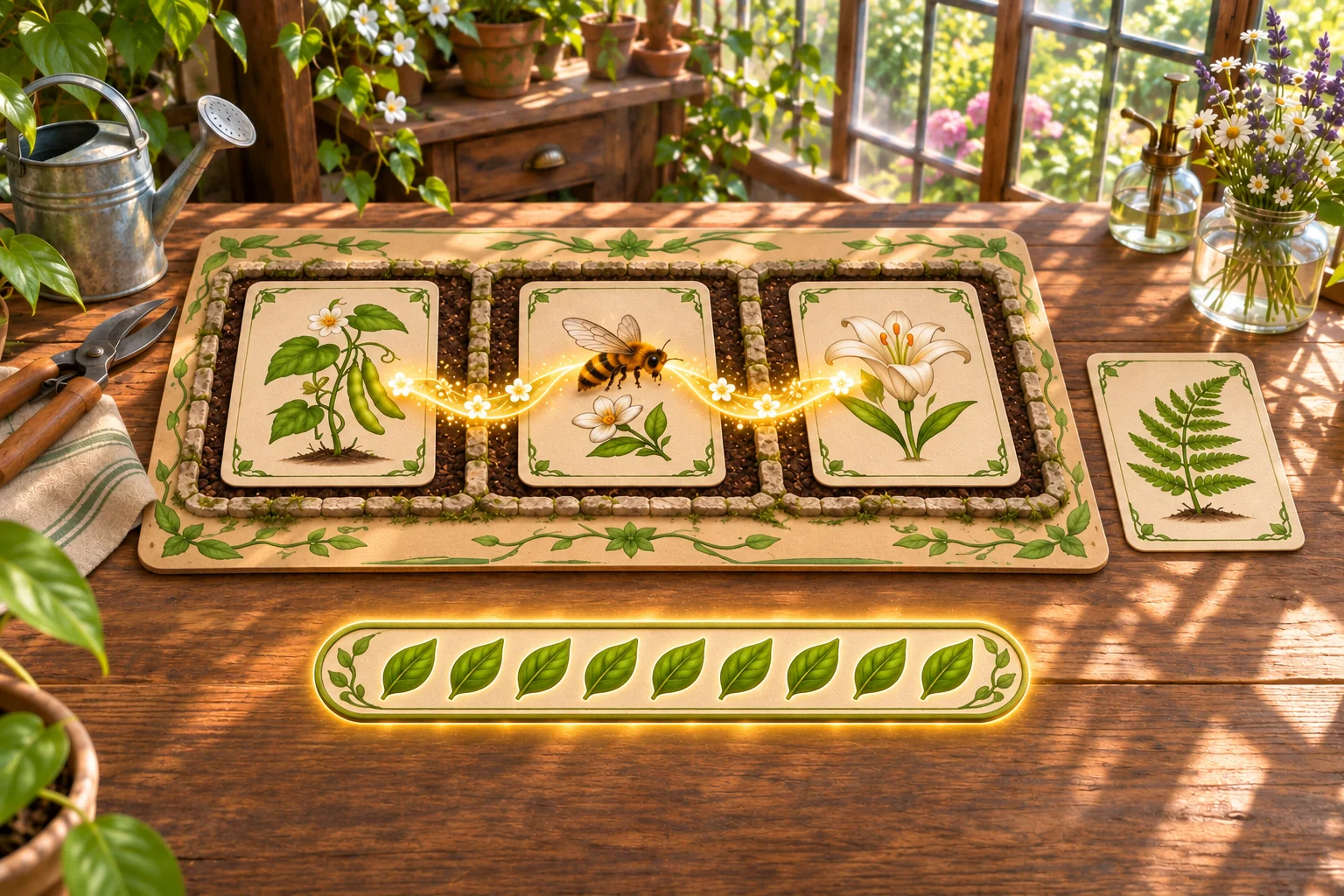
Use the layout Bean | Bee | Lily. The Bee sits between the crops, so it is adjacent to both. Lily does not reach across the Bee to Bean: adjacency is immediate, not a general connection across the row. In v0, begin with base values of 3, 1, and 1. The Bee adds 1 to Bean and 1 to Lily. The resulting card values are 4, 1, and 2, for a total of 7. The target is 9, so this version misses by 2.
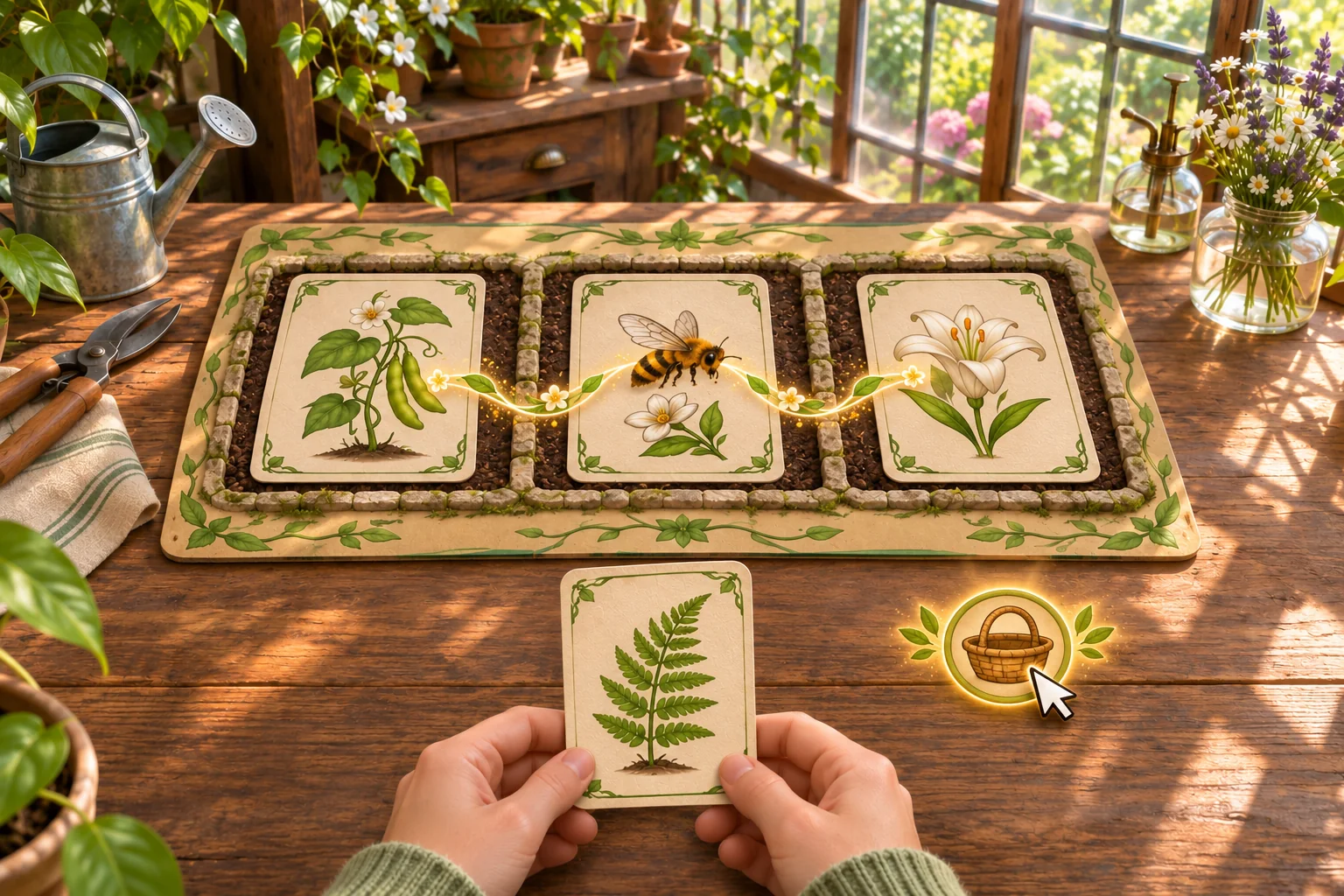
The mechanism image shows the completed v0 row before harvest. A future interface could preview the 7-point result while the player considers the harvest action, but the rules still resolve the score only once, after the third placement. A visible preview is a proposed design choice for a future build, not a feature already demonstrated by Greenhouse Row.
This small row gives the reader a reusable way to explain spatial effects: name the exact neighbor, show when the effect runs, and check one card’s final value at a time. It also creates a fixed baseline for testing one design change.
Change one effect value and recalculate
Make one change only: Bee’s adjacency bonus moves from +1 to +2. Keep the hand, row, card values, placement sequence, harvest timing, and target unchanged. In v1, Bean becomes 5, Bee stays 1, and Lily becomes 3, for a total of 9. The same layout now reaches the target. The alternative row Bean | Lily | Fern scores 8 in both versions: Bean receives Lily’s +2, while no Bee is present to change.
| Layout | v0 card values | v0 total | v1 card values | v1 total | Target result |
|---|---|---|---|---|---|
| Bean | Bee | Lily | 4 / 1 / 2 | 7 | 5 / 1 / 3 | 9 | v0 misses; v1 reaches 9. |
| Bean | Lily | Fern | 5 / 1 / 2 | 8 | 5 / 1 / 2 | 8 | Misses in both versions. |
This is a hand-calculated design comparison, not evidence that players prefer v1 or that its target is balanced. Its value is methodological: preserve the same layout and objective, change a single number, and recompute each affected card. If a later playtest shows a different result, compare the observed board and score with the rule sheet before changing more values.
Turn the card contract into a focused build request
A useful first prompt names the table state, legal action, timing rule, output, and checks. The template below is unexecuted. It describes a small prototype for future review; it is not a report of a generated or playable result.
Build a small, playable tableau card game from this fictional rules brief.
Show one greenhouse table with three adjacent plots: left, center, and right. Start with exactly four unique cards: Bean (base 3, no effect), Bee (base 1), Lily (base 1), and Fern (base 2). The player takes exactly three turns, placing one unused card in one empty plot per turn. Played cards stay in their plots until harvest; one card remains unused. Do not add a draw, shuffle, market, discard, reroll, currency, or extra objective.
At harvest, count each card's base value, then apply each listed neighbor effect exactly once from the complete row. Adjacent means immediately next to a card in this row. Lily adds 2 to each immediately adjacent Bean. Bee adds 1 to each adjacent non-Bee card in version 0. Effects do not chain, and cards do not buff their own values. Win at a total of 9 or higher; otherwise show that the target was missed.
Make the row, hand, current turn, harvest state, and score easy to inspect. Use simple plant icons and clear plot placement feedback. Include a restart that restores the same four-card hand and empty three-plot row.
Acceptance checks: place Bean | Bee | Lily and verify v0 card values 4 / 1 / 2 and total 7; place Bean | Lily | Fern and verify 5 / 1 / 2 and total 8; confirm no card is reused and Lily cannot affect a Bean two plots away; confirm restart restores the opening state. Do not imply these checks have already been run.
The prompt holds the game’s design contract steady. A creator can inspect whether the three plots are visible, whether each card stays after placement, and whether harvest applies the local effects only once. Keep art polish and more cards out of the first request until those states can be read.
Review one future result before expanding the deck
After a future build, compare its state with the expected row and find the earliest mismatch. If Bean | Bee | Lily shows 8 in v0, check whether the Bee bonus reached both immediate neighbors and whether the center Bee was counted as a card. If v1 shows 7, check whether the +2 effect was applied to both adjacent non-Bee cards. If Bean | Lily | Fern shows 10, check whether Lily’s +2 was incorrectly applied to both neighbors rather than only the Bean.
These are conditional debugging examples, not observations from a real build. Record the layout, each card’s base and final value, and the first rule that differs. Change that one rule or display, then repeat the same layout before adding new cards. This keeps a later correction tied to a specific state instead of making the whole deck harder to reason about.
Hand the design to a general game workflow
The current Free AI Game Maker page describes plain-English input, a playable first version in 2D or 3D, browser testing, and refinement through follow-up prompts. Those general capabilities do not establish Greenhouse Row as a preset or guarantee that an exact card-effect rule will be implemented correctly.
Use the card contract as an idea brief, inspect the returned result, and replay the two layouts against the score table. Treat differences as something to check in the build rather than assuming the output matches the plan. Before submitting, review the selected model, available Koin balance, and displayed generation cost in Workspace. Free AI game maker is the approved general creation entry. This article’s candidate path and attribution slug remain provisional until the Blog route is accepted.
Greenhouse Row is a fictional teaching design. The manual v0/v1 totals explain its written rules only; no prompt was run, no playable build was reviewed, and no player preference or balance result is claimed.
Frequently asked questions
Do played cards stay in the tableau?
Yes. In Greenhouse Row, each card remains in its plot after placement and stays there until the third turn is complete and harvest resolves. That persistence is what makes Bee and Lily depend on neighboring positions. The example has no draw or discard rule, so the four-card hand is fixed.
Can card effects trigger more than once?
No. The rules calculate each base value, then apply each listed adjacency effect exactly once after the third placement. Bonuses do not chain and a card never increases its own value. This keeps the score tied to the final row rather than to an order of repeated triggers.
Does the v1 score prove that the stronger Bee is more fun?
No. The v1 example changes Bee’s bonus from +1 to +2 and recalculates the same row from 7 points to 9. That shows only what the authored rules produce on paper. Whether players prefer the stronger effect, or whether the target feels fair, would require a playable version and actual testing.
Has Greenhouse Row been generated or tested?
No. Greenhouse Row is an original fictional design used to show a repeatable card-scoring method. The sample totals are hand calculations, and the build prompt is an unexecuted template. No generated prototype, game session, customer example, online case, or measured player result is claimed.