Make a small region feel open through choice
An open-zone RPG needs a reason to choose a route and a reason to return, not a huge map. Start with one hub, two short clue paths, a shared gate, one objective, and a shortcut home. Then define what each clue changes and when the next part of the quest becomes visible.
This guide uses Mosswind Reach, an original fictional region designed for planning. Its two routes, gate conditions, and quest flags are hand-checked as a paper simulation; no prompt was run and no playable game was tested. The example gives you a compact specification to adapt, plus visible checks for a future prototype.
The key is to make geography and state agree. A player can choose either branch, but each path must set a flag the shared gate understands. Recovering the Survey Bell opens a return shortcut; reporting it at the hub reveals the next region. These transitions make a short route loop feel connected.
Bound the first open zone
Begin with five places and a small number of connections. The hub is the starting point and return destination. Each branch contains one clue. Both branches meet at the same gate and lead to the same objective, so route choice has a consequence without doubling the content.
| Place | Purpose | What changes |
|---|---|---|
| H — Reedwater Market | Quest start and return hub | Reporting the Bell reveals the next region. |
| N — Reed Watch | North clue branch | Collect the Wind Sigil. |
| W — Glass Orchard | West clue branch | Collect the Silt Sigil. |
| G — Old Ridge Gate | Shared route join | Open if either Sigil is held. |
| C — Bell Cairn | Quest objective | Recover the Survey Bell and unlock C–H. |
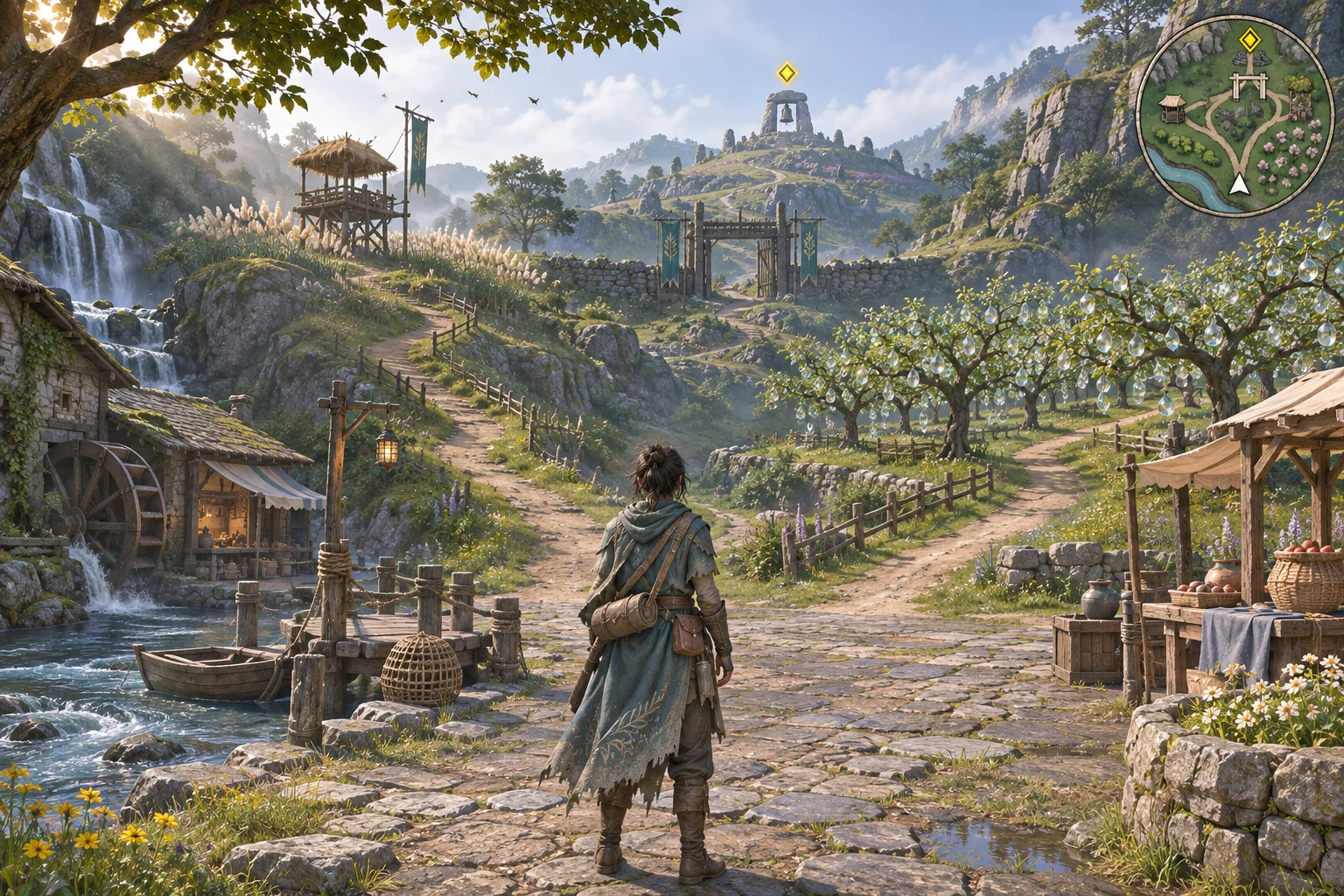
The connection list is easier to verify than a vague promise of exploration: H–N, H–W, N–G, W–G, and G–C are available from the start. C–H is locked until the Bell is recovered. This is a bounded loop, not a claim that the fictional region is a generated map or existing game.
Give each branch a small identity—different terrain, a distinct landmark, and one clue—while keeping its contribution to the main objective comparable. The player should understand that either path is valid before committing. Keep distance, encounters, and reward pacing as later design questions; this first slice is about readable topology and state.
Write the zone-state contract
A route graph says where the player can go; state rules say why an edge opens. List every flag, its starting value, and the event that changes it. For Mosswind Reach, a fresh run starts with all five flags false:
windSigilbecomes true when the player collects the clue at N.siltSigilbecomes true when the player collects the clue at W.surveyBellbecomes true when the player recovers the Bell at C.shortcutOpenbecomes true when the Bell is recovered, enabling C–H.nextRegionRevealedbecomes true only after the player returns to H and reports the Bell.
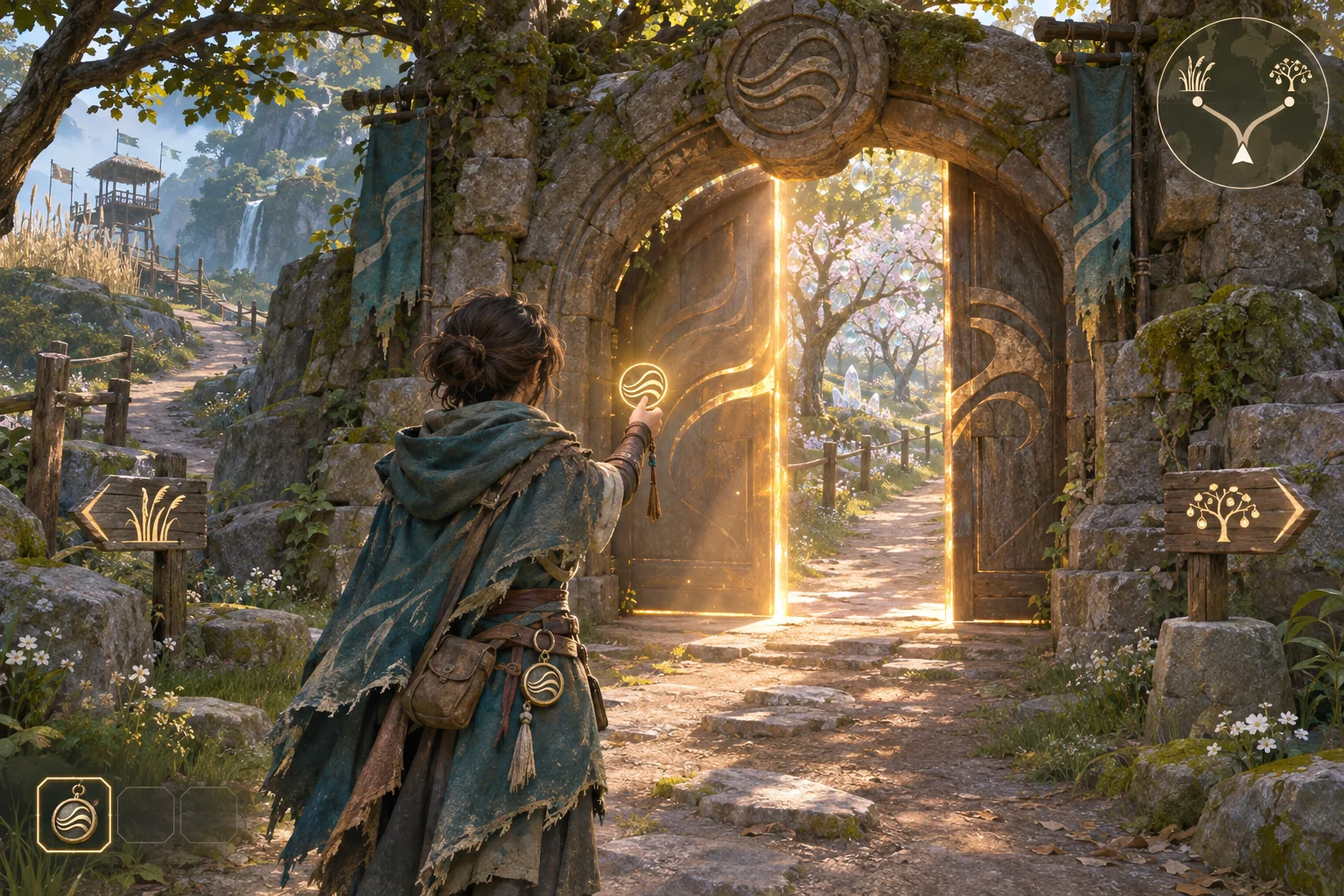
The Old Ridge Gate checks windSigil OR siltSigil. It reads a held clue but does not consume it. Keeping the predicate separate from the clue flags prevents a common ambiguity: does opening the gate spend the item, or merely require that the player has it?
| Event | Required state | Expected transition | Visible feedback |
|---|---|---|---|
| Approach G | Either Sigil is true | Allow passage; keep the clue flag true. | Gate bars lift and the path lights. |
| Approach G without a clue | Both Sigils are false | Keep the gate closed. | Show the blocked route and point back toward both branches. |
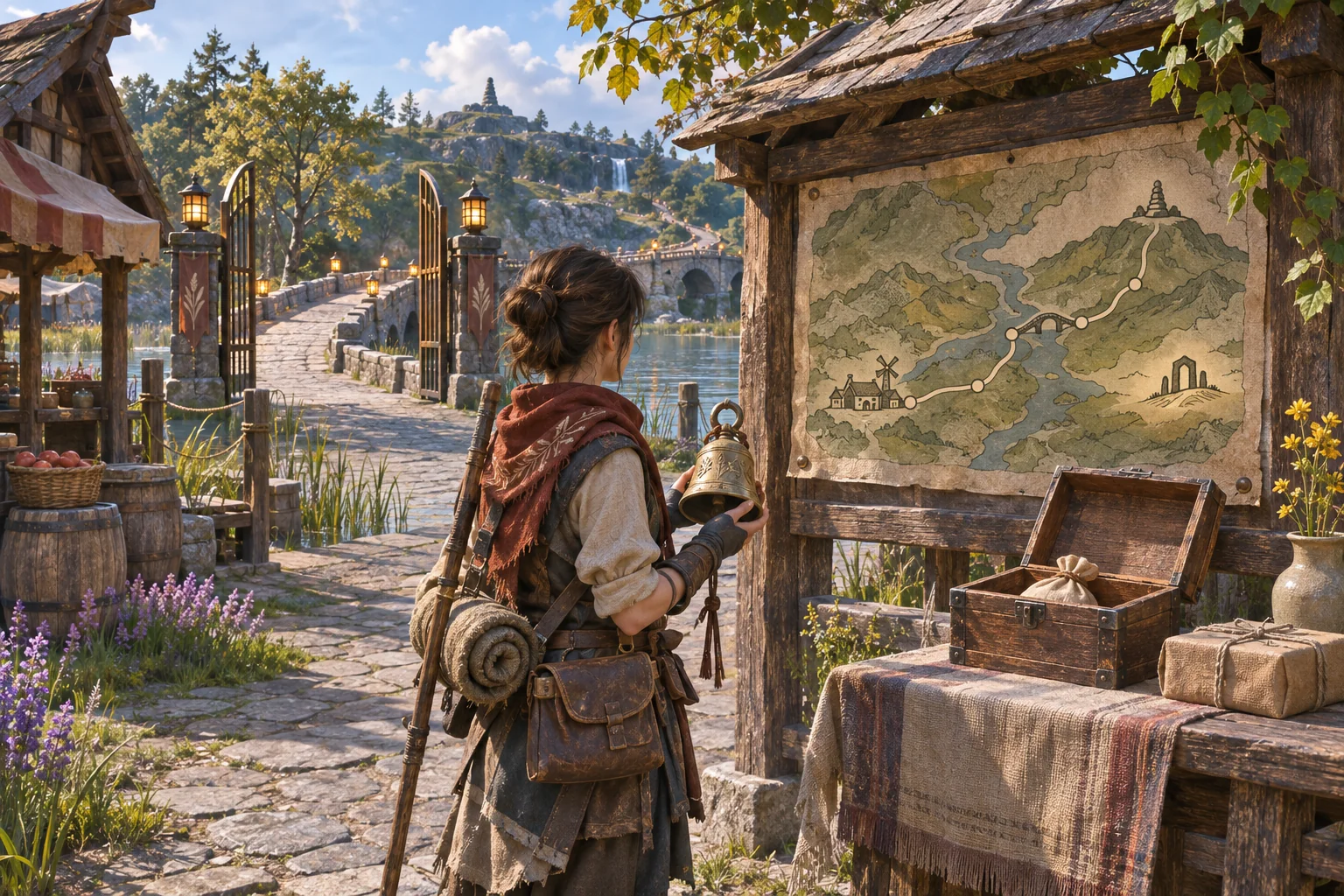
| Recover Bell at C | Player reaches C through G | Set surveyBell and shortcutOpen true. | Bell appears in the quest state; C–H opens. |
| Report at H | surveyBell is true | Set nextRegionRevealed true. | Hub map reveals a new landmark. |
This separates possession, route access, and quest completion into observable changes. It also prevents a timing mistake: the next region is not revealed at the Cairn or simply when the Bell is picked up; the player must return and report at the hub.
Prompt 1: define the region and its state
Plan one compact open-zone adventure RPG slice called Mosswind Reach. Use Reedwater Market (H) as the hub, Reed Watch (N) and Glass Orchard (W) as optional clue branches, Old Ridge Gate (G) as their shared join, and Bell Cairn (C) as the objective. Initial paths are H–N, H–W, N–G, W–G, and G–C. The C–H shortcut starts locked. A fresh run starts with windSigil=false, siltSigil=false, surveyBell=false, shortcutOpen=false, and nextRegionRevealed=false. Collecting the clue at N sets windSigil=true; collecting it at W sets siltSigil=true. G opens when windSigil OR siltSigil is true; opening the gate does not consume either clue. Recovering the Survey Bell at C sets surveyBell=true and opens C–H. Only reporting the Bell at H sets nextRegionRevealed=true. Return a map, the route graph, each flag's trigger, blocked and open feedback, and any unresolved assumptions. Keep both routes short and avoid adding party recruitment, crafting, or extra quest branches.Review the answer by tracing both branches from the same clean state. A map without the state transition is incomplete; a flag table without the map may hide a dead end. Keep one source of truth for each edge and event so the prompt, diagram, and acceptance checks cannot drift apart.
Prompt a playable exploration slice
Once the route contract is stable, scope the interaction around movement, clues, the gate, and the return. Ask for a legible map or route display, a clear objective cue, and feedback when a condition changes. Include a reset so the same branch can be checked again from the same starting state.
Prompt 2: make one route loop inspectable
Using the Mosswind Reach state contract, build only one playable exploration slice. Let the player move between H, N, W, G, and C along the listed paths. At N or W, collect the matching Sigil once and show its held state. At G, test the OR predicate: either Sigil opens the gate, neither leaves it closed, and the held Sigil is never removed. At C, collect the Survey Bell, open the C–H shortcut, and preserve the Bell state on return. At H, provide a report action; reveal the next region only after that report. Show the current location, reachable paths, objective, and state changes with clear visual feedback. Include a restart that resets all five flags and relocks C–H. Do not add unlisted connections, hidden requirements, random quest states, combat, or party systems. Return the control mapping, a state view, and one acceptance trace for each branch.A good first slice should let a reviewer answer four questions at a glance: where am I, which way can I go, why is the gate open, and what remains before the quest advances? If any answer requires guessing, ask for clearer state feedback before enlarging the zone. The prompt is a plan for future work, not a record of a generated result.
Hand-check the return loop
Walk the graph with each flag initialized to false. First take H–N, collect the Wind Sigil, pass G, recover the Bell, use C–H, and report at H. Reset all five flags, then repeat via H–W with the Silt Sigil. Both manual traces should reach the same payoff through different first choices.
| Fresh route | Gate check | After C | After return and report |
|---|---|---|---|
| H → N; collect Wind Sigil | true OR false opens G | Bell held; C–H open | Next region revealed at H |
| H → W; collect Silt Sigil | false OR true opens G | Bell held; C–H open | Next region revealed at H |
Now compare a wind-only first draft with the intended either-clue rule. Under v0, the north route reaches C, but the west route stops at G. Under v1, G checks windSigil OR siltSigil; a fresh west run succeeds without changing the north result. This is a hand-resolved design comparison, not an experiment on a generated game.
Keep each route run independent: reset all flags before comparing it. Otherwise, a Sigil from an earlier run can make a broken gate appear correct. The manual trace checks only the written predicate and quest order; it cannot tell you whether a player notices the clue, understands the gate, enjoys the travel time, or finds the reward satisfying.
Review one simulated iteration
A useful revision changes one rule and preserves the rest. The paper review identifies a concrete route failure in v0, then changes only the gate predicate. Treat the comparison as a debugging method for your own future build rather than proof of improved play.
| Rule version | North run from a fresh start | West run from a fresh start | Change |
|---|---|---|---|
| v0: Wind-only gate | Passes G and reaches the Bell. | Blocked at G with only Silt held. | Predicate tests windSigil. |
| v1: Either clue | Passes G and reaches the Bell. | Passes G and reaches the Bell. | Predicate tests windSigil OR siltSigil. |
The v1 design preserves route choice because either branch satisfies the shared condition. The Sigil remains held after the gate opens; the objective, shortcut, and report timing stay unchanged. A later actual prototype review should capture its build version, exact route, observed state, and any player confusion. Until then, distance, visual readability, pacing, and player preference remain unverified.
When revising a result, compare the same inputs from a clean start and ask for before-and-after states. If another route, quest trigger, or map connection changed too, isolate the predicate change before drawing a conclusion.
Check the route boundaries before expanding
Before adding another region, ask whether the small loop behaves as intended at its boundaries. These are proposed acceptance checks for a later build, not tests already run.
| Starting condition | Action | Expected state and feedback |
|---|---|---|
| No Sigils held | Approach G | Gate stays closed; both clue paths remain discoverable. |
| Only Wind Sigil held | Approach G | Gate opens; Wind remains held. |
| Only Silt Sigil held | Approach G | Gate opens; Silt remains held. |
| Both Sigils held | Approach G | Gate opens once; neither clue is consumed. |
| Bell not recovered | Try C–H | Shortcut remains locked. |
| Bell recovered, not reported | Return to H | Bell is retained; next region is still hidden until report. |
| Any partial route | Restart | All flags reset; C–H relocks; the map returns to its initial state. |
For each check, record the initial flags, route taken, action, expected response, observed response, and reset result. Keep that record separate from a fictional walkthrough or concept image. If travel distance or level pacing becomes important, add a real run and player observation rather than inferring enjoyment from the graph.
Carry the brief into an RPG creation workflow
The official AI RPG Maker page recommends beginning with a character goal, a short quest route, a visible clue or objective, and a choice that changes what happens next. It also discusses checking continuity between the cast, clues, and payoff. Mosswind Reach turns those general planning ideas into a small route brief; the product page does not verify this region, its gate predicate, or a playable result.
Take your own map, route condition, objective, and expected state changes into a creation workflow, then inspect what comes back. Check whether the north and west choices stay distinct, the held clue opens the shared gate, and the Bell report occurs at the hub. Review any generated route directly; a prompt description alone cannot confirm movement, persistence, or pacing.
Make the return part of the quest
Limit the first region to a few connected places, give both branches a clear state change, and let the objective alter how the player returns. Hand-check each path from a fresh start, then list what a real prototype must show before you expand the map.
When you are ready to develop your own quest route, continue with the AI RPG maker. Bring the route, objective, and state conditions, then review the resulting design against them.
Open-zone RPG prompt questions
How large should the first open-zone RPG area be?
Use only enough locations to support a choice, a shared progression point, an objective, and a return. Mosswind Reach uses one hub, two clue branches, one gate, and one destination. That is an example scope, not a universal map-size rule.
How can two routes reach the same objective?
Give each branch a distinct clue or state change, then let a shared condition accept either result. State the predicate explicitly and show the player why the gate is open. Preserve both paths in the map even after one is chosen.
Should a key clue disappear when it opens a gate?
That is a design choice. Mosswind Reach keeps the Sigil and uses it as a flag, so the gate checks whether either clue is held without consuming it. If your design spends an item, say when and show the changed inventory state.
When should the next region become visible?
Choose a specific event. In this example, recovering the Survey Bell opens the return shortcut, but the next region appears only after reporting the Bell at the hub. Keeping those events separate makes the quest state and payoff easier to inspect.
Was Mosswind Reach generated or playtested?
No. It is an original fictional design with hand-checked route traces; no game prompt, playable result, or real player test is claimed. The route checks are expectations to compare with a future build, not evidence about one. Concept art only visualizes the plan; empirical claims need a real, versioned build and a recorded route run.