Key Takeaways: Roblox AI Game Prompt Examples for Better Prototypes
- A useful Roblox AI game prompt defines one player-visible goal, a bounded mechanic or content scope, relevant project context, rules and state, constraints, requested output, edge cases, and observable success evidence. Use AI output as a planning draft, then implement and validate the final feature in Roblox Studio and Luau.
A useful Roblox AI game prompt is a compact design contract, not a request to “make a game.” State one player-visible goal, the relevant project context, the rules and state changes, constraints, failure cases, and the evidence that will count as success. Ask for a small planning artifact—such as a mechanic spec, level beat sheet, quest state table, NPC behavior outline, or test checklist—then rebuild and validate the final feature in Roblox Studio and Luau.
AI can help you explore design options and turn an idea into a reviewable prototype plan. It cannot see your full Roblox Studio DataModel unless you describe it, confirm that an engine API is current, decide whether a mechanic is fun, or publish a safe Roblox experience for you. Treat every output as a draft. The final implementation, networking, security, testing, and publishing remain your responsibility in Roblox Studio.
The seven parts of a useful Roblox game prompt
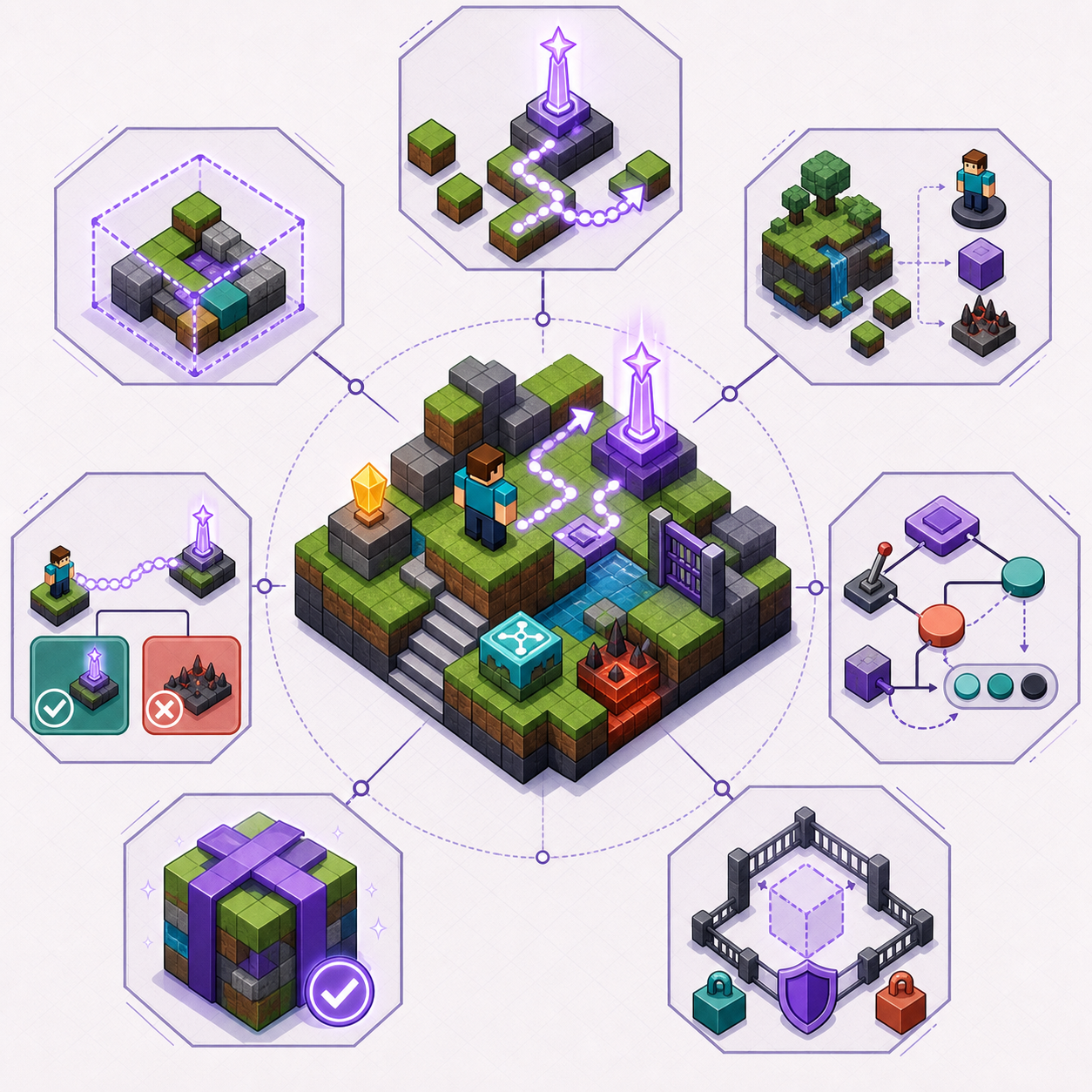
A good prompt answers seven questions before it asks the model to produce anything.
- Player goal: What should the player understand or accomplish?
- Prototype scope: Are you planning one mechanic, one room, one quest, or one NPC state loop?
- Context: What genre, camera, player count, age range, and existing systems matter?
- Rules and state: What can change, who owns the decision, and what ends the loop?
- Constraints: What must the design avoid because of time, platform, content, performance, or safety?
- Output format: Do you need a table, beat sheet, state diagram in prose, Luau pseudocode, or test checklist?
- Success evidence: What observable result would let you accept or reject the draft?
The last part is the most frequently omitted. “Design a fun collection mechanic” invites adjectives. “Design a 90-second collection loop that teaches movement, has one escalating obstacle, resets cleanly, and can be tested with three counters” invites a testable plan.
Do not hide uncertainty. If you have not chosen multiplayer authority, persistence, or monetization, say that those decisions are unresolved and ask the model to keep them out of scope. A useful draft makes assumptions visible instead of filling gaps with confident fiction.
Start with a design contract, not a giant build request
The fastest way to get a weak answer is to ask for an entire Roblox game in one prompt. The model must then invent audience, mechanics, map size, progression, assets, scripts, networking, data storage, and testing at once. Even polished output becomes difficult to verify.
A design contract narrows the job. For example: “Plan a two-minute cooperative pressure-plate room for two to four players. Players must communicate which colored plates to hold. The room has three rounds, no combat, and no permanent rewards. Return the rules, state transitions, edge cases, and five playtest observations. Do not write code.”
That request establishes a player goal, scope, player count, limits, and acceptance evidence. You can review the room before deciding how to represent plates, timers, and doors in Studio. If the interaction is not worth building, you have discarded a document rather than a large code generation.
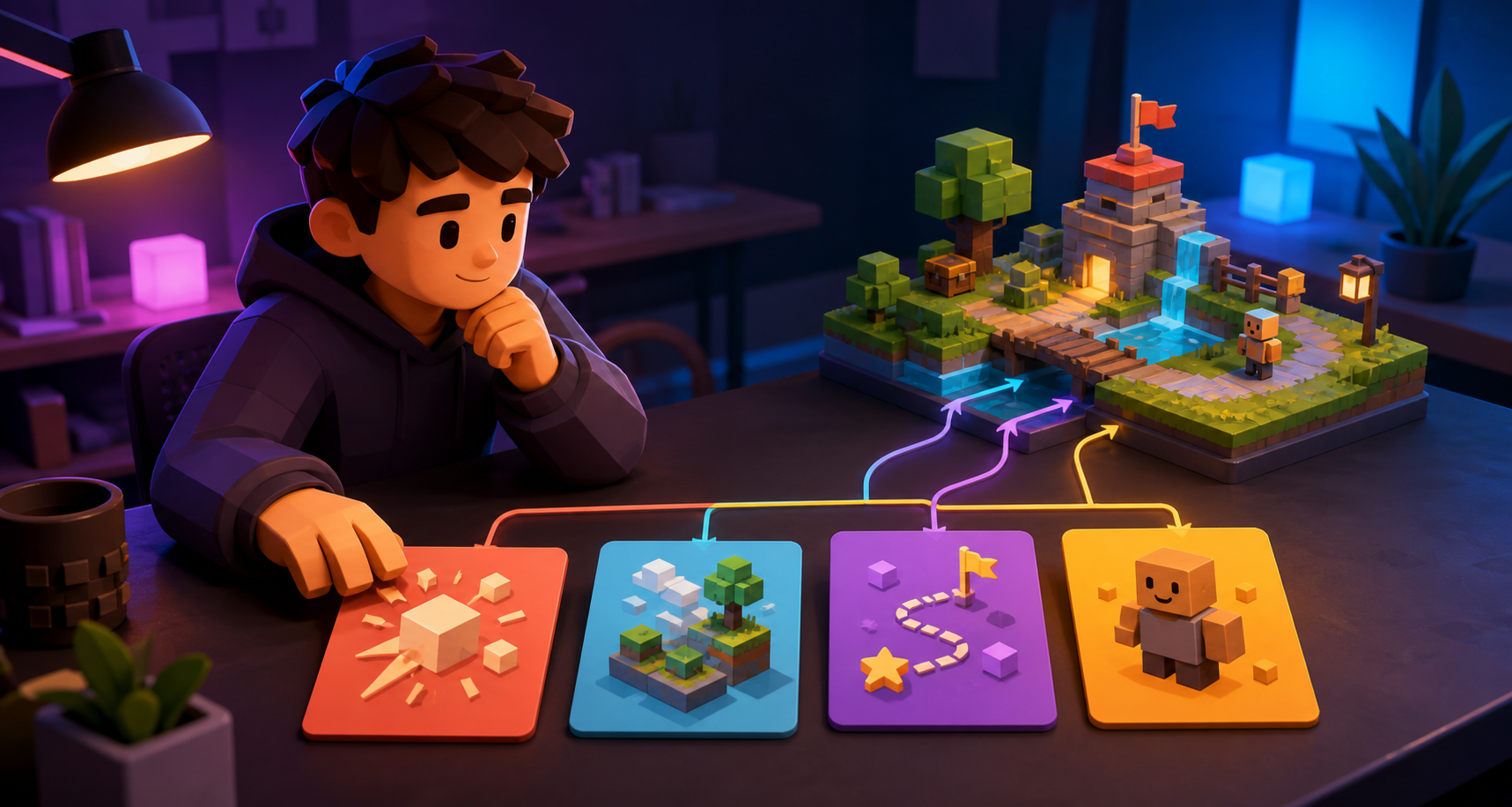
Prompt pattern 1: a mechanic prototype
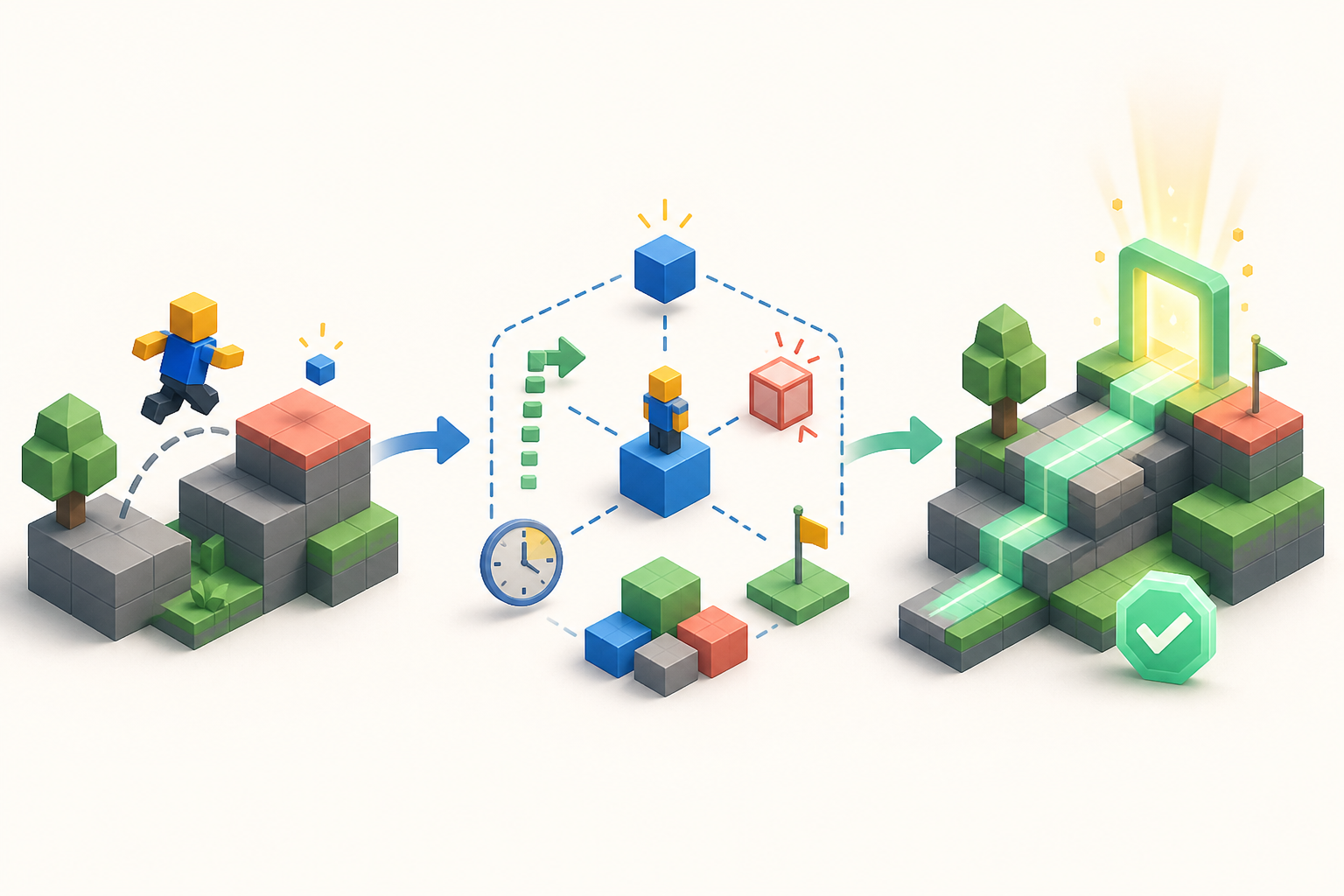
Mechanic prompts should describe the input, rule, feedback, state change, reset, and edge cases. Avoid tuning numbers presented as universal truths; ask for initial values and a plan for testing them.
Template
Plan one [mechanic] for a [genre] Roblox experience. The player does [input/action]. The system may change [state]. The server must own [authoritative decisions]. Give me: a one-paragraph loop, a state table, feedback for success and failure, six edge cases, and a small playtest plan. Do not invent existing object paths or claim the values are balanced.
Example
Plan a dash mechanic for a third-person obstacle course. The player presses one input to move a short distance in the current travel direction. The server must validate cooldown and impossible movement. The dash cannot deal damage or bypass locked checkpoints. Return the state transitions, client/server responsibilities, feedback cues, failure cases, and tests for latency, slopes, repeated input, and respawn. Use placeholder tuning values and label them as hypotheses.
A strong answer separates responsive local feedback from authoritative shared-state decisions, but it should not pretend to know your exact architecture. Once the behavior contract is stable, implement the smallest version in Studio and test it in the project’s real hierarchy.
Prompt pattern 2: a level or room
A level prompt needs spatial beats and player decisions, not a list of decorations. Ask what the player sees first, what they learn, how difficulty changes, where failure returns them, and what evidence indicates pacing problems.
Template
Create a beat sheet for one [level/room] that lasts about [target duration]. The player already knows [skills]. Teach [new idea] without a text tutorial. Include entrance read, three escalating beats, recovery space, checkpoint logic, optional mastery path, and playtest questions. Keep geometry conceptual; do not claim this is a Roblox Studio map.
Example
Create a beat sheet for a three-minute lava-factory obby room. Players know jumping but not moving platforms. Introduce one moving platform safely, combine it with a timed hazard, then offer an optional faster route. Include sightline goals, reset locations, multiplayer congestion risks, and observations to record during five playtests.
This structure helps the model reason about teaching and pacing. It also gives you concrete questions: Did players see the safe demonstration? Where did they hesitate? Did another player block the landing? Those observations are more useful than asking whether the room was “fun.”
Prompt pattern 3: a quest
Quest prompts should define states, transitions, information, failure, and consequences. Otherwise the output tends to become narrative prose with no implementable logic.
Template
Outline a [quest type] for [player profile]. Define available, accepted, active, blocked, completed, and abandoned states where relevant. For each transition, state the trigger, player-facing feedback, and recovery behavior. Include objective wording, three edge cases, and a test matrix. Do not add purchases, permanent inventory, or data saving unless specified.
Example
Outline a short repair quest in a social exploration game. The player speaks to a mechanic, finds three differently located parts, and returns. Parts are shared world objects but collection credit is per player. There is no trading or persistence in this prototype. Provide the state table, duplicate-collection behavior, player-leave assumption, dialogue intent, and five tests.
The phrase “collection credit is per player” removes a major ambiguity. So does explicitly excluding persistence. Later, if you add saved progress, treat that as a separate architecture and security task rather than silently expanding the prompt.
Prompt pattern 4: an NPC prototype
An NPC prompt needs observable behavior, triggers, state, boundaries, and fallback behavior. Personality alone does not define a system.
Template
Design a bounded NPC behavior prototype. The NPC can perceive [signals], choose among [states], and affect [allowed outputs]. Define transition conditions, cooldowns as hypotheses, unreachable-target behavior, multiplayer ownership assumptions, and debugging signals. Return behavior prose and tests, not a finished Studio integration.
Example
Design a museum guide NPC that notices nearby players, offers one of three exhibits, walks only between fixed waypoints, and returns home when no player is engaged. It cannot chase, fight, make purchases, or generate unrestricted dialogue. Explain state transitions, how two players compete for attention, path failure recovery, and what to log during testing.
For movement implementations, verify current pathfinding and character guidance in Roblox Creator documentation. An AI outline can organize the behavior, but only Studio tests can show whether your rig, waypoints, collision, and crowded server conditions work.
Add constraints that prevent plausible but unusable output
Constraints are not negative decoration; they define the boundary of the prototype. Useful constraints include:
- do not invent Roblox services, classes, events, or object paths;
- separate design decisions from implementation suggestions;
- label tuning values and capacity assumptions as hypotheses;
- treat client-originated values as untrusted when shared state is involved;
- exclude persistence, purchases, trading, moderation, or user-generated text unless specifically in scope;
- avoid copyrighted characters, copied maps, and deceptive branding;
- return assumptions and unresolved questions before code;
- keep the first build small enough to test in one session.
A model may still violate a constraint. Review the output line by line. When an API or engine behavior matters, verify it against current official Creator documentation rather than relying on a citation invented by the response.
Ask for decisions and tests before asking for Luau
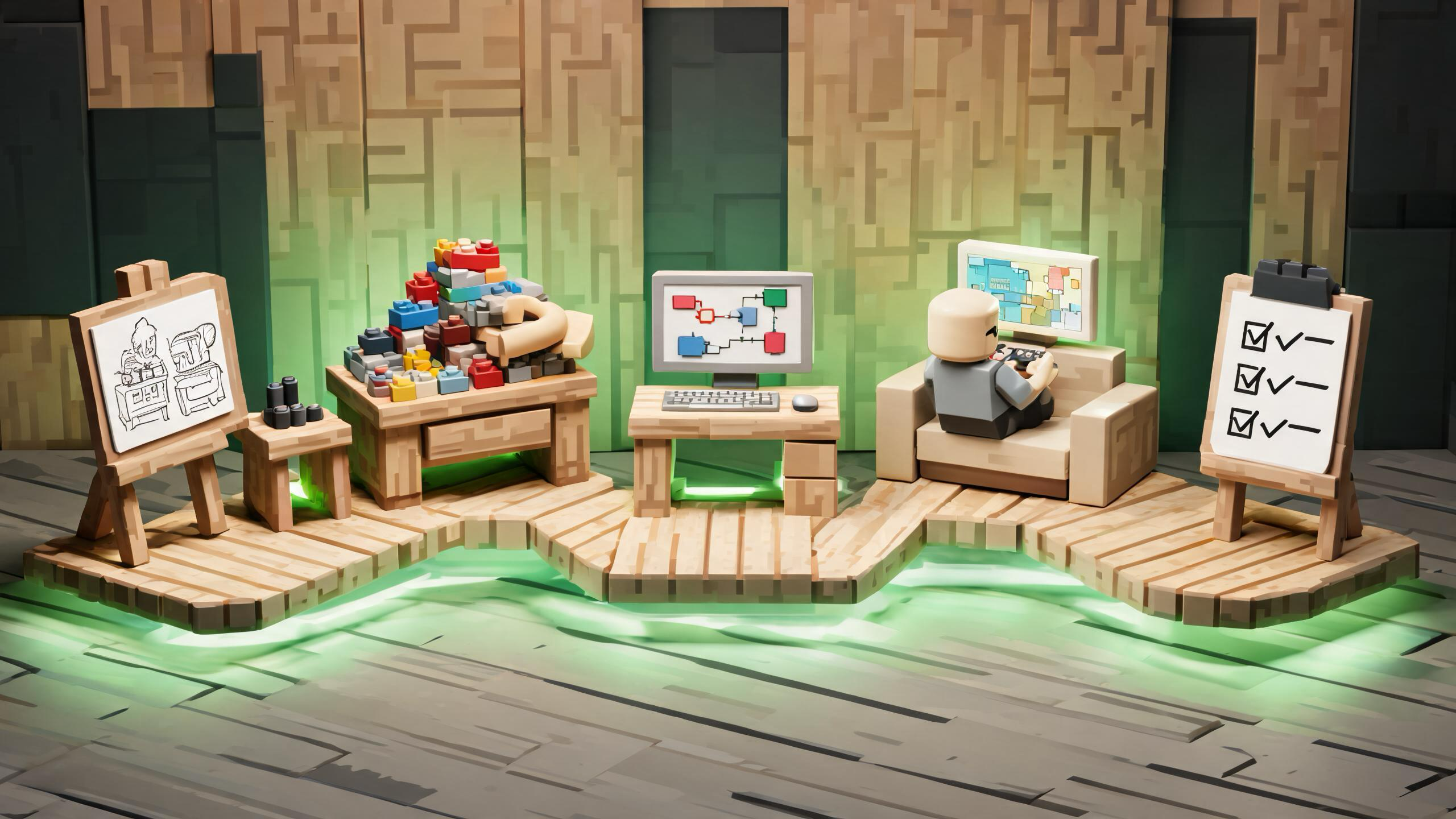
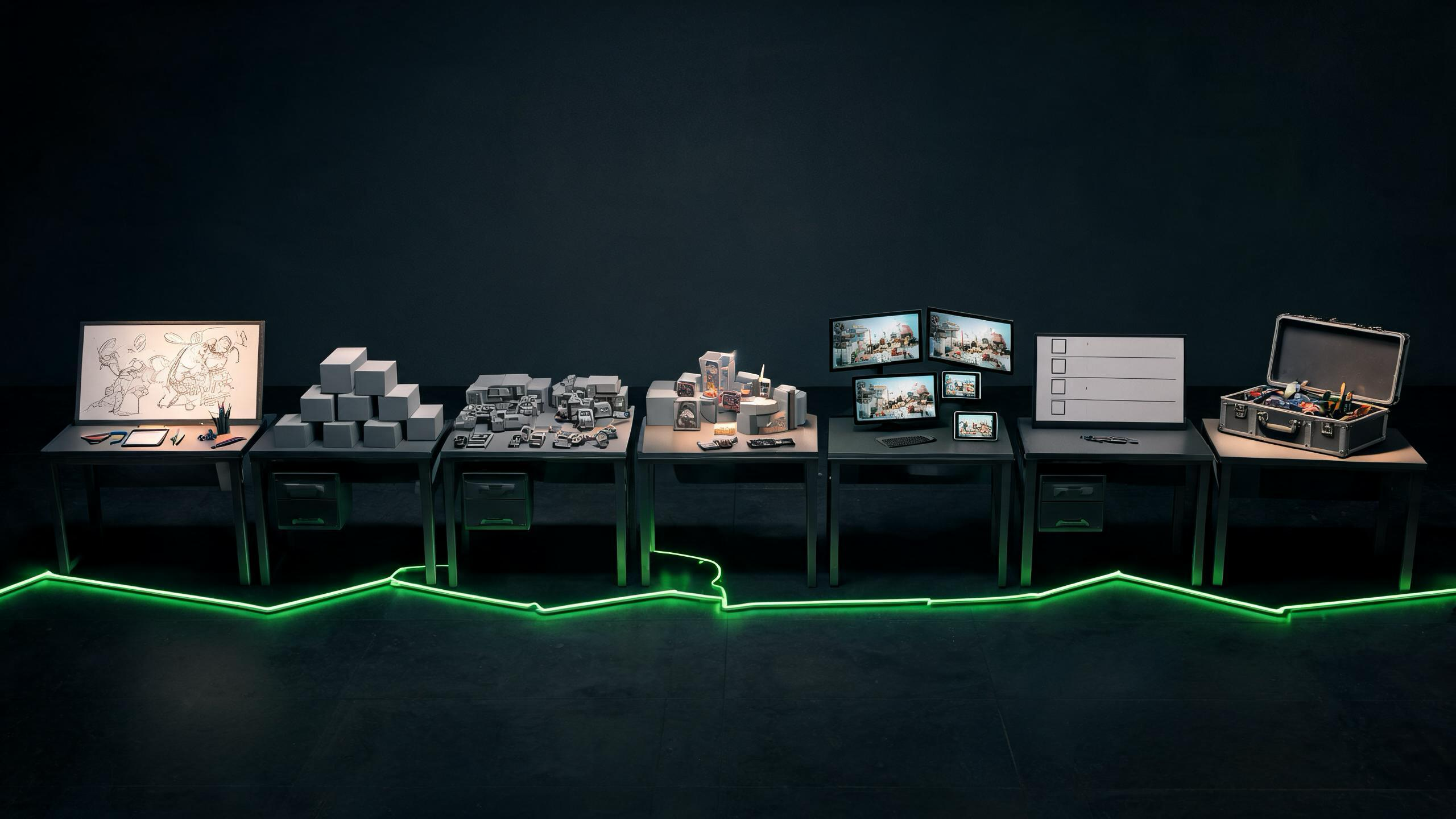
There is a useful order for AI-assisted prototyping:
- define the player-visible outcome;
- choose the smallest loop that could test it;
- list state and authority decisions;
- create a beat sheet or state table;
- define acceptance and failure evidence;
- implement one slice in Roblox Studio and Luau;
- test, observe, and revise.
Skipping directly to code makes design uncertainty look like syntax. If you do request Luau, provide the exact runtime location, relevant hierarchy, input sources, server authority, failure behavior, and expected tests. Ask for assumptions separately. Never treat a script that parses as proof that the mechanic is secure, performant, or enjoyable.
Roblox provides distinct Studio testing modes because client-server behavior matters. Use current testing guidance and exercise more than one simulated client when the feature changes shared state or uses remote communication. Record whether a failure occurred on the client or server and preserve the smallest reproducible case before asking AI to diagnose it.
A reusable master prompt
Copy and adapt this structure:
I am planning one Roblox prototype, not asking for a complete published game.
Player and genre: [who it is for and the experience type]
Player-visible goal: [one observable outcome]
Scope: [one mechanic, room, quest, or NPC loop]
Existing context: [camera, player count, relevant systems and hierarchy]
Rules/state: [inputs, transitions, authority, reset]
Constraints: [time, platform, content, security, excluded systems]
Deliverable: [beat sheet, state table, assumptions, edge cases, test checklist]
Success evidence: [what you will observe or measure]
Ask up to five clarification questions before drafting. Do not invent engine APIs or project objects. Label all tuning values as hypotheses. Separate design recommendations from implementation suggestions.
After the response, run a second prompt: “List every assumption, every claim that requires current Roblox documentation, and every condition that cannot be validated without Roblox Studio.” This review pass often reveals more value than requesting a longer first answer.
How to review the result
A useful answer should let another developer explain the loop, identify each state owner, point to unresolved risks, and run a small test. Reject or rewrite the output if it:
- expands one prototype into a full game roadmap;
- invents specific Studio objects you never described;
- treats client input as authoritative for shared rewards or progress;
- presents tuning values as proven balance;
- confuses concept art or a standalone prototype with Roblox gameplay evidence;
- claims SEELE AI has an official Roblox partnership, direct Studio integration, or Roblox project export;
- provides no reset, failure, or multiplayer behavior;
- cannot say what would falsify the design.
If the design still looks promising, build only its riskiest assumption first. For a movement mechanic, that may be replication and collision. For a quest, it may be per-player state. For an NPC, it may be path failure and attention ownership. Testing the riskiest assumption prevents polished secondary work from hiding a broken core.
Using SEELE AI without overstating the workflow
SEELE AI can be used for standalone concept exploration and playable prototype experiments. That can help you test a rule, pacing idea, or visual direction before committing to a Roblox implementation. It is not evidence of an official Roblox partnership, direct Roblox Studio integration, or one-click Roblox project export.
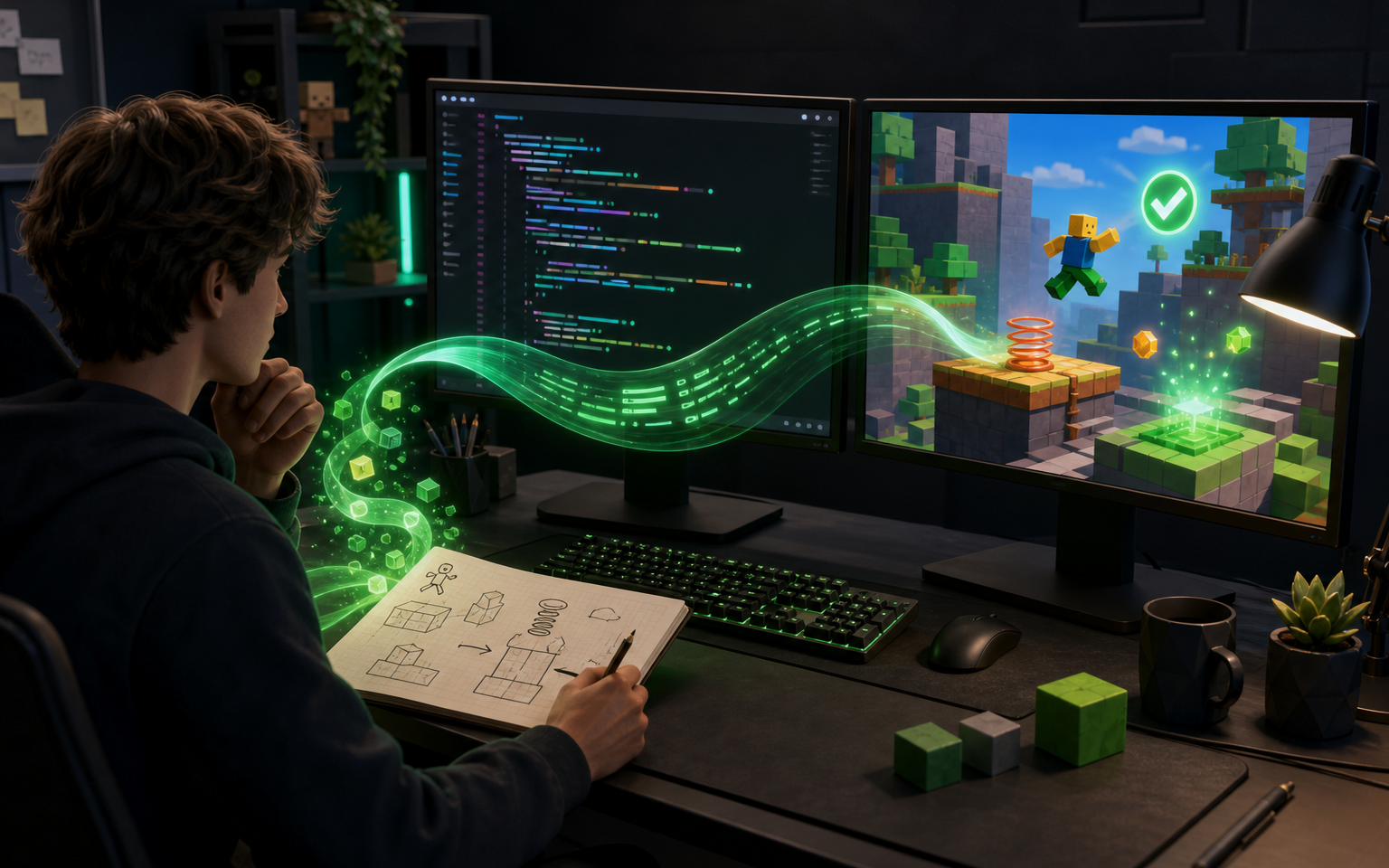
Use a standalone result as a design reference. Recreate the accepted mechanic in Roblox Studio, implement it in Luau against the real DataModel, apply Roblox’s client-server and safety requirements, and publish through Roblox’s own workflow.
Final prompt checklist

Before sending a Roblox game prompt to an AI assistant, confirm that it names one player-visible goal, one bounded scope, relevant context, rules and state, authority decisions, constraints, requested output, edge cases, and success evidence. After receiving the answer, verify APIs, expose assumptions, test the smallest risky slice in Studio, and revise from observed behavior rather than confident prose.
A better prompt does not guarantee a better game. It gives you a smaller, clearer hypothesis that can fail cheaply—and that is what makes AI useful in a Roblox prototyping workflow.
Frequently Asked Questions
What should a Roblox AI game prompt include?
Include one player-visible goal, bounded scope, relevant project context, rules and state, authority decisions, constraints, the requested deliverable, edge cases, and observable success evidence.
Can AI build and publish a complete Roblox game from one prompt?
AI can draft plans and small implementation artifacts, but the final experience still requires Roblox Studio and Luau implementation, architecture, security review, testing, assets, and publishing decisions.
Should I ask for Luau code in the first prompt?
Usually start with the behavior contract, state, risks, and tests. Request a small Luau component only after the design is bounded and you can provide its actual runtime location and relevant hierarchy.
How do I prompt an AI for a Roblox NPC?
Define observable signals, bounded states, transitions, allowed effects, fallback behavior, multiplayer ownership assumptions, and tests. Personality alone is not an implementable behavior system.
Does SEELE AI export directly to Roblox Studio?
No direct Roblox Studio integration or project export is claimed here. Treat standalone prototypes as design references, then rebuild and validate accepted features through Roblox Studio and Luau.