Upgrade intent · replay production tasks before switching
Claude Opus 5 vs Opus 4.8 for Unreal — the world's first online native Unreal workflow
Compare Claude Opus 5 and Opus 4.8 for Unreal coding, debugging, long agents, price, migration, safety fallback, native validation, and rollback.
Direct answer
Opus 5 is the newer model and Anthropic reports major gains over Opus 4.8 at the same $5/$25 base token price, especially in coding, verification, and long-running work. Do not migrate an Unreal workflow on vendor benchmarks alone. Replay saved tasks and compare accepted edits, root-cause accuracy, tool use, total cost, latency, safety behavior, recovery, and native build evidence.
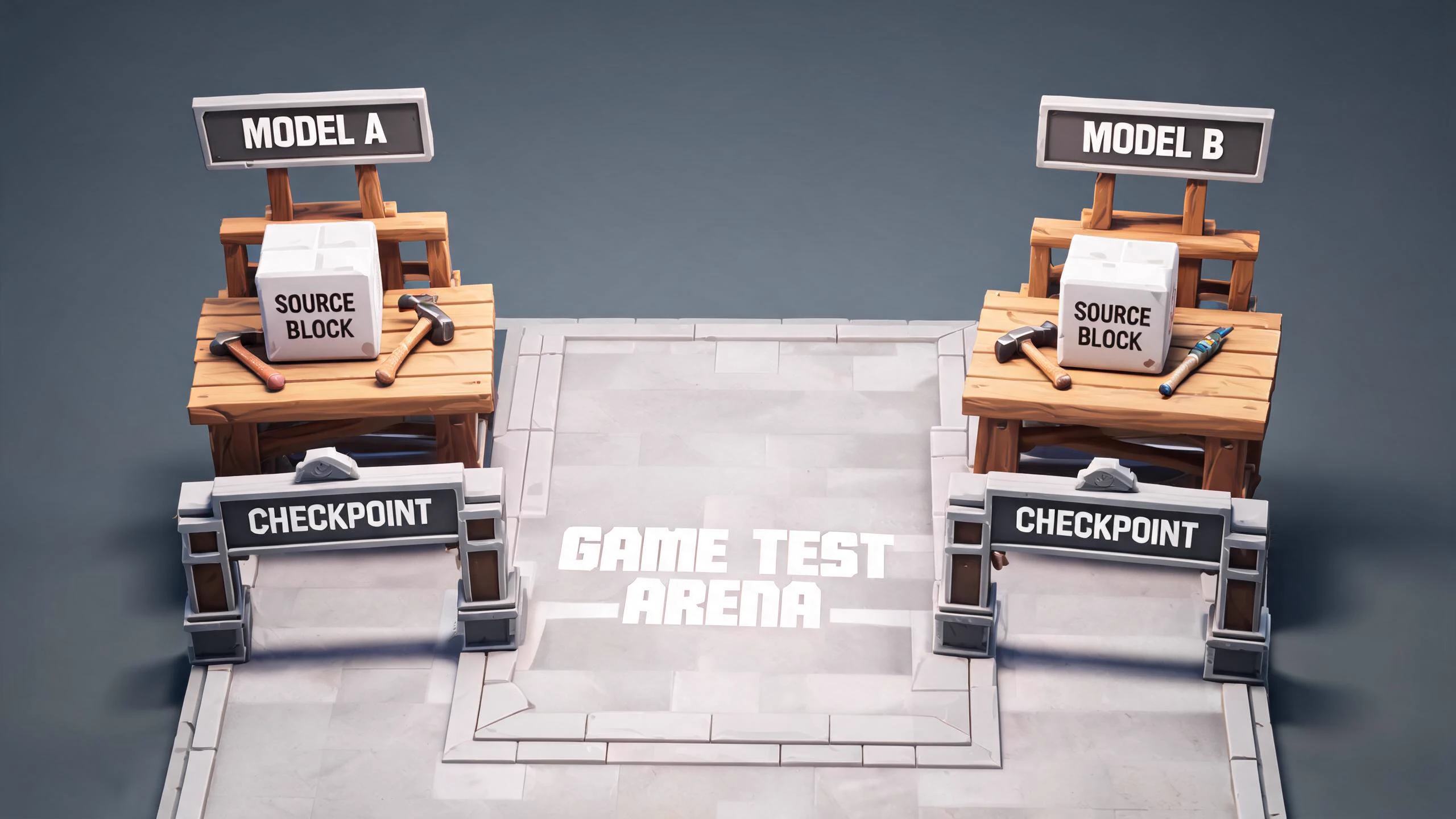
SEELE editorial concept created with Seedream 5.0. It is not an Anthropic or Epic asset, not a real Unreal Editor screenshot, not gameplay, and not proof of an official integration.
Start building an Unreal 5 game in SEELE
Choose a concrete prompt, open the SEELE Unreal creator, review the prefilled brief, and generate the native project. The first prompt is tailored to this page; the remaining prompts are reusable starting points.
Use this page's scoped brief
Create a native Unreal 5 ruins-navigation benchmark slice for repeatable evaluation. The player opens a gate, avoids one moving trap, retrieves a relic, and returns to the entrance. Include deterministic objective states, failure and restart, clear instrumentation points, and a short browser-preview route so two workflows can be compared on the same visible result.
Use Unreal Engine to generate a simple third-person tour game with mountains and water. Include responsive movement, a clear route, one completion state, failure recovery, immediate restart, browser preview, and a native downloadable Unreal 5 project.
Build a compact dungeon crawler using Unreal Engine. Include third-person movement, one combat loop, two connected rooms, one key-and-door objective, visible health and feedback, death, completion, immediate restart, browser preview, and a native downloadable Unreal 5 project. Test and regress the result.
Create a native Unreal 5 third-person city tour with a compact walkable district, vegetation, landmark lighting, and sunny, cloudy, and rainy weather states. Include clear controls, browser preview, stable restart behavior, packaging checks, and local project download.
An inspectable Unreal project rather than a model answer or an unofficial integration claim.
Browser preview
A fast way to check camera, controls, objective clarity, feedback, completion, failure, and restart before local continuation.
Optimization and packaging path
A workflow for performance review and package preparation before external distribution.
Downloadable project
A local project handoff for source, Blueprint, asset, plugin, rights, build, target-device, and release review.
What is verified—and what it means for Unreal
Published improvement
Anthropic says Opus 5 greatly improves performance for the same cost as Opus 4.8 and more than doubles 4.8 performance on its cited Frontier-Bench setup.
Price continuity
Both models are listed at $5 per million input tokens and $25 per million output tokens at launch.
Fallback relevance
Anthropic describes Opus 4.8 fallback behavior for some safety-classifier cases, so migration plans should record whether automatic fallback is enabled.
Unreal evidence gap
Neither the general benchmark result nor equal pricing proves better C++, Blueprint, plugin, cook, package, or target-device outcomes for a specific project.
A five-stage Opus 4.8 migration and upgrade workflow
Export the real regression set
Collect representative prompts, approved context, expected outputs, accepted and rejected diffs, tool traces, build logs, failures, and reviewer decisions from the existing Opus 4.8 workflow. Redact sensitive material.
Run both model IDs
Use the same repository revision, tools, permissions, effort policy, time and cost ceilings, engine version, targets, and acceptance checks. Mark any automatic fallback so it is not scored as Opus 5.
Compare completed work
Measure correct root cause, accepted change rate, unsupported assumptions, unnecessary churn, tool calls, total tokens, latency, build passes, recovery after interruption, and reviewer time.
Canary the upgrade
Route a small reversible task class to Opus 5, monitor quality and cost, preserve 4.8 as an explicit fallback where permitted, and expand only after the canary sample meets predetermined thresholds.
Revalidate the game path
For creation goals, keep the model comparison separate from SEELE native Unreal generation. The model may influence the brief, while SEELE project output must be previewed, downloaded, built, and tested on its own evidence.
Failure modes to block before adoption
Risk 1
Prompt and tool behavior can change even when token prices remain the same.
Risk 2
Automatic safety fallback can contaminate results if the final model identity is not logged.
Risk 3
A model that solves hard tasks better can still create more expensive loops on routine work.
Risk 4
Migration without a saved regression set makes quality loss hard to detect or reverse.
Decision scorecard
Dimension
What good looks like
Evidence to keep
Quality
Correct ownership, root cause, accepted edits, and no new defects
Blind reviewer and native test outcomes
Efficiency
Tokens, tools, elapsed time, retries, and human review per accepted task
Provider and workflow telemetry
Reliability
Variance, interruptions, refusals, fallbacks, and rollback
Repeated matched trials and forced recovery
Migration fit
Prompt, schema, tool, policy, and operational compatibility
Canary plus instant route-back test
Unreal implementation notes for this decision
Hold the migration surface constant
Compare the same API or client path, prompts, context retrieval, tools, permissions, effort, timeouts, retry policy, and fallbacks. Otherwise the experiment measures a platform migration and a model change at the same time.
Include regression tasks
New-model evaluation needs known hard wins and known past failures: invented APIs, wrong subsystem ownership, excessive churn, interruption loss, security boundary mistakes, compile-only success, and packaged-build regressions. Improvement should reduce specific failure classes without creating new ones.
Use canaries and route-back
Adopt on a small task pool, log actual model identity and acceptance, cap spend, preserve the old route, and define automatic rollback thresholds. A reversible operational migration is more credible than a one-day benchmark victory.
From evaluated idea to a SEELE native Unreal project
Use the model research to tighten the brief, not to replace project evidence. The direct creation path is deliberately short and observable:
1. Bound the player loop
Keep one camera, one primary verb, one objective chain, explicit failure and completion, restart behavior, visual direction, controls, target session length, and a clear cut list.
2. Generate in SEELE
Open the canonical Unreal creator, choose the closest verified starter world, submit the brief, and generate a native Unreal 5 project rather than treating a text answer as the deliverable.
3. Inspect the browser preview
Play the result from start through success, failure, and restart. Check camera, input, objective clarity, feedback, interaction state, visual hierarchy, and obvious performance or stability problems.
4. Download or continue production
Review the project, source, Blueprints, assets, plugins, rights, configuration, performance, saves, networking, cook, package, and target requirements before local continuation or external release.
Starter creation brief
Create a native Unreal 5 ruins-navigation benchmark slice for repeatable evaluation. The player opens a gate, avoids one moving trap, retrieves a relic, and returns to the entrance. Include deterministic objective states, failure and restart, clear instrumentation points, and a short browser-preview route so two workflows can be compared on the same visible result.
Official evidence and capability boundary
Snapshot date: July 25, 2026. Anthropic's July 24, 2026 announcement is the first-party source for release status, pricing, positioning, and launch availability. It does not claim an Epic-supported Unreal integration. Epic documentation and the exact project remain authoritative for engine behavior, compilation, assets, tests, cooking, packaging, and target-platform results.
Anthropic release
Release date, claude-opus-5 model ID, coding and agent positioning, pricing, Fast mode, alignment, safety, and availability.
Continue through the Claude Opus 5 × Unreal cluster
Claude Opus 5 vs Sonnet 5 for Unreal
Compare Claude Opus 5 vs Sonnet 5 for Unreal coding by quality, speed, price, reviewer effort, matched native tests, task routing, and SEELE game creation.
Evaluate Claude Opus 5 computer use around Unreal Editor with bounded permissions, visual-state checks, save and package gates, audit trails, recovery, and a SEELE creation handoff.
Move from Claude Opus 5 game ideas and specifications to a native Unreal 5 project in SEELE AI, with browser preview, validation, packaging, and download checkpoints.
Anthropic reports a substantial general improvement, but an Unreal team should decide from matched project tasks and native evidence.
Do they have the same API price?
At launch, yes: $5 per million input tokens and $25 per million output tokens.
Should I replace 4.8 immediately?
No. Replay saved tasks, canary a narrow class, log fallbacks, and preserve a tested route back until quality and cost are stable.
Why log the actual responding model?
Safety or server-side fallback can route a request to another model, which changes both evidence and debugging.
Does the upgrade change SEELE output?
No relationship is claimed. SEELE native Unreal generation is a separate workflow and should be evaluated from its actual project and preview output.
Should I migrate every Unreal task from Opus 4.8 at once?
No. Test task classes, canary a limited route, preserve the previous model, monitor acceptance and failure types, and expand only when native evidence supports it.
Turn the research into a native Unreal 5 game
Open the canonical SEELE Unreal creator, choose a verified starter world, generate the native project, inspect the browser preview, then download or continue optimization and packaging. Keep third-party model evaluation and project evidence separate.