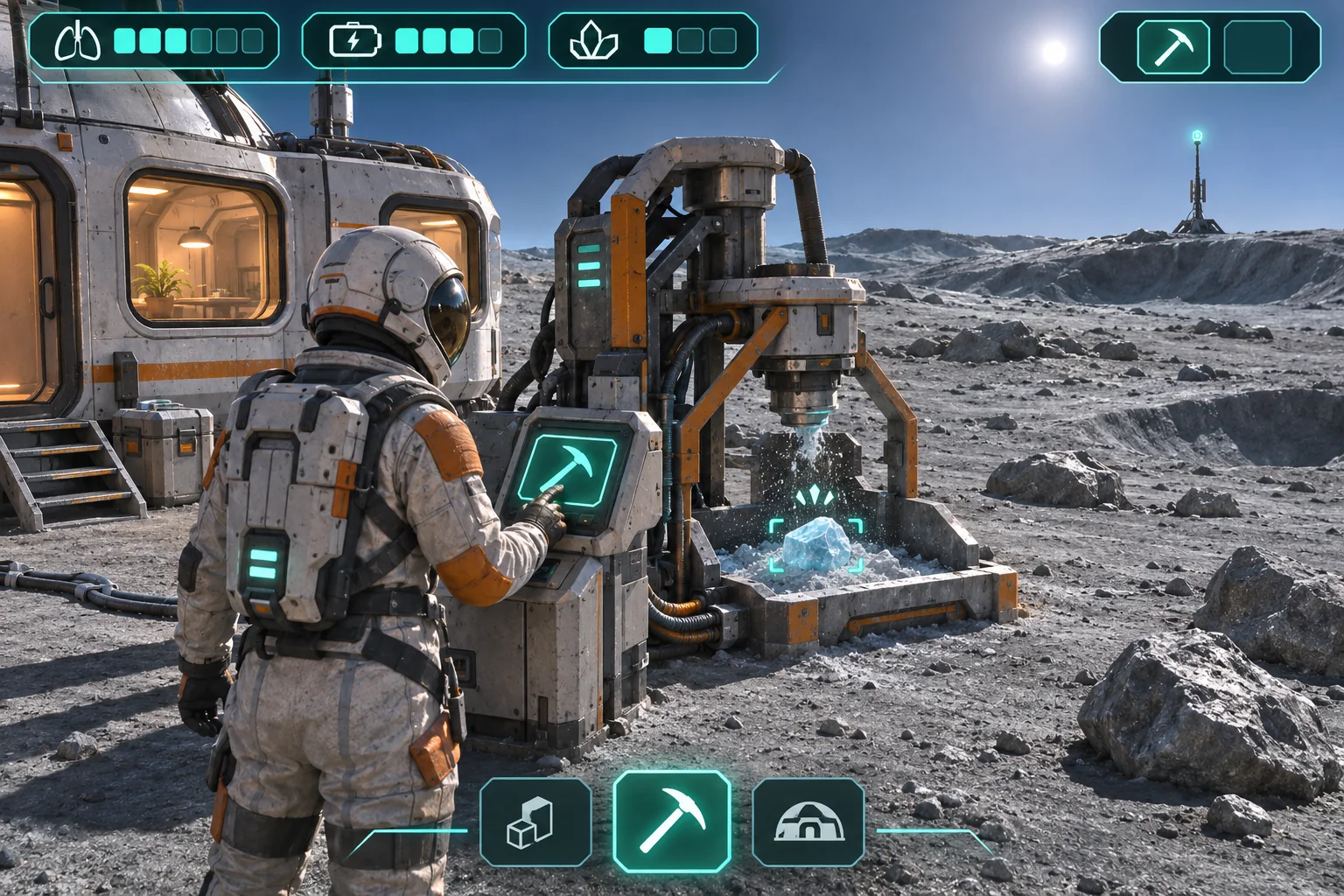
For a game built around an economy, simulation, or connected systems, start by testing one loop of decisions rather than generating a large world. Name the resources, the action that changes them, the feedback the player sees, and the condition that makes the next decision harder or more interesting. AI can help draft variations, but the prototype must show whether those rules create a meaningful choice. This keeps attention on the link between game mechanics and player experience described by Hunicke, LeBlanc, and Zubek in their MDA framework; the framework is design context, not evidence that a generator can validate the result.
A systems-heavy game can appear rich on paper while playing like a set of disconnected menus. One small scenario exposes that problem earlier than a full progression tree or many polished assets.
Key Takeaways - Pick one loop, such as gather, spend, and recover, before designing a full economy. - Make resource changes and consequences visible in the prototype. - Expand only after a player can explain why one choice is preferable to another.
Define the loop as a sequence of decisions
Write the loop in plain language: the player gathers a resource, spends it to improve a system, then faces a new constraint. A settlement game could use food, labor, and shelter; a factory game could use inputs, throughput, and storage. The first scenario needs only enough rules to create a tradeoff.
Ask the model for alternative rules, edge cases, and a compact scenario. Have it label assumptions separately from requirements. Then choose a version that can be tested with a small map or a few turns. Do not let a broad feature list obscure the one question the prototype should answer: does the player face a decision with a visible consequence?
Build a scenario that exposes the tradeoff
A useful first scenario has a starting state, a constraint, a player action, and a feedback signal. For instance, if spending workers on production reduces the number available for repairs, the prototype should make that cost visible before the player commits. A tester should be able to describe what changed and why.
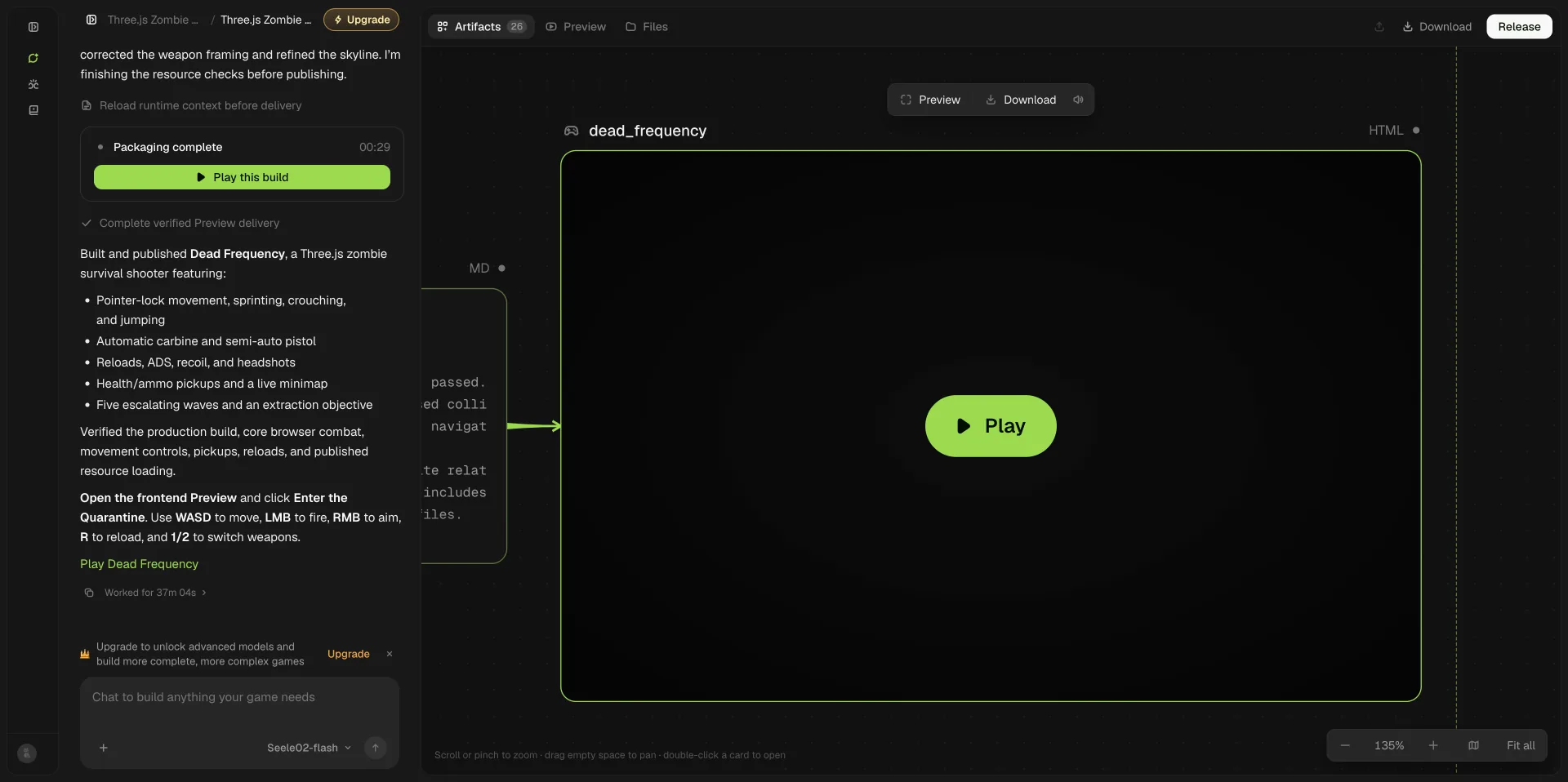
The supplied zombie-shooter materials are not evidence for an economy or simulation system. They can illustrate a more general production checkpoint: a generated task has a build preview that a person can open and evaluate. The screenshot records a build-complete state and preview entry point, not the quality of any resource loop.
Use a short test note with three columns: decision offered, feedback shown, and question still open. If players cannot tell why a choice matters, change the rules or feedback before adding more systems.
Use AI to vary rules, not to hide dependencies
AI can propose a harder starting condition, a resource shortage, or a different reward schedule. Ask it to change one variable at a time and predict how the change might alter player choices. Then test the variant. Avoid accepting a large web of dependencies without checking which rule causes which outcome.
The prompt should request a compact deliverable, such as:
Design a one-screen prototype for a settlement game. Include three resources, two player actions, one visible tradeoff, a win condition, and a failure condition. Explain what changes after each action. List assumptions separately. Do not add extra systems unless they are required to test the tradeoff.
The point is to make a small system inspectable. The AI's explanation can guide the test, but the running prototype remains the evidence for what it actually does.
Keep generation, preview, and release separate
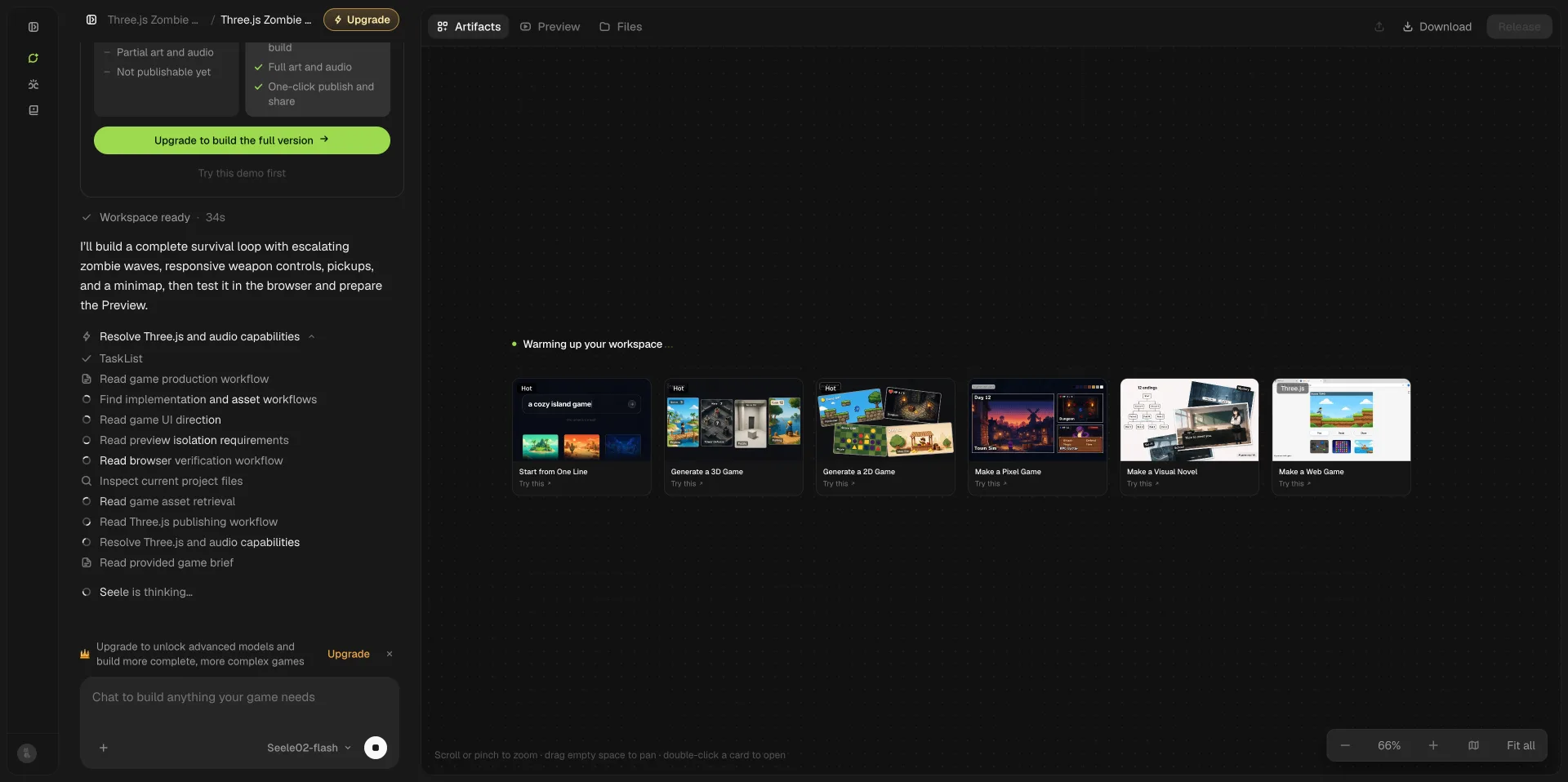
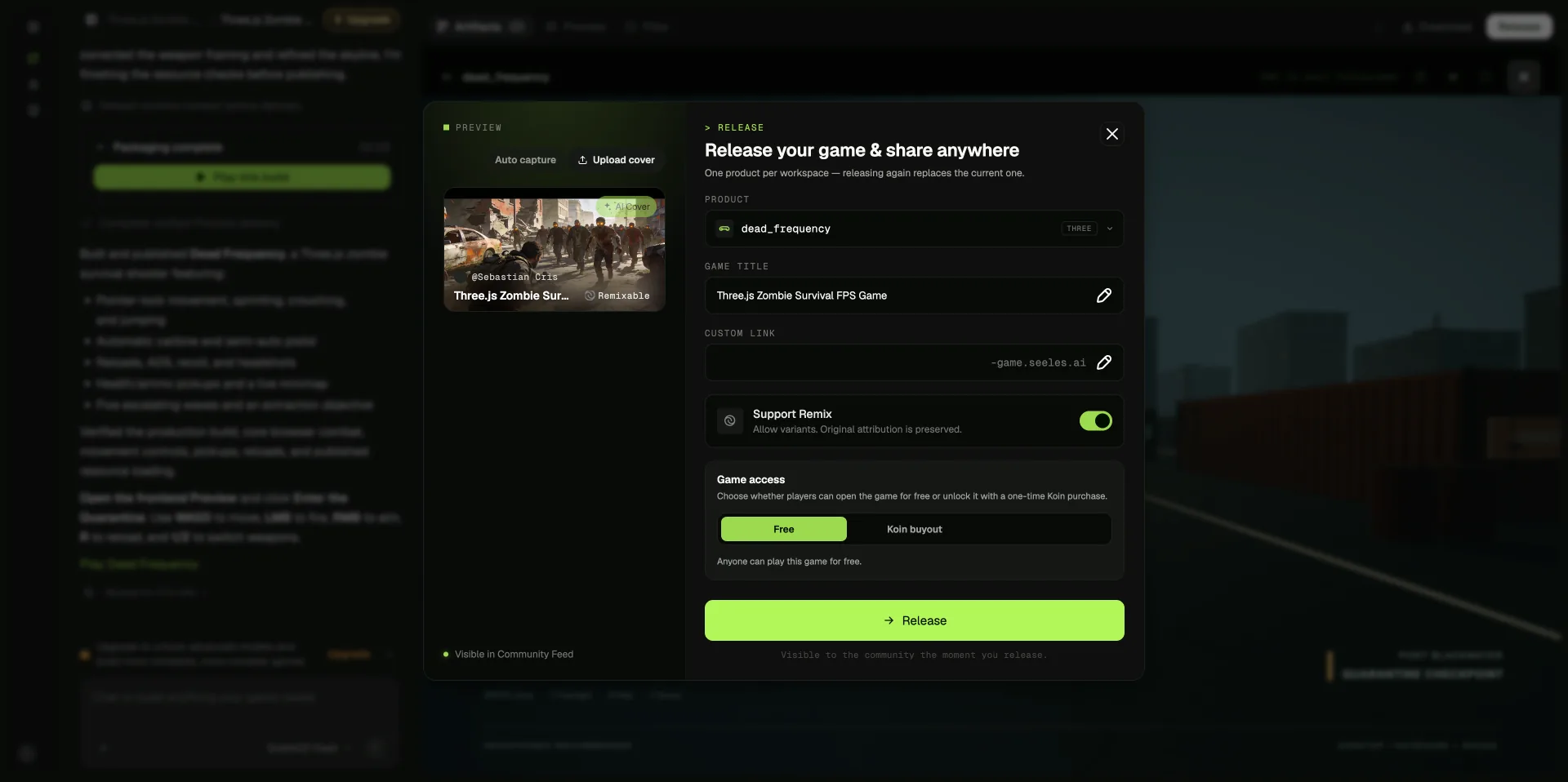
The supplied October 2026 test record shows a generation workspace, a build preview panel, and a release settings dialog for a different genre example. Those screens can help teams discuss workflow stages: generate a request, inspect a build, and review sharing settings. They do not demonstrate systems-game features, and a release dialog does not prove that a project shipped.
For your own game, keep the acceptance criteria attached to the scenario. A build is ready for another iteration only when someone has tested the decision loop and recorded what happened. A larger map, more resources, or additional progression should answer a follow-up design question, not simply make the project feel more complete.
Expand one dimension at a time
When the first loop creates a legible choice, expand carefully. Add a second resource only if it changes a decision. Add an event only if it pressures the loop in a useful way. Add visual polish after the player can understand the rule through the current feedback.
If you need a narrow brief-to-build process, see how to turn a game brief into a prototype. For human testing and acceptance gates, read the review workflow for game prototypes. The indie team handoff guide explains how to assign ownership for each review.
The practical way to build a systems-heavy game with AI is to keep the first playable loop small, observe its consequences, then earn each added system through a test.
Worked example: test one economy loop before a full simulation
Consider a settlement game with food, labor, and repairs. The player starts with a small workforce and must decide whether to gather extra food or repair a damaged shelter before the next turn. The prototype only needs one map, a few turns, and clear resource changes. It does not need a technology tree, dozens of buildings, or a long campaign to answer the first question: does the tradeoff create a decision the player understands?
Write down the state before each action and the visible consequence after it. For example, if assigning one worker to repairs means one fewer worker can gather food, the interface should show both effects before confirmation. A tester should be able to explain why they chose one option and what they expect to happen next. If they cannot tell whether the cost is immediate or delayed, the rules or feedback need revision before more systems are added.
Ask AI to propose several variants of the same loop, not an entire simulation. For each variant, request the starting state, action options, resource changes, failure conditions, and assumptions. Have a designer choose one variant and check that the numbers are internally consistent. A model-generated table can contain arithmetic or logical errors; recalculate state transitions before using them in a build.
Separate system rules from content generation
A useful system specification has a small number of clear layers:
- State: the resources, conditions, and values that matter to the decision.
- Actions: what the player may do and what each action costs.
- Transitions: how the state changes after the action or turn.
- Feedback: how the game communicates the change and its consequence.
- Boundaries: what is impossible, capped, delayed, or reversible.
Keep this specification separate from generated names, descriptions, event text, and visual decoration. If a rule changes, the team should know whether it requires a code change, a data change, or a content update. Mixing all of those in one prompt makes it harder to locate the cause of a broken test.
A state table can help reviewers inspect edge cases. Check what happens when a resource reaches zero, when the player cannot afford any action, when a turn repeats, and when two effects happen at once. A prototype does not need every final rule, but it should not hide a condition that changes the main decision.
Use AI to explore alternatives, then choose deliberately
AI is helpful for generating possible events, rule variations, and edge cases. It should not decide the game’s balance by producing plausible-sounding values. Ask for a range of options and the tradeoff each option creates, then evaluate those choices in the prototype. If the model proposes a new mechanic, label it as a candidate rather than silently adding it to the design.
When testing a variation, keep the scenario stable. Change one cost, one rule, or one feedback cue at a time. Record the starting state and the player’s choices so the team can compare runs. Informal playtests can reveal confusing rules or uninteresting choices, but they do not establish that the economy will remain balanced across a full game.
Expand along one axis at a time
After the initial loop works, choose the next uncertainty. Add a second resource only if it creates a distinct decision. Add a new building only if its cost and effect are understandable. Add a longer scenario only after the short one demonstrates that players can read the consequences. Each expansion should have an acceptance question and a way to observe it.
When a change introduces a bug, reduce the example until the issue is reproducible. Keep a known-good build or scenario as a comparison point. A build note should say what changed and what was retested, particularly when a system affects multiple resources or turn transitions.
How can I tell whether a strategy loop is meaningful?
Ask players to describe the choice they faced, why they chose it, and what consequence they expected. If all options feel interchangeable or one action is always obviously superior in the tested scenario, revisit the costs and feedback. The answer may depend on the intended game, so treat this as a design signal rather than a universal balance rule.
Should AI generate the resource values?
It can suggest candidate values for exploration, but a person should check the arithmetic, assumptions, edge cases, and play experience. Generated values are proposals, not validated balance data.