Chain-Reaction Room
Scope dominos, a rolling ball, and one player-triggered switch with a deterministic reset.
Use this promptTurn a physics-led game idea into a bounded prototype brief with explicit rules, controls, and repeatable tests.
Start a physics sandbox prototype
Describe one interaction to test, then carry the scoped prompt into the SEELE workspace for iteration.
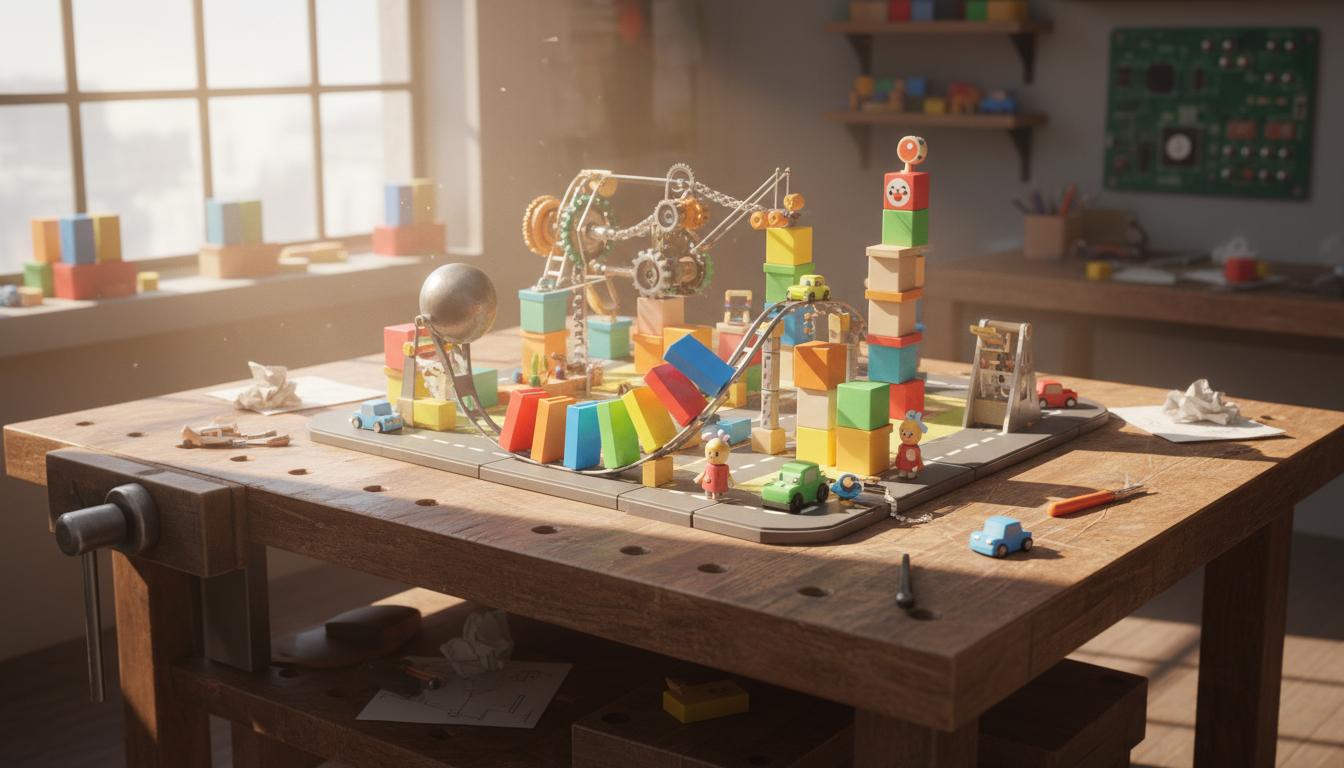
Start With One Observable Physics Behavior
Each prompt limits the scene and names the evidence to collect.
Scope dominos, a rolling ball, and one player-triggered switch with a deterministic reset.
Use this promptTest movement, collisions, and restart behavior in one compact platforming room.
Use this promptDefine acceleration, braking, obstacles, and repeatable track checks before adding content.
Use this promptWhat This Prototype Workflow Makes Explicit
The page organizes intent and tests; it does not treat concept art or generated copy as proof of working physics.
List every dynamic object, force, collision group, material, joint, and constraint before implementation.
Open WorkspaceDefine the initial state and reset behavior so each playtest begins from comparable conditions.
Open WorkspaceTurn feel-based goals into visible checks for stability, responsiveness, reproducibility, and failure recovery.
Open WorkspaceHow It Works
Keep the first slice small enough to debug and specific enough to produce evidence.
Name the behavior to test, such as stacking, rolling, swinging, driving, or chain reactions. The workflow narrows the scene to one observable player outcome.
Define gravity, collision groups, materials, forces, joints, player inputs, and reset behavior. The prompt is organized around explicit objects and deterministic constraints.
Open the scoped prompt in SEELE and iterate on the smallest playable slice. The handoff preserves the chosen objects, behaviors, controls, and test target.
Run repeatable checks, capture failures, and change one parameter at a time. Human review separates a convincing interaction from an unverified visual concept.
What You Get
These outputs make the next build step reviewable instead of treating a prompt as proof.
A bounded scene, player goal, and interaction hypothesis for the first playable slice.
Objects, forces, collisions, materials, joints, controls, and reset conditions in one reviewable list.
A specific prompt that carries the selected physics behavior and scope into SEELE for iteration.
Repeatable checks for stability, responsiveness, determinism, edge cases, and performance before expansion.
Where This Works Best
An AI physics sandbox creator is a prompt-first workflow for defining a small interactive scene around forces, collisions, joints, object properties, and player actions. Treat the result as a prototype direction: the actual behavior still needs to be implemented, played, measured, and tuned in the target runtime.
Name the objects, gravity direction, collision rules, available player verbs, reset condition, and one observable success condition. Also set a strict scope, such as one room or one chain reaction, so the first prototype can answer a specific design question instead of becoming an open-ended simulation project.
No claim on this page says that SEELE provides a proprietary physics engine or replaces engine-level implementation. The workflow helps organize a prototype brief and a workspace-ready prompt. A developer still needs to choose and configure the runtime, verify collision behavior, test edge cases, and inspect performance.
Define repeatable checks before building: objects should settle without tunneling, reset should restore the same state, controls should remain responsive under load, and the intended chain reaction should be reproducible. Record failures and adjust parameters one at a time rather than judging the scene only from a single successful run.
SEELE is an independent product. This page does not claim that SEELE uses, includes, or is powered by Claude, Claude Code, Claude Opus 5, or any other named third-party model. Searches using those terms may describe a separate coding workflow; they are not evidence of a SEELE integration.
Start with one controllable object, two material types, one force or joint, a reset action, and a visible goal such as reaching a target or completing a chain reaction. That slice is small enough to debug while still revealing whether the interaction feels understandable, responsive, and worth expanding.
Turn a rough creation goal into a clearer prompt, direction, and next step inside Seele AI.
Open Workspace