Premise to opening direction

Turn a world premise into a choice readers can understand.

Capability: organize an original world idea into a lead goal, opening pressure, and distinct directions for the next beat. How to start: define one world rule, one character who wants something now, and one event that forces a decision. Expected output: a reviewable premise and opening-scene plan. Limitation: this is a transport handoff only; the proof below verifies one scripted choice-to-next-beat path, not a general branching engine, generated outcomes, memory, or multiple endings.

World and premise board

Give the world one rule that creates pressure.

Premise board

World rule
Floating cities descend whenever their public bells fall silent.
Lead goal
A novice cartographer must keep her home aloft until sunrise.
Immediate conflict
The last working bell has been sealed inside an abandoned observatory.
Opening question
Does she warn the council, enter the observatory, or trust a rival who claims to know another route?
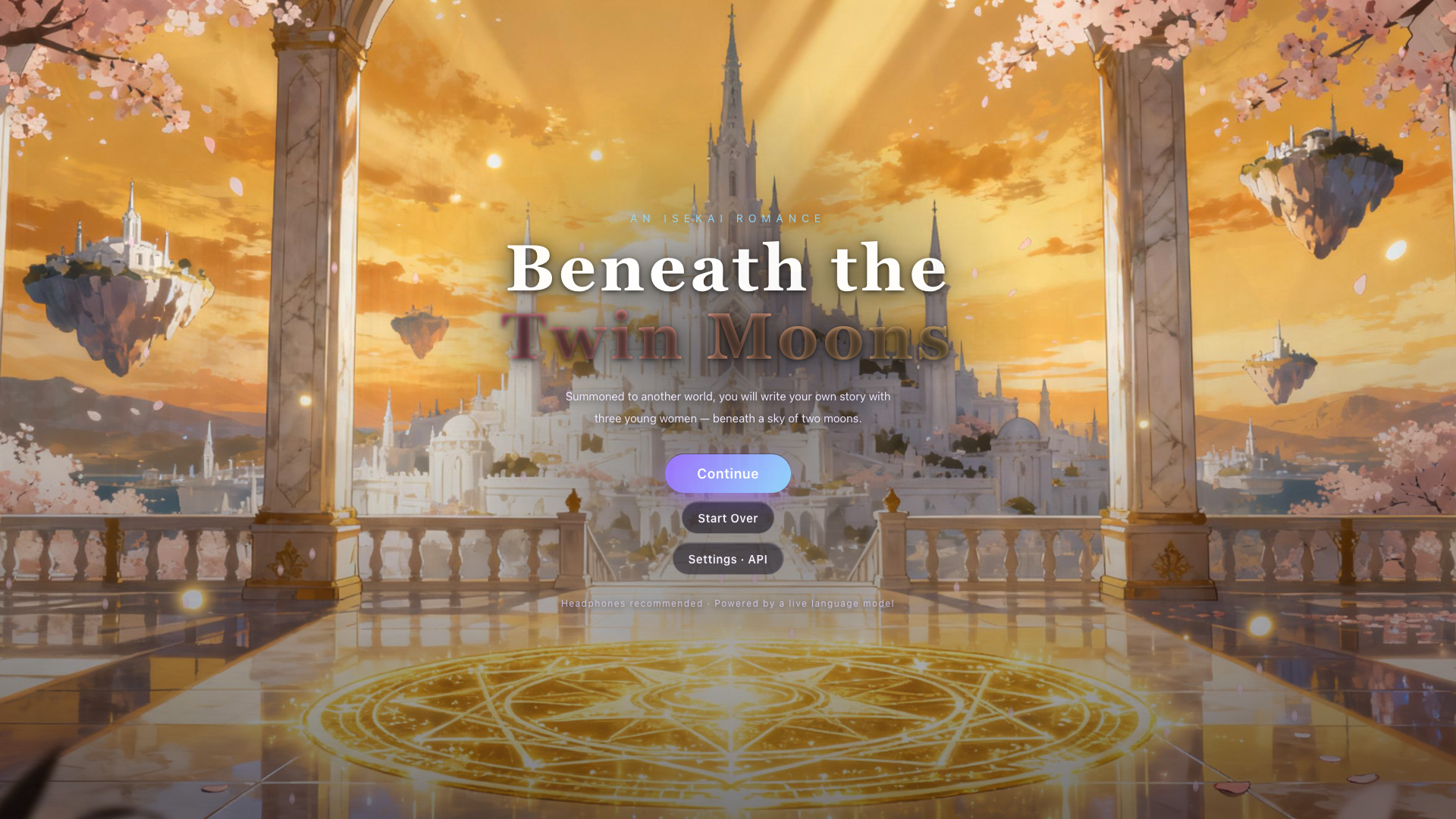
Secondary world context

A title image can set tone, not interaction.

A fantasy landscape with floating islands and a castle beneath a golden sky.

Visible facts: floating islands, a castle, mountains, clouds, and a golden sky establish an original fantasy setting. The image does not show an opening decision or what comes next.

Opening scene anatomy

Move from reveal to pressure to a readable decision.

Reveal one changed fact

Open on something the lead can see, hear, or discover: a stopped bell, a missing map mark, or a town gate closing at the wrong hour.

Connect it to the lead's goal

Explain why the change matters to this person now. The world detail should create a problem, not remain decoration.

Increase immediate pressure

Add a deadline, witness, rival, or limited resource that prevents the lead from waiting for perfect information.

Offer distinct next directions

Frame options around different approaches, such as warning someone, investigating directly, or trusting an uncertain ally.

Primary story proof

One same-run path shows before, choice, and after.

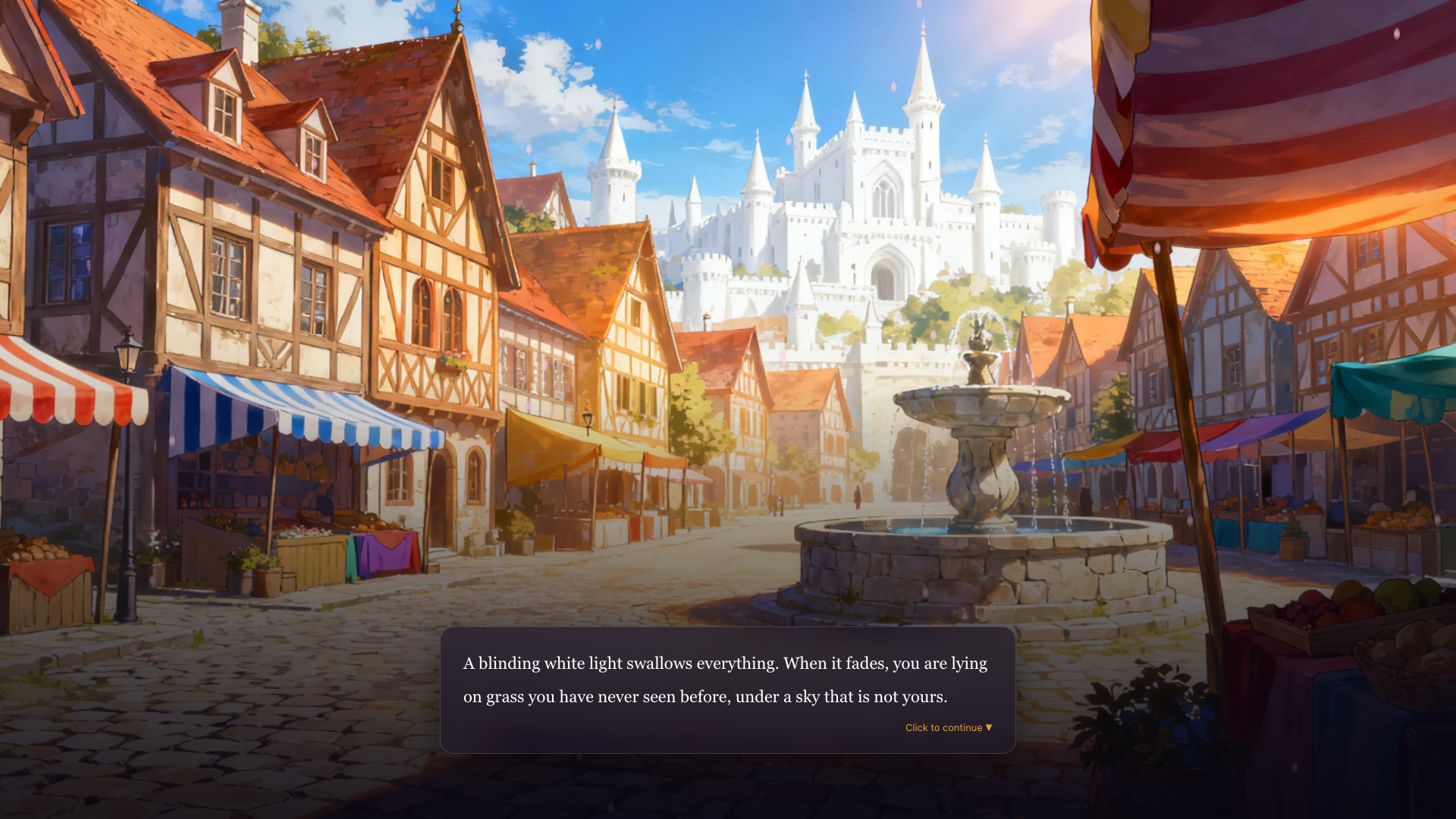
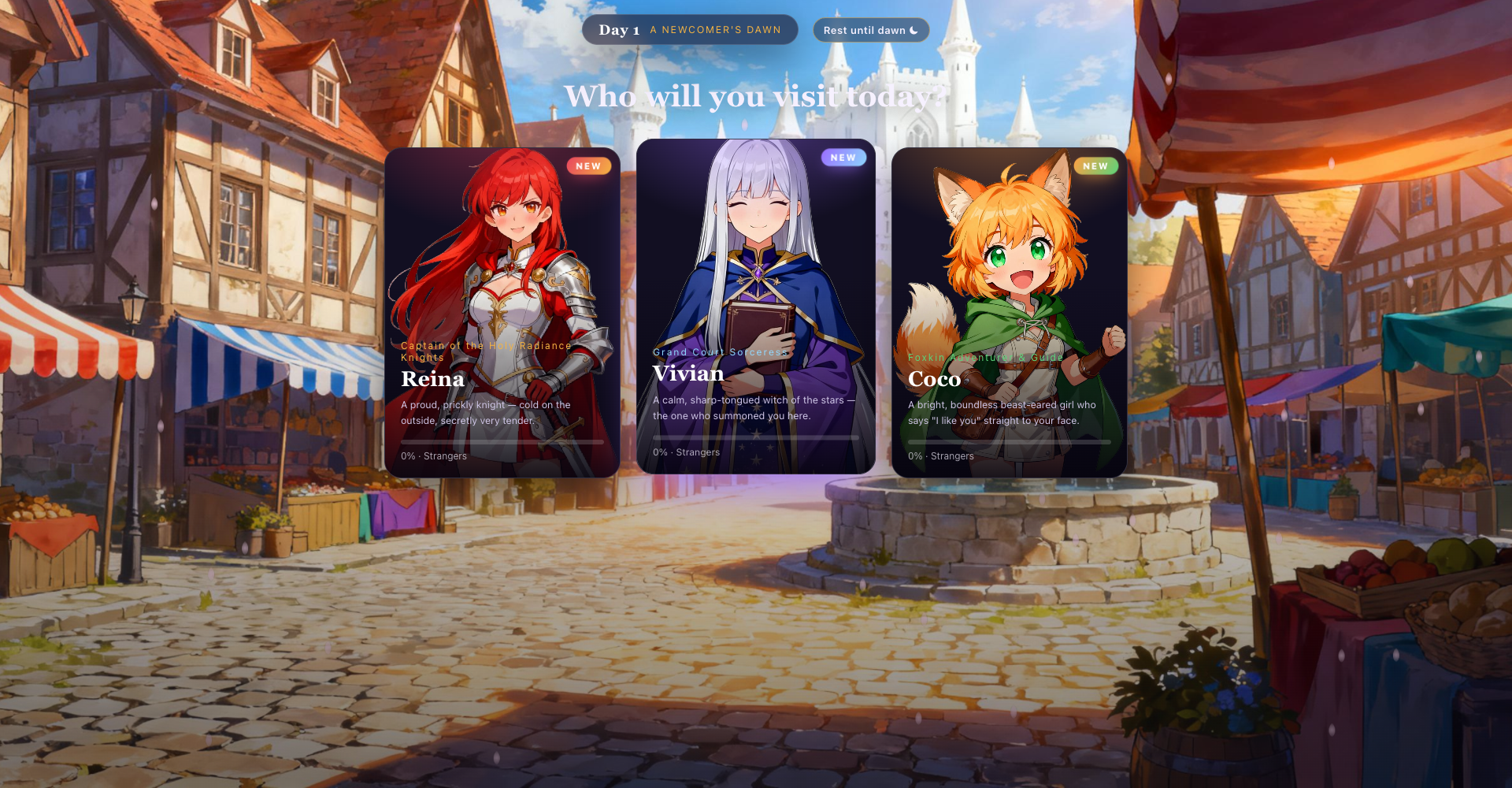
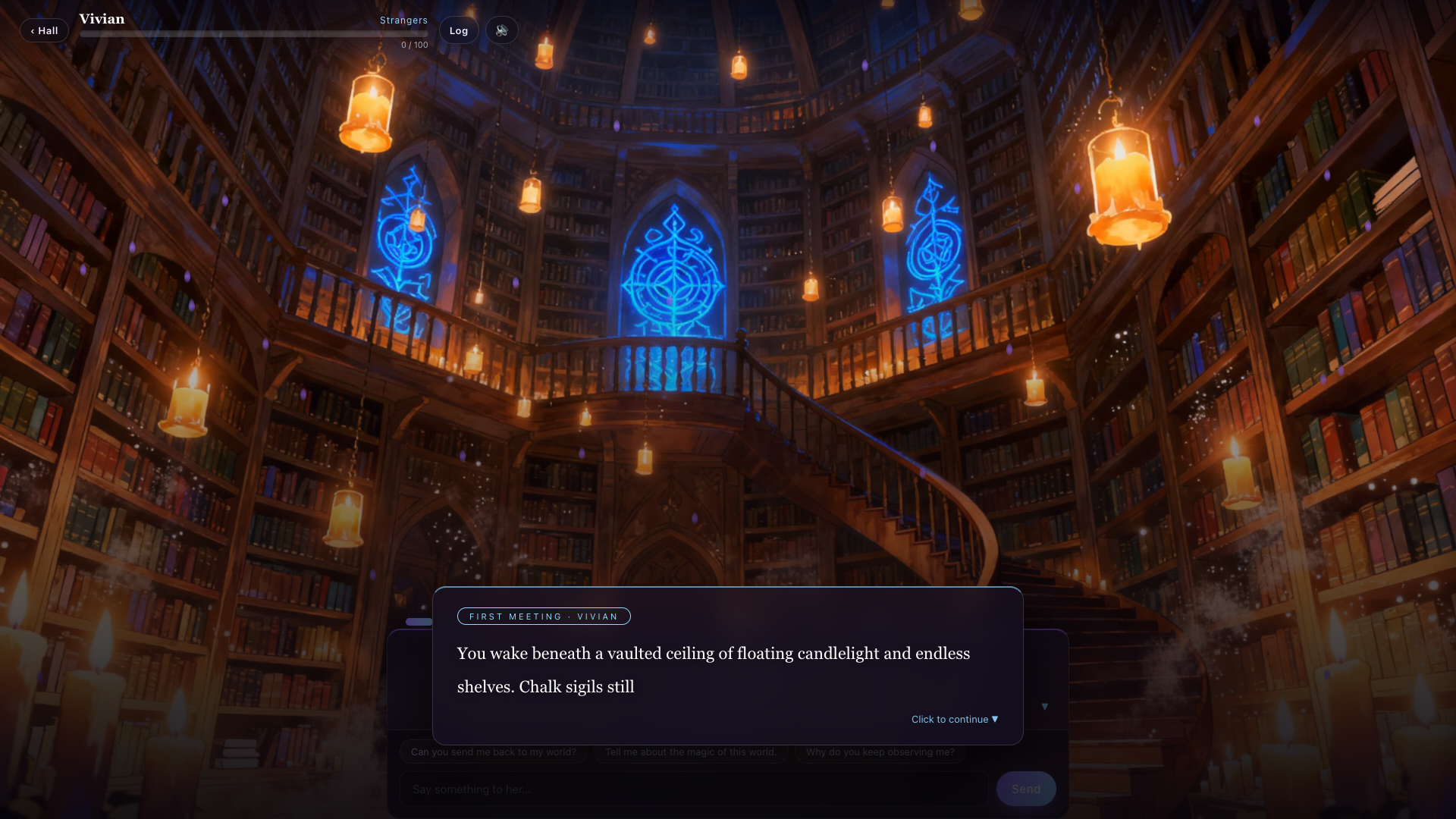
These three hash-bound captures come from one deterministic SEELE playable run. Read them in order: the premise appears, Vivian is selected from three encounter choices, and the setting changes to her named First Meeting beat.

1 · Before

An opening premise

Same-run opening premise where the player wakes in an unfamiliar world after a blinding light.

The frame establishes the visible starting state. Alone, it does not prove a choice or a later change.

2 · Choice

Three encounter directions

Same-run choice screen offering character-specific encounters with Reina, Vivian, and Coco.

The player is offered three visible encounter choices. Vivian is the choice followed in the next frame.

3 · After

Vivian's First Meeting

Same-run changed story state after Vivian is selected, showing Vivian's First Meeting in a candlelit library.

The town hub changes to Vivian's candlelit library and begins her named First Meeting beat. This proves one local scripted path only.

Choice-quality review

Check what changes without overstating the result.

Before is legible

Can a reader identify the starting premise and the character goal before the choice appears?

Choices are distinct

Do at least two options point toward meaningfully different encounters or approaches?

After is observable

Can a reader see the immediate changed setting or next beat after the selected option?

Boundary stays explicit

Describe only the observed path. Do not generalize it into generated branching, persistent memory, or multiple endings.

Four story directions

Concrete interactive story maker starter prompts

Each prompt defines a world rule, character goal, opening beat, and decision point without asserting what a later result will contain.

Fantasy discovery

The map that changes at dusk

Draft an interactive story opening in Asterfall, where maps redraw themselves whenever a floating district is about to descend. Elara, a novice cartographer, wants to keep her neighborhood aloft until sunrise. Open as a new route appears through the sealed observatory while the warning bells stop. End the scene with three directions: alert the council, follow the new route, or ask a disgraced rival cartographer for help.

Coastal mystery

The ticket dated tomorrow

Draft an interactive mystery opening in a coastal town where the last train arrives only when someone is about to disappear. Mara, a junior reporter, wants to find a missing violinist before midnight. Open as she discovers the violin case beside a ticket dated tomorrow and hears footsteps in the closed station office. End with three directions: question the stationmaster, board the arriving train, or trace the wet footprints.

Archive adventure

The silent library clock

Draft an interactive adventure opening in a library where every book loses its final page when the central clock stops. Kato, an apprentice binder, wants to preserve his mentor's last manuscript. Open as the clock freezes and a stranger returns the missing final page with a warning. End with three directions: repair the clock, follow the stranger, or read the page aloud to the waiting scholars.

Science-fiction rescue

The garden ship changes course

Draft an interactive story opening aboard a seed ship whose gardens control its navigation. Imani, the youngest systems keeper, wants to reach the colony before the stored crops fail. Open as an unknown flower blooms and the ship turns toward an uncharted signal. End with three directions: remove the flower, study the signal, or wake the captain before the course locks.

Continue by rewriting

Change the world rule or the next beat—not everything at once.

Rewrite the world

Keep the lead and goal stable, then change one rule. If maps no longer predict danger but conceal safe routes, review how the opening discovery and pressure must change.

Keep the leadKeep the goalChange one rule

Rewrite the next beat

Keep the premise stable, choose one proposed direction, and describe only the next visible action, new information, and renewed story question.

One actionOne revealOne new question

Check continuity

Does the revision still follow the stated world rule and the lead's goal?

Check direction quality

Do the proposed directions represent different approaches rather than cosmetic wording changes?

Check the visible next beat

Can a reader tell what changed immediately after the chosen direction without relying on an unexplained summary?

Interactive story maker questions

How do I turn a world idea into an interactive story opening?

Define one world rule, give the lead a concrete goal, add an immediate pressure, and end the opening on a decision the reader can understand.

What should an opening scene plan include?

Include the visible setting, the lead's goal, a reveal, growing pressure, and a few distinct directions for the next beat.

What do the gameplay images prove?

The same-run sequence shows an opening premise, three character-specific encounter choices, and the immediate Vivian First Meeting state after Vivian is selected. It proves this one local path, not a general branching engine or generated outcome.

How do I continue after the first story direction?

Rewrite either one world rule or the next visible beat, then check that the character goal and immediate story question remain clear.

Start with one world rule and one urgent story question.

Open the story-opening brief in Workspace and review the handoff there. This transport link does not by itself verify any generated, saved, or published result.